To avoid these ads, REGISTER NOW!

School me on electric hand hole pull boxes

larry4406

Well-known member
Joined
Jan 27, 2006
Messages
19,257
Location
Northern Virginia
I need to run power to my detached barn. It will be inspected. It will be a sub panel off the house using 4-wire mobile home feeder with separate neutral and ground. I have already received good guidance on this from the helpful sparkies here.

I am thinking of installing a below grade electric hand hole pull box (something like the attached picture) at intermediate points to aid installation of the underground conduit (in stages) and subsequent cable pull as well as provide access point for a future (hopefully) large detached garage.

My understanding is that wire can be direct buried at 24" depth and if in conduit 18" depth.

I assume then that the depth of the pull box must then match these minimum burial requirements?

Does one normally penetrate thru the side wall of the pull box (knock out or hole saw) or turn up thru the open bottom? If turns up, then the cable will essentially make a U-turn when it comes up from one conduit then down the next? I don't intend to use the box as a splice point.

Do they make pull boxes that are internally split - power on one side and low voltage on the other? Would make for a nicer installation vs two boxes proximate to each other.

I assume the ends of the conduit (ones with wire or spares) should be sealed with duct seal? I know water will get in regardless but this would at least minimize the mud intrusion.

Lastly, I assume one would set the box on a nice compacted bed of gravel or sand so it is well supported and drains as I'm sure these become a collection point for groundwater.

I welcome any and all tips and suggestions.
 

Attachments

  • Example Below Grade Enclosure.jpg
    Example Below Grade Enclosure.jpg
    41.1 KB · Views: 197
To avoid these ads, REGISTER NOW!

Stuart in MN

Well-known member
Joined
Sep 8, 2005
Messages
23,112
Location
Minneapolis
First, what's the distance between the house and barn? Do you need hand holes?
It's typical to turn the conduit up through the open bottom of the box, and plug the ends with duct seal. Putting the box on a bed of gravel for drainage is also typical. There may be hand holes with an internal divider for power on one side and low voltage on the other but I'm not aware of any.
 

LifeLongWNYer

Well-known member
Joined
Oct 23, 2013
Messages
1,231
Location
South of Rochester, NY
Good question on the divided hand holes. I was involved in running a duct bank at a local university, they ran separate conduits for HV and LV, and set separate ( side by side ) vaults for each, every 300'.
 

Gummi Bear

Well-known member
Joined
Nov 5, 2006
Messages
524
Location
Sunset, Texas
Unless it’s a super long wire pull, I’d skip the box.

Upsize your conduit to reduce pulling friction, and rent a tugger if needed. One day rental is not that much. Rent a heavy pulling rope too.

Bonus- if you ever want a larger service later on, you’ll already have the conduit in place for larger conductors.


Handholes work great, when they’re necessary. I buy lightweight concrete ones as a minimum, with a traffic rating. That way if you run it over with a truck or tractor, it won’t collapse.


I went to the woods because I wished to live deliberately...

Henry David Thoreau
 
OP
L

larry4406

Well-known member
Joined
Jan 27, 2006
Messages
19,257
Location
Northern Virginia
First, what's the distance between the house and barn? Do you need hand holes?
It's typical to turn the conduit up through the open bottom of the box, and plug the ends with duct seal. Putting the box on a bed of gravel for drainage is also typical. There may be hand holes with an internal divider for power on one side and low voltage on the other but I'm not aware of any.

Thanks Stuart!

The buried portion is about 200' from the house.

Do I need them - maybe not.

Do I want one - yes. Because the barn is further away from the house and I hope to build a large detached garage between the house and the barn. When this happens, the feeder from the barn will be pulled back to the hand hole and rerouted to the new detached garage and the barn will then be fed as a sub panel off the detached garage. This will minimize having to tear up more yard in the future. I am also planning for a whole house back up generator and will pipe conduit to the pull box for this future expansion as well.
 

teamextreme

Well-known member
Joined
Aug 10, 2013
Messages
867
Location
Lakewood, CO
If you're direct burying, or even running conduit, you can just dig up the run to the barn when you're ready to re-route the feed to the garage, no need for a pull box. Just carefully mark or document exactly where the line runs and where you will want to intercept. When it's time, dig it up and re-direct it to the new garage. You will have to run conduit if you intend on pulling back the wiring to the barn to re-use/re-direct to the garage. Unless it's a longer run and that portion won't reach anyway, then you will need a pull box to use for a splice.
 

matt_i

Well-known member
Joined
Mar 14, 2008
Messages
10,727
Location
SE Michigan
I agree with TeamExtreme, I wouldn't go thru the trouble right now. You're already going to have to dig up the run to cut-in the new "in" and "out" to the middle building.

As long as you have something like an LB (etc) to pull the long wire back towards your main panel (also pull in a string, rope, etc) then its just work.

Imo the additional work doesn't really equal the benefit that i can see getting out of it in that situation.
 
OP
L

larry4406

Well-known member
Joined
Jan 27, 2006
Messages
19,257
Location
Northern Virginia
If you're direct burying, or even running conduit, you can just dig up the run to the barn when you're ready to re-route the feed to the garage, no need for a pull box. Just carefully mark or document exactly where the line runs and where you will want to intercept. When it's time, dig it up and re-direct it to the new garage. You will have to run conduit if you intend on pulling back the wiring to the barn to re-use/re-direct to the garage. Unless it's a longer run and that portion won't reach anyway, then you will need a pull box to use for a splice.

Thank you all for the responses.

I understand this and have had this thought all along. The feed to the barn will end up being long when it is pulled back and rerouted to the future detached. I will then have to pull a new feeder from the detached to the barn thru this pull box location. I am not planning on a splice in the box.

However if the pull box is strategically located, then open the lid, trench from it to the new future intermediate detached garage, run conduit from this pull box to/from, then pull and go. No trying to dig up a conduit without damage and cutting it off without damaging the conductors inside, etc.

I also want to terminate conduits in a location for a future whole house generator while trenching from the house to the barn. Thus the other desire for a pull box.

My intent is to trench once while keeping my options open for the whole house generator and the future detached.

Still looking for an internally divided pull box for low voltage and line voltage.

If I continue with the pull box, what depth of box? 24" for direct burial yet 18" for conduit? Is 18" to the top of the turned up conduit?

I watched the power company heat up some of my houses under construction this week and their pull boxes are maybe 16" deep and have splices to feed several homes. Their wires are just under the lid's surface. The linemen working on the services could not answer my questions.
 

Bert_

Well-known member
Joined
Dec 24, 2016
Messages
9,727
Location
NW Iowa
If it were me I'd do a box for the power and a separate box for the communication. Or just forget the box for communication and leave an extra conduit buried in the area that the new garage will be located.

In the power box I would 90 up into the bottom and use whatever size box needed for whatever size wire you are planning. The wires do not have to be 18" or 24" below the lid, they only need to be that depth where they exit the box.. I would splice the wires now or leave a loop long enough to splice them later. Then when you feed the new building you can just use a 3 tap polaris connector or similar to connect a third wire to the new building. Much simpler than going in and back out of the future panel.

I'd make sure the box will be right beside or behind the new building when it is built.
 
Last edited:

rburke65

Well-known member
Joined
Nov 10, 2007
Messages
12,349
Location
Canfield, Ohio
I ran 2" to my pole barn....about 250' but I set a box on a fence rail.....above ground....and it helped on the pull and gave me an oppertunity to feed power to a garden shed.
 
Last edited:
To avoid these ads, REGISTER NOW!
OP
L

larry4406

Well-known member
Joined
Jan 27, 2006
Messages
19,257
Location
Northern Virginia
If it were me I'd do a box for the power and a separate box for the communication. Or just forget the box for communication and leave an extra conduit buried in the area that the new garage will be located.

In the power box I would 90 up into the bottom and use whatever size box needed for whatever size wire you are planning. The wires do not have to be 18" or 24" below the lid, they only need to be that depth where they exit the box.. I would splice the wires now or leave a loop long enough to splice them later. Then when you feed the new building you can just use a 3 tap polaris connector or similar to connect a third wire to the new building. Much simpler than going in and back out of the future panel.

I'd make sure the box will be right beside or behind the new building when it is built.

Bert - thanks for your response. The 3-tap Polaris connector is pretty slick for making a splice in the pull box. Actually very similar to what I observed the power company using in their splice box on the job heating up my homes under construction.

My original thinking was that the 90A breaker in the house would via the feeder connect to the barn's sub panel. Later when the detached is built and the feeder pulled back and rerouted, the 90A house breaker would via the relocated feeder connect to the detached garage's sub panel and a breaker in this sub panel would then connect to the barn via a new feeder. So the barn's sub panel would be a sub panel off the detached and no underground splices.

If I did the 3-Tap Polaris connector splice in the pull box as you suggest, then as you pointed out the barn is not feed from the detached and no need to relocate the feeder. Very clever.
 
OP
L

larry4406

Well-known member
Joined
Jan 27, 2006
Messages
19,257
Location
Northern Virginia
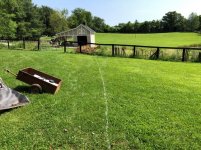
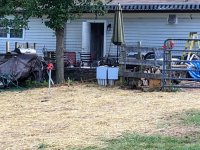
This project is taking me a lot longer than I had hoped but making headway. Finally got trench dug, conduits run and inspected, backfilled, and seeded and strawed. Conduits are all still empty though..

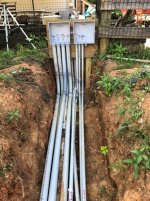
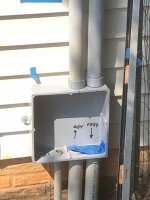
Instead of hand hole pull boxes, I mounted (3) 12x12 by 4" deep junction boxes on a pressure treated frame on 4x4 posts. One box is for 240V junctions, another for 120V junctions, and lastly one for communications. The communication box is on the backside of the pedestal.

The "pedestal junction" is about 100' conduit wise from the house and about 140' from the barn so a nice intermediate pull point. I also have piped conduits to a marked location for hopeful connection to a future detached garage (will use a Polaris T connector to tap the barn feeder as Bert suggested). There are 2" conduits for 240V, 1" conduit for lighting/outlets, and 1" conduit for communications. Also ran a 2" conduit for a future generator. Lastly, the ditch also contains water for yard hydrant, buried RapidAir line for pneumatic tools, and propane gas line.

Onwards now to sizing of wires which will be another subject.
 

Attachments

  • Barn Trench Before.jpg
    Barn Trench Before.jpg
    152.2 KB · Views: 89
  • Pedestal Junction Boxes.jpg
    Pedestal Junction Boxes.jpg
    113.3 KB · Views: 121
  • Pedestal Junctions Backfilled.jpg
    Pedestal Junctions Backfilled.jpg
    152.5 KB · Views: 93
  • House Junction Box Zoom.JPG
    House Junction Box Zoom.JPG
    91 KB · Views: 98

wyliesdiesels

Well-known member
Joined
Aug 14, 2012
Messages
20,013
Location
Modesto, CA
Ummm you need to backup.

It appears you have multiple feeds running to the same structure. This is a BIG code violation. You can only have one feed.
 

ard

Well-known member
Joined
Feb 16, 2015
Messages
4,391
Location
Sierra Foothills... California
I think he is just running lights on that second set of conduits. Not sure if that is 'a feed'. Also, not sure if the lights/wires enter the structure.


BUT..Question for others:

I always run the conduit deep, then 90 degree up into the bottom of the pull box. They leave a loop of wire, then back down into the next conduit. Seems cleaner than having the open conduits down at the bottom of the boxes. Any comments on this?
 

Kevin Essiambre

Well-known member
Joined
May 1, 2014
Messages
208
Location
Ottawa, Ontario, Canada
Ummm you need to backup.

It appears you have multiple feeds running to the same structure. This is a BIG code violation. You can only have one feed.
I've done multiple runs to building before... but that was for 3 way switches so you don't have to go to the out building to shut off the lights. The 3 way switches are always fed from the out building so that they're able to be shut off to be worked on from either end (either shut off the breaker feeding the building, or shut off the disconnecting means in the out building.)

Sent from my SM-G920W8 using Tapatalk
 

wyliesdiesels

Well-known member
Joined
Aug 14, 2012
Messages
20,013
Location
Modesto, CA
I've done multiple runs to building before... but that was for 3 way switches so you don't have to go to the out building to shut off the lights. The 3 way switches are always fed from the out building so that they're able to be shut off to be worked on from either end (either shut off the breaker feeding the building, or shut off the disconnecting means in the out building.)

Sent from my SM-G920W8 using Tapatalk

apples to oranges

that is not multiple feeds to the same building.
 
OP
L

larry4406

Well-known member
Joined
Jan 27, 2006
Messages
19,257
Location
Northern Virginia
I've done multiple runs to building before... but that was for 3 way switches so you don't have to go to the out building to shut off the lights. The 3 way switches are always fed from the out building so that they're able to be shut off to be worked on from either end (either shut off the breaker feeding the building, or shut off the disconnecting means in the out building.)

Sent from my SM-G920W8 using Tapatalk

Kevin - that is my plan. The 3-way switches will be fed from the out building.
 
To avoid these ads, REGISTER NOW!
Top Bottom