Has anyone used or have knowledge about whether or not a Scissor Truss puts more stress or outward leverage on a wall than a Standard Truss? I am planning a build of a 24x48 pole building and the Scissor Truss would give a little more head room with out going 12 ft wall height. I have not compared the additional cost of the scissor truss to just going 12 ft wall height! Any info would be helpful!


You are using an out of date browser. It may not display this or other websites correctly.
You should upgrade or use an alternative browser.
You should upgrade or use an alternative browser.
Scissor Truss?
- Thread starter lrainh2o
- Start date
Perryk
Well-known member
I have scissor trusses in my shop. I have 11' walls and 2x12 on the inside which makes the peak almost 14'. If I remember correctly, they were about 10% more than a standard truss.
I chose the scissor for added height for a 2 post lift. So far I am happy with it and most people who see it comment on the ceiling.
I dont think it would add anymore stress to the walls.
If you havent already thought about it, insulating is a little different as well. And since you have no attic space you have to pretty much have any wires/lines run prior to finishing.
I chose the scissor for added height for a 2 post lift. So far I am happy with it and most people who see it comment on the ceiling.
I dont think it would add anymore stress to the walls.
If you havent already thought about it, insulating is a little different as well. And since you have no attic space you have to pretty much have any wires/lines run prior to finishing.
ishiboo
Well-known member
Has anyone used or have knowledge about whether or not a Scissor Truss puts more stress or outward leverage on a wall than a Standard Truss? I am planning a build of a 24x48 pole building and the Scissor Truss would give a little more head room with out going 12 ft wall height. I have not compared the additional cost of the scissor truss to just going 12 ft wall height! Any info would be helpful!
It will. I'd check with an engineer, it's not too big of a deal but I've never worked with a span like that, and it probably depends a lot on the truss itself, your pitch and loading, etc.
You can attach one end to the top plate, and then complete the roof/attic load/etc. and attach the other side, this way the only outward force will be with live loads/snow/etc.
Personally, I'd rather have the higher walls and flat conventional ceiling. I bet it's nearly a wash materials-wise.
bczygan
Well-known member
Has anyone used or have knowledge about whether or not a Scissor Truss puts more stress or outward leverage on a wall than a Standard Truss? I am planning a build of a 24x48 pole building and the Scissor Truss would give a little more head room with out going 12 ft wall height. I have not compared the additional cost of the scissor truss to just going 12 ft wall height! Any info would be helpful!
All forces must be in equilibrium or there will be movement. You can design a scissors truss so it has side thrust by improperly sizing the members or improperly designing the connections. If you have horizontal loads they must be resisted by buttressing on the outside or cables in tension on the inside. Or the wall cross section must resist the loads as a beam. So the answer is that the simplest and cheapest way is to design the truss so loads at the plate are vertical.
What's the objection to the higher wall? It gives a much better solution inside. If outside looks are the problem simply give it an overhang, use a steeper pitch, a taller fascia and put the wall on a masonry base or plinth. All these de-emphasize the wall height and give you more attic storage and a better interior. What are your zoning requirements?
Last edited:
stingry
Well-known member
[Has anyone used or have knowledge about whether or not a Scissor Truss puts more stress or outward leverage on a wall than a Standard Truss? I am planning a build of a 24x48 pole building and the Scissor Truss would give a little more head room with out going 12 ft wall height. I have not compared the additional cost of the scissor truss to just going 12 ft wall height! Any info would be helpful!
A properly designed truss will not put any outward or horizontal load on the side walls, be it regular trusses, scissor trusses, attic trusses, etc.. That is the beauty of truss systems. A scissor truss will be more expensive.
Cheers
Steve
NCCheesehead
Well-known member
What was said above is correct, typically a "standard" or traditional type truss is designed to only bear weight on the outer walls and span the complete interior. My truss company consistantly designs truss to span 40-45 feet bearing only exterior walls, interior walls float and are not nailed to the truss.
Steve got it right - if the truss is designed properly.
That being said - a scissor truss is probably not as strong as a regular storage truss.
I have seen several professionally built shops/garages that had scissor trusses ove the lift bays, then a regular storage type truss 4' -6' on the ends of the building, I assume for strength to "tie off" the end of the building.
Or at least that was the explanantion I got - don't know if it is correct, but makes sense.
That being said - a scissor truss is probably not as strong as a regular storage truss.
I have seen several professionally built shops/garages that had scissor trusses ove the lift bays, then a regular storage type truss 4' -6' on the ends of the building, I assume for strength to "tie off" the end of the building.
Or at least that was the explanantion I got - don't know if it is correct, but makes sense.
stingry
Well-known member
Steve got it right - if the truss is designed properly.
That being said - a scissor truss is probably not as strong as a regular storage truss.
I have seen several professionally built shops/garages that had scissor trusses ove the lift bays, then a regular storage type truss 4' -6' on the ends of the building, I assume for strength to "tie off" the end of the building.
Or at least that was the explanantion I got - don't know if it is correct, but makes sense.
Scissor trusses are as structurally sound as the regular trusses if properly designed. Many pole buildings here are built with all scissor trusses.
Steve
bczygan
Well-known member
Just to throw a little bit of a wrench into this discussion there is always some amount of possible side loading on a truss, scissors or otherwise. A structure is a dynamic thing. Every beam and truss deflects Wind exerts variable loads. When the roof sheathing and roofing material is installed it adds a dead load to the trusses. Sometimes builders will fix one end of a scissors truss and leave the other end free until the dead loads are applied before fixing the other end. A good rule of thumb for scissors trusses is to keep the inside pitch 3 less than the outside one. So if you need a 3/12 inside you need 6/12 outside. Another thing to consider is that you need good depth at the heel. This also helps so you can get your full depth of ceiling insulation all the way to the outside of the wall and still have 1" airspace above. Another trick, if you have the room, is to use a girder truss down the ridge and hang a truss off each side. This requires a way to support the girder truss at each end.
Last edited:
.
What's the objection to the higher wall? What are your zoning requirements?
The only objection to a higher wall is the extra area to heat up, and thats not that big of an issue, I will be using wood heat in the shop and only needing to take the chill off the air!
My zoning requirements are not over 1200 sqft and max wall height of 12 ft!
I was just looking at the scissor truss as an option to gain a little inside height! I built a 20x28 with 10 foot walls at the house I am currently trying to sell, in that build I built my own rafters and the collar tie is at 13 ft high with a 6/12 pitch, the extra height was nice at times! This was just an idea to gain that same amount of extra height without going 12 ft walls! So far I havent made up my mind, still weighing out the pros and cons of both! I appreciate the help!
Last edited:
stingry
Well-known member
wolfmoon
Member
I’m in the progress of building a 24’ X 35’ detached boat garage/shop with 10’ wall’s (10/12 pitch). I have no structural knowledge, Nevertheless, I live in an Inland I Exposure C Coastal Region and in order to get the new addition insured, I’m required to have my build windstorm state certified and inspected by an engineering firm. Windloads were calculated for 120 MPH.
I had a bid for approximately $1300 for pre-engineered scissor/storage trusses (12’ of Storage in rear).
Although, it probably cost me over $2K to have my roof framed, I’m extremely content with the outcome.
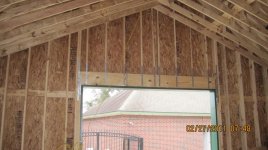
My personal opinion is, if it’s acceptable to have scissors at these wind speeds, then if properly designed and constructed there shouldn’t be any issues. Also, I was required to have balloon framing on the gable ends.
Hope these pictures can help with your decision.
I had a bid for approximately $1300 for pre-engineered scissor/storage trusses (12’ of Storage in rear).
Although, it probably cost me over $2K to have my roof framed, I’m extremely content with the outcome.
My personal opinion is, if it’s acceptable to have scissors at these wind speeds, then if properly designed and constructed there shouldn’t be any issues. Also, I was required to have balloon framing on the gable ends.
Hope these pictures can help with your decision.
Attachments
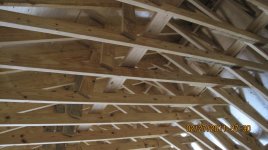


Last edited:
wolfmoon
Member

My 40' X 60 ' is half std truss, half sissor truss (back half) coffer trusses were an option but I knew there would be multiple lifts in my garage, so that eliminated the coffer truss. My trusses were professionaly engineered and constructed and are 3/12 inside and 5/12 outside, if I recall the sissors were about 15-20% more each compared to the std trusses. I live in the mts. of SW VA where the storm load allowed the inside and outside pitch, if you live in a bad snow area your outside pitch would be steeper, or so I was told. They sit on 10' 6" walls (to the top of the plate) They have more steel in them than a tank, and are constructed with a good deal of 2 X 6 lumber, compared with the std truss which is mostly 2 X 4. The way it worked out one of my lifts is against a wall and there is enough clrnc. to work on an average vehicle with no problem, presently I have my '67 and '65 mustangs double stacked for the winter. I have a 12K lift in the center where there is about 15' of clrnc. not the best of pics but here you can see the clrnc. near the side wall. I plan on removing the ceiling fan that is on the lift side, when I do that the lift will be able to go up at least another 18" , which is being done so I don't take out a windshield or roof , right now the height is enough for my 5'10" size.
http://i73.photobucket.com/albums/i229/holdover/Jan30th2011009.jpg
http://i73.photobucket.com/albums/i229/holdover/Jan30th2011009.jpg
Last edited:
mark2457
Well-known member
Hi All
I just got a quote from Menards for a 24' span (scissor trusses were almost double cost of common trusses BTW, but only total of $500 extra for entire project.) The specs I got from Menards are pretty poor (see attached). I t looks like there is no flat are where it meets the top plate (like a rafter would be). In a rafter, I'd do a birdsmouth cut, but I can't do that with a truss.
Do i just use rafter ties to attach to top plate? Are there special ones for scissor trusses.
I'm limited in height by village code, so scissor trusses give me a lot more ceiling room
I just got a quote from Menards for a 24' span (scissor trusses were almost double cost of common trusses BTW, but only total of $500 extra for entire project.) The specs I got from Menards are pretty poor (see attached). I t looks like there is no flat are where it meets the top plate (like a rafter would be). In a rafter, I'd do a birdsmouth cut, but I can't do that with a truss.
Do i just use rafter ties to attach to top plate? Are there special ones for scissor trusses.
I'm limited in height by village code, so scissor trusses give me a lot more ceiling room