
You are using an out of date browser. It may not display this or other websites correctly.
You should upgrade or use an alternative browser.
You should upgrade or use an alternative browser.
Scrap Metal Bins?
- Thread starter tom86951
- Start date
clutchee
Well-known member
I use an old chemical tote, sits outside, back of shop, will throw whatever inside and then when I need something go grab.
I leave the valve open to allow water to drain.
I leave the valve open to allow water to drain.
engineer2
Well-known member
5-gallon bucket. Anything long goes in the rafters.
Yeah, I am a small-time scrapper too. I just have 5-gallon buckets for copper, aluminum, motors and transformers. I typically don't bother with steel unless I have a scrap-trip planned soon. It's just too big, heavy and mostly worthless to keep piled up around here.5-gallon bucket. Anything long goes in the rafters.
engineer2
Well-known member
I save useable scraps of metal. It's a real lifesaver when you need an odd bracket or home-made tool. Unwanted scrap goes to the curb the night before garbage day and will be gone by morning.
Ole Slewfoot
Well-known member
55 metal drums are less fail prone, and are easy to trim if too tall.
TurnipTruck
Well-known member
I once had a pyramid of drums on their sides for different shapes of steel: angle/bar/tube/pipe/plate/channel/stainless/etc. They were slightly sloped downward for drainage.
jimgood
Well-known member
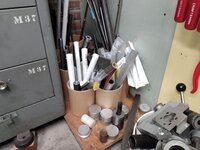
I've been thinking about doing something as well. I am leaning toward a system of smaller to larger containers that are sized for the approx. length of the scraps. I was going to cut them out of some PVC drainage pipe I have laying around. Cut wood discs to screw in for bottoms. Maybe mount them on a cart of some sort. The question is whether I can be disciplined enough to take the time to put the scraps in the right sized container.
Right now, everything is in a metal garbage can. It's a mess.
Right now, everything is in a metal garbage can. It's a mess.
jimkinney
Well-known member
I use cat litter buckets. They're rectangular and stack better than paint buckets.

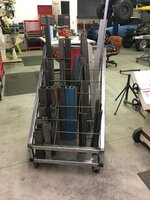
I made it using scrap I had on hand including the casters. Still haven’t painted it, once I filled it up it was too much work to remove everything for paint. I keep it under the stairs to the loft, easy to move if needed.
cpttuna
Well-known member
55 gallon barrel for big stuff 5 gallon bucket for little stuff
thr3squared
Well-known member
I made it using scrap I had on hand including the casters. Still haven’t painted it, once I filled it up it was too much work to remove everything for paint. I keep it under the stairs to the loft, easy to move if needed.
Nicely done!
thr3squared
Well-known member

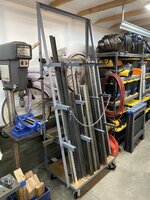
Before and after of my material rack, I couldn’t handle the blue paint. Found it cheap at a shop that was closing down.
Pardon the mess in the first picture. I’d just moved into in the garage (fully remodel).
I need to add brackets off the back of mine to hold sheet metal
MadeByMiller
Well-known member
I realize that this isn't exactly helpful for the OP, but I saw scrap bin and I just had to share this self dumping bin I was hired to design to fit a particular location on the customer's tube laser. They built a couple of them and they work great!
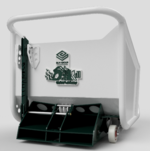
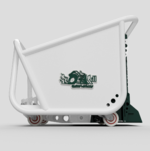

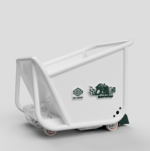
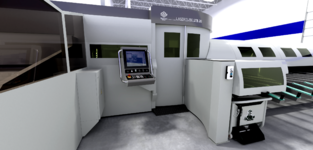
Not the best renderings I've done, but they were done quickly to show the customer some 3D printed badge ideas.
Not the best renderings I've done, but they were done quickly to show the customer some 3D printed badge ideas.
paulsomlo
Well-known member
blacksuit99
Well-known member
- Joined
- May 21, 2007
- Messages
- 91

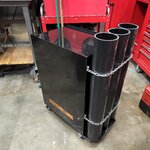
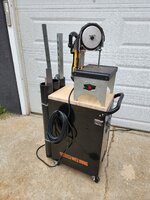
I used a similar concept - biggest ABS I could find at home depot - to add scrap storage to my little portaband cart made from a Harbor Freight welding cart. Long stuff in the tubes, short scraps in the drawers.
Attachments

thr3squared
Well-known member
I used a similar concept - biggest ABS I could find at home depot - to add scrap storage to my little portaband cart made from a Harbor Freight welding cart. Long stuff in the tubes, short scraps in the drawers.
That's awesome, great use of the cart!
stubbsrodandcustom
Well-known member
- Joined
- Aug 30, 2012
- Messages
- 70
4" pvc screwed to the stud. Works great.
I am a 2 car attached and keep things simple and clean here now.

I am a 2 car attached and keep things simple and clean here now.
Rendering? I thought they were pictures. Computers sure have gotten fancy if that's a "quick" one.I realize that this isn't exactly helpful for the OP, but I saw scrap bin and I just had to share this self dumping bin I was hired to design to fit a particular location on the customer's tube laser. They built a couple of them and they work great!
Not the best renderings I've done, but they were done quickly to show the customer some 3D printed badge ideas.
Thanks all. Keep them coming! I have some tubes and channels, etc., but my storage issue is more about sheet metal. I like the rack sandman made and am thinking something like that might be best, but with a good portion of mine set up to slide sheet metal into...
WoodsTruck
Well-known member
- Joined
- Jan 12, 2013
- Messages
- 1,035

Joemctag
Well-known member
That sounds good because you’re looking at the ends of stuff and can see what you got and pull it out from under other stuff.I once had a pyramid of drums on their sides for different shapes of steel: angle/bar/tube/pipe/plate/channel/stainless/etc. They were slightly sloped downward for drainage.
In our fab shop, it’s similar, but horizontal racks, 5 of them, about 15’ long and 2’ deep. So pieces up to 4’ long, some a lot shorter. Longer stuff, we stand up leaning against a wall. It’s important to see what you got, readily, and, with how much steel costs, we wouldn’t even throw away a 1’ long piece of anything.
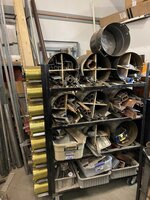
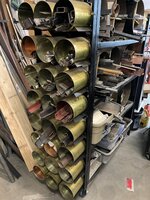
My solution is similar to Joemctag. I have 20 gallon drums that I cut in half that are stacked on their sides. On the ends, I did the same thing on a smaller scale using cans that at one time had tomatoes in them from a restaurant. I used old bed frame material that I got at the landfill for a lot of the racks. I try to put everything in my shop on casters to move it out of the way when it is not needed. Since floor space is limited, think about going vertical with your material storage.
Joemctag
Well-known member
You’re giving me some ideas for the next one I build. Keeping the really short pieces separate. Also, using Bed frame angle, which is very strong, but can’t (easily) be drilled, so has limited usefulness.My solution is similar to Joemctag. I have 20 gallon drums that I cut in half that are stacked on their sides. On the ends, I did the same thing on a smaller scale using cans that at one time had tomatoes in them from a restaurant. I used old bed frame material that I got at the landfill for a lot of the racks. I try to put everything in my shop on casters to move it out of the way when it is not needed. Since floor space is limited, think about going vertical with your material storage.