
To avoid these ads, REGISTER NOW!

Screw Extraction via Leht Handed Drill Bits - Drill Ratings?

YoshiMoshi3

Well-known member
Joined
Nov 2, 2022
Messages
502
What drill ratings increase my chances of extracting a screw with a left handed drill bit?

Meaning if I used the same left handed drill bit that was identical for each attempt (brand new one each time, same manufacturer etc), multiple of same bolt broken off in the same way, use a different broken bolt on each attempt, each attempt I use a different model drill.

What properties of the drill increases my extraction chances?

Max torque
Max RPM
Min RPM
Drill Weight

Or some other parameter?

I have multiple drills of different models, trying to figure out which is best for screw Extraction via left hand drill bit.

Thanks everyone for any ideas!
 
To avoid these ads, REGISTER NOW!

PCustoms

Well-known member
Joined
Jul 23, 2011
Messages
23,520
Location
VT
None of the above.

Next question?

Just grab a drill with an appropriately sized chuck and give it a go. Getting your bit centered is the most important thing, as odds are the drill won't back it out and then you'll need to drill right to the threads and use a pick to pull out what's left.
 
Last edited:

bwringer

Well-known member
Joined
Jan 1, 2013
Messages
10,324
Location
Indianapolis
Olde motorcycle enthusiast here... I've seen things, man. Bad things...

And yes, I have indeed found that some broken fasteners will spin out when attacked with a left-handed drill bit. Most do not, of course, but hey, it's worth a shot since you're drilling a hole anyway. Once in a while you get a freebie.

None of the listed properties for the drill matter. THE most important factors are the ability to accurately center the start of the first hole, to start very slowly, and to drill square and straight.

Get to a flat, clean-ish surface then use a punch to dimple the exact center. Use a good sharp fresh bit and good lube and go very, very slowly and gently. The outcome you do NOT want is breaking the drill bit. Quality HSS is much less brittle than cobalt.

As to the drill itself, what matters most is controllability. You want a very good variable speed trigger that allows extremely fine control from zero to a very, very low minimum speed so that you can watch the chip form and react to keep it exactly on center. Once you've got a good start, then you can give 'er hell.

Another very important property that is unfortunately quite rare is a drill body with visual references to help you stay aligned and square with the surface. I guess uninterrupted straight lines at 90 degrees look "dorky" or something, and so drills are designed to look like swoopy, curvy ray guns, or they have all sorts of sticky-outy bits and plastic and rubber greebling to make them look, I dunno, "exciting" or something.

In some situations, you can try using a drill guide, but this doesn't really work if there's anything sticking out. Most of the time you have to just do the best you can to drill straight and square, using whatever visual and tactile references you can. Go slow, peck at it, and check yourself frequently. DON'T bend the drill bit or it will snap off inside the hole, and NOW you've got a REAL problem.

I was once remotely coaching a friend through a tricky broken fastener and helicoil situation, and he had no end of difficulty and frustration because the only drill he had was a cheap cordless with a two speed trigger. (It took us a while to figure out WTF was happening.) Without a variable speed trigger, it's nearly impossible to start a hole on-center with a handheld drill and keep it from wandering in hard materials.
 

larry_g

Well-known member
Joined
Apr 28, 2007
Messages
16,896
Location
oregon
Olde motorcycle enthusiast here... I've seen things, man. Bad things...
As to the drill itself, what matters most is controllability. You want a very good variable speed trigger that allows extremely fine control from zero to a very, very low minimum speed so that you can watch the chip form and react to keep it exactly on center. Once you've got a good start, then you can give 'er hell.

Another very important property that is unfortunately quite rare is a drill body with visual references to help you stay aligned and square with the surface. I guess uninterrupted straight lines at 90 degrees look "dorky" or something, and so drills are designed to look like swoopy, curvy ray guns, or they have all sorts of sticky-outy bits and plastic and rubber greebling to make them look, I dunno, "exciting" or something.

In some situations, you can try using a drill guide, but this doesn't really work if there's anything sticking out. Most of the time you have to just do the best you can to drill straight and square, using whatever visual and tactile references you can. Go slow, peck at it, and check yourself frequently. DON'T bend the drill bit or it will snap off inside the hole, and NOW you've got a REAL problem.
I concur with the above. I go slow as much as I can hoping the bit grabs and turns out the screw. The idea is to turn out the screw, not to make a hole in it. If you drill through then move onto step two. I don't live in the rust belt and work more on machines than cars so I'm not usually fighting rust issues and have good luck with left handed bits.

If your lucky enough to have a good stub of the broken screw sticking up then make a stepped drill guide. Think a counterbored hole where the counterbore just fits the screw and the through hole fits the drill bit you intend to use. This guides the drill bit and holds it on center if things go well. Do the inverse if the screw is down a hole, make a bushing to slip in the hole and guide the drill bit.

lg
no neat sig line
 
OP
Y

YoshiMoshi3

Well-known member
Joined
Nov 2, 2022
Messages
502
Thanks for all suggestions. So would hand drill be best, since you can manually control the speed as slow as you want with your hands?
 

PCustoms

Well-known member
Joined
Jul 23, 2011
Messages
23,520
Location
VT
Thanks for all suggestions. So would hand drill be best, since you can manually control the speed as slow as you want with your hands?
Do you have a specific task you're working on or is this a thought exercise?
 

Beerhippie

Well-known member
Joined
Oct 13, 2023
Messages
10,028
Location
Far NE Oregon
I have the highest rate of success using a drill press at very low--250-300 rpm--speeds.

That said, I very infrequently need to remove a broken fastener from anything I can bring to the drill press. My car just doesn't fit.

For starting the drill in a fastener that's broken off below the surface (and can't be brought to the DP), I use a Dremel-type tool or mini-die grinder and a small ball burr to make my centering divot. It works much better than trying to use a center punch on a broken off, irregular end. I can work the ball around as I cut until I have a nicely centered dimple. Then I start with a small--1/8" or so--right-hand bit for a guide hole. Get that nice and straight and then move on to the LH bit. Using a guide hole means less force to drill with the larger bit--look at the tip of a drill bit and you'll see why--and it makes the larger and more expensive bits last longer.

Oh, yeah--start soaking the fastener with a good penetrating oil--I'm becoming a real believer in Kroil--at least the day before. If you can get some heat on it, better yet. If you can get enough heat to get the PO smoking nicely, even more better yet. Smoke the oil off and add more. Repeat.
 

Hakeem

Well-known member
Joined
Jan 22, 2024
Messages
1,278
Location
Chicago
I have no experience with them but these seem like a good idea:


IMG_1631.jpeg
 

KnurledNut

Well-known member
Joined
Jan 28, 2011
Messages
8,205
Location
n/a
The times this has worked for me, the bolt started backing out after drilling into it quite a ways generating some heat and grab.
 
To avoid these ads, REGISTER NOW!

rancherbill

Well-known member
Joined
Oct 18, 2007
Messages
5,336
Location
Foothills County, Alberta, Canada
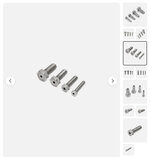
I had varying results. I bought a drill guide kit. It has guildes for various size drills. You clamp it and your holes are straight and Where you want them. My success went way up.

Here's a pic of the sleeves and an idea of what the guide looks like.

Apparently you can't post links to teemu
 
Last edited:

whateg01

Well-known member
Joined
Mar 13, 2006
Messages
11,536
Location
doo dah, kansas, usa
I had varying results. I bought a drill guide kit. It has guildes for various size drills. You clamp it and your holes are straight and Where you want them. My success went way up.
I wish some of the fasteners I've had to drill out would have been on time that had surfaces i could clamp to! That must be nice.

Apparently you can post links to teemu
Thank goodness!
 

Leaflessshadetree

Well-known member
Joined
Aug 1, 2013
Messages
7,177
Location
Don't ask.
Choosing a drill look for Min RPM and plenty of pressure.
Centering on the bolt and drilling straight are important.
Pay attention to how the bit is cutting. Spirals are good, chips are OK.
 

rancherbill

Well-known member
Joined
Oct 18, 2007
Messages
5,336
Location
Foothills County, Alberta, Canada
I wish some of the fasteners I've had to drill out would have been on time that had surfaces i could clamp to! That must be nice.


Thank goodness!
Im retired living on a pension. Six or seven bucks delivered versus the same thing on Amazon for $28. It's something you need every couple of years. Actually I think it's the same one.
 

kbeefy

Well-known member
Joined
Sep 14, 2013
Messages
3,468
Location
Harington, Eastern Washington
Apparently I have had more luck with reverse drill bits than anyone in this thread. They are my first choice for broken fasteners, but I don't attempt things like broken exhaust manifold bolts with them. The trick is to get the broken hardware mostly drilled out, square and true, then try the reverse drill bit. No sense trying a reverse 1/8 bit in a broken 3/8 bolt, you'll just wear out the bit or break it.


I'd say I'm about 50% success with reverse drill bits.
 

PCustoms

Well-known member
Joined
Jul 23, 2011
Messages
23,520
Location
VT
Apparently I have had more luck with reverse drill bits than anyone in this thread. They are my first choice for broken fasteners, but I don't attempt things like broken exhaust manifold bolts with them. The trick is to get the broken hardware mostly drilled out, square and true, then try the reverse drill bit. No sense trying a reverse 1/8 bit in a broken 3/8 bolt, you'll just wear out the bit or break it.


I'd say I'm about 50% success with reverse drill bits.
Why not just use an extractor if it's that loose?
 

kbeefy

Well-known member
Joined
Sep 14, 2013
Messages
3,468
Location
Harington, Eastern Washington
Why not just use an extractor if it's that loose?

If the reverse bit doesn't get it I'll try an extractor, but they don't seem to work as well for me and have a higher chance of breaking. The reverse drills put heat into the equation which seems to help. Of course liberal application of fire is usually beneficial.
 

RoninB4

Well-known member
Joined
Jul 22, 2020
Messages
3,620
Location
Under My House
Thanks for all suggestions. So would hand drill be best, since you can manually control the speed as slow as you want with your hands?
-If you mean a drill entirely powered by hand (eggbeater type) then no. They work ok on wood but not drilling through the metal of a broken off fastener. Is it possible? Yes, but you won't like the effort and coordination required.
 
To avoid these ads, REGISTER NOW!
Top Bottom