To avoid these ads, REGISTER NOW!

Seal new concrete?

Wiebster

Well-known member
Joined
Jul 18, 2015
Messages
194
Location
Rapid City, Sd
Hello everyone, I’m having a new shop floor poured on Tuesday and was wondering if I should have it sealed. I asked my concrete contractor and he just said “ I can if you want me to”. Is this something I should/ need to have done? Is sealing the concrete for the curing process or to keep moisture and stain penetration to a minimum. The slab is 2900 sq ft and he said it would be around $500. This slab may end up sitting out in the weather for the winter before I can stick build on it so I am concerned about the freeze/thaw cycle. Thanks for your input.
 
To avoid these ads, REGISTER NOW!

ConCretin

Well-known member
Joined
Jan 20, 2011
Messages
3,378
Location
Central Maine
Protecting a slab against short term freeze/thaw is tricky. Permanently exposed exterior concrete is protected by the use air entrained concrete. The problem is that air entrained concrete generally isn't used for interior slabs because surface defects such as de-lamination can occur when a steel trowel finish is applied especially in hot or windy conditions. This isn't an issue for exterior concrete where a broom finish is usually used. You could use air entranced concrete to protect your slab during the first winter but you need to make sure your contractor can manage it properly.

I'm not aware of any research or field experience on the issue but one would think if you limit moisture from entering the concrete by sealing it, there is likely to be less risk of damage from freeze/thaw conditions. If you opt for non-air entrained concrete, sealing your slabs is probably advisable. For what it's worth, I had the same dilemma when I built the Concrete Underground. I used non-air concrete and did not seal the concrete and my slabs survived a Maine winter with no issues.

Cure and seal products that are applied at the time of placement form a surface film that holds mix water in the concrete for curing and some protection against intrusion by water or other substances. The downside to these products other than limited effectiveness. is that they can interfere with the application of subsequent products such as epoxy or penetrating sealers.

Penetrating sealers are much more effective protection but aren't applied for a month after placement. If you have the time, this might be a better option for maximum protection. There are guys on here that can provide more info on these products. If you wait a month to use a penetrating sealer you could moist cure your slab or if conditions are calm and cool, you could forgo curing entirely.

Sorry for the long winded response but it's a common question and there's no simple answer. You can check out my Guide to Floor Slabs in the link below for more information of this and other slab related issues. Good luck with your build.
 

Rusted Nut

Well-known member
Joined
Dec 11, 2022
Messages
1,810
Location
Northern Arizona
There are curing compounds you can apply to freshly poured concrete to help the curing process. You can also spray the slab with a garden hose for a few days. Sealing the slab for other purposes is usually applied later, depends on product. There are some curing/sealer products as well. Ask you concrete contractor if they recommend a curing compound based on weather conditions, etc… Protecting from freeze throw is best done with a cover of some sort.
 
OP
W

Wiebster

Well-known member
Joined
Jul 18, 2015
Messages
194
Location
Rapid City, Sd
Thank you sir! That was very informative. I’m around to moist cure the slab so I think I will go that route and then seal it a month later. I appreciate your input.
 
OP
W

Wiebster

Well-known member
Joined
Jul 18, 2015
Messages
194
Location
Rapid City, Sd
Protecting a slab against short term freeze/thaw is tricky. Permanently exposed exterior concrete is protected by the use air entrained concrete. The problem is that air entrained concrete generally isn't used for interior slabs because surface defects such as de-lamination can occur when a steel trowel finish is applied especially in hot or windy conditions. This isn't an issue for exterior concrete where a broom finish is usually used. You could use air entranced concrete to protect your slab during the first winter but you need to make sure your contractor can manage it properly.

I'm not aware of any research or field experience on the issue but one would think if you limit moisture from entering the concrete by sealing it, there is likely to be less risk of damage from freeze/thaw conditions. If you opt for non-air entrained concrete, sealing your slabs is probably advisable. For what it's worth, I had the same dilemma when I built the Concrete Underground. I used non-air concrete and did not seal the concrete and my slabs survived a Maine winter with no issues.

Cure and seal products that are applied at the time of placement form a surface film that holds mix water in the concrete for curing and some protection against intrusion by water or other substances. The downside to these products other than limited effectiveness. is that they can interfere with the application of subsequent products such as epoxy or penetrating sealers.

Penetrating sealers are much more effective protection but aren't applied for a month after placement. If you have the time, this might be a better option for maximum protection. There are guys on here that can provide more info on these products. If you wait a month to use a penetrating sealer you could moist cure your slab or if conditions are calm and cool, you could forgo curing entirely.

Sorry for the long winded response but it's a common question and there's no simple answer. You can check out my Guide to Floor Slabs in the link below for more information of this and other slab related issues. Good luck with your build.
Thank you sir! That was very informative. I’m around to moist cure the slab so I think I will go that route and then seal it a month later. I appreciate your input.
 
OP
W

Wiebster

Well-known member
Joined
Jul 18, 2015
Messages
194
Location
Rapid City, Sd
There are curing compounds you can apply to freshly poured concrete to help the curing process. You can also spray the slab with a garden hose for a few days. Sealing the slab for other purposes is usually applied later, depends on product. There are some curing/sealer products as well. Ask you concrete contractor if they recommend a curing compound based on weather conditions, etc… Protecting from freeze throw is best done with a cover of some sort.
Getting info from my concrete contractor is like pulling teeth. I think I’d rather ask you guys that have no conflict of interest. Will 3-5 days of keeping it wet be long enough?
 

Armorpoxy

Well-known member
Joined
Aug 18, 2013
Messages
3,735
Location
NJ
Hi, we have an amazing product called Coval that just sprays on the floor with prep being just a cleaing and is more resistant to chemicals, tires and solvents than polyaspartics or urethanes (both of which we also carry). It's VERY user friendly and economical and applies in just a few hours.
 

Attachments

  • COVAL1.jpg
    COVAL1.jpg
    968.1 KB · Views: 80
  • COVAL2.jpg
    COVAL2.jpg
    169 KB · Views: 67
  • COVAL3.jpg
    COVAL3.jpg
    1.2 MB · Views: 81
OP
W

Wiebster

Well-known member
Joined
Jul 18, 2015
Messages
194
Location
Rapid City, Sd
Hi, we have an amazing product called Coval that just sprays on the floor with prep being just a cleaing and is more resistant to chemicals, tires and solvents than polyaspartics or urethanes (both of which we also carry). It's VERY user friendly and economical and applies in just a few hours.
Can I ask a few questions about Coval? First, where can I get this? How long must the concrete cure before application? Is it slippery? Will welding and cutting steel ruin the appearance? Does it need to be reapplied over time or does it soak in to the concrete. Thank you.
 

Armorpoxy

Well-known member
Joined
Aug 18, 2013
Messages
3,735
Location
NJ
Hi,
1. We sell Coval. It consists of spraying down a sealer (not needed if your surface is burnished highly)
2. It has a high coefficient of friction, but like any topical coating product is more slippery than concrete. We do have a small particle aluminum oxide which can be mixed into the coval and sprayed out with it, or you can hand broadcast a small nonskid onto it while it's wet. You can live with it without the nonskid if you want, and if needed spray on another coat with nonskid if needed.
3. It's a topical product and has a very long life span. If the floor does need maintenance you can just clean and respray those areas, prep is just wipe down with microfiber mops and acetone. We carry everything.
4. Concrete should cure at least a month or so prior to coating.
5. Welding and cutting sparks won't affect it. Slag will affect with a slight burn mark possibly like it would any topical product other than a penetrating product like Ghostshield (we also carry that).

Please contact us directly at below (not PM) for quotes and additonal tech advice since we do not monitor the GJ ln a continuous basis. Thank you very much.
 

Armorpoxy

Well-known member
Joined
Aug 18, 2013
Messages
3,735
Location
NJ
Both penetrating sealers and topicals re excellent products. Penetrating is best with a lot of welding but the floors are harder to clean as they can still dust a bit. A topical fully protects a floor and makes sweeping easier and the floor appearance cleaner.
It all depends on what the client wants and their usage. No costing fits every application perfectly, so that is why we carry virtually any coating for any type project.
 
OP
W

Wiebster

Well-known member
Joined
Jul 18, 2015
Messages
194
Location
Rapid City, Sd
Well I finally poured yesterday. I’m moist curing as I type. A lot harder to do than I thought. Slab is so warm from curing I can feel the heat as I walk around radiating from the slab. Water is evaporating very quickly. My water pressure is too low over there to run an oscillating sprinkler effectively. Probably should have went with a curing compound instead. Going to keep it pooled as best I can and start researching and deciding on a sealing product.
 

Attachments

  • IMG_0240.jpeg
    IMG_0240.jpeg
    858.1 KB · Views: 74
  • IMG_0246.jpeg
    IMG_0246.jpeg
    856.2 KB · Views: 72

Tom Sestito

Well-known member
Joined
Dec 25, 2017
Messages
310
Location
Winnipeg, MB
Last year I did what you are proposing - let a slab sit over the winter. I just covered it in tarps, and because I was worried about frost heave, I put some insulation around the perimeter. Figured if I removed the moisture and the frost then it wouldn't heave.

It worked - then first thing this spring I pulled the tarps off and put some acid etch and floor sealer from Home Depot on the slab. No cracks, water damage or heaving. Now I'm building a house on it.

It's worked well for me.
 
OP
W

Wiebster

Well-known member
Joined
Jul 18, 2015
Messages
194
Location
Rapid City, Sd
That is interesting, I’ve tried to keep decks dry over winters with tarps and it seemed to just keep moisture trapped between the deck and the tarp. Obviously didn’t use a good enough tarp But that is an option and I am insulating the foundation right now. Hopefully I’ll have a shell over it before the snow flies. Thank you for letting me know a workable solution.
 
To avoid these ads, REGISTER NOW!

Treeman

Well-known member
Joined
Jan 4, 2008
Messages
548
Location
Michigan
Cure and seal products that are applied at the time of placement form a surface film that holds mix water in the concrete for curing and some protection against intrusion by water or other substances. The downside to these products other than limited effectiveness. is that they can interfere with the application of subsequent products such as epoxy or penetrating sealers.
I had this dilemma very late last fall when we had a small 18' x 18' pole barn addition slab poured one week before freezing weather. My contractor and others here warned me of the bolded statement above. I moist cured it several days and installed concrete blankets for extra safety. Don't second guess your decision about the cure and seal if you intend to put a better product on in the future. Our slab made it through our unusually mild winter o.k..

Good luck. There's definitely too many choices! Darn the internet!
 
OP
W

Wiebster

Well-known member
Joined
Jul 18, 2015
Messages
194
Location
Rapid City, Sd
If I mist it, it’s dry before I get to the other end. In fact it’s drying even using the hose wide open. I had enough plastic cover about half of it and it really helped keep it saturated.
 
OP
W

Wiebster

Well-known member
Joined
Jul 18, 2015
Messages
194
Location
Rapid City, Sd
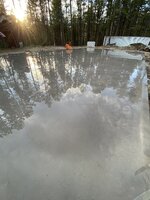
I should probably start a new thread on this topic but I have a couple deep pools that hold about 3/8-1/2” of water. Isn’t that a bit excessive? They are large areas of about 30 square feet or more. Was hoping for a flatter floor than that.
 
OP
W

Wiebster

Well-known member
Joined
Jul 18, 2015
Messages
194
Location
Rapid City, Sd
I had this dilemma very late last fall when we had a small 18' x 18' pole barn addition slab poured one week before freezing weather. My contractor and others here warned me of the bolded statement above. I moist cured it several days and installed concrete blankets for extra safety. Don't second guess your decision about the cure and seal if you intend to put a better product on in the future. Our slab made it through our unusually mild winter o.k..

Good luck. There's definitely too many choices! Darn the internet!
Way too many choices and a bit of conflicting information on when and how to use them.
 

ConCretin

Well-known member
Joined
Jan 20, 2011
Messages
3,378
Location
Central Maine
I should probably start a new thread on this topic but I have a couple deep pools that hold about 3/8-1/2” of water. Isn’t that a bit excessive? They are large areas of about 30 square feet or more. Was hoping for a flatter floor than that.
It's certainly an indication of flatness issues but it may not be as bad as the water makes it look. Water will pool to some degree on even the flattest floors. Measure the gap under a 10' straightedge to objectively evaluate your flatness. Gaps of 1/4" or less is a pretty good floor and I suspect many floors are perfectly serviceable with far worse. Unless you are going to polish or epoxy your floor, you'll probably never even notice.

Btw, the purpose of curing is just to keep the mix water already in the concrete from evaporating before the concrete reaches strength. The concrete doesn't need more water, spraying water on the surface just provides a barrier to keep the existing water in. In all honesty, you'd probably never know the difference if you didn't cure at all.
 
OP
W

Wiebster

Well-known member
Joined
Jul 18, 2015
Messages
194
Location
Rapid City, Sd
It's certainly an indication of flatness issues but it may not be as bad as the water makes it look. Water will pool to some degree on even the flattest floors. Measure the gap under a 10' straightedge to objectively evaluate your flatness. Gaps of 1/4" or less is a pretty good floor and I suspect many floors are perfectly serviceable with far worse. Unless you are going to polish or epoxy your floor, you'll probably never even notice.

Btw, the purpose of curing is just to keep the mix water already in the concrete from evaporating before the concrete reaches strength. The concrete doesn't need more water, spraying water on the surface just provides a barrier to keep the existing water in. In all honesty, you'd probably never know the difference if you didn't cure at all.
That is true, I agree with everything you said. I’d almost rather not know how deep it is because there is nothing I can do about it. I was disappointed, but honestly didn’t notice it until I started using water on it. Of course now I can’t unsee it! And I also agree with your view on moist curing. Thanks for the info.
 

rixtrix1

Well-known member
Joined
Aug 25, 2013
Messages
3,010
Location
Chandler, AZ (from west NE)
My 24x32 monolithic slab turned out extremely well, but it does have a couple of low spots in the back away from the doors. The slab was troweled with a steel trowel on a long pole. They went over it 6 times. It is very smooth. Between keeping it wet to cure and subsequent rains before getting it dried in I was concerned, but now, a year and a half later, I don't even notice them. They looked terrible when wet and I seemed to squeegee a lot of water but they are less than 3/16" at the lowest spot, but will pool over a 6'x8' area. d I'll never put the volume of water down that occurred prior to enclosing the structure.
 

rixtrix1

Well-known member
Joined
Aug 25, 2013
Messages
3,010
Location
Chandler, AZ (from west NE)
I wanted to use solvent based.Eagle Supreme Seal on my shop floor, based on what others have said and shown. I like "the concrete look"! The problem is the Eagle product isn't allowed in Arizona to it's higher VOC. In my other shops back in Nebraska I just went to the local janitorial store and picked up some "gym floor sealer". I don't have any idea what was in it and yes ,brake fluid would peel it up if you left it on. I'd just dry it off and reapply more. everything just beaded up and was easily wiped up. Mind you, this was 45 years ago! Sweeping was dustless and traction wasn't a problem.

I see Armorpoxy has a solvent based sealer that's almost double the price as Eagle that IS sold in AZ, but they have so many products it's kind of confusing. I really don't want to do a topical product as I plan on doing a lot of welding and grinding.

Suggestions?
 
OP
W

Wiebster

Well-known member
Joined
Jul 18, 2015
Messages
194
Location
Rapid City, Sd
My 24x32 monolithic slab turned out extremely well, but it does have a couple of low spots in the back away from the doors. The slab was troweled with a steel trowel on a long pole. They went over it 6 times. It is very smooth. Between keeping it wet to cure and subsequent rains before getting it dried in I was concerned, but now, a year and a half later, I don't even notice them. They looked terrible when wet and I seemed to squeegee a lot of water but they are less than 3/16" at the lowest spot, but will pool over a 6'x8' area. d I'll never put the volume of water down that occurred prior to enclosing the structure.
Thanks for the pep talk. I too will probably notice them less once they stop filling with water but I do think the lows are pushing 1/2” easy. Not happy about it but I’m moving on to the building phase.
 

Beemer

Well-known member
Joined
Jun 21, 2020
Messages
1,417
Location
Northeast
There are curing compounds you can apply to freshly poured concrete to help the curing process. You can also spray the slab with a garden hose for a few days. Sealing the slab for other purposes is usually applied later, depends on product. There are some curing/sealer products as well. Ask you concrete contractor if they recommend a curing compound based on weather conditions, etc… Protecting from freeze throw is best done with a cover of some sort.
That was on every job ever designed. Concrete needs to be cured.
Attention is needed to confirm compatibility with proposed floor finishes to avoid having to strip it off later.
We generally used a hardener/sealer later but only on concrete to be left bare, without a finish product.
 

jsundin65

Member
Joined
Aug 23, 2024
Messages
18
I should probably start a new thread on this topic but I have a couple deep pools that hold about 3/8-1/2” of water. Isn’t that a bit excessive? They are large areas of about 30 square feet or more. Was hoping for a flatter floor than that.
How has it been for you? My slab was just poured and I am curing it now. If my pool area was on a spot entirely inside the building, I would not worry a bit about it. But my pool is right where the building meets the Lean and where my 8x8 side garage door will be. I am debating with myself about covering the back and side of my lean, which would keep most water from getting in and then I could use it to keep things out of the bigger elements.
 
OP
W

Wiebster

Well-known member
Joined
Jul 18, 2015
Messages
194
Location
Rapid City, Sd
As embarrassing as it is, I still don’t have my roof on. So it’s a complete pain in my a$$ to sweep it out every time it rains. The worst low spot is near a large door so I sweep it out and then get to walk through the mud it causes for a few days. Should have a roof on within a week. I think I’ll eventually forget about it once it’s covered. So in regards to your situation, yes, I would try to cover it or it will be a constant pain. Especially if you’re in a freeze thaw climate where you could slip on it.
 
To avoid these ads, REGISTER NOW!
Top Bottom