To avoid these ads, REGISTER NOW!

Sealing Block Wall Over Paint

ringandtip

Member
Joined
May 14, 2015
Messages
14
Hi All;

Working on finishing a new shop with concrete block walls. The exterior has two coats of paint that was supposed to also seal against moisture.

Not so much. During a driving rain, water penetrates the block and mortar joints.

Anyone have any experience with sealers that can be used on already painted block? Seal-Krete seems to be a possibility. Don't know about something like Thompson's water seal. Would like to avoid repainting the building if possible.

I plan on studding the interior and using fiberglass insulation. Was also thinking about using 6 mil or so poly sheeting on the outside of the studs for insurance against wet insulation.

Any thoughts or advice would be appreciated.

Thanks
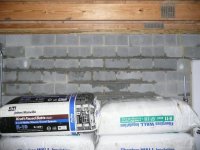
 

Attachments

  • P1040367.jpg
    P1040367.jpg
    142.8 KB · Views: 142
To avoid these ads, REGISTER NOW!

Jhoff310

Well-known member
Joined
Jan 2, 2012
Messages
876
Location
Perrysburg Ohio
Not knowing where youre from it's hard to say if your local building code will permit a vapor barrier, most should; but I would check with your local building codes as they have the final say.

As far as sealing the exterior. I can't say if more paint is the answer or a water sealer over paint will help. There are other options though
Seal the inside with drylock or other interior waterproofing product
Apply a fresh new mortar coat on the outside and go for a "stucco" look.

There are a few unanswered questions.
Age of the building---looks relatively new based on the picture
Exterior mortar joints--what condition are they in...is this something some tuck-pointing could fix?
What kind of paint was used on the exterior...latex, oil based etc..

Good luck, I hope someone else will chime in and give you some other insight.
 

Blazinzuk

Well-known member
Joined
Mar 13, 2016
Messages
637
Location
Afton Wy
The foundation of my house is cmu. When we bought this house there was water problems in the basement.

Paint does not seal concrete blocks at all. It used to be roofing tar they sealed foundations with, still is in many places. There are tons of products out there that are water proofing products.

Clean the surface. Remove any loose paint. Then remove any old paint you think might be loose. Then do that again. These waterproofers don't work if there is any break in them.

I used dry lock it is obviously different the first time you even look at it way thicker than any paint I have ever used.

There are tons of houses around here with cmu foundations. The dry lock is well regarded
 

BlackTalon

Well-known member
Joined
Aug 22, 2014
Messages
183
Location
Alexandria, VA
For above-grade CMU walls there are elastomeric coatings that will work. But not over paint. You would need to blast off the paint, apply a block filler, end then apply the elastomeric coating.
 
OP
R

ringandtip

Member
Joined
May 14, 2015
Messages
14
Thanks for the input.

Building is 18 mos old. Mortar joints are perfect. Latex paint (for masonry) 2 coats.

I considered using DryLok on the interior but worry that all that moisture would then be trapped in the block. Plus at that point I may as well re-coat the exterior. Similar cost and labor.

I also worry that if I try some easily applied waterproofing product (Thompson's, SealKrete) on the exterior, and it doesn't work, I may have a problem getting good results coating over that.

Thanks Again

btw David, great handle. A real "blast" from the past. I bet I still have a few boxes squirreled away somewhere.
 

Showkey

"MEMBER EMERITUS"
Joined
Aug 9, 2014
Messages
8,638
Location
Wausau WI
Is this block wall below grade ? Guessing it above grade and the paint on the outside is NOT sealing the wall. Block is porous and must be sealed.

Think DRYLOK is the exact product to solve the problem in the picture. Two heavy coats will be needed. If this wall above grade DRYLOK on the outside prior to color would have been a good choice. DRYLOK type products are designed to be the base coat and are not designed to go over existing paint.

What ever you do ......do not cover the inside wall until your absolutely sure that wall is dry and will stay dry over time.

You might try DRYLOK on the outside over the existing paint, again two heavy coats. This is only if the paint that is there is firmly stuck to the wall. With the amount of water wicking you getting the outside paint is doing nothing to seal the block and is very thin coat ?
 

joes169

Well-known member
Joined
Sep 19, 2011
Messages
663
Location
WI
I'm a masonry contractor, and I have a block shop myself. In the picture, that is ALOT of water for a painted exterior block wall. I think some detailing at the top of the wall is lacking. Any way you can share a picture with us of the outside?

Second, DO NOT use Drylock on the interior, you need to solve this problem on the outside. Drylock will not stay on the interior for long, it will eventually get pushed off by the moisture. In the meantime, the block will likely get damaged by the prolonged moisture. Drylock is a waste of time, unless you're trying to hide a damp wall at the sale of a house.

I would recommend visiting a real paint store, like Sherwin-WIlliams, and speak to a manager or specialist there who knows' their industrial coatings. They're going to push "Loxon" masonry pint, but they have better commercial coatings, even elastomerics, that will help, if the paint is REALLY the problem.
 

Blazinzuk

Well-known member
Joined
Mar 13, 2016
Messages
637
Location
Afton Wy
Everything I have ever read where the person had any credentials at all said the same thing as above you seal from the outside. Not the inside
 

Showkey

"MEMBER EMERITUS"
Joined
Aug 9, 2014
Messages
8,638
Location
Wausau WI
Agree........what ever they did to the outside has to be fixed.

I this case OP needs to seal both sides........before installing interior walls. In the Midwest with basements, DRYLOK type products are often used to seal moisure wicking through pour concrete or block walls. Sealing the inside helps control humidity. If you water pouring in the problem needs to fixed outside. The outside basement walls are sealed waterproofed and often foam paneled by code in most areas. Since this is above grade sealing the wall and at this point covering the outside wall with siding would not be a bad choice. Especially if the current outside paint has to be removed before another product can be applied to properly seal the wall.
 
Last edited:
To avoid these ads, REGISTER NOW!
OP
R

ringandtip

Member
Joined
May 14, 2015
Messages
14
...that is ALOT of water for a painted exterior block wall. I think some detailing at the top of the wall is lacking.

Seems like a lot to me. 2 coats of "masonry" paint. Don't have the cans unfortunately to see exactly what it is. Siding has good overhang at top of block (~3/8) providing a pretty good drip edge. Closed cell foam gasket between top plate and block. Side wall also have the problem (when the rain drives from that direction) even with about a foot overhang at the eave.


Second, DO NOT use Drylock on the interior, you need to solve this problem on the outside. Drylock will not stay on the interior for long, it will eventually get pushed off by the moisture. In the meantime, the block will likely get damaged by the prolonged moisture.

Exactly as I was thinking.

Any way you can share a picture with us of the outside?
 

Attachments

  • P1040294-1.jpg
    P1040294-1.jpg
    86.6 KB · Views: 80
OP
R

ringandtip

Member
Joined
May 14, 2015
Messages
14
Well, thanks again for the input.

I was hoping someone had some experience with SealKrete or a similar product. It dries clear and the manufacturer says it's OK over paint and application would be easier than a total repaint.

Don't want to take the chance of applying yet another coat of something I'll end up having to ultimately try to paint over.

Thanks joes169...I think I'm going to go with one of the commercial coatings as you suggest. Hopefully they will have something that I can apply over the 2 coats of Sherwin-Williams acrylic latex that's already on there.
 

SALIV8

Well-known member
Joined
Dec 11, 2008
Messages
2,114
Location
chicago and s/w michigan
With that much water coming through I would bet there are minor shrinkage or settlement cracks where the mortar lines are on the outside, allowing water to wick in. Did you inspect the wet mortar lines, on the outside, for any cracks/shrinkage?

Im not sure painting would bridge the crack, so I'd start inspecting for cracks first, fix them, then seal the outside only.
 

DTE

Well-known member
Joined
Jul 13, 2013
Messages
996
Location
North Carolina
That is a lot of water coming through, I have spent most of my life in a block building and some dampness is normal in really wet weather, at least that has been my experience. I have a new shop at home that is block and I am not planning to paint the outside but I am going to use some type of sealer, probably the Create seal as it can be painted over. In my 35 years of keeping up a block building I found that painting it with Kilz 2 and not putting a top coat on lasted longer and sealed it better than any type of paint I tried. For what it's worth that is my experience. Now I did paint the inside of my new shop and I used Kilz 2 and had Lowes tint it gray and went with that. Here is a photo where I had some Legacy concrete densifier left from my floor and you can see where I sprayed the walls on the outside with it. I have not looked lately when it is damp out to see if it is still repelling water though. It does look like you have a really tall gable and maybe you are getting a lot of run off depending on how the rain blows.
 

Attachments

  • garage build 2015 187.jpg
    garage build 2015 187.jpg
    146.5 KB · Views: 43

Showkey

"MEMBER EMERITUS"
Joined
Aug 9, 2014
Messages
8,638
Location
Wausau WI
DTE has it right........block by their nature are wet and damp. In foundation they may never dry in some locations.

I know some guys aren't fond for DRYLOK type products. The facts are there different grades for these products .........they are basicly a hydraulic cement with pigment. They will fill large gaps, fill porous block, the better grades will seal active leaks in walls.
 
Last edited:

country83

Well-known member
Joined
May 28, 2009
Messages
504
I'm interesting in sealing the exterior walls of my garage as well, and am wondering what would be the best way to do that. The walls are cinder block and have to my knowledge never been sealed, painted, nothing. Any input would be appreciated.
 

dublove

Active member
Joined
Aug 9, 2010
Messages
25
Wow, I'm very surprised at this.

Typically here in England the only time a concrete block wall would be left exposed is if it was a cavity wall construction. Then it doesn't matter.

Best way is a waterproof cement render on the outside.

You could cheat a bit - skim it over with a tanking slurry, which will fill the holes giving a smoother surface. Then Paint it with a good masonry paint.
A 'pliolite' based masonry paint is the one to go for.
 

jaysberman

Well-known member
Joined
Nov 13, 2008
Messages
77
Location
Pottstown,Pa
Sherman Williams has a great product for this that works well.
It is put on with an pressure sprayer like you use for weeds.
It goes on kinda blue but dries clear. Used it on painted cement block.
 
To avoid these ads, REGISTER NOW!
Top Bottom