

You are using an out of date browser. It may not display this or other websites correctly.
You should upgrade or use an alternative browser.
You should upgrade or use an alternative browser.
See anything wrong with my sink drain vent?
- Thread starter green.bubbly
- Start date

OP
green.bubbly
Well-known member
Yes, I forgot one important piece. 
The second pic shows how I had to get a little creative with the vent pipe. I needed it to exit the back wall in the center of the steel siding ribs on a flat portion of the sheet. I was about 1.5 inches off.
The second pic shows how I had to get a little creative with the vent pipe. I needed it to exit the back wall in the center of the steel siding ribs on a flat portion of the sheet. I was about 1.5 inches off.
Attachments


darkk
Well-known member
Hmmmm.....out a wall? In Ct. it has to exit thru the roof.
hydramatic
Well-known member
here in alabama, out the roof.

OP
green.bubbly
Well-known member
I agree but when you are 19 miles from the nearest hardware store that would have a 22 1/2, you have to get creative.
I am not sure on the code for exiting the roof but I see them out the back of buildings everywhere around here. Guess I will find out shortly.
I am not sure on the code for exiting the roof but I see them out the back of buildings everywhere around here. Guess I will find out shortly.
rwhite692
Well-known member
Code in California = exit through the roof....Check your local codes as well to make sure that PVC is allowed for waste lines/venting....Out here it has to be ABS...
A 22 1/2 with a street 22 1/2 would probably have worked perfectly and looked a ton better. Even a 45 and a street 45 would have worked a lot better but it would have had to be "rolled out" at an odd angle.
My thoughts as well. He should have extended it to the proper length instead of cobbling a bunch of 90's and short pieces together.
Not to sound like a ****, but it looks like ****. Take the time and do it right.
nehog
Well-known member
I'm not sure I like big holes in the girts either...
Code in California = exit through the roof....Check your local codes as well to make sure that PVC is allowed for waste lines/venting....Out here it has to be ABS...
That's a relatively rare requirement.
OP
green.bubbly
Well-known member
Ok, how much offset will two 22 1/2s give me? I need to be over 1.5 inches. That was the issue with two 45's, it shifted it over too much and I did not have enough wall depth to get the required angles.
Is the air admittance valve allowed to be used in this situation? I thought they were mainly for mobile homes and island sinks. I sure would have preferred using one versus cutting a hole in the roof/wall.
Is the air admittance valve allowed to be used in this situation? I thought they were mainly for mobile homes and island sinks. I sure would have preferred using one versus cutting a hole in the roof/wall.
Ok, how much offset will two 22 1/2s give me? I need to be over 1.5 inches. That was the issue with two 45's, it shifted it over too much and I did not have enough wall depth to get the required angles.
Is the air admittance valve allowed to be used in this situation? I thought they were mainly for mobile homes and island sinks. I sure would have preferred using one versus cutting a hole in the roof/wall.
If you make a hardware run get 2 - 22 1/2s, a street 22 1/2, a 45, a street 45, a 90, and a street 90. Try a 22 1/2 and a 90 like in the illustration shown. Then continue from there. You should not need to use more than 3 fittings and probably not more than 2. Then return what is extra.
HVAC Phil
Well-known member
If i were an inspector, i'd fail it based on looks. It looks hacked in. Here's a tip: if the work looks really neat, the inspectors tend to not pick the job to death. If i saw that, i'd be pulling a level out, checkings slopes, etc. I figure if the guy rigged that simple piece up, what else will i find?
Bustawrench
Well-known member
Yeah, a couple of eighth bends would be better and in Jersey it has to go out the roof.
back2class
Well-known member
- Joined
- Jan 7, 2009
- Messages
- 2,723
I believe it needs to exit roof in most codes, but this is not residental and not sure how tough your inspector can be. It is not very hard to google and find out! I believe all the bends are code and not a code issue unless in has negative slope. It is dam ugly. Sometimes a furnco can be used to move something over a tiny bit. It does not always have to be hard plastic and when things are a little off a furnco can be a great help. Some states require a main stack to be 3". Silly in this case, but sometimes code is written to cover all possible things and gets silly. I would have skipped the hole and just put a studder vent in under the sink. I belive most codes allow one per structure, though some codes may state you need to have an open air vent at some point in the building. Silly since this is the only plumbing structure, but coded were not written for hobby workshops. I would have said just cap the pvc and add the sink ofter inspection was done.
Ya never know, inspect could be a jerk and fail you on ugly! He could be cool and realize that this will work fine and presents no hazzard. Could tell you need to roof vent. May wa well see what he says before you fix anythng.
Ya never know, inspect could be a jerk and fail you on ugly! He could be cool and realize that this will work fine and presents no hazzard. Could tell you need to roof vent. May wa well see what he says before you fix anythng.
Last edited:
cbacres
Well-known member
Two of the fittings apear to be pressure fitings, not drain, vent & waste.
May be a issuewith a tight inspector.
May be a issuewith a tight inspector.
if it just a sink with no sewer on it, some sink has built in vents, so vent might not be required
Really? I have never heard of a sink with a built in vent that any code found acceptable for replacing a piped vent. Care to share a link or picture?
Two of the fittings apear to be pressure fitings, not drain, vent & waste.
May be a issuewith a tight inspector.
Ever see a vent 90?
I believe it needs to exit roof in most codes,
The two main codes in use are the UPC and the IPC. Most local codes are adaptions of one of these two. I am not aware of a requirement to vent through the roof in either of those codes. Past the roof, yes. Through the roof, no. If anyone can cite the section of either of those codes that prove me wrong they are free to do so.
I would have said just cap the pvc and add the sink ofter inspection was done.
I am a bit hazy on this (memory issues) but I am pretty sure the IPC and the UPC require the rough in plumbing to be completed. No dead ends. In other words, you can't rough in the drain and leave the vent for later. Again, if anyone can cite the section of either of those codes that prove me wrong they are free to do so.
Frank The Plumber
Well-known member
Here:
Not out the side, out the roof, should be 2 feet into the structure.
Fittings are assorted types, should have used all schedule 40 fittings, and the 90's are not swept, you would not be able to rod the vent if it plugged.
We can be failed for craftsmanship here.
It can be correct in it's configuration yet fail on appearance.
The drilled structure would raise an eye brow as well.
I did a short term as an inspector, part time. In a suburb.
Here:
I would have failed it for craftsmanship, the fittings, the primer all over, and the fitting out of the floor looks soiled yet not cleaned well at the joint.
Not going out the roof.
Cutting the purlins, I believe they are called.
I would have been allowed to reschedule an inspection with a $25 fee, for the re inspection.
Next:
If I felt that the work was sub par, I could ask for a full stack test upon the work in question.
This would mean that I would want that filled with water to the roof termination with a full sized clean out and test device at the base of the stack.
Sounds strict, yes it is. Realize that if you want to be plumber, you have to live as a plumber. If a plumber called me out and showed me this as his install here, I would enforce the code to the absolute letter of the law.
If a licensed plumber called me out to look at that, He better be wearing a bucket on his *** so I break my foot.
All of the other stuff you did wrong can be easily corrected. Plastic pipe is cheap, don't fret. We'll show you the way.
I would not cut any more structure in Hurricane country though, that could be expensive to fix.
Note:
He may actually be allowed to use a mechanical vent, he should look up his code.
Not out the side, out the roof, should be 2 feet into the structure.
Fittings are assorted types, should have used all schedule 40 fittings, and the 90's are not swept, you would not be able to rod the vent if it plugged.
We can be failed for craftsmanship here.
It can be correct in it's configuration yet fail on appearance.
The drilled structure would raise an eye brow as well.
I did a short term as an inspector, part time. In a suburb.
Here:
I would have failed it for craftsmanship, the fittings, the primer all over, and the fitting out of the floor looks soiled yet not cleaned well at the joint.
Not going out the roof.
Cutting the purlins, I believe they are called.
I would have been allowed to reschedule an inspection with a $25 fee, for the re inspection.
Next:
If I felt that the work was sub par, I could ask for a full stack test upon the work in question.
This would mean that I would want that filled with water to the roof termination with a full sized clean out and test device at the base of the stack.
Sounds strict, yes it is. Realize that if you want to be plumber, you have to live as a plumber. If a plumber called me out and showed me this as his install here, I would enforce the code to the absolute letter of the law.
If a licensed plumber called me out to look at that, He better be wearing a bucket on his *** so I break my foot.
All of the other stuff you did wrong can be easily corrected. Plastic pipe is cheap, don't fret. We'll show you the way.
I would not cut any more structure in Hurricane country though, that could be expensive to fix.
Note:
He may actually be allowed to use a mechanical vent, he should look up his code.
Last edited:
Isn't the reason that the sewer vent needs to pass thru the roof is to avoid any sewer gas from entering the attic space thru the overhang vents? I can also see why a horizontal portion of the vent could pose a possible problem. So why couldn't you do as "BlackLead" suggested then add another 90 to make the vent run vertical again and go above the roofline (may have to brace to facial board in some way).
Last edited:
OP
green.bubbly
Well-known member
Isn't the reason that the sewer vent needs to pass thru the roof is to avoid any sewer gas from entering the attic space thru the overhang vents? I can also see why a horizontal portion of the vent could pose a possible problem. So why couldn't you do as "BlackLead" suggested then add another 90 to make the vent run vertical again and go above the roofline (may have to brace to facial board in some way).
That is how I did it and how I usually see it done around here on metal buildings. Exits the wall as high as possible then 90 back up above the roof line.
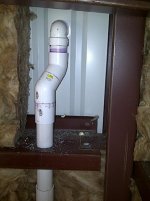
Per the many suggestions, I redid the vent line. Still not sure if perfect but it is hopefully better. Thanks for all the constructive criticism.
Question for Frank, how should the excess primer be removed or should I have just been a little sloppy when putting it on?
Attachments
Last edited:
OP
green.bubbly
Well-known member
I believe it needs to exit roof in most codes, but this is not residental and not sure how tough your inspector can be. It is not very hard to google and find out! I believe all the bends are code and not a code issue unless in has negative slope. It is dam ugly. Sometimes a furnco can be used to move something over a tiny bit. It does not always have to be hard plastic and when things are a little off a furnco can be a great help. Some states require a main stack to be 3". Silly in this case, but sometimes code is written to cover all possible things and gets silly. I would have skipped the hole and just put a studder vent in under the sink. I belive most codes allow one per structure, though some codes may state you need to have an open air vent at some point in the building. Silly since this is the only plumbing structure, but coded were not written for hobby workshops. I would have said just cap the pvc and add the sink ofter inspection was done.
Ya never know, inspect could be a jerk and fail you on ugly! He could be cool and realize that this will work fine and presents no hazzard. Could tell you need to roof vent. May wa well see what he says before you fix anythng.
This garage is located in the "country" which still requires certain codes to followed. With that said, the inspectors are really a great bunch of guys that go out of their way to help home owners such as myself.
For example, when I was having my home slab poured, I had a couple of questions about the Ufer ground. The inspector told me to get the copper wire and clamp and lay it on the ground near where my panel would be. He told me that he would connect it for me if I did not fully understand what to do. He went on to explain to me how to do it and I actually did it correct.
back2class
Well-known member
- Joined
- Jan 7, 2009
- Messages
- 2,723
Yeah, here they did nit even inspect new buildings or homes untill 2005. They would pass the original work for a home shop. Would have failed you if you were a pro or this was not on a shop. I did mis-state somethig. Of course it can exit the wall, but has to be above roofline as far as I remember. I would keep the supplies on hand for the inspection. That way you can do it while he waits if he wants it up over roof height and return if he says fine as is. A few elbows and some strapping should get you there. My guess is he will pass it as is, or pass it when he sees you have the stuff and are making the recomendations on the spot right then. That is if he is a decent guy.
Frank The Plumber
Well-known member
The purple is a PIA, they only went with it to be really obnoxious. I've seen Journeymen making $42 an hour get that stuff on every surface under the stars, It's really disheartening. I guess they do that to protest the very existence of PVC, sadly, in the end it shines poorly upon them as craftsmen to have the mess. In most cases the guy who does the install does not make the presentation for code compliance. You tend to as the presenter, use the guys who get you the least flak off the inspector.
Essentially, primer is a lacquer thinner type solvent, they usually sell it in clear and purple. One trick I like to use to keep a neat appearing job is to use a clear to clean the existing pipe, this way if you drool the stuff all over, it's not so visible. You can use the clear to really scrub off the oxides on the older piece, then dauber carefully away all of the excess and put a careful bead of purple over the clear primer. For the other fittings you can do the same or just angle the fittings in a way so as not to make a big purple catastrophy.
You just want to give an inspector a nice uniform look.
You want to bore an inspector, no questions, no comments, no reason to pause, pulse just above consciousness, just ho hum and on to the next. You never want to be the guy who inspires a story back at the office. His story will be your legacy of grief.
Now it looks like you care, if it looks like you care then you must. Those who care are respected, so we always want to give our best appearance.
Hopefully your guy will just look and leave. That's a good thing.
Another trick:
Never ever ask questions or shoot the **** in front of the install, get that thing out of his vision so he can stop looking at it, the longer that he looks the more he will start to mentally critique it and if you piss him off at all, he may find a flaw, imagined or real, that he can toss at you.
Essentially, primer is a lacquer thinner type solvent, they usually sell it in clear and purple. One trick I like to use to keep a neat appearing job is to use a clear to clean the existing pipe, this way if you drool the stuff all over, it's not so visible. You can use the clear to really scrub off the oxides on the older piece, then dauber carefully away all of the excess and put a careful bead of purple over the clear primer. For the other fittings you can do the same or just angle the fittings in a way so as not to make a big purple catastrophy.
You just want to give an inspector a nice uniform look.
You want to bore an inspector, no questions, no comments, no reason to pause, pulse just above consciousness, just ho hum and on to the next. You never want to be the guy who inspires a story back at the office. His story will be your legacy of grief.
Now it looks like you care, if it looks like you care then you must. Those who care are respected, so we always want to give our best appearance.
Hopefully your guy will just look and leave. That's a good thing.
Another trick:
Never ever ask questions or shoot the **** in front of the install, get that thing out of his vision so he can stop looking at it, the longer that he looks the more he will start to mentally critique it and if you piss him off at all, he may find a flaw, imagined or real, that he can toss at you.
Grumpy365
Well-known member
Really? I have never heard of a sink with a built in vent that any code found acceptable for replacing a piped vent. Care to share a link or picture?
Have you ever seen a sink in an island?
Edit: they use an AAV Vent (air admittance valve).
Last edited:
Have you ever seen a sink in an island?
Edit: they use an AAV Vent (air admittance valve).
What does that have to do with a lavatory with a built in vent?
And yes, I am familiar with island sinks. I was venting island sinks before AAVs were ever legal for island sinks. Hint: I have a little piece of paper on the wall with my name on it and words like Master Plumber, license, 1995, etc. That doesn't mean I know everything about plumbing but it's a clue I am not a total ignoramus about plumbing.
Grumpy365
Well-known member
What does that have to do with a lavatory with a built in vent?
And yes, I am familiar with island sinks. I was venting island sinks before AAVs were ever legal for island sinks. Hint: I have a little piece of paper on the wall with my name on it and words like Master Plumber, license, 1995, etc. That doesn't mean I know everything about plumbing but it's a clue I am not a total ignoramus about plumbing.
Ease up there chief, your post said sink with a vent.
In the OP I see nothing about a toilet or anything to indicate this is anything more than a sink.
I don't give a damn about this guys sink, or give a damn you are a plumbing god. Someone posted about a sink with a built in vent, I don't know about that either, but I do know people use AAV's and I am fairly certain that's what the post was referring to.
And you being a master plumber, you probably knew he was talking AAVs as well. You could have used your knowledge of when you can use an AAV and when you can't to educate everyone or you could be a ****.
Get your ******* out of a wad. Sheesh

No offense intended to the OP. It will drain, the inspector here would never pass the pressure PVC fittings as opposed to sanitary fittings or not venting thru the roof, but if there is no inspection, and in a shop building somewhere, I think it's fine. I mean, it ain't going to burn your house down or anything.
Ease up there chief, your post said sink with a vent.
In the OP I see nothing about a toilet or anything to indicate this is anything more than a sink.
I don't give a damn about this guys sink, or give a damn you are a plumbing god. Someone posted about a sink with a built in vent, I don't know about that either, but I do know people use AAV's and I am fairly certain that's what the post was referring to.
And you being a master plumber, you probably knew he was talking AAVs as well. You could have used your knowledge of when you can use an AAV and when you can't to educate everyone or you could be a ****.
Get your ******* out of a wad. Sheesh
No offense intended to the OP. It will drain, the inspector here would never pass the pressure PVC fittings as opposed to sanitary fittings or not venting thru the roof, but if there is no inspection, and in a shop building somewhere, I think it's fine. I mean, it ain't going to burn your house down or anything.
I am sorry what I wrote was upsetting to you. Have a beautiful day!
Those 90 bends will be prone to getting clogged
A am obviously not a plumber but how would a vent get clogged?
A am obviously not a plumber but how would a vent get clogged?
Birds or animals going down the vent or putting things in the vent.
Sewer backing up and solids staying in the vent piping. (The most common one I have seen.)
Frost closure.
Etc.
Frank The Plumber
Well-known member
On an island you use a drip leg loop drain vent with clean outs on both the vent and the drain. All in long sweeps to provide a good airflow. You put a drain leg on the vent to drain vapor waters. You then connect the loop into a vent that continues to an exit at a higher elevation.
In respect to some of the who cares what's the harm type of comments.
If you are going to do something it reflects well upon you to do it correctly.
Also:
The OP asked about presenting his install to a plumbing inspector, therefore we would like for him to be respected and to not be failed.
And.
This is not a journal of good enough who the F cares anyway.
Honestly, is that the kind of advice you are seeking?
If so I would wonder why.
In respect to some of the who cares what's the harm type of comments.
If you are going to do something it reflects well upon you to do it correctly.
Also:
The OP asked about presenting his install to a plumbing inspector, therefore we would like for him to be respected and to not be failed.
And.
This is not a journal of good enough who the F cares anyway.
Honestly, is that the kind of advice you are seeking?
If so I would wonder why.
OP
green.bubbly
Well-known member
On an island you use a drip leg loop drain vent with clean outs on both the vent and the drain. All in long sweeps to provide a good airflow. You put a drain leg on the vent to drain vapor waters. You then connect the loop into a vent that continues to an exit at a higher elevation.
In respect to some of the who cares what's the harm type of comments.
If you are going to do something it reflects well upon you to do it correctly.
Also:
The OP asked about presenting his install to a plumbing inspector, therefore we would like for him to be respected and to not be failed.
And.
This is not a journal of good enough who the F cares anyway.
Honestly, is that the kind of advice you are seeking?
If so I would wonder why.
I my last house, the plumber thought that my island sink would have a wall on the end that went up to the ceiling. His plan was to run the vent in this wall. In reality, there was never a wall planned and he had no vent. So what he did was to create a fake loop vent. It all looked correct except the pipe that went into the base of the cabinet was capped instead of actually going to a vent line.
Of course nobody knew this and the inspector even passed it. After we moved in, we kept having trouble with the garbage disposal backing up/draining slow. One day, I could not get it unclogged and called a plumber out. He was the one that realized what the original plumber did.
Called the state inspector out and he was not very thrilled. He allowed the plumber to install a air vent which was not really per code in this situation. The alternative was to have the plumber trench the concrete across my kitchen, tear open the walls and run a vent. The inspector said it was my call to either use the air vent of have him tear up my kitchen.
Of course as compensation, I got two nice pressure flushing toilets from the plumber.
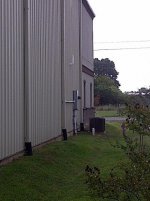
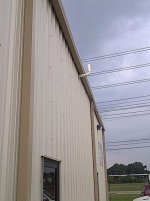
Back to the vent going out the wall, I took these pics of buildings around where I work. Of course this is all commercial so I am not sure if it would apply to my garage, but all the vents come out of the side of the buildings.

Attachments


Frank The Plumber
Well-known member
It may be legal there to run out the side, it looks like it is.
In some cases you can get an in field decision in your favor, it will not be written in most cases but they will at least not make you chop stuff up.
The reason that the mechanical vent would be out of favor is due to the fact that it is a maintenance type product. A pipe type vent is absolutely no maintenance, so it is preferred. The diaphragm vents generally have a soft rubber seal that will dry up in 5 to 8 years and allow odor or gas to enter the home. In windy situations the mechanical diaphragm can cavitate allowing mild burping of gas into the home. So for these several reasons a pipe vent is the better way to provide a gas vent for the plumbing system.
The initial investment in labor and materials gives you a noble and long lasting product that requires very minimal servicing.
I should note that if you install a mechanical vent in the overflow zone or have a sink backup and the device is not working properly, you may sustain property damage as the device may leak water without you knowing it.
In some cases you can get an in field decision in your favor, it will not be written in most cases but they will at least not make you chop stuff up.
The reason that the mechanical vent would be out of favor is due to the fact that it is a maintenance type product. A pipe type vent is absolutely no maintenance, so it is preferred. The diaphragm vents generally have a soft rubber seal that will dry up in 5 to 8 years and allow odor or gas to enter the home. In windy situations the mechanical diaphragm can cavitate allowing mild burping of gas into the home. So for these several reasons a pipe vent is the better way to provide a gas vent for the plumbing system.
The initial investment in labor and materials gives you a noble and long lasting product that requires very minimal servicing.
I should note that if you install a mechanical vent in the overflow zone or have a sink backup and the device is not working properly, you may sustain property damage as the device may leak water without you knowing it.
Last edited:
OP
green.bubbly
Well-known member
It may be legal there to run out the side, it looks like it is.
In some cases you can get an in field decision in your favor, it will not be written in most cases but they will at least not make you chop stuff up.
The reason that the mechanical vent would be out of favor is due to the fact that it is a maintenance type product. A pipe type vent is absolutely no maintenance, so it is preferred. The diaphragm vents generally have a soft rubber seal that will dry up in 5 to 8 years and allow odor or gas to enter the home. In windy situations the mechanical diaphragm can cavitate allowing mild burping of gas into the home. So for these several reasons a pipe vent is the better way to provide a gas vent for the plumbing system.
The initial investment in labor and materials gives you a noble and long lasting product that requires very minimal servicing.
I should note that if you install a mechanical vent in the overflow zone or have a sink backup and the device is not working properly, you may sustain property damage as the device may leak water without you knowing it.
The last thing I want is burping of gas in my home. I saw the last of that issue when my two sons moved out.
I was reading somewhere that these mechanical air vents had a service life of something like 30,000 cycles which equated to 40 years of normal service. But that was in a lab through constantly repeating test cycles. Like you said, what will happen to the rubber seal after 8 years in a hot shed? I doubt it would actually last 1,000 cycles.