Introduction:
My attached, two-car garage in my 1984-built home has one outlet in it, and I would like to install a subpanel so that I can run additional circuits for the purpose of woodworking. The immediate question is can or should I do this myself?
House main panel information:
The existing main panel is a Cutler-Hammer CH7CC, presumably original to the home, with a 100-amp main breaker and two of the 22 slots open. One breaker will have to be moved to install a new, two-pole breaker for a new subpanel in the garage. The breakers are CH, given the 3/4” width and tan handles. Two of the three licensed master electricians I had in this past week to provide estimates for the job ($2,200 - $2,600) said it is a very high-quality panel that will last for many more decades, additionally noting that it will not be a problem to install a few 20-amp circuits in the garage, even given the 2,300 sf home has central air, an electric clothes dryer, and an electric range. For woodworking, only a main tool and a dust collector would run at the same time. There is -- oddly -- spray foam around the panel. This was clearly added more recently, likely to keep out rodents or cold air. One electrician noted this, adding that it is unusual...but not bad for the wiring.
House main panel location and proposed wire run:
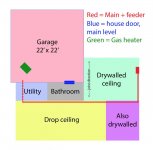
The existing main panel is located in a drywalled wall in the finished basement, 16' 8" directly across from the side garage-house wall. The space has a drywalled ceiling, part of which is 6.5" lower due the sunken living room above, and the joists are running perpendicular to a direct wire run. Both the garage and this space are in the front half of the house.
The back half of the basement is all drop ceiling and so is effectively open and accessible. There is actually a >6" wide space running along the center beam (so between the main ductwork and the beam itself) that already has several wires running along it. To get to this beam, one would have to go up the drywalled wall into the ceiling and back (parallel to the joists) 10', and once the wire has been run 30' across the house to the utility room, it's just 5' across the room and a few feet up the back of the garage wall that is shared with the house. The total wire run would be roughly 45' plus going up from panel to ceiling and going up from utility room ceiling / garage floor to subpanel in garage. This is the same path the three electricians said they would take, each saying they would use six-gauge wire.
I have run miles of low-voltage wire in commercial facilities, including through drop ceilings, and I've done enough drywall work to not be concerned about access or patching. So this wire run, so long as it's legal, which I presume it to be given that three licensed master electricians would do the same thing, is not going to be a problem for me. Additionally, I am assuming that involving a city code person and/or an inspector would alleviate any potential problems with legality or safety.
Subpanel placement:
The garage on the other side of the utility room and one level up. The rear wall of the garage is 22' long. If looking at the back of the garage from the inside, the utility room is on the right side, and the house door is on the left side. I am thinking a subpanel would go about three feet from the house door, meaning the wire would not only have to go up, but over a few feet as well. As I intend to hang a 45,000 BTU gas heater on the ceiling towards the right side of the space, I don't know if I can put a subpanel directly up from the utility room.
Other things:
I see the rest as needing to learn and understand the hookups as well as any potential rules and regulations dictating subpanel placement. It is also my understanding that I might need a torque wrench to torque one or more connections. It is only now that I am starting to read up on these things.
Questions:
Can or should I do this myself? Is there anything wrong with the feeder wire going out the side of the main panel, through a stud, and then up so that I don't have to pull out insulation foam around existing wires? How difficult is it to ensure that everything is done to code so that it passes inspection(s)? Is it odd for the feeder wire to go up into the garage wall and then over a few feet, through studs? Or would it have to either go up into the attic and then back down a few feet over or even in conduit on the surface of the drywall?
I've tried to be as comprehensive as possible here. I started thinking about this in December, and, as noted, I had three electricians in to provide quotes this past week.
Attached is a diagram and a few photos. I cannot link to a high-resolution photo yet, as I just joined and do not have the required five posts yet
My attached, two-car garage in my 1984-built home has one outlet in it, and I would like to install a subpanel so that I can run additional circuits for the purpose of woodworking. The immediate question is can or should I do this myself?
House main panel information:
The existing main panel is a Cutler-Hammer CH7CC, presumably original to the home, with a 100-amp main breaker and two of the 22 slots open. One breaker will have to be moved to install a new, two-pole breaker for a new subpanel in the garage. The breakers are CH, given the 3/4” width and tan handles. Two of the three licensed master electricians I had in this past week to provide estimates for the job ($2,200 - $2,600) said it is a very high-quality panel that will last for many more decades, additionally noting that it will not be a problem to install a few 20-amp circuits in the garage, even given the 2,300 sf home has central air, an electric clothes dryer, and an electric range. For woodworking, only a main tool and a dust collector would run at the same time. There is -- oddly -- spray foam around the panel. This was clearly added more recently, likely to keep out rodents or cold air. One electrician noted this, adding that it is unusual...but not bad for the wiring.
House main panel location and proposed wire run:
The existing main panel is located in a drywalled wall in the finished basement, 16' 8" directly across from the side garage-house wall. The space has a drywalled ceiling, part of which is 6.5" lower due the sunken living room above, and the joists are running perpendicular to a direct wire run. Both the garage and this space are in the front half of the house.
The back half of the basement is all drop ceiling and so is effectively open and accessible. There is actually a >6" wide space running along the center beam (so between the main ductwork and the beam itself) that already has several wires running along it. To get to this beam, one would have to go up the drywalled wall into the ceiling and back (parallel to the joists) 10', and once the wire has been run 30' across the house to the utility room, it's just 5' across the room and a few feet up the back of the garage wall that is shared with the house. The total wire run would be roughly 45' plus going up from panel to ceiling and going up from utility room ceiling / garage floor to subpanel in garage. This is the same path the three electricians said they would take, each saying they would use six-gauge wire.
I have run miles of low-voltage wire in commercial facilities, including through drop ceilings, and I've done enough drywall work to not be concerned about access or patching. So this wire run, so long as it's legal, which I presume it to be given that three licensed master electricians would do the same thing, is not going to be a problem for me. Additionally, I am assuming that involving a city code person and/or an inspector would alleviate any potential problems with legality or safety.
Subpanel placement:
The garage on the other side of the utility room and one level up. The rear wall of the garage is 22' long. If looking at the back of the garage from the inside, the utility room is on the right side, and the house door is on the left side. I am thinking a subpanel would go about three feet from the house door, meaning the wire would not only have to go up, but over a few feet as well. As I intend to hang a 45,000 BTU gas heater on the ceiling towards the right side of the space, I don't know if I can put a subpanel directly up from the utility room.
Other things:
I see the rest as needing to learn and understand the hookups as well as any potential rules and regulations dictating subpanel placement. It is also my understanding that I might need a torque wrench to torque one or more connections. It is only now that I am starting to read up on these things.
Questions:
Can or should I do this myself? Is there anything wrong with the feeder wire going out the side of the main panel, through a stud, and then up so that I don't have to pull out insulation foam around existing wires? How difficult is it to ensure that everything is done to code so that it passes inspection(s)? Is it odd for the feeder wire to go up into the garage wall and then over a few feet, through studs? Or would it have to either go up into the attic and then back down a few feet over or even in conduit on the surface of the drywall?
I've tried to be as comprehensive as possible here. I started thinking about this in December, and, as noted, I had three electricians in to provide quotes this past week.
Attached is a diagram and a few photos. I cannot link to a high-resolution photo yet, as I just joined and do not have the required five posts yet