To avoid these ads, REGISTER NOW!

Selecting the Best Mini Split System

To avoid these ads, REGISTER NOW!
OP
I

Idle Serge

Well-known member
Joined
Apr 28, 2014
Messages
272
Location
SE Washington State
My mini split came in :eek:

It came in one big package but the truck that delivered it didn't have a lift gate, therefore; I had my buddy back his truck in and we dropped it into the bed of his truck--we then opened the package and took it in a few pieces at a time.

Compressor and base/slap.


Indoor unit and Evap:


There were a few other pieces such as the hardware and some covers for the outside unit--overall: very well packaged!


I'll be honest--I didn't do a "write-up" type documentation based upon the fact that the instructions do a mighty fine job of instructing you in the correct path.

I did take a few pics regardless:

Lineset connections on outdoor compressor:


220V connection which comes from the INDOOR EVAP UNIT:


Inside unit installed--simple and easy! Screw bracket on then the evap hooks and clicks on to that bracket:


We were very limited on space and this was truly the only option we had to place is as everywhere else it was either too close to the doors and/or would be facing in the wrong direction, not utilizing the flow directed to the back rooms.

You can see it's very close to the natural gas fire place, therefore; we will either have to move the exhaust or wrap it to prevent it from damaging the evap--not that I think it'll get that hot but better to be safe. we have some time to decide as we wont be using the fire place in the near future lol


onto the outside--2 connections and we were done!


The wiring pigtail was a simple click :cool:


Slapped the covers on:


As it sits:


This was truly a simple and painless process! I do recommend having a few helping hands tho as you don't want to kink the lineset! But other then that, a 3" Hole Saw and a big enough drill to accommodate that and you're set to go with a trim knife, Phillips and and 1/2" socket for 4 bolts on the compressor to slap. PLUS the fact that you need to wire up a new 220V outlet from you panel box which I still need to have done :(

I will prob come back and get the covers for the lineset soon--but for now it don't look like too much of an eye sore.
 

JakeKohl

Well-known member
Joined
Feb 23, 2012
Messages
1,365
Location
Greenville, SC
Check your manual with regards to the recommended rear clearance for the outdoor unit. That looks much closer to the wall than I've seen most recommendations.

Also - what kind of connection was that for the line sets? It looks like some sort of quick disconnect. I haven't seen that before.
 
OP
I

Idle Serge

Well-known member
Joined
Apr 28, 2014
Messages
272
Location
SE Washington State
Check your manual with regards to the recommended rear clearance for the outdoor unit. That looks much closer to the wall than I've seen most recommendations.

Also - what kind of connection was that for the line sets? It looks like some sort of quick disconnect. I haven't seen that before.

I skimmed thru the manual as that was indeed one of my concerns, however; I didn't see any recommendations--I will continue to look tonight.

As for the connection, you are indeed correct. Thus far seems to be a solid connection.
 

ssbtech

Well-known member
Joined
May 1, 2012
Messages
420
Location
BC, Canada
220V connection which comes from the INDOOR EVAP UNIT:

So the outdoor unit draws power from the indoor unit? Main A/C runs to the evaporator and not the condenser?

Also what is the wiring from the panel to the system? It's 220V, but does it require a neutral?

The reason I ask is that I've heard that some systems don't require neutral. I'm thinking of a system for my condo and would re-use the electric baseboard heater wiring to avoid pulling a new 220v since that would require opening up many walls.
 
OP
I

Idle Serge

Well-known member
Joined
Apr 28, 2014
Messages
272
Location
SE Washington State
So the outdoor unit draws power from the indoor unit? Main A/C runs to the evaporator and not the condenser?

Also what is the wiring from the panel to the system? It's 220V, but does it require a neutral?

The reason I ask is that I've heard that some systems don't require neutral. I'm thinking of a system for my condo and would re-use the electric baseboard heater wiring to avoid pulling a new 220v since that would require opening up many walls.

I'm not very "electrician" savvy but this all I needed to buy to perform the final wiring: (plus the breaker which I already had and some staples--BUT we will redo the wiring as we needed to get it done ASAP since we have family from out of town coming in)


I believe the wiring was a 12X3 if I recall correctly--it did in fact have a ground.

Yes the outside unit draws power from the indoor evap. Uber easy install. Everything is pre-charged so all I did was use the quick connect and that was that.


Wuaname

Well-known member
Joined
Jan 28, 2014
Messages
601
Location
Florida
I read posts randomly on this thread so I might have missed my question.

Op, how much did that unit run you?:rocker:
 
OP
I

Idle Serge

Well-known member
Joined
Apr 28, 2014
Messages
272
Location
SE Washington State
I read posts randomly on this thread so I might have missed my question.

Op, how much did that unit run you?:rocker:

$1900 +100 bucks for misc 220V hook up so about 2k all said and done.


Update: Thus far it is keeping the entire house cooled! We are loving it--fairly quite and super COLD! :thumbup:
 

LS6 Tommy

Well-known member
Joined
Dec 27, 2013
Messages
26,162
Location
Northern NJ
Idle Serge, everything looks great, but if you haven't already done it I'd suggest rerouting the condensate drain line. The manufacturer's usually recommend running as short of a run as possible, preferably not running it horizontally for that far. It should just run straight down the outside wall.


Tommy
 
Last edited:
To avoid these ads, REGISTER NOW!

Tislane

Member
Joined
Mar 27, 2014
Messages
5
When you purchase air conditioning equipment through the internet some manufacturers void the warranty if not purchased from an authorized distributor or dealer. Some go further and void the warranty if not installed by an authorized dealer or installer.

I see this all the time, homeowner wants to save some money so they buy the equipment and install it, a part goes bad and the homeowner finds out their was no savings.

Go to the manufacturers website, read the small print, the installation manuals, and the warranty information before purchase. And finally, some websites claim to be authorized distributors and dealers when they are not, back-check through the manufacturers website.
 

NdTheriot3030

Member
Joined
Jun 10, 2015
Messages
5
Your post on the Friedrich Breeze is great, thanks for the pictures and the write-up, great help.
Questions:
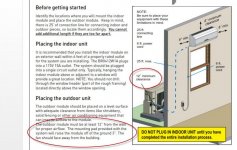
1) In the Friedrich Breeze Installation Video it shows the coolant lines coming out the back to the Air Handler, immediately taking a 90 degree turn, running along the back of the unit in a trough, then turning 90 again to go outside. Do you see any reason why the lines can't just go right out the back of the unit to outside without making that 1st turn and running along to back?
2) I am doing a new construction installation, is there any reason why one wouldn't want to run the coolant lines inside the wall and turning 90 to go outside at the compressor level, to hide the lines rather than have them exposed on the outside of the bldg.?

Thanks,
The Riot
 
OP
I

Idle Serge

Well-known member
Joined
Apr 28, 2014
Messages
272
Location
SE Washington State
Your post on the Friedrich Breeze is great, thanks for the pictures and the write-up, great help.
Questions:
1) In the Friedrich Breeze Installation Video it shows the coolant lines coming out the back to the Air Handler, immediately taking a 90 degree turn, running along the back of the unit in a trough, then turning 90 again to go outside. Do you see any reason why the lines can't just go right out the back of the unit to outside without making that 1st turn and running along to back?
2) I am doing a new construction installation, is there any reason why one wouldn't want to run the coolant lines inside the wall and turning 90 to go outside at the compressor level, to hide the lines rather than have them exposed on the outside of the bldg.?

Thanks,
The Riot

I sent you a PM! :thumbup:
 

NdTheriot3030

Member
Joined
Jun 10, 2015
Messages
5
Thank you ! Sorry for the duplicate, I'm just learning to use the GJ site and still stumbling around a bit.
The reason we want to run inside the wall is coming from my builder, he doesn't like the idea of have the line exposed on the exterior, thinks it will look bad.

Your help is very much appreciated.
 

miketyler

Well-known member
Joined
Sep 10, 2009
Messages
635
Location
Cedar Hill, TX
Interested in the response on this. I like a clean looking install as much as the next guy. The benefits of running inside are better protection and added insulation. The down side might be no access for inspection and possibility of leaking or dripping condensation inside the structure leading to mold or other problems down the road.
 

Fueler

Well-known member
Joined
Jun 22, 2006
Messages
1,620
Location
Urbana, IL
Thank you ! Sorry for the duplicate, I'm just learning to use the GJ site and still stumbling around a bit.
The reason we want to run inside the wall is coming from my builder, he doesn't like the idea of have the line exposed on the exterior, thinks it will look bad.

Your help is very much appreciated.
I went through the same dilemma.
Inside walls.
Pros:
Hidden
Cons:
1: Expensive do over if a problem arises.
2: Someone could drive a nail into the tubing unknowingly
3: Always a potential for condensation sweat, even with the insulation
4: 2 holes to worry about.
5: Tight bends in making the turn from the inlet, up the wall and so on.
6: If you look at how the inside unit is installed I think it's going to be a ***** to do the hidden unit.
7: Edit: Just thought of more awkward problem. You would have to drywall where the inside unit is in 2 pieces and then you have to paint around it. Kind of a ship in a bottle routine.
8: Because of the tight turn down in the wall there will be NO removing of the inside unit for repair or replacement. That is a kill right there.

Outside:
1: Easy access with only 1 point of access to worry about.
2: Simpler, less expensive by time installation. If the outside unit is mounted up on the wall and I think it should be, the lineset is short.

I chose exterior. Using lineset covers makes it look no worse than a downspout. Actually it looks better than a downspout. You won't even notice it after a week. Paint to match if you like.
Google mini split installation photos for ideas. There are also a whole mess of installation videos to get ideas and insight from.
 
Last edited:

finn

Well-known member
Joined
Mar 27, 2005
Messages
16,187
Location
The UP, God's country
I wouldn't be afraid of the minor brands for use in a small space as you describe. Make sure you get an inverter, then narrow the search by price and efficiency.

You don't plan to live there forever, and sound level isn't very important in a garage environment. If a cheap unit goes bad in five or ten years, you can replace it with another cheap unit with then current technology, and have use of your "saved" money in the meantime. I also suspect competition and widespread acceptance will drive costs down with time

I have a Mitsubishi, which I like, but I also think it was overpriced for what it is.
 

bazar01

Well-known member
Joined
Jan 30, 2009
Messages
326
Location
Leesburg, GA
I wouldn't be afraid of the minor brands for use in a small space as you describe. Make sure you get an inverter, then narrow the search by price and efficiency.

You don't plan to live there forever, and sound level isn't very important in a garage environment. If a cheap unit goes bad in five or ten years, you can replace it with another cheap unit with then current technology, and have use of your "saved" money in the meantime. I also suspect competition and widespread acceptance will drive costs down with time

I have a Mitsubishi, which I like, but I also think it was overpriced for what it is.

Makes sense.
If I can get >five years from my cheap $500, 1-ton inverter unit, I'll be happy.
In another five years, technolgy and competition will drive the prices down and I will just buy another high efficiency unit to replace it.
 

CA_Tallguy

Well-known member
Joined
Sep 4, 2014
Messages
120
7: Edit: Just thought of more awkward problem. You would have to drywall where the inside unit is in 2 pieces and then you have to paint around it. Kind of a ship in a bottle routine.

One trick I saw on youtube when watching an install on bare framed walls is that you can put a piece of drywall in behind the inside unit while installing it so you don't have to worry about trying to finish around it later.
 

CA_Tallguy

Well-known member
Joined
Sep 4, 2014
Messages
120
One brand folks might want to consider is Gree -- they claim to be the worlds largest air conditioner manufacturer and make 1/3 of all the (home?) air conditioning units in the world. I believe they make units branded for other companies too. One spec document that I was looking at last night said they were using Mitsubishi compressors in those particular units. Pricing is very good on these and if I end up going with a discount brand I feel better about going with them because they are such a big company. Apparently these units are widely available so parts and service *might* be easier should the need arise.
 

Fueler

Well-known member
Joined
Jun 22, 2006
Messages
1,620
Location
Urbana, IL
One trick I saw on youtube when watching an install on bare framed walls is that you can put a piece of drywall in behind the inside unit while installing it so you don't have to worry about trying to finish around it later.
Yup, that's what I was referring to. Still seems like bad planning.
 

tmcdonal

Well-known member
Joined
Jan 8, 2013
Messages
62
Location
San Antonio, TX
Also, this particular unit has a fixed 25 foot line. That would likely be awkward to route in between studs and make the condensate line work.

-Tom
 
To avoid these ads, REGISTER NOW!
Top Bottom