TDabney
Member
Hello,
I'm looking for additional guidance on dealing with the concrete slab floor in my (new to me) shop. The slab isn't in as bad a shape as the one in this recent thread: http://www.garagejournal.com/forum/showthread.php?t=192322 but I haven't completely ruled out removing it and pouring a new one either.
The floor is about 1,100 sq.ft. and divided into 6 separate squares. It's big enough that removing it and pouring a new slab is not a trivial expense and big enough that tiling is significant $$ too.
To start with, it was filthy, so I started another thread about cleaning it here: http://www.garagejournal.com/forum/showthread.php?t=191010 ... I spent an entire day with a pressure washer and a few different detergents cleaning and scrubbing every sq. inch, with poor results - I barely made a dent in the oil/diesel/grime stains.
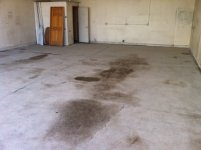
So last week, I paid to have it ground down. My hope was that by having it ground, a lot of the oily, stained top layer would be ground off and the process would also help flatten the high/low spots. I also was thinking that it would be a necessary step anyway if I decided to do an epoxy coating. The end result - It was quite successful in cleaning the stains, but less successful in leveling the high/low spots.
So as it sits now, visually, the ground concrete is 100% acceptable to me. What is still a concern is the waviness - there are many high/low spots with maybe the worst dip being almost 1/8" plus or minus. These are not gradual, but can be found with a 6' long straight edge. I feel like that it's JUST bad enough that it will bug me every time I walk in the door and especially when I need to have a large flat area to weld something big or do an alignment on my track car where having a flat surface to start from makes it so much easier etc...
I have been trying to find a local contractor that has experience with self-leveling polymer-modified overlays, but have come up empty so far. How do these toppings hold up in a shop-type environment? I have a few large items on casters that I plan to wheel around the shop - like car tubs on dollies and a Celette bench which is big and very heavy. Am I asking for trouble down the road by considering using an overlay? Here's one produce I've found, MG-Krete: http://www.imcotechnologies.com/us/floorresurfacing.html
I was originally thinking that I'd leave the floor as bare concrete, maybe with some type of sealer applied. If an overlay is appropriate and recommended, I'd consider a high quality epoxy coating the floor so the finish is uniform and cleaner looking. Might this also help seal the edges of the topping slab?
I think I'll stop my ramblings here for now...
Thanks,
Tom
I'm looking for additional guidance on dealing with the concrete slab floor in my (new to me) shop. The slab isn't in as bad a shape as the one in this recent thread: http://www.garagejournal.com/forum/showthread.php?t=192322 but I haven't completely ruled out removing it and pouring a new one either.
The floor is about 1,100 sq.ft. and divided into 6 separate squares. It's big enough that removing it and pouring a new slab is not a trivial expense and big enough that tiling is significant $$ too.
To start with, it was filthy, so I started another thread about cleaning it here: http://www.garagejournal.com/forum/showthread.php?t=191010 ... I spent an entire day with a pressure washer and a few different detergents cleaning and scrubbing every sq. inch, with poor results - I barely made a dent in the oil/diesel/grime stains.
So last week, I paid to have it ground down. My hope was that by having it ground, a lot of the oily, stained top layer would be ground off and the process would also help flatten the high/low spots. I also was thinking that it would be a necessary step anyway if I decided to do an epoxy coating. The end result - It was quite successful in cleaning the stains, but less successful in leveling the high/low spots.
So as it sits now, visually, the ground concrete is 100% acceptable to me. What is still a concern is the waviness - there are many high/low spots with maybe the worst dip being almost 1/8" plus or minus. These are not gradual, but can be found with a 6' long straight edge. I feel like that it's JUST bad enough that it will bug me every time I walk in the door and especially when I need to have a large flat area to weld something big or do an alignment on my track car where having a flat surface to start from makes it so much easier etc...
I have been trying to find a local contractor that has experience with self-leveling polymer-modified overlays, but have come up empty so far. How do these toppings hold up in a shop-type environment? I have a few large items on casters that I plan to wheel around the shop - like car tubs on dollies and a Celette bench which is big and very heavy. Am I asking for trouble down the road by considering using an overlay? Here's one produce I've found, MG-Krete: http://www.imcotechnologies.com/us/floorresurfacing.html
I was originally thinking that I'd leave the floor as bare concrete, maybe with some type of sealer applied. If an overlay is appropriate and recommended, I'd consider a high quality epoxy coating the floor so the finish is uniform and cleaner looking. Might this also help seal the edges of the topping slab?
I think I'll stop my ramblings here for now...
Thanks,
Tom