To avoid these ads, REGISTER NOW!

Service Pit Cap

isb cornbinder

Well-known member
Joined
Nov 3, 2010
Messages
7,073
Location
Pacific South West, BC, Canada
The building code in this area requires a pit, used or not used to have monitored ventilation. If the pit is permanently out of service. the pit must be filled and capped with concrete. There is the real hazard of heavier than air combustible fumes collecting in the pit and exploding when in contact with an ignition source.
The city will not issue a permit to build an inspection pit in a domestic garage. The retired fire-fighter in the next block told me is was not uncommon for his crew to attend a situation where the contents of an old pit contributed to an explosion and fire. He said a few of these events contributed to the death of a person.
 
Last edited:
To avoid these ads, REGISTER NOW!

Old Man Roger

Well-known member
Joined
Apr 6, 2017
Messages
17,656
Location
Palm Coast Florida
If you ever want to jack a car up using a floor jack, make sure it will support that. I would think you would want to keep the pit, considering your lift only goes 4 feet up. Hell, I'd consider moving the lift over the pit.
 

Monza Harry

Well-known member
Joined
Dec 29, 2018
Messages
1,433
Location
Windsor ON
I've seen many car trailers with a 2' x 2' structure covered with 3/4" Ply' (PT), while that is a little springy for my liking, 2x6's on the same structure were extremely adequate. Add some sheet metal [16 or at least 18 Ga. will be fairly dent resistant and leak proof. 2x6 on edge [16" OC] with ply' and some metal @ 2' or 3' [32" is 6 panels] length will be heavy enough, remember you sound young now but "that to shall pass". I'm closing in on 60 yrs. and while still strong I'm not what I used to be and now everything hurts, so while I can lift things, I am usually reminded [the next couple of days] that it was a "BAD IDEA" after the fact. You could add a solar powered fan for nearly continuous evacuation. That will be another maintenance item to take care of though (fan{s}/heat exchanger/battery/vent-intake flaps etc.). Harry
 

scottydosnntkno

Well-known member
Joined
Aug 8, 2010
Messages
670
Different how? I just re-ran the numbers on AWC's site:
https://www.awc.org/codes-standards/calculators-software/spancalc

2x4 doug-fir, stud grade, 100PSF live, 20PSF dead, 16" OC, L/720 deflection, works out to 3' 4" maximum span. So yeah, you can EASILY drive on this if you did it with 2x4's.

A more realistic use of 2x4, L/360, 40PSF live, 10PSF dead gives you a maximum span of 5' 2". So, even if this trench were 2' wider, you could still cover it on 2x4's and drive on it!
Not sure where your getting your 40psf for a garage from. 40psf is standard for living space but not garages.

Let’s take my truck, a lifted megacab ram. It weighs about 9600lbs depending on what’s in the bed at the time. Split over four wheels that’s 2400 lbs per wheel. One wheel has less than 1sq ft of contact patch. So that one wheel would need to touch 24 sq ft, or the whole truck 96 feet (larger than his entire pits area).

Vehicles apply point loads, you can’t treat it the same as living space floor loads
 
OP
M

MattRMagnum

Well-known member
Joined
May 10, 2012
Messages
225
Location
PNW
The building code in this area requires a pit, used or not used to have monitored ventilation. If the pit is permanently out of service. the pit must be filled and capped with concrete. There is the real hazard of heavier than air combustible fumes collecting in the pit and exploding when in contact with an ignition source.
The city will not issue a permit to build an inspection pit in a domestic garage. The retired fire-fighter in the next block told me is was not uncommon for his crew to attend a situation where the contents of an old pit contributed to an explosion and fire. He said a few of these events contributed to the death of a person.

Hm, this very much changes the potential complexity of using it for things. I think a vent system would be fairly straight forward (low power fan pushing air towards one end that has an exhaust system built into it), but it's an additional cost for keeping it... though I couldn't find a concrete company that wanted to fill my pit (construction is booming and it's a small job), which means I'd probably have to do it myself.
 

James-W

Well-known member
Joined
Feb 3, 2013
Messages
12,432
Location
Southeastern Wisconsin
Many years ago service pits were common. These days, with all the new laws we have concerning things like service pits, I am not even sure it is something you can have in your garage. Even if you are able to use it, I suspect that regardless whether you use it as a service pit or as storage space, you would have to meet a very strict set of guidelines in order to make it legal. If you don't care if it is legal or not then I guess it wouldn't matter, at least until you tried to sell the place and then you may have a problem.

If it were mine I would fill it in with sand and concrete over the top of it. If you need more storage space, add on to the garage, or add a second floor to the garage. In my opinion, what you are thinking about doing is not an idea that will be in your best interest as time goes on. I think it will turn out to be expensive long term and it won't be as nice as you thought it would be. That is my opinion, take it for what it is worth.
 

c39er

Well-known member
Joined
Mar 23, 2008
Messages
1,663
Location
Seattle, Washington
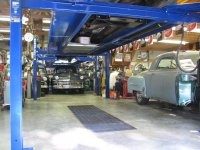
I have a nice shop pit under one of my high lift 4 post lifts.
3' X 12' with four heavy grates 3' X 3'. love it.
 

Attachments

  • Shop and lifts Oct 17 2010 (14).JPG
    Shop and lifts Oct 17 2010 (14).JPG
    141.8 KB · Views: 56
To avoid these ads, REGISTER NOW!

coljar

Well-known member
Joined
Sep 26, 2010
Messages
6,244
Location
Belpre, Ohio
I used 2x6 tongue and groove lumber held together with 2x4's and deck screws in 3 ft. sections setting on 2" angle iron. Works great.
 

rust in the eye

Well-known member
Joined
Oct 2, 2017
Messages
2,795
Location
Chicagoland
Geez people. We have one person recommending he fill the hole with nothing by 6x6's, and you're calling for 2x6 spaced 12" OC.

Consulting a span table, 2x6 (stud grade; so the **** of the ****) spaced 16" OC can support 100 PSF live plus 20PSF dead load over a 5' span with a L/720 deflection (way more than good enough for a plaster ceiling underneath), and he only has a 3' span (which basically falls off the charts for a 2x6 joist, because 2x6 is so ludicrously overkill). Passenger vehicle parking garages only need a 40PSF rated floor, so are we planning to park armored vehicles over this pit?

The floor is supposed to be non-combustible, so if you do use wood, consider treating it with fire retardant or at least paint.
RE 40PSF floor; Wouldn't this be for a concrete floor, sitting on earth?
If you do the math for weight of a vehicle and tire contact patch size it will work out well in excess of that. I've had my foot run over and can attest to significantly more than 40# on MY foot.
Not knowing the OP's layout there might not even be a consideration for the vehicle weight as it'll never drive on it, just over it. So, building a cover over a hole that I can walk on or building a bridge?
Regarding lumber dimension; Wood is cheap, today's lumber is ****. Over build it and if too heavy make it in sections.
My $.02
 
Last edited:

rlitman

Well-known member
Joined
Oct 18, 2010
Messages
24,620
Location
Long Island
RE 40PSF floor; Wouldn't this be for a concrete floor, sitting on earth?
If you do the math for weight of a vehicle and tire contact patch size it will work out well in excess of that. I've had my foot run over and can attest to significantly more than 40# on MY foot.
Not knowing the OP's layout there might not even be a consideration for the vehicle weight as it'll never drive on it, just over it. So, building a cover over a hole that I can walk on or building a bridge?
Regarding lumber dimension; Wood is cheap, today's lumber is ****. Over build it and if too heavy make it in sections.
My $.02

Contact patch has NOTHING to do with live load in PSF.

Start by reading this:
https://www.parking.org/wp-content/uploads/2016/01/TPP-2013-03-Garages-are-for-Parking.pdf
They figure that a 2010 Cadillac DTS with five passengers works out to 31PSF. So yes, parking garages are often designed around 40PSF live load. That's all that code calls for.

Next, re-read my post. 40PSF is plenty. But across that 3' span, you could probably get that with 2x2 lumber to get 40PSF. Really! The tables I consulted top out at 100PSF live + 20PSF dead, and even at L/720 deflection (which is ludicrous, because there's no plaster ceiling under this, so L/240 deflection would be just fine), 2x4's are still off the charts for such a short span.

Yes, contact patch is important. But the contact patch is supported by the plywood, and 3/4" ply can easily hold a tire. From there, the load is spread across the joists, and that's where the PSF comes into play.

As for "****" lumber, I used "stud" grade lumber in the span tables. That accounts for the lumber being **** for joist purposes. Select lumber (and engineered lumber) allows for much longer spans.
 
OP
M

MattRMagnum

Well-known member
Joined
May 10, 2012
Messages
225
Location
PNW
I have to say, I'm impressed by the amount of knowledge poured into mathing out exactly what it would take to make this driveable, but yeah, guys: the pit is narrow enough neither of the vehicles I'm thinking of parking there will ever drive onto it. They'll just drive on either side of it.

My garage doesn't have a lot of storage space, and so sealing the pit completely would cost me a lot of usable area. It's only 30' deep, and when you add 2 vehicles that're 20+ feet long, and the middle bay being totally empty to account for a lift (lift is offset from the other two vehicles so that you can still get into/out of all vehicles easily), the amount of space to use for tools/equipment/parts storage rapidly disappears.

As for ventilation, I already need to buy a fan to run when moving vehicles onto/off the lift, since the ceiling* that's left up does a good job of holding the exhaust fumes, it seems, and I have bigger priorities around the garage then taking it down.

I'm thinking I'll get something like this, and leave the ductwork plumbed into the pit, and then just turn it on from time to time to force clean air through there. If I'm really feeling ambitious, maybe get two: one intake, one exhaust.

https://www.ebay.com/itm/12-Extract...-Duct-Hose-High-Rotation-exhaust/263247113366


* It's foil-wrapped styrofoam leftover from the previous owner.
 

rsanter

Well-known member
Joined
Dec 22, 2007
Messages
18,521
Location
visalia ca
If it was me I would buy some 1/4” diamond plate.
I would add some 2x3 angle iron bracing welded under it.
Have the diamond plate extend Over the edge 2” on each side.
Make the angle iron the width of the opening so that it prevents the plates from moving.

Make the plates in 3’ to 4’ sections so that can be moved one section at a time.

Cove the hole with that
 

scottydosnntkno

Well-known member
Joined
Aug 8, 2010
Messages
670
Contact patch has NOTHING to do with live load in PSF.

Start by reading this:
https://www.parking.org/wp-content/uploads/2016/01/TPP-2013-03-Garages-are-for-Parking.pdf
They figure that a 2010 Cadillac DTS with five passengers works out to 31PSF. So yes, parking garages are often designed around 40PSF live load. That's all that code calls for.

Next, re-read my post. 40PSF is plenty. But across that 3' span, you could probably get that with 2x2 lumber to get 40PSF. Really! The tables I consulted top out at 100PSF live + 20PSF dead, and even at L/720 deflection (which is ludicrous, because there's no plaster ceiling under this, so L/240 deflection would be just fine), 2x4's are still off the charts for such a short span.

Yes, contact patch is important. But the contact patch is supported by the plywood, and 3/4" ply can easily hold a tire. From there, the load is spread across the joists, and that's where the PSF comes into play.

As for "****" lumber, I used "stud" grade lumber in the span tables. That accounts for the lumber being **** for joist purposes. Select lumber (and engineered lumber) allows for much longer spans.
Contact patch has everything to do with it in this case.

Comparing a parking garage to a home garage is literally apples to oranges.

The entire point of that article and design considerations is that for every foot of space on the ground the structure has to hold 40lbs plus the weight of itself. Because cars can never cover every square foot. So they’re example of a car being 5000lbs and a psf weight of 31 is true, if you spread that 5000lbs over 161 sq ft (area of the car). But again, this is only relevant to that article in that people have a density much higher that 40lbs a ft, so parking garages aren’t designed to hold that much weight.

But that same Cadillac would have contact patch weight of somewhere around 1800lbs/sq ft assuming an 8x8 contact patch. I would love to see you try and drive a that over a 2x2 and 3/4 plywood cover. You would instantly crack it.

Or like I said before look at my truck with a contact patch of 2600 lbs. if I were to put a piece of plywood on the grass and drive over it, it would most certainly crack (been there done that).

Looking at a typical 2x12x12’, it can hold 180lbs/ft or 2100lbs evenly distributed. But if you put a 2100 lb point load directly in the center it would snap. Overall design loads and individual point loads are two different things. I guarantee that parking structure is designed for point loads much higher (clearly) that 40/sq ft.

Live loads and point loads are two different things.

Let’s say we make your 2x2 plywood structure in a 3x4’ section. That’s 12 ft, so it could hold 480 lbs evenly distributed. You drive that Cadillac tire over it at 1600lbs and it’s snap instantly. That one tire applies over three times the total capacity of that cover.

Do you see it now? Garages are designed for much higher point loads the. Their live loads. Hence why concretes 3-5000psi not 40psi
 

lakeroadster

Well-known member
Joined
Jan 19, 2015
Messages
5,166
Location
Central Colorado
..... I'm thinking I'll get something like this, and leave the ductwork plumbed into the pit, and then just turn it on from time to time to force clean air through there. If I'm really feeling ambitious, maybe get two: one intake, one exhaust.

https://www.ebay.com/itm/12-Extract...-Duct-Hose-High-Rotation-exhaust/263247113366

The fan you linked to is not suitable for explosive vapors.. it's noted as such:

"Note: this fan is for extracting air, Then it is not suitable for extracting explosive dust or fumes."
 

lakeroadster

Well-known member
Joined
Jan 19, 2015
Messages
5,166
Location
Central Colorado
... Do you see it now? Garages are designed for much higher point loads the. Their live loads. Hence why concretes 3-5000psi not 40psi

Ever looked at a car hauler trailer? It has wooden boards over a steel ladder type structure and holds the weight of vehicles just fine.

I ran the numbers before I made post no. 8... it will support the weight of a full size 1/2 ton Silverado pickup rolling over it.

I agree with the fella's saying to use wood.

As Eddie mentions 4 ft sections allows removal of however much space you need, rather than the entire 16 ft. If it were mine I'd build a sub structure to bring the boards up flush with the floor.

Something like shown below:

attachment.php
 
Last edited:
To avoid these ads, REGISTER NOW!
Top Bottom