To avoid these ads, REGISTER NOW!

Setup blocks for woodworking-What style do you like?

To avoid these ads, REGISTER NOW!

niget2002

Well-known member
Joined
Oct 2, 2012
Messages
11,265
Location
Josephine, TX
I use a tape measure, then I cut scrap pieces until the fit is perfect.

I have considered the second style. But my boards are never perfect width, so all they'd do is replace the tape measure for the first part of the setup. I'd still cut scrap pieces for final depth.
 

Spud McGee

Well-known member
Joined
Apr 11, 2022
Messages
405
If I need to adjust a saw or stop, I will either use my workpiece to set the saw, or a set of calipers.
For a repeatable stop, I use the magnetic base from harbor freight. Flip a switch, and it turns into a magnet that will stick very well to your cast iron table saw top for a stop block. Flip the switch again, and its no longer a magnet.

For setting table saw and miter saw blade tilt, I use a magnetic angle gauge. Set it on the saw, zero it, stick it to the blade, and then adjust your blade till its at whatever angle you want. Way more accurate than using the number sand tick marks that come on the saw.
 
OP
R

Richard D

Well-known member
Joined
Jan 19, 2007
Messages
1,923
Location
Texas City, between Houston and Galveston
So those are more of a gimmick? I have calipers, indicators, etc. with my metalworking/machining tools. I’m not really new to woodworking per se, but I am new to precision woodworking. I’m just tooling up now, actually getting some budget friendly but well reviewed stuff for now to see if I will really stick with it.
 

Cc_windsurfer

Well-known member
Joined
May 1, 2015
Messages
260
Location
SB, ca
I use a marking gauge and scribe. For most woodworking exact dimensions are not important (because the wood changes with humidity) matching sizes and fitting the joinery is what matters.
 

strutaeng

Well-known member
Joined
Dec 12, 2011
Messages
2,294
Location
Dallas, TX
I've always just used a combination square as a guage for things like setting up depth of router bit, table saw height, etc.

I mean, the blocks are nice to have, but not absolutely necessary. I've done plenty of woodworking with power tools and have even done hand-cut joinery like mortise and tenon and dovetails.
 

jar944

Well-known member
Joined
Jul 26, 2010
Messages
5,967
Location
Northern VA
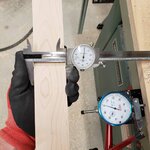
Sometimes you want a exact size, the actual size isn't important but you want it within a couple thousands.
IMG_20200203_195427_314 (1).jpgIMG_20200203_195427_305.jpg

I might want a groove 0.477" wide and 0.210" deep. Blocks wouldn't work in that situation but a set of calipers will.
 

LeeG

Well-known member
Joined
Nov 29, 2012
Messages
1,532
Location
Phoenix, AZ
I have both sets, and calipers, micrometers, and a bunch of other metrology stuff.
I like the first set for quick, repeatable setups to standard sizes (think gauge blocks for woodworking). I use them mostly when I want a spacing repeated - stack several together to get your spacing, then index off them.

The thing you can do with these blocks that you can’t easily do with most other measuring devices is test the fit. If I want a specific “feel” to a fit, I can use a stack of blocks to do that.

Lee
 

Stuart in MN

Well-known member
Joined
Sep 8, 2005
Messages
23,187
Location
Minneapolis
They appear to be a woodworker's version of the Johansen block sets that machinists use. I haven't seen them before but they seem like a good idea if you need precise measurements, with calipers or micrometers there's always the chance of making errors.
 
To avoid these ads, REGISTER NOW!

PoorUB

Well-known member
Joined
Mar 29, 2021
Messages
11,730
Location
Fargo, ND
I have never used setup blocks. I just cut a piece of scrap and verify that its is cutting the way I want and would still be doing that with blocks.

Perhaps I am missing something!
 

2Fast

Well-known member
Joined
Mar 20, 2020
Messages
248
Location
Southwest
OP the ones in your second photo can be used for a variety of different things. What makes them convenient is the easy repeatability. Setting up the depth of cut for a router bit or how far away to set the fence. Setting the depth of cut for a table saw blade, etc. Setting up the fence to be a certain distance from the blade (table saw, bandsaw, etc) and you can move the fence and come back and with the block get the same size. The list goes on.

Setup blocks like story sticks help eliminate errors because you read the tape measure wrong, or whatever wrong
 

Jgaz

Well-known member
Joined
Dec 16, 2016
Messages
1,713
Location
AZ
I also use dial calipers, rules, etc.and but have found these useful at times.
IMG_3493.jpeg

This height gage I use occasionally for old times sake.
I made this on a non DRO, hand cranked, Bridgeport for metal shop class in 1974.
And yes, it is accurate to a couple of .0001.

Both sides shown
IMG_3491.jpegIMG_3490.jpeg
 

Jackfre

Well-known member
Joined
Dec 26, 2010
Messages
4,417
Location
N CA
We just downsized and I had to finally go through my tool boxes and thin the herd. You just look at things that seemed such a good idea and wonder what the hell you were thinking. As you are capable mechanically I’d suggest that yoou work the core tools pretty hard and be skeptical of add ons because they looked good. It is really easy to end up working for your tools rather than the tools working for you.
 

bdbecker

ALLIANCE MEMBER
Joined
Nov 18, 2015
Messages
5,584
Location
Iowa
I received a set of brass blocks similar to the first link as a gift awhile ago. While they can be handy, I either forget I have them, or I'm working with odd dimensions and just end up using a calipers or combo square. For the price, it's worth having a set floating around, but it's not a necessity in my opinion.

If you don't have one, I'd highly recommend picking up a 4-6" combo or double square, even if you already have a 12". I find myself reaching for that more than any other measuring tool (besides a tape measure).
 
To avoid these ads, REGISTER NOW!
Top Bottom