DocsMachine
Well-known member
- Joined
- Sep 16, 2006
- Messages
- 1,917
Just finished my shop airline install and compressor relocation project. 
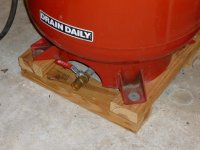
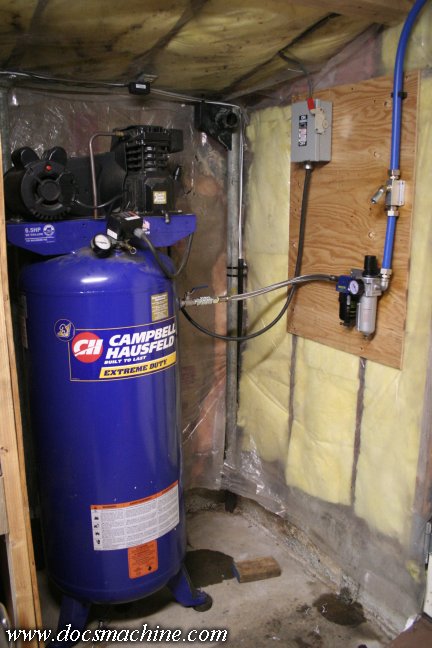
Plumbed the main shop (2 car bays) and side machine room with eight drops all told, with a total of 11 QD connections, all run off a 60-gal CH upright. I moved it out of the main shop and into a side storage room, which made it a LOT quieter.
While I had the tank emptied to replumb the connections, I of course popped open the inspection cap and had a look inside. It was rustier than I'd hoped to see, of course, but from what I could see, it didn't look "dangerously" rusty. I also don't get like rust flakes and whatnot out with the drain water either.
I bought this thing in '98, so it's past 20 years old. Question one is, with relatively mild use (I don't paint cars and only use air tools sporadically, half the connections I put in are just for blowguns at the machine tools) and regular water draining (which I've always tried to do) what sort of life expectancy can a compressor like this have?
Should I start thinking about replacing it, or at least getting a new tank? Or just "monitor the situation" for another 5 to 15 years.
Question two is, along that note, does anyone know if Eastwood is planning an upright/60-gal version of that quiet scroll compressor? Kinda moot for me at the moment, as the move quieted it down substantially, but I'd be curious to know, anyway.
Question three, I've always been curious why somebody hasn't come up with a way to coat or seal the inside of a compressor tank, to prevent rust in the first place. Only good reason I can see- and it likely IS a good one- is that if the coating somehow cracks or chips, rust starts as a point, leading, I think, a lot quicker to a "point failure", rather than a more uniform, widespread coating.
Still seems odd somebody hasn't come up with something- an epoxy coat, or hot-galvanized, or something, to make an extra-long-life tank.
And going off that idea, question four is, has anyone given any thought to periodically treating or protecting the tank? Like emptying it, letting it dry completely inside, and coating the inside with something like Ospho? (Chemical rust converter.) How about Waxoyl?
Doc.
Plumbed the main shop (2 car bays) and side machine room with eight drops all told, with a total of 11 QD connections, all run off a 60-gal CH upright. I moved it out of the main shop and into a side storage room, which made it a LOT quieter.
While I had the tank emptied to replumb the connections, I of course popped open the inspection cap and had a look inside. It was rustier than I'd hoped to see, of course, but from what I could see, it didn't look "dangerously" rusty. I also don't get like rust flakes and whatnot out with the drain water either.
I bought this thing in '98, so it's past 20 years old. Question one is, with relatively mild use (I don't paint cars and only use air tools sporadically, half the connections I put in are just for blowguns at the machine tools) and regular water draining (which I've always tried to do) what sort of life expectancy can a compressor like this have?
Should I start thinking about replacing it, or at least getting a new tank? Or just "monitor the situation" for another 5 to 15 years.
Question two is, along that note, does anyone know if Eastwood is planning an upright/60-gal version of that quiet scroll compressor? Kinda moot for me at the moment, as the move quieted it down substantially, but I'd be curious to know, anyway.
Question three, I've always been curious why somebody hasn't come up with a way to coat or seal the inside of a compressor tank, to prevent rust in the first place. Only good reason I can see- and it likely IS a good one- is that if the coating somehow cracks or chips, rust starts as a point, leading, I think, a lot quicker to a "point failure", rather than a more uniform, widespread coating.
Still seems odd somebody hasn't come up with something- an epoxy coat, or hot-galvanized, or something, to make an extra-long-life tank.
And going off that idea, question four is, has anyone given any thought to periodically treating or protecting the tank? Like emptying it, letting it dry completely inside, and coating the inside with something like Ospho? (Chemical rust converter.) How about Waxoyl?
Doc.