To avoid these ads, REGISTER NOW!

Several Issues Related to Heating a Garage

wacomme

Well-known member
Joined
Feb 1, 2012
Messages
152
Location
Colorado Springs, CO
I have an attached one-car garage with a high efficiency furnace located in the garage. I believe all of the vents from the furnace enter and exist through roof vents.

For the past few winters I get a lot of condensation on the inside of the garage door when it's below freezing outdoors at night. This creates a dripping mess when the garage door is raised and has also created a mold issue on the one wall that is not insulated or drywalled (the wall is an outside wall). Trying to determine the source of the condensation, or where the humidity is coming from, has been problematic. Is it coming directly from the furnace? Is it coming from the door to the house (I live in Colorado and we have a humidifier to keep our house about 40% humid - perhaps too high as our house windows also have some condensation on cold nights). Is there another humidity source that's causing condensation on the garage door.

Anyway, it's been suggested that I: 1) Insulate the garage by finishing the garage's open frame wall with insulation and drywall (all other walls and ceiling are drywalled); 2) Install a 240v electric heater in the garage if insulating the garage does not solve the garage door condensation problem.

Is this a good plan? Are there other sources for the apparent humidity in the garage? The garage door itself it apparently insulated. Should I add more insulation to it? Do I need to reseal the garage/house door? I don't see any gaps around outside of the door. Any other consideration?

On a slightly different topic, is a 240v electric heater the best way to heat the garage? Besides the dripping garage door issue, I use the garage, when my wife isn't parking her car in there, as a gym. In the winter a little heat is nice. Perhaps a 110v, 1500w electric heater will suffice when I insulate the uninsulated wall, but right now a 110v heater isn't warm enough when the outside temperature dips below the twenties. I would need to get an electrician to install a 240v outlet in the garage if I need something more powerful. I also read about ventless propane heaters, but is this really a good idea?

Thank you.

Michael
 
To avoid these ads, REGISTER NOW!

gmcgeo

Well-known member
Joined
Mar 11, 2019
Messages
3,701
on the subject of the vent less propane heater, this will add to your moisture problem.

for every gallon a vent free propane heater burns it puts 1 gallon of water vapor in your building.

I don't know what's contributing to your moister problem but don't add vent free in there
 

HoosierBuddy

Well-known member
Joined
May 9, 2006
Messages
2,927
Location
Southern Indiana
Is it possible that what you describe as a "High Efficiency Furnace" is actually a ventless garage heater?

If "YES" that is the source of your humidity. The primary products of combustion for natural gas (or) propane and air are CO2 and Water vapor. If it's actually a FURNACE, it will have a flue that take these products outside and vent them outdoors, but ventless appliances can and do put a lot of water vapor into the heated space.
 

HoosierBuddy

Well-known member
Joined
May 9, 2006
Messages
2,927
Location
Southern Indiana
Then I suspect what is happening is warm moist air in your garage is coming against cold surfaces that are colder than the dew point of your air. That causes water to condense on the cold surfaces. The only fixes that I'm aware of are to heat the interior space to a high enough temperature that it heats those doors etc. up to a high enough temperature that water will no longer condense there OR provide enough insulation to accomplish the same thing without heating more.

Case in point, I worked in an office building where the exterior walls drywall over firring strips over concrete block and we heated the interior to 70-degrees. Walls were always wet. Carpet over slab was always wet. We firred out the exterior block, wrapped the whole building in 2" styrofoam, and covered that with a new steel exterior and trimmed out all the windows to match. Problem solved because the walls now stayed warm enough that water would no longer condense out of the interior air onto them.

For your doors, that would mean replacing with insulated doors probably.

I still have this problem in my barn. I rarely use any heat out there, but when I do, I'll see water dripping off every metal surface in the shop....like my table saw for instance.

Phil
 

HeadsUp

Well-known member
Joined
Jun 7, 2006
Messages
556
Location
Central CT
I have an attached 2 car garage with all walls insulated. However not conditioned. Also experience below freezing days here in CT. Have never had a issue with moisture.

You say "High Efficiency furnace". Does it have fresh air intake and exhaust? Is it electric/gas? Without knowing more, I'm with gmcgeo.
 
OP
W

wacomme

Well-known member
Joined
Feb 1, 2012
Messages
152
Location
Colorado Springs, CO
I'm at work so I don't have the model (Carrier furnace I believe), but it is high efficiency and there are two PVC pipes that go through the ceiling and roof to the outdoors. The furnace is gas.

Phil, when you say insulate the doors, are you referring to both the garage door and the door from the garage to the inside of the house? Could I add a layer of insulation to the inside of the garage door instead of replacing the garage door?

I also presume that insulating the non-insulated garage wall would also help, per Phil's case in point.

Michael
 
OP
W

wacomme

Well-known member
Joined
Feb 1, 2012
Messages
152
Location
Colorado Springs, CO
Could the source of the moisture be the humidity from inside the house? I do get condensation of the windows; is this a problem? We also open the door from the house to the garage somewhat often. And occasionally, I come home from work, open the garage door and I'm met with a wave of moist air. Would this mean that either the furnace is leaking or the door to the house leaks?

Michael
 

HoosierBuddy

Well-known member
Joined
May 9, 2006
Messages
2,927
Location
Southern Indiana
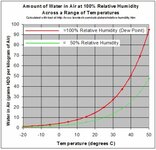
Relative-Humidity-Graph-e1367505504127.jpg

That's your problem. Look at the bottom. 20 degrees C is about 68 degrees F. So picture your garage at 68 degrees with 50% relative humidity as shown on the green line. Now....some of that 20 degree c air is up against a 10 degree C surface (50 degrees F). If you look at the graph that moves you straight to the LEFT of the 100% relative humidity Red line. You can't have more than 100% relative humidity. Whatever water vapor is in the air above 100 has to condense out. Dew if you will.

You need to insulate to allow your heat inside the building a chance to heat those surfaces up more so water won't condense. OR if you don't heat the garage at all as the previous poster mentions it also will not condense,.
 

Showkey

"MEMBER EMERITUS"
Joined
Aug 9, 2014
Messages
8,638
Location
Wausau WI
OP stated high efficiency furnace located in the garage, assume it’s vented out side …..so that’s not the source of the moisture.

Moisture in the garage will condensate and or frost on metal doors in cold temperatures. Totally normal and no getting around it. Lowering the humidity levels in the garage is not easy. This has been discussed in many prior posts over the years.
.
The OP did not mention if a vehicle used daily is parked garage. Ice and snow melt brings gallons of water in every. It’s normal for winter garage relative humidity witha car coming and going to be 60-85%.
The humidity level can be change only slightly:
1. Vent the garage……wastes heat and not effective.
2. Floor drains are one of the best solutions, code problem is some areas, retro fit drain expensive, drains open to daylight can freeze.
3. squeegee the floor daily or as needed, can crate an ice rink on the driveway.
4. shop vac the water…….work and a mess
5. dehumidifier……..high cost to run, not effective below 50*F, must be emptied, even at 50* dehumidifier will spend a lot of time in defrost mode.
6. Fan are not eff3xtive, they might evaporate the water into the air but moisture in still in the building and will conde and frost in the right conditions.

If vehicles are not coming and going …….running a heater in an insulated and sealed garage will lower the humidity just like a home to 30-40%.

Where’s the humidity coming from:

B175C375-DAD3-4AD4-B369-DE42D282DB1A.jpeg

8D2599F8-084B-4A3F-BA9A-59D030EABE2F.jpeg

This shop with no vehicles coming and going heated today 50*plus constant has 42% humidity.
Last week in below zero and below zero over night the insulated and sealed metal doors frosted.

F8D6A7F9-ED86-465F-9475-66F6D12CA358.jpeg
 
Last edited:

HeadsUp

Well-known member
Joined
Jun 7, 2006
Messages
556
Location
Central CT
Could be wrong but having condensate on your interior windows is bad since it will promote mold growth. We have a humidifier on our furnace. Guessing you do as well living in dry Colorado. Perhaps dial down the humidity to help narrow down the issue.
 
OP
W

wacomme

Well-known member
Joined
Feb 1, 2012
Messages
152
Location
Colorado Springs, CO
How is it from my wife’s car? She only packs in the garage overnight. And if you’ve seen Colorado‘a weather, we’ve had no precipitation.
 

PoorUB

Well-known member
Joined
Mar 29, 2021
Messages
11,652
Location
Fargo, ND
Where does the condensate drain go to from the furnace?

Also, are you certain the venting from the furnace goes outside? I have seen guys slap a 90% in a garage and just let it vent indoors!
 
OP
W

wacomme

Well-known member
Joined
Feb 1, 2012
Messages
152
Location
Colorado Springs, CO
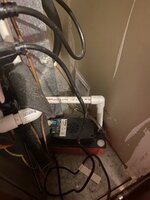
Great questions. Here are are a few photos.6210D366-8CFA-4184-A2EE-A7FA9C98619D.jpeg
 

Attachments

  • 9D28E39D-77EA-4173-B5E9-47769230F584.jpeg
    9D28E39D-77EA-4173-B5E9-47769230F584.jpeg
    241.3 KB · Views: 27
  • FD2F186A-DCD8-4F80-BCC5-6D3E63BF72DF.jpeg
    FD2F186A-DCD8-4F80-BCC5-6D3E63BF72DF.jpeg
    255.6 KB · Views: 28

PoorUB

Well-known member
Joined
Mar 29, 2021
Messages
11,652
Location
Fargo, ND
So the furnace is for the house? I assumed, like many others it heated the garage. If you don't have any water dripping on the floor from the furnace i doubt is has anything to do with humidity in the garage.

It is probably humidity from the house migrating to the garage. Fix up the garage, get some heat in it and the issues will probably go away.
 
OP
W

wacomme

Well-known member
Joined
Feb 1, 2012
Messages
152
Location
Colorado Springs, CO
So the furnace is for the house? I assumed, like many others it heated the garage. If you don't have any water dripping on the floor from the furnace i doubt is has anything to do with humidity in the garage.

It is probably humidity from the house migrating to the garage. Fix up the garage, get some heat in it and the issues will probably go away.
Thanks. I believe we've come full circle. And that's good. This was my original advise last winter, and it seems to be the advice now. During winter break (I'm a teacher) I plan to insulate and drywall the one remaining non-insulated wall in the garage. Maybe that alone will work. If not, I'll hire an electrician to install a 240v outlet so that I can put in an electric heater and thermostat.

Michael
 

rawen2

Well-known member
Joined
Feb 26, 2021
Messages
168
Location
High Desert of CO
You could check for air tightness of the furnace ducts and humidifier in the garage. With the humidifier set that high it wouldn't be out of the question that it is providing a lot of extra moisture in the garage even without opening the door to the house. Is it the beige unit on the top right side of the picture? As an experiment you could shut off the humidifier during a few days of cold weather and see if that makes a difference.

I agree with the others that keeping the garage warmer will help. If you insulate the wall and add insulation to the garage door you might be surprised what a 120VAC 1500 watt heater would do. I have a fully insulated 3-car with only one wall shared with the house and my 240VAC electric heater is set to low which is about 2667 watts. It keeps the garage 50 deg. all winter (I'm in the Springs area too). Is your garage attic space insulated?
 
To avoid these ads, REGISTER NOW!

BillK

Well-known member
Joined
Aug 24, 2006
Messages
9,328
Location
Beautiful Southern Maryland
I dont think insulating the wall is going to do anything. It sounds like the condensation is all on your garage door and the reason is that it is cold while the rest of the garage is somewhat warmer. You need an insulated door.
 
OP
W

wacomme

Well-known member
Joined
Feb 1, 2012
Messages
152
Location
Colorado Springs, CO
Could be wrong but having condensate on your interior windows is bad since it will promote mold growth. We have a humidifier on our furnace. Guessing you do as well living in dry Colorado. Perhaps dial down the humidity to help narrow down the issue.
Will do.
 
OP
W

wacomme

Well-known member
Joined
Feb 1, 2012
Messages
152
Location
Colorado Springs, CO
You could check for air tightness of the furnace ducts and humidifier in the garage. With the humidifier set that high it wouldn't be out of the question that it is providing a lot of extra moisture in the garage even without opening the door to the house. Is it the beige unit on the top right side of the picture? As an experiment you could shut off the humidifier during a few days of cold weather and see if that makes a difference.

I agree with the others that keeping the garage warmer will help. If you insulate the wall and add insulation to the garage door you might be surprised what a 120VAC 1500 watt heater would do. I have a fully insulated 3-car with only one wall shared with the house and my 240VAC electric heater is set to low which is about 2667 watts. It keeps the garage 50 deg. all winter (I'm in the Springs area too). Is your garage attic space insulated?
Yes. That beige unit in the photo is the home humidifier. I will try your experiment and see if that makes any difference to the garage door condensation. And perhaps a cheap 1500w heater will the the garage warm enough when I'm out there. However, if a heater is needed to keep the garage door condensation issue at bay, one that would heat the garage continuously, then wouldn't a 240v heater be more energy efficient, and thus over time much cheaper than a 120v 1500w heater?
 
OP
W

wacomme

Well-known member
Joined
Feb 1, 2012
Messages
152
Location
Colorado Springs, CO
I dont think insulating the wall is going to do anything. It sounds like the condensation is all on your garage door and the reason is that it is cold while the rest of the garage is somewhat warmer. You need an insulated door.
What's the best way to insulate a garage door outside of replacing it? Our garage door is insulated, but apparently not enough.
 
OP
W

wacomme

Well-known member
Joined
Feb 1, 2012
Messages
152
Location
Colorado Springs, CO
Is your garage attic space insulated?
Great question. I don't know. How do I check? I assume the wall from the garage to the house is insulated, but I don't know if the the one wall or garage attic is insulated. I assumed it would be, but maybe not. I need to find out. What's the point of insulating and drywalling the unfinished wall in the garage if the ceiling and other wall are drywalled but not insulated?
 
OP
W

wacomme

Well-known member
Joined
Feb 1, 2012
Messages
152
Location
Colorado Springs, CO
It sounds like the condensation is all on your garage door and the reason is that it is cold while the rest of the garage is somewhat warmer.
This is partially true. I also get condensation (and mold) on the behind-the-stucco batting on the unfinished wall near the garage door, so the condensation is more widespread than just the garage door.
 

jonshonda

Well-known member
Joined
Jul 17, 2017
Messages
4,744
Location
Wisconsin
If it is warmer inside your garage then outside, you will get condensation, pretty basic principle. Take a cold can of beer outside on a hot day, what forms on the outside? Put that cold beer in a good can cooozy, and ****...no more condensation.

For now just run a fan to help dry the air. But you will likely make your current issues worse by adding a heater and making it warmer inside. Insulation first, heat second. You can buy door Insulation kits at home improvement stores.
 

PoorUB

Well-known member
Joined
Mar 29, 2021
Messages
11,652
Location
Fargo, ND
Yes. That beige unit in the photo is the home humidifier. I will try your experiment and see if that makes any difference to the garage door condensation. And perhaps a cheap 1500w heater will the the garage warm enough when I'm out there. However, if a heater is needed to keep the garage door condensation issue at bay, one that would heat the garage continuously, then wouldn't a 240v heater be more energy efficient, and thus over time much cheaper than a 120v 1500w heater?
Electric heat is 100% efficient. The only reason you would need to go 240 volt is for a higher wattage, higher output heater. If you get it insulated and a 1500 watt plug in heater keeps it warm to your satisfaction that is all the heat you need. I would not run a plug in heater constantly. Good opportunity for an electrical fire. With a small garage even a couple base board strip heaters will probably work.
 

rawen2

Well-known member
Joined
Feb 26, 2021
Messages
168
Location
High Desert of CO
Great question. I don't know. How do I check? I assume the wall from the garage to the house is insulated, but I don't know if the the one wall or garage attic is insulated. I assumed it would be, but maybe not. I need to find out. What's the point of insulating and drywalling the unfinished wall in the garage if the ceiling and other wall are drywalled but not insulated?
There should be an access hatch in the ceiling that would allow you to look. If no hatch in the garage then the hatch is probably in the house. Is one of the rooms of your house above the garage? If so then there wouldn't be any access to it and it's most likely insulated.

I'd address the insulation of the garage door and the open stud wall first. The exterior wall that has drywall installed could be checked by just making a small hole and looking or probing to find out if there's insulation installed. If not there are companies that can blow in insulation without needing to remove the drywall.
 
OP
W

wacomme

Well-known member
Joined
Feb 1, 2012
Messages
152
Location
Colorado Springs, CO
Big bummer. The garage sidewall that is drywalled is NOT insulated. I haven't checked yet, but I presume the ceiling is not insulated either; the ceiling goes directly to an A-frame roof - nothing above it. Now, to insulate the garage, I see big dollar signs. Is it even worth it?

The garage door and the nearby walls that are not drywalled get condensation, but only in very cold and generally snowy, damp weather. It got down to the teens last night, but no snow, and consequently no garage condensation. So far this winter I have not had the garage condensation problem, but Colorado has not had any snow along the front range. The problem will likely surface again January - March. Is it worth spending money on fixing up the garage for three months of condensation? I also workout in the garage (weights and bicycle trainer), and I'm lacking electricity to keep lights on and a 120v 1500w heater without breaking a circuit. Though wasteful over time with electrical costs (heating a garage that's not insulated), perhaps my best bet is to install another electrical circuit or two (maybe one 120v and one 240v) to get more light and heat in the garage - and only for the 1-2 hours/day that I'm in the garage.

Thoughts? Suggestions?

Michael
 
OP
W

wacomme

Well-known member
Joined
Feb 1, 2012
Messages
152
Location
Colorado Springs, CO
Besides the aesthetics of a finished garage, would drywalling the remaining garage wall (insulated) help in any way with my condensation issue if the ceiling and the other sidewall are not insulated?
 
OP
W

wacomme

Well-known member
Joined
Feb 1, 2012
Messages
152
Location
Colorado Springs, CO
If I'm heating the garage for 1-2 hours/day (uninsulated garage), would a ventless propane heater be my best bet? Yes. The heater will bring moisture into the garage, but I can always open the garage door after my workout, and to bring my wife's car into the garage for the night, to vent the garage. While this doesn't address my condensation problem, it should heat the garage quickly for a workout, and it is cheaper than installing a 240v circuit in the garage. I may go through several 20 gallon propane tanks during the winter, but the cost should be on par, or cheaper, than electrical heat. I would install a CO monitor in the garage, and I'd likely crack the garage door during my workout. Would that be safe?
 

PCustoms

Well-known member
Joined
Jul 23, 2011
Messages
23,037
Location
VT
Man, your post are all over the place....

Do you currently (as in today) have a condensation issue? Or is it only when you have snow/rain and a car parked in there?

Don't put a ventless propane. That is just going to dump humid air in there, and without dehumidifiers it is going to stay.
 
OP
W

wacomme

Well-known member
Joined
Feb 1, 2012
Messages
152
Location
Colorado Springs, CO
Man, your post are all over the place....

Do you currently (as in today) have a condensation issue? Or is it only when you have snow/rain and a car parked in there?

Don't put a ventless propane. That is just going to dump humid air in there, and without dehumidifiers it is going to stay.
The car is always parked in the garage overnight. That's consistent. So far this winter I have not had the condensation issue with the garage door. However, I have had the problem for at least the last three winters. This winter in Colorado Springs has been extremely mild. Only a few nights has the outdoor temperature been much below freezing. As a recall, the condensation problem in previous years has been when the temperature is quite cold outside, but not necessarily snowy or wet. I'm trying to prevent the condensation issue from happening again this winter. However, if it's going to cost me thousands of dollars to insulate and heat the garage to prevent the condensation from happening again, I'm inclined to leave it "as is" and allow the condensation to happen - as long as it's not causing permanent damage. And if that's the case, I'm wanting to just heat the garage for 1-2 hours after work for a gym workout.

So while I'm all over the map, there is rationale for my jumping around. I had fully planned to insulate and drywall the unfinished garage wall until I discovered today that the finished wall, and likely the garage ceiling/attic is not insulated. I presume, but don't really know, that it's now not worth insulating and drywalling the unfinished wall. I presume doing so will not potentially fix my garage door condensation problem, whereas if the finished walls and ceiling were insulated, then insulation and drywalling the unfinished wall would fully insulate the garage and, with or without heat, would fix my garage door condensation problem.
 

Showkey

"MEMBER EMERITUS"
Joined
Aug 9, 2014
Messages
8,638
Location
Wausau WI
Unfortunately insulation, drywall and some heat, no heat, will not eliminate frost or condensation under certain conditions. Obviously mild weather it will be substantially less common.

But frost and condensation is very very common ( normal) again under those certain conditions.
 

PoorUB

Well-known member
Joined
Mar 29, 2021
Messages
11,652
Location
Fargo, ND
I wouldn't put a ventless heater in my chicken coop!
There are plenty of manufacturers of sidewall vented heaters you could go with. They screw to the wall and there is an exhaust and air intake that you cut a hole to the outside.
 

PoorUB

Well-known member
Joined
Mar 29, 2021
Messages
11,652
Location
Fargo, ND
Besides the aesthetics of a finished garage, would drywalling the remaining garage wall (insulated) help in any way with my condensation issue if the ceiling and the other sidewall are not insulated?
Do yourself a favor and insulate and sheet rock the bare walls. The wall that is sheet rocked I probably would just tear down the sheet rock, insulate and re- sheet rock it. Take a look in the garage attic and make sure there is insulation up there too. If not, buy some unfaced bats and insulate the attic too. The more insulation, the better. With an attached garage you may be surprised how it stays warm without extra heat. On warmer days you can probably just open the door to the house and blow some air out there.
 

Showkey

"MEMBER EMERITUS"
Joined
Aug 9, 2014
Messages
8,638
Location
Wausau WI
This frost and condensation garage discussion is closely related to frost, ice and condensation on windows in the home. Many variables in play like out door temperature, indoor temperature, surface temperature of the wall,door, window or glass, humidity levels, air circulation to mention just a few.

Google the topic there are books, home repair guys , home inspection companit’s , insulation contractors, window door companies have 100 of hours of reading, opinions and fixes for the issues.

This morning it’s 12*F outside, indoor humidity 43%…….glass has condensation. Pretty much a normal condition and almost impossible to stop. Lower the humidity comfort might suffer. Raise the indoor temp. Better quality window. Close the curtains it would most likely get worse. Turn a fan it would get better as the temperature of the glass would be warmer. In severe cases wood rot, mold mildew and ice build up. if this was Indoor cold wall poor insulation in closet it might mold over time.

This window in the cold beer can on a summer warm humid day ……as mention in prior post.

42762CD2-4139-4F49-80F4-9D249A1B1F0C.jpeg

This is the window in the garage 45*F 71% humidity north side …B5C349E8-A3C1-4A61-A614-06138506D5CC.jpeg
 
Last edited:

andyvh1959

Well-known member
Joined
Feb 15, 2020
Messages
2,598
Location
Green Bay WI
When heating an attached garage you may want to check with your home insurance provider. Some of them are VERY picky about any heating system in a garage that produces a flame or an open heated element.

Perhaps its gotten better than years past, but back in the early 90s I planned to build a new house with an attached 2.5 car shop backed up to the 2-car attached garage. I discussed it with my insurance agent and he said State Farm would likely reject any plans for a heated garage other than a heated concrete floor.
 

toyotadriver

Well-known member
Joined
Dec 30, 2010
Messages
1,586
When heating an attached garage you may want to check with your home insurance provider. Some of them are VERY picky about any heating system in a garage that produces a flame or an open heated element.

Perhaps its gotten better than years past, but back in the early 90s I planned to build a new house with an attached 2.5 car shop backed up to the 2-car attached garage. I discussed it with my insurance agent and he said State Farm would likely reject any plans for a heated garage other than a heated concrete floor.

I have State Farm and have propane Mr Heater Big Maxx heaters in both my attached garage and detached shop. They had no issues with them.

Years ago I bought a house and insured it through State Farm. When I bought it, the house’s only heat source was a vent free NG heater. I bought it in the spring and planned to replace it by fall with a proper vented heater. In mid summer I got a call from my agent. State Farm told him to tell me I had 30 days to install a proper vented heating system or they would drop me. So, I self installed a vented wall furnace. The insurance agent came out, looked at my install, and said everything looked good and all was well….they didn’t cancel my policy.
 
To avoid these ads, REGISTER NOW!
Top Bottom