To avoid these ads, REGISTER NOW!

Sewing machine recommendation?

WILD-BILL

Well-known member
Joined
Dec 10, 2011
Messages
872
Location
Brook Park Oh
Regular polyester thread is not particularly UV resistant. Polyester has modest resistance to UV, which may be good enough for some uses. It's very common for things sewn with ordinary weight (tex 40 or less) polyester garment sewing thread to fall apart because the thread fails from UV exposure, when left exposed to sunlight for long periods. This is more of a problem in the tropics, or at altitude, where UV exposure is higher than some where like Ohio.


Thicker thread will have a longer life, and some colors may be more resistant than others (dyes absorb it before it hits the polyester), and there are all sorts of thread treated for UV resistance. Lots of upholstery thread is uv resistant, even when that isn't explicitly listed as a selling point.
Yeah, All my thread is upholstery thread so I must admit to being a little lacking where lighter threads are concerned. LOL

I typically use sizes like V 92, V 138 and V 207 in my work.

There is also a Tenara Life thread which is a PTFE but it is considerably more expensive and I only use it on boat covers and other canvas products that are constantly in the sun.
 
To avoid these ads, REGISTER NOW!

F-22

Well-known member
Joined
Jan 23, 2022
Messages
1,830
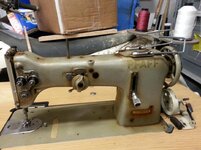
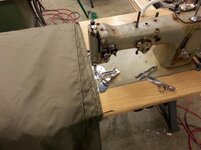
Pfaff or Consew. Quick pic of my Consew, which I acquired with a bundle of other leather shop supplies about 12 years ago. I use it for upholstery and leather mainly, or any heavy materials that I need to fabricate/repair. Looks like they can be had for $4-600 on Marketplace.
That Consew is using a similar design to the 1900's Singer like the 31k15. Those were the "tailor" machines, more heavy duty than generic homeowner ones but meant for a lot of tasks unlike more specific industrial ones.

It is really nice to get a machine that can do zig zag. Other features are not very meaningful but zigzag does help a lot in some cases. I have a Pfaff 138. To tackle almost anything (slowly), ideally a triple feed and zig zag but those are very rare...
 

jar944

Well-known member
Joined
Jul 26, 2010
Messages
5,895
Location
Northern VA
That Consew is using a similar design to the 1900's Singer like the 31k15. Those were the "tailor" machines, more heavy duty than generic homeowner ones but meant for a lot of tasks unlike more specific industrial ones.

It is really nice to get a machine that can do zig zag. Other features are not very meaningful but zigzag does help a lot in some cases. I have a Pfaff 138. To tackle almost anything (slowly), ideally a triple feed and zig zag but those are very rare...

The 138s are nice.
Screenshot_20250129_115621_Gallery.jpgScreenshot_20250129_115635_Gallery.jpg
 

jar944

Well-known member
Joined
Jul 26, 2010
Messages
5,895
Location
Northern VA
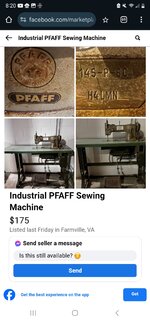
Where did you find one for $145? There are several current listing's all $950 - $1200 (which is pretty much what I would have expected). The 1541 has come down a bit but is now available new for about $1,800 I think I'd still go with that over taking a gamble on used machine for about $1000. I'd definitely consider it at the price you paid though. Great deal.

Cough...
Screenshot_20250130_082048_Chrome.jpg
 

tjansson

Well-known member
Joined
Apr 25, 2018
Messages
196
Location
Northern Vermont
We picked up a "vintage" Bernina 930 Record Electronic a year ago. It's not industrial, but it's all metal. It does fine sewing patches on my insulated duck overalls. The old school Swiss quality is nice. Not exactly a budget option though, unless you stumble upon a good deal like we did.
 

Aaron_W

Well-known member
Joined
Feb 6, 2018
Messages
2,890
Location
Northern California
Don't fall into the common trap of thinking an "industrial" machine will work for your needs (whatever they are).

Industrial just means they are made to run all day, everyday but it does not mean they can work any material.
There are industrial machines for ultra lightweight materials, industrial machines for stitching saddles and many in-between. Industrial grade machines are great, but you have to pick the right one.
 

cgrutt

Well-known member
Joined
Mar 4, 2016
Messages
8,162
I'm not good with Facebook but using my wife's account I don't see it listed anymore assuming it sold quickly at that price. I'm 7 hrs away and would have jumped on that if it was running.
 
OP
S

Shopmaster

Active member
Joined
Mar 21, 2013
Messages
28
Missed out on a 201 by a few hours today. Learning a lot about sewing machines and what to look for now though.
 
OP
S

Shopmaster

Active member
Joined
Mar 21, 2013
Messages
28
Anyway, the OP wants to close bags. And do so in a UV stable way. The best answer I can think of is to buy a Bag Closer They're dedicated to this EXACT task, are inexpensive, run very heavyweight threads, and use a chain stitch, so there are no bobbins to waste time on.
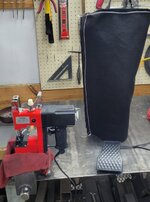
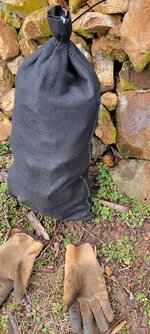
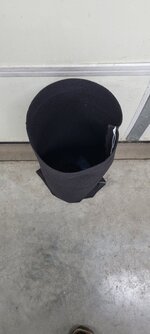
@rlitman Thanks for this response. Everyone please try not to laugh at my photos, but here's my set up. Bag closer clamped in my vice, plugged into a very (non) high quality vari-speed pedal. It took the rpms down from 50,000 to about 1200....not great, but a lot better. I tried making a couple with the crappy thread it came with and it works! 8 oz. non woven geotextile. When I fill the bags for real it will be with small gravel, not these baseball sized rocks. I filled, tied top and dropped, stomped cussed and didn't blow out! Bags are 14" wide x 26" tall.

Now I need help with a thread recommendation. The spool that came with it says either 12/3 or 12/4 polyester. Not super strong, but will almost cut your fingers before you can pull it apart. What would be better?

20250215_163135.jpg

20250215_141815.jpg

20250215_164801.jpg
 

rlitman

Well-known member
Joined
Oct 18, 2010
Messages
24,579
Location
Long Island
Now I need help with a thread recommendation. The spool that came with it says either 12/3 or 12/4 polyester. Not super strong, but will almost cut your fingers before you can pull it apart. What would be better?
12/3 is about twice too big to fit the largest needles that will fit in any of my sewing machines (12/4 is 25% heavier than that), but I've been known to use stuff that thick with my Speedy Stitcher sewing awl for hand sewing leather projects. Anyway, as has been pointed out above, the thicker the thread, the longer it will stand up to UV. However, 12/4 also requires a bigger needle to match. Does the cone it comes with say anything? Any numbers may be useful to cross reference that, because there are quite a few systems of thread measurement. I ask, because if what you have works, maybe try sticking with that, even if it happens to be 12/3, because we now know something that reliably sews this thread with your needle and your fabric. Why mess with a known good? OTOH, if you know the needle it comes with is meant to take the 12/4, it might not work as reliably with the 12/3. Also, changing thread sizes with the same needle may require tension adjustments.

Also as stated above, get any color other than white. White is the worst when it comes to UV, and black is probably the best option, but better yet would be to find a thread that specifically calls out UV resistance AND is black. Polyester without UV treatment is so-so, but with it, I think it should match or exceed the geotextile in performance (you can't really ask for more than that).

The bench mount and foot pedal makes perfect sense for making the open bags (I'm not laughing at all), and now you have a hand-held tool that you can pick up and close them with, if you don't want to waste all that space with tying them. If you're a fan of the How It's Made series, I'm betting you'd find several of these hanging from tool balancers in production settings, but that's probably way overkill for you. As for the speed, the faster you can go (without going so fast you risk running your fingers through it), the better it will look. And anyway, for a bag of rocks, that looks pretty darned good to me.

Oh, and remember to tie off (or just glue) the tails of the thread before you unravel the chain by accident. ;)
 

WWheeler

Well-known member
Joined
Jun 23, 2015
Messages
4,105
Location
Middleofnowhere USA
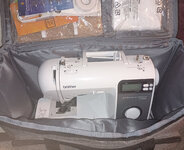
I bought a Brother Strong & Tough ST150HDH in 2022 to make a few custom wrench rolls out of 16oz waxed canvas and my wife used it to repair a whole bunch of my work jeans (they're a LOT thicker than today's Levis), mostly torn belt loops from when I forgot to put on a belt, which required stitching through many layers of the denim. It hasn't been used a whole lot, actually barely at all, but all of what we have used it for was probably a bit more tasking than making dresses and curtains, at least as far as dealing with thicker materials goes. It's handled everything we've thrown at it so far without any issues.

Brother likes to market it as one of their 'heavy duty' models, but I'm not so sure it's internals are anything close to what commercial grade or old-school machines used to be. It's plenty good enough for me though. Definitely don't regret the purchase.

Brother Strong - Tough ST150HDH.jpg
 

rlitman

Well-known member
Joined
Oct 18, 2010
Messages
24,579
Location
Long Island
I bought a Brother Strong & Tough ST150HDH in 2022 to make a few custom wrench rolls out of 16oz waxed canvas and my wife used it to repair a whole bunch of my work jeans (they're a LOT thicker than today's Levis), mostly torn belt loops from when I forgot to put on a belt, which required stitching through many layers of the denim. It hasn't been used a whole lot, actually barely at all, but all of what we have used it for was probably a bit more tasking than making dresses and curtains, at least as far as dealing with thicker materials goes. It's handled everything we've thrown at it so far without any issues.

Brother likes to market it as one of their 'heavy duty' models, but I'm not so sure it's internals are anything close to what commercial grade or old-school machines used to be. It's plenty good enough for me though. Definitely don't regret the purchase.
It looks like it shares a lot of components with my embroidery model. If so, I'm sure it's a great machine.

You can find machines at estate auctions very cheap. My favorite machine is this 1914 Singer model 127. Was my Great Grandmothers. Sews nice.
IMG_9620.jpeg
Wait till you try something with a class 15 bobbin and upgrade from that shuttle machine.
 

cvairwerks

Well-known member
Joined
Aug 12, 2016
Messages
7,183
Location
Within hearing distance of Texas Motor Speedway
Hey guys need you to put on your thinking hats and ponder this. I will need a machine in the near future for some things for the airplane. Worst case is 4 layers of #8 or #9 cotton duck, with possible up to 4 layers of .050" cotton webbing. Needs to be a walking foot, single needle and have adjustable stitch length. Stitching is straight stitch only, so don't need zig zag or any of the other fancy stitches.

Thinking about a Juki 1541 series machine for now, anything better out there that won't break the bank?
 

cgrutt

Well-known member
Joined
Mar 4, 2016
Messages
8,162
Hey guys need you to put on your thinking hats and ponder this. I will need a machine in the near future for some things for the airplane. Worst case is 4 layers of #8 or #9 cotton duck, with possible up to 4 layers of .050" cotton webbing. Needs to be a walking foot, single needle and have adjustable stitch length. Stitching is straight stitch only, so don't need zig zag or any of the other fancy stitches.

Thinking about a Juki 1541 series machine for now, anything better out there that won't break the bank?
1541S is perfect for your application it's the same machine I'd love to get. Been looking at older machines though just for sake of budget. Juki 563 (not "-3"), Consew 206R and PFAFF 145 H4 are some alternatives I've been considering similar attributes to the 1541S. I recently saw a new 1541S with servo motor and table for $1675. Happens to be local to me. Lowest price I've seen for that machine in several years.
 

DGersic

Well-known member
Joined
Mar 12, 2017
Messages
6,265
Location
DeKalb, IL
Hey guys need you to put on your thinking hats and ponder this. I will need a machine in the near future for some things for the airplane. Worst case is 4 layers of #8 or #9 cotton duck, with possible up to 4 layers of .050" cotton webbing. Needs to be a walking foot, single needle and have adjustable stitch length. Stitching is straight stitch only, so don't need zig zag or any of the other fancy stitches.

Thinking about a Juki 1541 series machine for now, anything better out there that won't break the bank?

I have the Consew CP206RL. Meets your described needs, for a bunch less than the Juki. $425 on Amazon right now.

Having it, I’d probably get something else. It works fine just as described, but doesn’t have zig zag. Now I think it’s worth the extra couple bucks to get the zig zag, even if you don’t think you’ll use it.

It also doesn’t have any support for optional other feet. It has a walking foot, straight stitch. But if you want, for example, piping, there are other machines where you can install a piping foot. You may not want piping, yet, but if you’re doing upholstery, you might.
 
OP
S

Shopmaster

Active member
Joined
Mar 21, 2013
Messages
28
Does the cone it comes with say anything? Any numbers may be useful to cross reference that, because there are quite a few systems of thread measurement. I ask, because if what you have works, maybe try sticking with that, even if it happens to be 12/3, because we now know something that reliably sews this thread with your needle and your fabric. OTOH, if you know the needle it comes with is meant to take the 12/4, it might not work as reliably with the 12/3.

Oh, and remember to tie off (or just glue) the tails of the thread before you unravel the chain by accident.
@rlitman the needle size says # 230. As for the cone of thread, it's smeared but almost positive it says 12/3.
 

dscheidt

Well-known member
Joined
Apr 26, 2017
Messages
2,880
@rlitman the needle size says # 230. As for the cone of thread, it's smeared but almost positive it says 12/3.
that's a giant needle, and should have no problem running 12/3 thread. That's a cotton count number, which tells you it's 3 plies of 12 weight thread. cotton is indirect, smaller numbers are bigger, because it's the notional length of a fixed weight of thread. that's "government size" FF, or ticket # 138, about tex-130. Should be easy enough to find some bonded nylon thread that size.
 
To avoid these ads, REGISTER NOW!

cody1325

Well-known member
Joined
Apr 17, 2024
Messages
1,075
Location
Southwest Virginia
Anyone know who made Kenmore sewing machines for Sears back in the '50s and '60s? Been meaning on getting the old one my great-Grandma had back out after decades of disuse to use to sew up a few pouches (canvas) and hem some trousers. Update: need to get it out and get photos, but I suspect that it's actually a Japan-made Maruzen from the '70s--and they're supposedly decent.

Otherwise, it's time to swear at getting the belt on my other sewing machine, a treadle Singer. My grandmother bought it to use almost a decade ago, and it's always been a nightmare to get the belt on.
 
Last edited:

dscheidt

Well-known member
Joined
Apr 26, 2017
Messages
2,880
Anyone know who made Kenmore sewing machines for Sears back in the '50s and '60s? Been meaning on getting the old one my great-Grandma had back out after decades of disuse to use to sew up a few pouches (canvas) and hem some trousers. Update: need to get it out and get photos, but I suspect that it's actually a Japan-made Maruzen from the '70s--and they're supposedly decent.

the model number will tell you. The first three numbers specify the supplier, 385 is Janome, 120 is chrysler (yes, that Chrysler), dunno the others. maruzen became or was acquired by jaguar (not that Jaguar), so keep that in mind if you find a list of numbers.
 

rlitman

Well-known member
Joined
Oct 18, 2010
Messages
24,579
Location
Long Island
@rlitman the needle size says # 230. As for the cone of thread, it's smeared but almost positive it says 12/3.
230 is huge (kind of expected). The chart in my link was showing a #140 needle matches 12/3 and a #180 matches 12/4, so #230 should leave plenty of room for either and then some. If the needle's that big I'd try for the bigger 12/4 thread.

As dscheidt points out, 12/4 is a way of calling out cotton thread size. Other numbers are usually associated with synthetic threads, but you can cross reference the sizes a bit. Looking for such heavy thread in sewing use may be difficult, since that gigantic needle is beyond the reach of even most commercial sewing machines, but I was able to find black bag closer thread on Amazon.
That one's 12/4, but doesn't call out UV treatment, so I'm a little concerned.
 

IndyGarage

Well-known member
Joined
Apr 29, 2010
Messages
9,669
Location
Indy
Hey guys need you to put on your thinking hats and ponder this. I will need a machine in the near future for some things for the airplane. Worst case is 4 layers of #8 or #9 cotton duck, with possible up to 4 layers of .050" cotton webbing. Needs to be a walking foot, single needle and have adjustable stitch length. Stitching is straight stitch only, so don't need zig zag or any of the other fancy stitches.

Thinking about a Juki 1541 series machine for now, anything better out there that won't break the bank?
Juki 1541 is a great machine for any heavy material. However it's about $2,000 set up. I don't know if that's breaking your bank.

Singer 111 will do the same thing for less money, so will any number of 111 clones - consew, juki, tecsew, pfaff, nakajima. Most of the 111's don't have reverse, which can be nice to have.

Here's what looks like a Pfaff 145 on Craiglist Chicago. $500. Pfaff sewing machine
 

Milton Shaw

Well-known member
Joined
Feb 11, 2011
Messages
4,835
About 20 years or so ago Levi moved all sewing overseas and a lot of machines went on sale at that time. Since now almost everything is sewn oversees the mass amount of machines are no longer available. Those had 3 phase motors on them so required a 120 volt motor replacement, now that VFD are lower price than the 120 motors that is the way to go. Check and get a photo of the motor name plate and voltage requirements would make sure no further modifications are needed. I have a walking foot that I use for heavy duty sewing and a Singer light weight commercial unit for drapery and light weight materials. I have used the walking foot for most of what I do and use the same base and motor assembly just swapping the heads.
 

cvairwerks

Well-known member
Joined
Aug 12, 2016
Messages
7,183
Location
Within hearing distance of Texas Motor Speedway
Thanks guys...Most of what I'll do is aircraft specific engine covers, stick boots, storage bags and straps, seats and draft curtains. Not the usual style of upholstery. Lots of straps and double and quad thickness seams.

DGersic: Don't need the zig zag at all. May end up having to do some zippers though...

Indy: 2K isn't going to break the bank. I will need reverse though. Lots of this stuff gets sewn to within a very close distance to an edge and then a right angle turn, about 1-2 stitches back from the edge, or in some cases, a diagonal stitch line to the opposite corner of the attachment.
 

IndyGarage

Well-known member
Joined
Apr 29, 2010
Messages
9,669
Location
Indy
Thanks guys...Most of what I'll do is aircraft specific engine covers, stick boots, storage bags and straps, seats and draft curtains. Not the usual style of upholstery. Lots of straps and double and quad thickness seams.

DGersic: Don't need the zig zag at all. May end up having to do some zippers though...

Indy: 2K isn't going to break the bank. I will need reverse though. Lots of this stuff gets sewn to within a very close distance to an edge and then a right angle turn, about 1-2 stitches back from the edge, or in some cases, a diagonal stitch line to the opposite corner of the attachment.
Industrial machines are typically straight stitch. Reverse is nice, but you have to practice some because industrial machines are very touchy - you can rip off 20 stitches very easily. Sometimes it's easier to do it manually, which is why they did fine without it for a long time.
I don't remember the model numbers or the exact differences, but Juki has another walking foot model that is priced in the $1200-1300 range. I think it's more of a 111 clone than the 1541 is.

Another nice feature on a newer machine is they use bigger bobbin reels that hold twice as much thread. That's one of the reasons I traded my Pfaff 145 for a 1245. With heavy material, and thick thread, you end up changing the bobbin pretty often on one of the older machines. It only takes 30 seconds to do, but it can be annoying to run out in the middle of an important stitch. Other than that and maybe some stitch length difference, the 145 does all the same stuff.

For bags, straps and seats, I would take a look at the Sailrite website. They have a ton of materials and videos to help you. I've bought a lot from them and it's all good quality, not always the cheapest.
 

dscheidt

Well-known member
Joined
Apr 26, 2017
Messages
2,880
Thanks guys...Most of what I'll do is aircraft specific engine covers, stick boots, storage bags and straps, seats and draft curtains. Not the usual style of upholstery. Lots of straps and double and quad thickness seams.

this is work someone is paying for? I have two suggestions. the first is sub it out, but if that's not possible, find a localish industrial sewing machine dealer, and seek advise from them. take samples of the stuff you plan to work with, so you can be sure they understand what you are trying to do, and that the machine will do it. the brand of machine you buy matters very little, and many people make machines that could suit your needs. Getting the right machine from the start, after sale service, parts support, etc matter a whole lot more, and a good dealer can help. If this is paying work, buy a new machine. provide your dealer materials, so it can be set up for it. Industrial sewing machines are a little like race cars in this respect. They can work on a range of goods, but they require adjustments for different weight ranges of fabric and thread and needle sizes.

A couple other thoughts -- get a T-leg table, with casters, not a K-leg table. You really want a modern machine, with either direct drive, or an external servo with good needle positioning system, and the goodies -- thread cutter, powered foot lift, tack programming, etc. These save so much time, frustration, and increase quality of the result.
 

WILD-BILL

Well-known member
Joined
Dec 10, 2011
Messages
872
Location
Brook Park Oh
230 is huge (kind of expected). The chart in my link was showing a #140 needle matches 12/3 and a #180 matches 12/4, so #230 should leave plenty of room for either and then some. If the needle's that big I'd try for the bigger 12/4 thread.

As dscheidt points out, 12/4 is a way of calling out cotton thread size.
rlitman, I'm glad you have an understanding of that that thread and was able to help. I was having a hard time finding anything.
Thanks guys...Most of what I'll do is aircraft specific engine covers, stick boots, storage bags and straps, seats and draft curtains. Not the usual style of upholstery. Lots of straps and double and quad thickness seams.

DGersic: Don't need the zig zag at all. May end up having to do some zippers though...

Indy: 2K isn't going to break the bank. I will need reverse though. Lots of this stuff gets sewn to within a very close distance to an edge and then a right angle turn, about 1-2 stitches back from the edge, or in some cases, a diagonal stitch line to the opposite corner of the attachment.
CV, I really like my 2 Consews. One is a 255 RB2 and the other is a 255 RB3. I found both for around $700 each. Either would do what you want and then some. A variety of feet readily available plus they use the very large U size bobbin.

I prefer the RB3 for 2 reasons. First, the stitch length adjustment is a little easier and has more settings. Second is it has a servo motor that has a needle down position that the Sailrite servo on my RB2 doesn't support.

I also wouldn't mess around with a VFD for running a clutch motor if you can't find a machine that already has a servo. Just get a brushless servo with a needle positioner and you'll be thankful you did. You can then set the servo to run as slow as your comfortable with . (I can get mine painfully slow LOL)
 

cvairwerks

Well-known member
Joined
Aug 12, 2016
Messages
7,183
Location
Within hearing distance of Texas Motor Speedway
this is work someone is paying for? I have two suggestions. the first is sub it out, but if that's not possible, find a localish industrial sewing machine dealer, and seek advise from them.
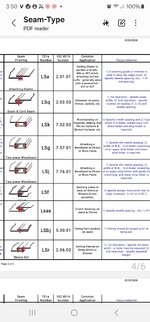
Maybe, maybe not on selling a few of these. I haven't committed either way. As to farming it out, way too expensive and time consuming. One of the guys that restored his a/c that is like mine, had covers made, about 5 years ago. Labor cost for the two stick boots and the landing gear draft curtains was over 1400$, plus another couple of hundred for materials, snaps, buckles and anchor pins. For a full set of duck and all the straps for mine would be probably over 4k$ in labor. The gal that did his, ended up taking several months to get them all done and they had to go back and forth to the aircraft a number of times for fit checks. None of this stuff has patterns available. We have most of the factory blueprints, which need to be developed into patterns to actually make the parts. It also requires doing some translating to convert WW2 standard call outs to something that is understandable to a sewer to day. Haven't found enough data to do the translating yet. Here's one on the drawing:

Seam Type LS (alpha) K-2
Stitch Type 301 or 401

Indy: Most of the bags and straps are for holding or securing specific equipment. One example is a loose items bag that is a rectangular block, with a 3 sided top that covers a portion of the bag, and has a number of DOT "Lift the DOT" sockets and studs. All the materials originally were either 8 ounce duck canvas or .030" or .050" thick cotton webbing. Finding the correct materials is a bit of a challenge.
 

DGersic

Well-known member
Joined
Mar 12, 2017
Messages
6,265
Location
DeKalb, IL
Thanks guys...Most of what I'll do is aircraft specific engine covers, stick boots, storage bags and straps, seats and draft curtains. Not the usual style of upholstery. Lots of straps and double and quad thickness seams.

DGersic: Don't need the zig zag at all. May end up having to do some zippers though...

Indy: 2K isn't going to break the bank. I will need reverse though. Lots of this stuff gets sewn to within a very close distance to an edge and then a right angle turn, about 1-2 stitches back from the edge, or in some cases, a diagonal stitch line to the opposite corner of the attachment.

In the Consew, the price to get zig zag is negligible. If I was doing it again, I’d get it.

Zippers don’t need, but could benefit from a zipper foot. See if you can get one for the machine you’re looking at. I don’t have one, can’t get one. I can still do zippers, it’s just harder.
 

dscheidt

Well-known member
Joined
Apr 26, 2017
Messages
2,880
also requires doing some translating to convert WW2 standard call outs to something that is understandable to a sewer to day. Haven't found enough data to do the translating yet. Here's one on the drawing:

Seam Type LS (alpha) K-2
Stitch Type 301 or 401

you need a copy of federal standard 751, which defines what all this is (with diagrams, for a lot of it.). the WWII era version should be readily available online (I have a printed version from the 60s, somewhere. I rather doubt the WWII edition would be much different.). At some point the FS751 got replaced by an ASTM standard, which I don't know the number of. it's still in use to specify how to sew stuff up, because there are lots of ways to do it, with various tradeoffs in required equipment, seam bulk, seam strength, material used, and so on. There's also an iso standard which specifies the same stuff, but uses an entirely different way of naming and calling out details.

an LS type seam is a lapped seam, the various sub classes tell you how to deal with the edges (what gets folded under what, before or after the initial seam, and whether it's sewn again. ) stitch type 301 is a single needle lockstitch, 401 is double chainstitch.
 

IndyGarage

Well-known member
Joined
Apr 29, 2010
Messages
9,669
Location
Indy
Indy: Most of the bags and straps are for holding or securing specific equipment. One example is a loose items bag that is a rectangular block, with a 3 sided top that covers a portion of the bag, and has a number of DOT "Lift the DOT" sockets and studs. All the materials originally were either 8 ounce duck canvas or .030" or .050" thick cotton webbing. Finding the correct materials is a bit of a challenge.
Yes, I'm sure the materials and sizes and shapes are unique to the airplane, but sewing is sewing and Sailboats have a ton of that kind of stuff onboard - from sail and equipment covers, to bags and cushions and everything in-between. I think Sailrite would be a good resource and it wouldn't surprise me at all if they didn't have the mil spec fabric and threads you need.

One of my favorite books for sewing is called Canvas for Cruisers, The complete guide. It's about 400 pages of detailed instructions on how to make stuff like you need, from sewing machines to tools to seam types to materials and techniques. I don't think I've exactly made anything in the book, but I've used a ton of the techniques described.

The good news is stuff like that isn't hard to make.

Good luck.
 

danielbuck

Well-known member
Joined
Apr 15, 2014
Messages
917
I use a Sailrite for my heavy duty stuff, and my lady uses a Viking Sapphire for her quilting and other projects. Both seem to be pretty good machines, I've used the VIking a few times, it's like driving an automatic transmission compared to the Sailrite, it just works :D
 

Aaron_W

Well-known member
Joined
Feb 6, 2018
Messages
2,890
Location
Northern California
Anyone know who made Kenmore sewing machines for Sears back in the '50s and '60s? Been meaning on getting the old one my great-Grandma had back out after decades of disuse to use to sew up a few pouches (canvas) and hem some trousers. Update: need to get it out and get photos, but I suspect that it's actually a Japan-made Maruzen from the '70s--and they're supposedly decent.

Otherwise, it's time to swear at getting the belt on my other sewing machine, a treadle Singer. My grandmother bought it to use almost a decade ago, and it's always been a nightmare to get the belt on.

White was the major supplier to Sears from the 1920s into the 1950s. Sears started to source over seas brands by the late 50s.

Sears used a series of 3 digit prefix numbers as part of the model number that identifies the maker.

Example from my Craftsman lathe 101.21400. The 101 identifies Atlas Press as the maker, and 21400 is the specific model of machine.


The prefixes / brands Sears used for sewing machines:

117 White Sewing Machine Company (USA)
120 New Process Gear / Chrysler (USA)
148 Soryu (Japan)
158 Maruzan, later Jaguar (Japan)
385 Janome (Japan, later Taiwan)
 

mavisrandal

New member
Joined
Jun 17, 2025
Messages
1
That’s an awesome project to dive back into sewing with! For 8 oz non-woven polypropylene, you’ll want a machine with a strong motor and the ability to handle heavier threads and thicker materials without skipping stitches.


Look into models like the Singer Heavy Duty 4452 or the Brother ST150HDH—both are budget-friendly, beginner-friendly, and powerful enough to handle utility materials like polypropylene. Just be sure to use the right needle (like a heavy-duty or denim needle) and test on scrap material first.


Also, if you’re looking for more sewing machine advice or tutorials tailored to practical projects.


Good luck with the sandbag project—and welcome back to sewing!
 
To avoid these ads, REGISTER NOW!
Top Bottom