To avoid these ads, REGISTER NOW!

Shared ground rods?

BruceMc

Well-known member
Joined
Jan 17, 2015
Messages
2,170
Location
Fairbanks, AK
I'm getting ready to run a sub-panel to a detached garage. Nothing unusual - approx 35' run, 4-wire, #4 Cu in PVC, 2 ground rods in the trench. I'm also planning on upgrading the house grounding rods.

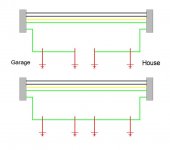
The last time I did this, due to the way the buildings were situated, the ground rods between the house and out building were physically separate. It occured to me the other night since the house and garage will be in such close proximity, it might be worth it to tie all the ground rods together like so:

Garage
4-wire ============================== House
ground -------o--------o o--------o-------

Garage
4-wire ============================== House
ground -------o--------o-----o--------o-------

Am I missing something here?
 
To avoid these ads, REGISTER NOW!

buddyboy

Well-known member
Joined
Oct 8, 2007
Messages
616
i'm not an electrician so forgive my questions.

why do you need to upgrade your homes ground rods?

what do you mean by 'worth it' when asking about tying all the ground rods together?

as far as I knew you only need two ground rods, 6 feet apart or you can go with just one if you can prove that you have 25 ohms or less, but why do that when ground rods are cheap?
 
OP
B

BruceMc

Well-known member
Joined
Jan 17, 2015
Messages
2,170
Location
Fairbanks, AK
The 2 rod/6' rule is a minimum. Having lost some expensive electronic gear to lightning this summer, I'd just as soon spend a few extra bucks to increase my margin of protection.
 

justsam

Well-known member
Joined
Aug 20, 2010
Messages
1,268
Location
Penngrove, California
If I understand you correctly this is already being done.

The 4th wire, the EGC, is connecting your house ground rods to the out building ground rods.

Are you suggesting that in addition to the above that you would put another EGC wire in the trench and it would connect directly from out building ground rods to house ground rods? It would be a parallel path to that mentioned above?
 
Last edited:

buddyboy

Well-known member
Joined
Oct 8, 2007
Messages
616
lightning/surge protection can get very complicated.

you're dealing with ground potential differences and depending on your situation your grounding rods might have a resistive or capacitive effect.

i wouldn't tie them together, instead make sure your ctv, phone and other low voltage stuff is earth grounded well, and surge protect at the device(s) and panel

all that surge protection stuff is designed assuming people are not bonding the ground rods from detached structures to the source in the ground.
 

MTW

Well-known member
Joined
Aug 6, 2013
Messages
294
Location
SE Michigan
There is nothing wrong with tying multiple ground rods together, so long as they have the correct connections and fittings. The grounding electrode conductor needs to be one piece and sized for the largest service. The code considers this one electrode when done correctly. Best is to use a solid bare copper conductor in the trench for added soil contact, decreasing resistance.

Rod requirement is 8' length, and needs to be spaced at least 8' apart from each other to have maximum effectiveness. The ground rods also need to be bonded to the metal water service pipe if you have one, within 3' of where it enters the structure.

250.58 Common Grounding Electrode.
Where an ac system is connected to a grounding electrode in or at a building or structure, the same electrode shall be used to ground conductor enclosures and equipment in or on that building or structure. Where separate services, feeders, or branch circuits supply a building and are required to be connected to a grounding electrode(s), the same grounding electrode(s) shall be used.

Two or more grounding electrodes that are bonded together shall be considered as a single grounding electrode system in this sense.
_________
A grounding electrode system (rods and conductors) are different from and separate from a equipment grounding conductor, you need both. The electrode system is to reference the system to earth and dissipate stray energy to the earth. The equipment grounding conductor is for carrying fault current from the system back to the utility source (transformer) and tripping the overcurrent device quickly.

While your upgrading things, you need one more additional item, an intersystem electrode grounding bar for connecting all of your communications services to. This is also a code requirement. It's no longer acceptable or desirable to use a separate grounding electrode system for the cable or phone services. The main electrode system must have provisions for connecting these other systems to near the service entrance location.

http://www.erico.com/category.asp?category=R2431


MTW Ω
 
Last edited:
OP
B

BruceMc

Well-known member
Joined
Jan 17, 2015
Messages
2,170
Location
Fairbanks, AK
If I understand you correctly this is already being done.

The 4th wire, the EGC, is connecting your house ground rods to the out building ground rods.

Are you suggesting that in addition to the above that you would put another EGC wire in the trench and it would connect directly from out building ground rods to house ground rods? It would be a parallel path to that mentioned above?

That's about it. Basically, the 2nd (end of the array) rods for the house and garage will be within a dozen feet or so of each other. Assuming the rods are actually doing their job, they should already be effectively coupled through the earth, so essentially adding a few dollars of copper wire to tie them together would turn two 2-rod arrays into a single 4 rod array. Is there something I'm not seeing?

eta: A better diagram
 

Attachments

  • ground schematic.JPG
    ground schematic.JPG
    41.6 KB · Views: 27
Last edited:

Aceman

Well-known member
Joined
Jan 28, 2007
Messages
2,513
Location
Eastern Oregon
In the past I've driven two rods between buildings and ran the ground wire from one buildings panel down and across the rods and into the other buildings panel. It beats driving two more rods!

More importantly, it meets code and passes inspection, despite what Sberry may think.
 

FMC1959

Well-known member
Joined
Feb 9, 2014
Messages
2,319
Location
Montreal, Canada / Upstate NY
Maybe what is acceptable depends on your local codes. I did very similar to the OP, I ran electrical for a shed that is about 35-40 feet from my house. I just ran the lines (including the ground) straight from my main panel using a 100 amp breaker from the main panel, to my shed's sub panel. There it is broken down to various circuits running pool heater, pump and machinery I have in my shed. I had consulted an electrician and he told me that I did not need add a separate grounding rod just for the shed.

Would this not work for you or was my electrician giving me bad advice?
 

Charles (in GA)

Well-known member
Joined
Jan 11, 2006
Messages
12,489
Location
50 mi south of Atlanta
No, this leaves an alternate pathway for faults other than the wire within the same raceway or cable.

That is my thinking, you have two separate ground paths between the buildings. I'm not familiar enough with the NEC, esp the section on earth grounds to know, but this really doesn't sound like a good thing to do.

Charles
 

sberry

Banned
Joined
Jun 18, 2005
Messages
35,747
Location
Brethren, Michigan
It may already be done with other line such as gas and phone wires but despite what Ace does where he does it to save a little work straying from the plan by diy types who come along with a better idea usually has some downside. It might be permissible with a master under inspection doesn't make it a good idea for everyone everywhere to do it.
 
OP
B

BruceMc

Well-known member
Joined
Jan 17, 2015
Messages
2,170
Location
Fairbanks, AK
Mostly this is just me thinking out loud. You already have 2 paths to earth intentionally designed into a proper sub-panel - 1) the grounding conductor that goes back to the main panel, and 2) the grounding rods. The grounding rods for the sub-panel and main panel are also electrically bonded via the earth they share, albeit with impedance. If they aren't, then they aren't achieving proper earth grounding and are doing you no good in the first place. By filling the earth gap between the 2 sets of ground rods with copper, you simply eliminate that impedance.
 

ching0n

Well-known member
Joined
Jul 21, 2016
Messages
1,496
In the past I've driven two rods between buildings and ran the ground wire from one buildings panel down and across the rods and into the other buildings panel. It beats driving two more rods!

More importantly, it meets code and passes inspection, despite what Sberry may think.

Can someone confirm? I'm running into the same situation atm (House and garage 5ft apart, House needs another ground rod and Garage does too). Can one get away w/2 and share (if I'm reading this correctly)? Does this not bond the neutral @ the sub via ground rods?
 
Last edited:
To avoid these ads, REGISTER NOW!

wyliesdiesels

Well-known member
Joined
Aug 14, 2012
Messages
20,067
Location
Modesto, CA
Can someone confirm? I'm running into the same situation atm (House and garage 5ft apart, House needs another ground rod and Garage does too). Can one get away w/2 and share (if I'm reading this correctly)? Does this not bond the neutral @ the sub via ground rods?
It shouldn’t bond the neutral in your sub because the neutral should be isolated from the ground bar in the sub
 

ching0n

Well-known member
Joined
Jul 21, 2016
Messages
1,496
It shouldn’t bond the neutral in your sub because the neutral should be isolated from the ground bar in the sub
yeah, i thought it over and would just be a parallel connection w/the ground already shared (green cable) which maybe is what makes it not work (rods needing to be decoupled between structures?
 

Innovate1

Well-known member
Joined
Jul 28, 2014
Messages
4,291
Location
Illinois near St. Louis, Missouri
yeah, i thought it over and would just be a parallel connection w/the ground already shared (green cable) which maybe is what makes it not work (rods needing to be decoupled between structures?
Not exactly. I think what Willes is saying is that it would be allowed but it would connect to the ground bar only (not the neutral bar) in the detached building panel (and connected to combined ground/neutral at main panel). So yes it would be in parallel with the ground wire between buildings. Seems like a reasonable plan to me but my buildings are too far apart to do this.
 
Last edited:

ching0n

Well-known member
Joined
Jul 21, 2016
Messages
1,496
Not exactly. I think what Willes is saying is that it would be allowed but it would connect to the ground bar only in the detached building panel. So yes it would be in parallel with the ground wire between buildings. Seems like a reasonable plan to me but my buildings are too far apart to do this.
In the past I've driven two rods between buildings and ran the ground wire from one buildings panel down and across the rods and into the other buildings panel. It beats driving two more rods!

More importantly, it meets code and passes inspection, despite what Sberry may think.
Reads to me like they're connected at both panels.
 

Innovate1

Well-known member
Joined
Jul 28, 2014
Messages
4,291
Location
Illinois near St. Louis, Missouri
Reads to me like they're connected at both panels.
What I meant was it was connected to the ground bar only on the garage end and not the neutral bar since you had said:
Can someone confirm? I'm running into the same situation atm (House and garage 5ft apart, House needs another ground rod and Garage does too). Can one get away w/2 and share (if I'm reading this correctly)? Does this not bond the neutral @ the sub via ground rods?
I never meant to mean leaving the house end disconnected. Of course the house has to have a ground rod connection too. I can see how that might be misunderstood... But the statement about it being in parallel with the ground wire between buildings note should have made it clear I think.
 

ching0n

Well-known member
Joined
Jul 21, 2016
Messages
1,496
What I meant was it was connected to the ground bar only on the garage end and not the neutral bar since you had said:

I never meant to mean leaving the house end disconnected. Of course the house has to have a ground rod connection too. I can see how that might be misunderstood... But the statement about it being in parallel with the ground wire between buildings note should have made it clear I think.
well....the way I'm seeing this is:

rod pair connected at neutral main and sub ground
neutral bonded at main (continuity to ground bus)

so ground cable parallel to ground rods via bonding no? Like this:

1683595931597.png
 

ching0n

Well-known member
Joined
Jul 21, 2016
Messages
1,496
Yes. That's the way I see it. Just because they connect the same points you can't eliminate either one - if that's what you are getting at.
Well, what I'm getting at is: does this even do anything?....hence why I wanted confirmation if this is code compliant. As I understand it, the rods are there to provide a path from static or lighting strike to the building(s). If each pair is "decoupled" I can see the electricity sinking into ground but this way it's just loop between buildings? I'm a bit perplexed
 

wyliesdiesels

Well-known member
Joined
Aug 14, 2012
Messages
20,067
Location
Modesto, CA
code requires the rods on both buildings

it doesnt create any kind of loop for current because current doesnt flow on the GEC under normal conditions.

and when it comes to lightning the more rods you have the better
 

pcmeiners

Well-known member
Joined
Aug 13, 2009
Messages
7,952
Location
In the only town in Pennsylvania, Bloomsburg.
Considering a lightning strike on either building (with separate ground rods), getting into the electrical system, requires time to disapate no made how good a ground you have, this would cause a potential difference between the buildings as lightning would take time to travel in the soil. Seen this happen to 2 buildings where wires in metal conduit fried due to the power potential difference, with no ground bonding. So technically the ground rods need to be bonded together according to this article .


ching0n

Well-known member
Joined
Jul 21, 2016
Messages
1,496
Considering a lightning strike on either building (with separate ground rods), getting into the electrical system, requires time to disapate no made how good a ground you have, this would cause a potential difference between the buildings as lightning would take time to travel in the soil. Seen this happen to 2 buildings where wires in metal conduit fried due to the power potential difference, with no ground bonding. So technically the ground rods need to be bonded together according to this article .


Section 250.32(A) requires a grounding electrode system in accordance with Part III of Article 250. This means the grounding electrode requirements in 250.50 must be applied to separate buildings or structures supplied by feeders or branch circuits. If any of the grounding electrodes in 250.52(A) are present (exist) at the building or structure served, they must be bonded together to form a grounding electrode system. This includes the water pipe electrodes, in-ground metal support structures that qualify as electrodes, concrete-encased electrodes, and so forth. If no electrodes are present, one must be installed. The exception to the grounding electrode requirement in 250.32(A) applies to a building or structure that is supplied by a single branch circuit, either an individual or multiwire, that includes an equipment grounding conductor.

If I understand that correctly, it's saying ground electrodes at each building must be bonded together....not necessarily bonded to the main building ground electrodes?

I guess in my mind, 2 electrodes servicing both buildings would be acceptable because lighting striking both buildings at the same time would be infinitesimally small so the electrodes servicing one building should be sufficient to service both buildings at any given time. Even if arcing happened between buildings from the strike, it technically would be sinking just one strike? However, it's the decoupling vs coupling that's got me hesitating (so I'll probably end up just doing 2 per).
 

pcmeiners

Well-known member
Joined
Aug 13, 2009
Messages
7,952
Location
In the only town in Pennsylvania, Bloomsburg.
As to the bonding, as in bonding between more than one separate building, needs bonding of all grounds A lightning hit to separate buildings travels relatively slowly through the ground, like a wave.Should you have wire between buildings it would travel faster in the wire(s), so a high voltage/current difference could exist, plenty to fry wires and possibly people. Bonding all system parts allows a faster path to any involved buildings, and hopefully not through power, network, cable,and telco lines. Now bonding every system/rod involved makes sense, but at the same time I wonder how much of a difference does it make, that said a powerful bolt hitting one building could cause a potential of megavolts between 2 buildings, until the ground absorbs the current or the buildings involved equalize naturally or due to bonding. My experience with lightning potential between building vaporized some cables and destroyed/melted a couple devices, there even could have been a fire... pity anyone who would have been in contact with any of those wires.

"....not necessarily bonded to the main building ground electrodes?"

Years ago I saw a bonding diagram, it showed a "home run" bonding cable from each building to " the main building". I believe the idea was to make a dedicated path from each building to the "main building"
 
Last edited:

wyliesdiesels

Well-known member
Joined
Aug 14, 2012
Messages
20,067
Location
Modesto, CA
Folks- keep in mind that microwave, cell, & other communications towers frequently get hit with lightning and very rarely ever take on any damage. this is because of the massive amount of bonding and grounding electrodes that are installed at the site....

It is possible to prevent lightning strikes from damaging equipment...
 

wyliesdiesels

Well-known member
Joined
Aug 14, 2012
Messages
20,067
Location
Modesto, CA
It is possible to minimise lightning strikes from damaging equipment, not prevent it.
the cell and microwave towers, PSAPs w/ towers, dispatch centers, etc that have taken direct lightning strikes and not sustained any equipment damage speaks otherwise...
 
To avoid these ads, REGISTER NOW!
Top Bottom