To avoid these ads, REGISTER NOW!

Shared Neutral

matt151617

Well-known member
Joined
Dec 17, 2011
Messages
488
Location
New Jersey
I'm not understanding how shared neutrals/multiwire branch circuits work. I have a subpanel in the garage powering a pool pump outlet and a shed. The wire running out to the shed and pool is 10/3, protected at 20 amps, and the red wire isn't being used. The pool pump needs to be on a timer, but this also shuts off the shed's power.

My understanding is I can use the red wire wire to power the shed, black to power the pool, and share the neutral between them... but only if both hot wires are protected at 15 amps. This would ensure there would never be more than the 30 amps max on the netural.

The other thing... where the UF wire comes into the garage, it transitions to regular 12/2 NM. I would have to run a seperate 14/2 line, and combine all the grounds and neutrals to the UF.

Am I correct, and can I do this?
 
Last edited:
To avoid these ads, REGISTER NOW!

Mickey O

Well-known member
Joined
Oct 25, 2009
Messages
6,153
Location
Chicago, IL
The hots would have to be off opposing legs (one from each different hot leg, providing you have 220~240), the breakers would have to be tied together and the neutral would never see more than 15 amps. You can't down size the wire unless using a device (circuit breaker, fuse, etc.) to protect the circuit for the smallest wire size (there are a few exception but not here).
 

sberry

Banned
Joined
Jun 18, 2005
Messages
35,747
Location
Brethren, Michigan
The neutral carries the imbalance of the current, it never sees more load than one of the hot (ungrounded conductors) If there were equel loads on the hots there would be ) on the N
 

w1im

Well-known member
Joined
Sep 3, 2011
Messages
169
Location
Western MA
I have seen 12/3 used to split a single circuit, so that the two hot wires are off of the same leg. In this case the neutral will carry the sum of the current in the two hot wires. As long as both hot wires are connected to the same breaker, and the neutral is sized correctly for the breaker, then it is fine to do electrically. I don't know what code says about it though.
 

ishiboo

Well-known member
Joined
Oct 27, 2010
Messages
9,481
Location
Oshkosh, WI
I'm not understanding how shared neutrals/multiwire branch circuits work. I have a subpanel in the garage powering a pool pump outlet and a shed. The wire running out to the shed and pool is 10/3, protected at 20 amps, and the red wire isn't being used. The pool pump needs to be on a timer, but this also shuts off the shed's power.

My understanding is I can use the red wire wire to power the shed, black to power the pool, and share the neutral between them... but only if both hot wires are protected at 15 amps. This would ensure there would never be more than the 30 amps max on the netural.

If it's a MWBC, i.e. each "hot" leg is the opposite phase (shifted 180 degrees), then you could have a full 30a 110 on one, a full 30a 110 on the other, and still use a #10 neutral.

The neutral does not need to be sized to carry the sum of both hots, as sherry said it carries only the imbalance.

So... if each leg has a full 30 amps on it, the neutral is carrying nothing at all. If one leg has a full 30 amps and the other has 0 amps, then the neutral is carrying 30 amps. If one leg is carrying 20 amps and the other 15 amps, then the neutral is carrying 5 amps.
 

reyna14

Well-known member
Joined
Feb 27, 2010
Messages
136
I have started this in my own garage but a debate has arisen about the breakers. Mine is 240V single phase 30 amp circuit. I am wiring this as two 20 amps circuits with a share neutral. Should I separate the breakers, one for each circuit, or tie them together as a double pole? I am moving towards the former since wouldn't expect that one circuit tripping would be able to move both breakers if they are tied together.
 

Stuart in MN

Well-known member
Joined
Sep 8, 2005
Messages
23,161
Location
Minneapolis
I have started this in my own garage but a debate has arisen about the breakers. Mine is 240V single phase 30 amp circuit. I am wiring this as two 20 amps circuits with a share neutral. Should I separate the breakers, one for each circuit, or tie them together as a double pole? I am moving towards the former since wouldn't expect that one circuit tripping would be able to move both breakers if they are tied together.

This type of circuit must have both poles of the breaker tied together. If they weren't and one side opened up, there would still be current flowing through the neutral wire because the other side was still closed.
 

reyna14

Well-known member
Joined
Feb 27, 2010
Messages
136
This type of circuit must have both poles of the breaker tied together. If they weren't and one side opened up, there would still be current flowing through the neutral wire because the other side was still closed.

Eventhough I won't have any 240V connections? This will simply be two 120V branches. I fear that if one branch is overloaded then two breakers tied won't properly trip.
 

Stuart in MN

Well-known member
Joined
Sep 8, 2005
Messages
23,161
Location
Minneapolis
Eventhough I won't have any 240V connections? This will simply be two 120V branches. I fear that if one branch is overloaded then two breakers tied won't properly trip.

Yes, you still need to do it. Under normal conditions, current is passing through the neutral wire for both circuits (as mentioned above, the current from one circuit is 180 degrees out of phase with the other circuit) so if one circuit is dead, there's still current in the wire that will bite you if you try to work on it.

You just use a regular two pole circuit breaker, they're designed so that if either leg has an overcurrent condition both poles will trip.
 

Charles (in GA)

Well-known member
Joined
Jan 11, 2006
Messages
12,489
Location
50 mi south of Atlanta
Eventhough I won't have any 240V connections? This will simply be two 120V branches. I fear that if one branch is overloaded then two breakers tied won't properly trip.

What do you think most two pole breakers are? they are two single pole breakers that the factory riveted together, and put some sort of tie to connect the handles (Square D QO is an exception).

It is legal to take two separate, single pole breakers and use an approved handle tie (yes the breaker manufacturers do make such things) and connect the handles, but why bother, you can buy a double pole for the price of two single poles.

In MOST cases, code requires the breakers of multi-wire circuits to have the handles tied together. Not sure where you get the idea they would not trip.

Seems we go thru this multi-wire stuff about once a year, we need a good sticky that covers all the bases on it.

Charles
 

Charles (in GA)

Well-known member
Joined
Jan 11, 2006
Messages
12,489
Location
50 mi south of Atlanta
I have seen 12/3 used to split a single circuit, so that the two hot wires are off of the same leg. In this case the neutral will carry the sum of the current in the two hot wires. As long as both hot wires are connected to the same breaker, and the neutral is sized correctly for the breaker, then it is fine to do electrically. I don't know what code says about it though.

Code does not allow paralleling of conductors, which is what you are doing in the case you describe. Not even sure why you would want to run two hots and a neutral to the same place. If you need to split or tee the circuit, you would run one hot and one neutral to that point, and they Y or T off with both a hot and a neutral, going their different ways.

Multi-wire circuits require the two hots be supplied by the opposite buss bars of the panelboard. This is most easily and safely done using a double pole, handle tied breaker, just as you would use for a 240v circuit in the US.

Charles

Charles
 
OP
M

matt151617

Well-known member
Joined
Dec 17, 2011
Messages
488
Location
New Jersey
as mentioned above, the current from one circuit is 180 degrees out of phase with the other circuit

This is the part I don't understand. Isn't regular household current single phase? Or does this mean the 2 separate lines supplying 240v to the subpanel (120v each)? The 180 degrees out of phase makes no sense to me.
 

pattenp

Well-known member
Joined
Jun 4, 2008
Messages
10,175
Location
Virginia - USA
I don't know your situation but I think doing a MWBC is just a bad idea unless there is some reason that the circuits have to be done as a MWBC. Just my opinion.

I have started this in my own garage but a debate has arisen about the breakers. Mine is 240V single phase 30 amp circuit. I am wiring this as two 20 amps circuits with a share neutral. Should I separate the breakers, one for each circuit, or tie them together as a double pole? I am moving towards the former since wouldn't expect that one circuit tripping would be able to move both breakers if they are tied together.
 

ishiboo

Well-known member
Joined
Oct 27, 2010
Messages
9,481
Location
Oshkosh, WI
This is the part I don't understand. Isn't regular household current single phase? Or does this mean the 2 separate lines supplying 240v to the subpanel (120v each)? The 180 degrees out of phase makes no sense to me.

In the US, "single phase" is the same phase but offset 180 degrees. Voltage potential is the difference in voltages. So to get 120v, you have one waveform that's +/- 170 volts and the neutral is at 0v, for an RMS value of about 120v.

For 240, you have the same +/- 170v, but they are timed 180 degrees apart... so when one phase is at +170v, the other is at -170v. That gives you an RMS value of ~240v.
 

Charles (in GA)

Well-known member
Joined
Jan 11, 2006
Messages
12,489
Location
50 mi south of Atlanta
I don't know your situation but I think doing a MWBC is just a bad idea unless there is some reason that the circuits have to be done as a MWBC. Just my opinion.

I agree with that. I did this for my lighting circuits, as it saved alot of wire, but they are dedicated lighting circuits, and run a evenly split load so sections of the neutral carry load, other sections do not.

Charles
 
To avoid these ads, REGISTER NOW!

w1im

Well-known member
Joined
Sep 3, 2011
Messages
169
Location
Western MA
Code does not allow paralleling of conductors, which is what you are doing in the case you describe.

I assume you are thinking that both conductors are connected together at both ends of the wire. Thats not quite what I meant. The situation I was describing had one of the hot leads come off of a light switch and the other connected to power. At the end of the wire was a light socket (switched) and an outlet (not switched)
 

sberry

Banned
Joined
Jun 18, 2005
Messages
35,747
Location
Brethren, Michigan
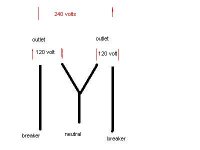
Multi wire is good for long runs, reduces
V drop in some cases, saves wire and numbers of cables, reduces pipe fill. I live in mobile home, before I move in I run 2 new countertop circuits for appliances, was about 60 maybe 70 ft, could use one cable.
 

Attachments

  • multi wire.JPG
    multi wire.JPG
    8 KB · Views: 29
Last edited:

jbberns

Well-known member
Joined
Jan 1, 2012
Messages
105
I assume you are thinking that both conductors are connected together at both ends of the wire. Thats not quite what I meant. The situation I was describing had one of the hot leads come off of a light switch and the other connected to power. At the end of the wire was a light socket (switched) and an outlet (not switched)

What?!?!
 

w1im

Well-known member
Joined
Sep 3, 2011
Messages
169
Location
Western MA
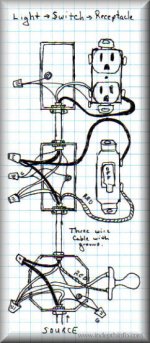
Found a picture that is similar to what I am talking about. The only difference is my source comes into the switch, so the 12/3 is between the switch and outlet, then 12/2 runs from the outlet to the light socket.
 

Attachments

  • light-switch-outlet.jpg
    light-switch-outlet.jpg
    54.6 KB · Views: 29

ElectroLight

Well-known member
Joined
Jan 5, 2011
Messages
494
Location
Rockville, MD
This is the part I don't understand. Isn't regular household current single phase? Or does this mean the 2 separate lines supplying 240v to the subpanel (120v each)? The 180 degrees out of phase makes no sense to me.

Google "center tap transformer", AC circuits are a whole different animal than DC. Best bet is to buy a book and study up on wiring before even thinking of making changes. These shared neutral circuits have the potential of burning the neutral (and the building...) if the supplies are on the same bus bar in the panel.
 

pattenp

Well-known member
Joined
Jun 4, 2008
Messages
10,175
Location
Virginia - USA
This is not a MWBC, it is a 3 wire conductor being used for a switch loop.

Found a picture that is similar to what I am talking about. The only difference is my source comes into the switch, so the 12/3 is between the switch and outlet, then 12/2 runs from the outlet to the light socket.
 

Executive

Well-known member
Joined
Jun 29, 2012
Messages
77
The MOST IMPORTANT thing when using a multi wire branch circuit is to put the red and black wires on ADJACENT POLES in the panel. The easiest and best way to accomplish this is by using a two pole breaker.

Once again, danger is possible with some of the advice offered here. Guys: you need to know what you do not know and call a professional sometimes.


Chris
 

w1im

Well-known member
Joined
Sep 3, 2011
Messages
169
Location
Western MA
This is not a MWBC, it is a 3 wire conductor being used for a switch loop.

I am aware that it is not a MWBC. Thats why I introduced it (a few posts up) as a situation where the neutral carries the sum of the two conductors in the 12/3 wire, not the difference as a MWBC does.
 

pattenp

Well-known member
Joined
Jun 4, 2008
Messages
10,175
Location
Virginia - USA
There is no sum of the two hots if being split from the same circuit when coming from one breaker. If the two hots are being fed from two different breakers from the same side of the buss then you would have a problem of over loading the neutral. Sorry, but I’m a little lost with what point you’re trying to make with using the 12/3 in your example.

Edit: What I'm trying to say is the neutral is not a shared neutral in your example.

I am aware that it is not a MWBC. Thats why I introduced it (a few posts up) as a situation where the neutral carries the sum of the two conductors in the 12/3 wire, not the difference as a MWBC does.
 
Last edited:

jbberns

Well-known member
Joined
Jan 1, 2012
Messages
105
I am aware that it is not a MWBC. Thats why I introduced it (a few posts up) as a situation where the neutral carries the sum of the two conductors in the 12/3 wire, not the difference as a MWBC does.

I don't understand what or why your saying.
 

jbberns

Well-known member
Joined
Jan 1, 2012
Messages
105
The MOST IMPORTANT thing when using a multi wire branch circuit is to put the red and black wires on ADJACENT POLES in the panel. The easiest and best way to accomplish this is by using a two pole breaker.

Adjacent would be across from, correct? That would be same leg. From your post sounds like just the wrong term.
 

Executive

Well-known member
Joined
Jun 29, 2012
Messages
77
The MOST IMPORTANT thing when using a multi wire branch circuit is to put the red and black wires on ADJACENT POLES in the panel. The easiest and best way to accomplish this is by using a two pole breaker.

Once again, danger is possible with some of the advice offered here. Guys: you need to know what you do not know and call a professional sometimes.


Chris

Adjacent would be across from, correct? That would be same leg. From your post sounds like just the wrong term.

Adjacent means next to so I suppose you have a point. However, that is the term used by every textbook, manual, code reference, and diagram for the past 50+ years so I will continue to use it. Note the emphasized text in my original statement above. If you do not understand what it refers to, you should not be doing electrical work.

Chris
 

jbberns

Well-known member
Joined
Jan 1, 2012
Messages
105
Stand corrected. Your definition is correct.

If you do not understand what it refers to, you should not be doing electrical work.

Chris

Thanks for the advice. I'll quit first thing tomorrow.
 
Last edited:
To avoid these ads, REGISTER NOW!
Top Bottom