To avoid these ads, REGISTER NOW!

Sharpening a step drill bit?

OP
B

Beerhippie

Well-known member
Joined
Oct 13, 2023
Messages
9,941
Location
Far NE Oregon
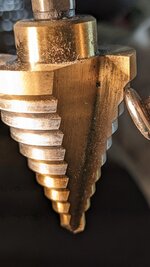
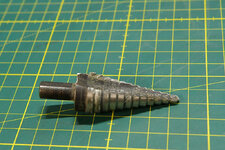
I went back and spent another ten minutes or so trying to get those last three steps sharp. I didn't. The step-bit goes in the "give it to the blacksmith" pile. I asked the drill sharpening guy I took some other bits to today if he sharpened step bits and his answer was "not worth it".

But he does have several of my Forstners and 1/2"-1" bits that should be done early next week. This guy knows his stuff--my 135 split points come back better than new.
 
To avoid these ads, REGISTER NOW!

Sumboodie

Well-known member
Joined
Mar 20, 2021
Messages
10,715
Location
AK
5" Angle grinder sharpens them good enough to finish a hole then trash.

They're like $5 each. I remember when they first came out paying like $40 for one. On $13/hr wages.
 

mreisner

Well-known member
Joined
Jun 25, 2019
Messages
912
Location
North of Detroit
I have been impressed with a Harbor Freight Cobalt step bits. They hold up well and do a good job of cutting. I have a set of Mac step bits and they are lifetime warrantied so I've never tried to sharpen them I just replace it when dull.
 

RTM

Well-known member
Joined
May 13, 2019
Messages
13,222
Location
SF Bay Area
Chuck it up, put a dial indicator on it, watch the diameter decrease as you move away from the cutting edge?

Ok, did it, no change in OD on the bit. My step drill bit has two halves, or flutes.

A real machinist will laugh, but humor a hacker. My only handy indicator had a mushroom head, so tilted it over to use the edge. My only step bit has never been sharpened, used twice on sheet metal.

Set it up on the leading edge of the second largest ring. Zero’d the face. Ran the bit up and down, no change. Turned the bit til the mushroom fell off the leading edge, minimal change until the gullet.

Sorry, the video won't drop in easily for me, see the link above.
PXL_20250228_231722954-XL.jpgPXL_20250228_231737491-XL.jpgPXL_20250228_231740987-XL.jpg

I could buy into that argument @Rusted Nut may be right.

But still, not buying into changing the diameter.
 

Rusted Nut

Well-known member
Joined
Dec 11, 2022
Messages
1,821
Location
Northern Arizona
Ok, did it, no change in OD on the bit. My step drill bit has two halves, or flutes.

A real machinist will laugh, but humor a hacker. My only handy indicator had a mushroom head, so tilted it over to use the edge. My only step bit has never been sharpened, used twice on sheet metal.

But still, not buying into changing the diameter.
Maybe if you had to correct size rotary sharpening stone, one could grind the flute sharp. When I tried it, the only way I could get a good cutting edge was to sharpen the round, which reduced the initial cutting diameter, then the manufactured round would get in the way of the cutting edge and it wouldn’t cut. We got pretty good use out of the step bits, when dull I pitched them and bought new ones. Two years ago I bought a dozen #7 bit for drilling for 1/4— 20 tap holes, still have the original dozen; probably sharpened each one 20 times now.
 

RTM

Well-known member
Joined
May 13, 2019
Messages
13,222
Location
SF Bay Area
Maybe if you had to correct size rotary sharpening stone, one could grind the flute sharp
I would think a rotary stone would need to be a flat surface with a very square edge, almost like a dremel cutting disk, but larger. I would use a Diamond plate, very thin, and do it by hand, and early, so you can knock it out quickly, rather than when it’s really dull.

Certain things you can only sharpen certain faces without messing things up. Auger bits for a brace, scissors, some router bits, and I’m sure there are others too.
 
OP
B

Beerhippie

Well-known member
Joined
Oct 13, 2023
Messages
9,941
Location
Far NE Oregon
As you can see in the "before" picture,

54356610344_12b5d65b5f_b.jpg

Rusted Nut is right. The original profile was made with a wheel (rotary sharpening stone).

I tried using a stone--somehow lost the picture--and the edge profile of the flute is concave. It would take a day or two to flatten it to where a stone (diamond plate) would contact the entire surface.

I tried.
 
To avoid these ads, REGISTER NOW!

RoninB4

Well-known member
Joined
Jul 22, 2020
Messages
3,597
Location
Under My House
Ok, did it, no change in OD on the bit. My step drill bit has two halves, or flutes.
-Ok then the other type of clearance/relief I purposely didn't mention is likely being used as in the image below that's called lip clearance angle which allows only the cutting edge to contact the material first. The way a cutter is made dictates what clearances are used. Either a spiral (radial) type of clearance is used (end mills) a lip clearance, or both. The lip clearance is less expensive to create. It's also found in single flute countersink tools.

1740833362252.png
A real machinist will laugh, but humor a hacker.
-I'm not laughing, you did the testing with what you had and confirmed the geometry of your step drill. Thank you.
But still, not buying into changing the diameter.
-On your step drill and probably other brands it isn't. Other types of cutting tools most certainly do have a reduced diameter because the added clearance is needed. Re-sharpening a step drill via the gullet is possible but would take a long winded explanation of geometry and a drawing for clarity that might incite further "controversy" so I won't go into it here. Suffice to say that re-sharpening is possible with home shop equipment but:
1) it probably won't cut as well as when new
2) isn't worth the cost in the opinion of at least one guy that does this for a living
3) perhaps some of you are making the edge dull from running it too fast for the material being cut

Aaaahhh what do I know, I've only been using/making/sharpening cutting tools on the job for 30+ years.
 
  • Like
Reactions: RTM

dutchgray

Well-known member
Joined
Sep 28, 2014
Messages
6,468
Location
Dorset. England.
I have never bothered to attemp sharpening one, they are cheap, just use a new one, not worth the time (and I own a tool and cutter grinder)
 

Plastikosmd

Well-known member
Joined
Nov 17, 2016
Messages
1,254
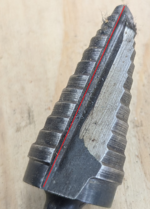
In my world, I'd want to sharpen along the red line, slightly undercutting the existing edge, with my abrasive "coming out of the page". This would push the red face "left", but would not reduce the diameter of the bit. I don't see how this would shrink the bit diameter.

1740722294526.png
That is how I do it. Dremel with a thin grinding wheel or cut off (in a pinch)

Spiral are more tricky

I haven’t bought a bit in years.
 

RTM

Well-known member
Joined
May 13, 2019
Messages
13,222
Location
SF Bay Area
Ok then the other type of clearance/relief I purposely didn't mention is likely being used as in the image below that's called lip clearance angle which allows only the cutting edge to contact the material first. The way a cutter is made dictates what clearances are used. Either a spiral (radial) type of clearance is used (end mills) a lip clearance, or both. The lip clearance is less expensive to create. It's also found in single flute countersink tools.

1740833362252.png

I’m trying to imagine how this would present itself in a step drill. Part of why I measured the vertical face also. Wanna give some more clues?

Thinking it would need to be on the “ down “ face as I measured, a little more height at the leading edge of the gullet, fading till I hit the trailing gullet.

I fully expected to see a few thousands change, as I understand what you are saying, but could not see losing that much to really impact the hole diameter.
 
Last edited:

RoninB4

Well-known member
Joined
Jul 22, 2020
Messages
3,597
Location
Under My House
I’m trying to imagine how this would present itself in a step drill. Part of why I measured the vertical face also. Wanna give some more clues?
-I tried to look up some reading/videos on this but nothing is suitable to post that would clearly explain. The info is there but you have to understand the basics of cutter geometry to glean what's being presented when they used different cutter types. I can create CAD models to illustrate the principles but:

1) It will take me a couple of hours to create the models/drawings and image editing that would help explain. I guess that's ok with me if this helps enough members.

2) What I fail to properly explain/illustrate/model will leave confusion unless those I've failed to reach will use clear images (image editing) of what I present with questions so I can provide clear answers. Everybody learns differently and what's clear to me may not be clear to somebody else so feedback is important. What I want is to help those that want to learn. If I fail to make things understood then I've failed in my intention, clogged the bandwidth with info nobody really gives a sh*t about, and wasted my time.

3) I really don't want to kick up another "controversy" or have a problem the admins have to step in to restore civility. If this is best accomplished in a PM then that's fine, just contact me and we'll go from there. If we can be civil to each other in public then I'll post for anybody that's interested. I don't have the inclination to spend hours creating something if some troll just wants to engage in a ******* contest.

I fully expected to see a few thousands change, as I understand what you are saying, but could not see losing that much to really impact the hole diameter.

-You're correct in your understanding with what you've examined. There are two different types of clearance/relief commonly used. Depending upon the cutter purpose and the way it's made there will be one type, the other, or both. The step drill you have seems to have only the one type but it hasn't been measured yet.
 

RTM

Well-known member
Joined
May 13, 2019
Messages
13,222
Location
SF Bay Area
-I tried to look up some reading/videos on this but nothing is suitable to post that would clearly explain. The info is there but you have to understand the basics of cutter geometry to glean what's being presented when they used different cutter types. I can create CAD models to illustrate the principles but:
Yeah, I'd say don't waste your time. If it was a 5 minute exercise, maybe, but not hours.

Thanks
 
To avoid these ads, REGISTER NOW!
Top Bottom