So i am building a 16 x 20 shed. I am a bit torn on what to do with a foundation. I cannot pour a slab otherwise i would just do that. I have 1/3" acre lot and a septic system and i do not want to risk damaging the leech field. So i was looking at deck piers, concrete blocks or digging holes and using tubes or traditional form work. I am leaning towards digging holes as that seems the most stout, but I live in SC and I do not need to go any deeper than about 6" to beat the frost line. Are the tubes worth it or can i just dig a hole and use of lumber to make a form for whatever height I would like the concrete to extend out of the ground.


You are using an out of date browser. It may not display this or other websites correctly.
You should upgrade or use an alternative browser.
You should upgrade or use an alternative browser.
Shed Foundation
- Thread starter Laucker
- Start date
matt_i
Well-known member
Dont build on the septic drainfield!
That is all.
That is all.
cdestuck
Well-known member
I've built many sheds on all diff foundation types. One I did was for my church and did the 4x4 on a brick in a dug hole. That'll work just fine.
theoldwizard1
Well-known member
If you build it on skids (3 doubled PT 2x8) you can just place it on gravel. Remove the sod about 4-6" deep. Lay down "commercial grade" landscape cloth and then fill with gravel and compact.
If you want a foundation I would use pier blocks.
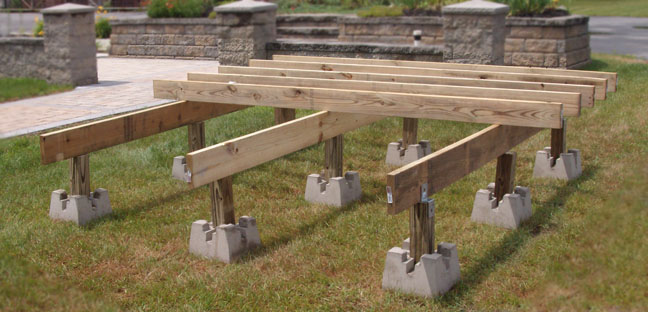
I would go a couple of extra step. Dig down about 12". Add 4-6" of gravel (for leveling) place a 2" thick patio stone and then the pier block.
You want your shed high enough off the ground to provide light and ventilation underneath for prevent "critter" from nesting there !
If you want a foundation I would use pier blocks.
I would go a couple of extra step. Dig down about 12". Add 4-6" of gravel (for leveling) place a 2" thick patio stone and then the pier block.
You want your shed high enough off the ground to provide light and ventilation underneath for prevent "critter" from nesting there !
Last edited:
If you build it on skids (3 doubled PT 2x8) you can just place it on gravel. Remove the sod about 4-6" deep. Lay down "commercial grade" landscape cloth and then fill with gravel and compact.
Wouldn't that be hard to get level? I guess the gravel can be moved around under it until the skids get leveled out.
I think I'd prefer to have it above the ground on concrete piers/forms in case of flooding/heavy rains. Sure it's PT, but water is still bad for wood.
theoldwizard1
Well-known member
I think I'd prefer to have it above the ground on concrete piers/forms in case of flooding/heavy rains. Sure it's PT, but water is still bad for wood.
Concur ! (Note I edited my post !!)
I've built many sheds on all diff foundation types. One I did was for my church and did the 4x4 on a brick in a dug hole. That'll work just fine.
That will be way cheaper...I mean I'm all over over engineering. But I rather spend the money else where. The bricky our talking about.... you mean like the cinder block solid cap blocks?
38Chevy454
Well-known member
If you build it on skids (3 doubled PT 2x8) you can just place it on gravel. Remove the sod about 4-6" deep. Lay down "commercial grade" landscape cloth and then fill with gravel and compact.
If you want a foundation I would use pier blocks.
I would go a couple of extra step. Dig down about 12". Add 4-6" of gravel (for leveling) place a 2" thick patio stone and then the pier block.
You want your shed high enough off the ground to provide light and ventilation underneath for prevent "critter" from nesting there !
I did like this, but way lower to the ground on a shed at an old house of mine. I dug down about 8 inches, placed a 24x24 precast square, and then placed the deck pier on top of that. Then just use your 2x8 floor joists (pressure treated). Add a few internal crossmembers for floor support and a good thick plywood floor. I made my shed 12x16, so I just laid out a pattern with supports every 4 ft. So I had 12 supports total. I only had about 4-6 inches clearance from the joists to the ground, but this also meant only about 1 ft to the floor level. Which worked out better for my riding mower and other wheeled garden equipment.
Also, you did not exactly ask this question, but the Hardie Panel are great for shed siding. Very rot resistant and as long as you plan out dimensions you can minimize cutting hte stuff.
Last edited:
jevoy
Well-known member
I agree with 38chevy454's method. I did my shed very similar to that layout. Make sure to have a support under the doorway. A row or 2 of blocking in between your floor joist helps to solidify and may cut back on your number of supports as well.
theoldwizard1
Well-known member
Sounds like a solid foundation !I did like this, but way lower to the ground on a shed at an old house of mine. I dug down about 8 inches, placed a 24x24 precast square, and then placed the deck pier on top of that.
My experience with sheds built close to the ground is that raccoon, possums and skunks like to nest underneath then.
One way to prevent this is to cut about a 3' wide strip of sod around the outside and roll it back. Use some medium thick fencing (heavier than chicken wire) about 3' high and tack it securely to the outer beam and fold it down and out flat. Roll the sod back in place.
Any animal trying to get under will actually be standing on the fencing while they are digging !
If you do get animals underneath, the solution is moth balls ! Lots of mothballs !
D45
Well-known member
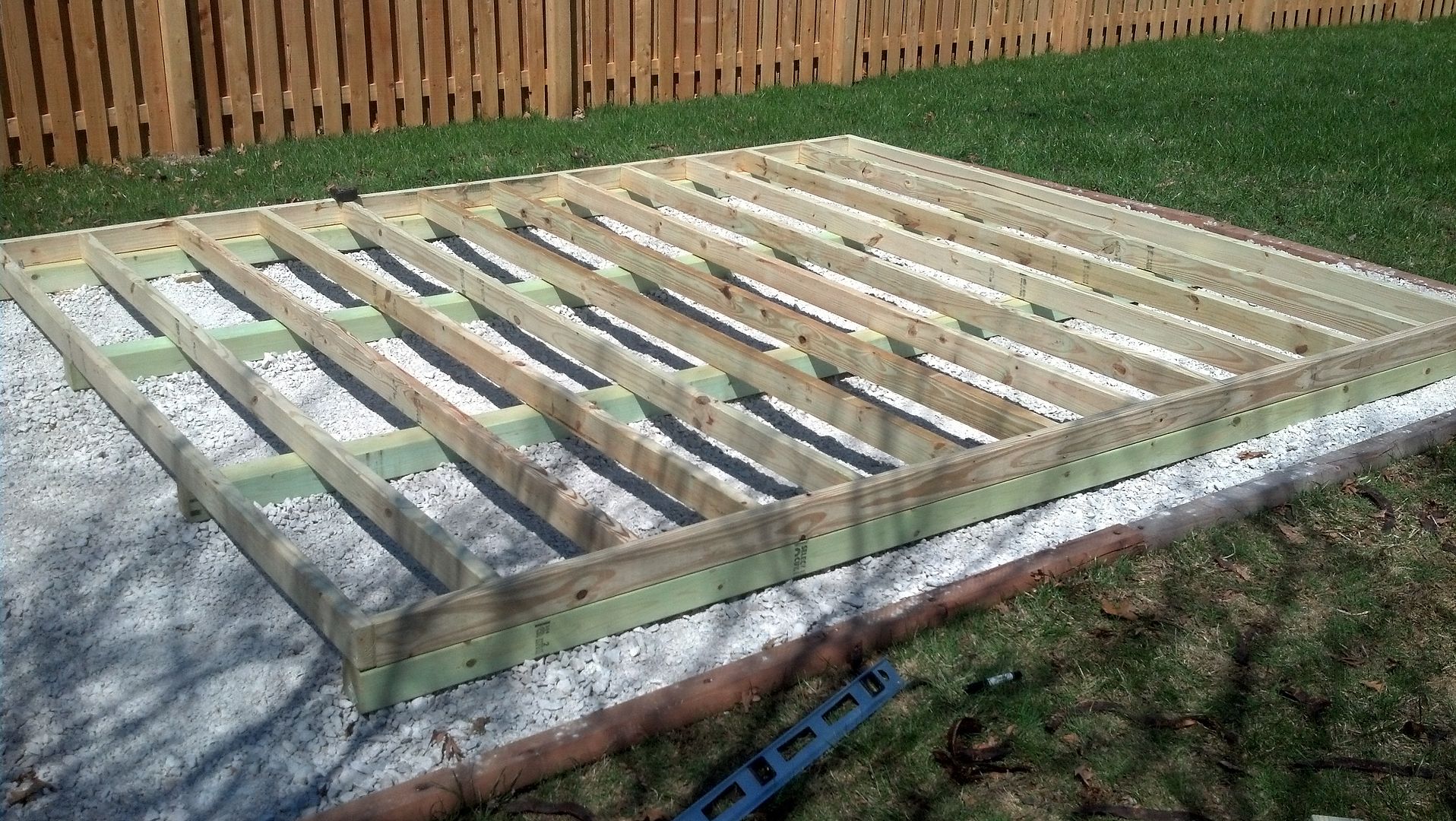
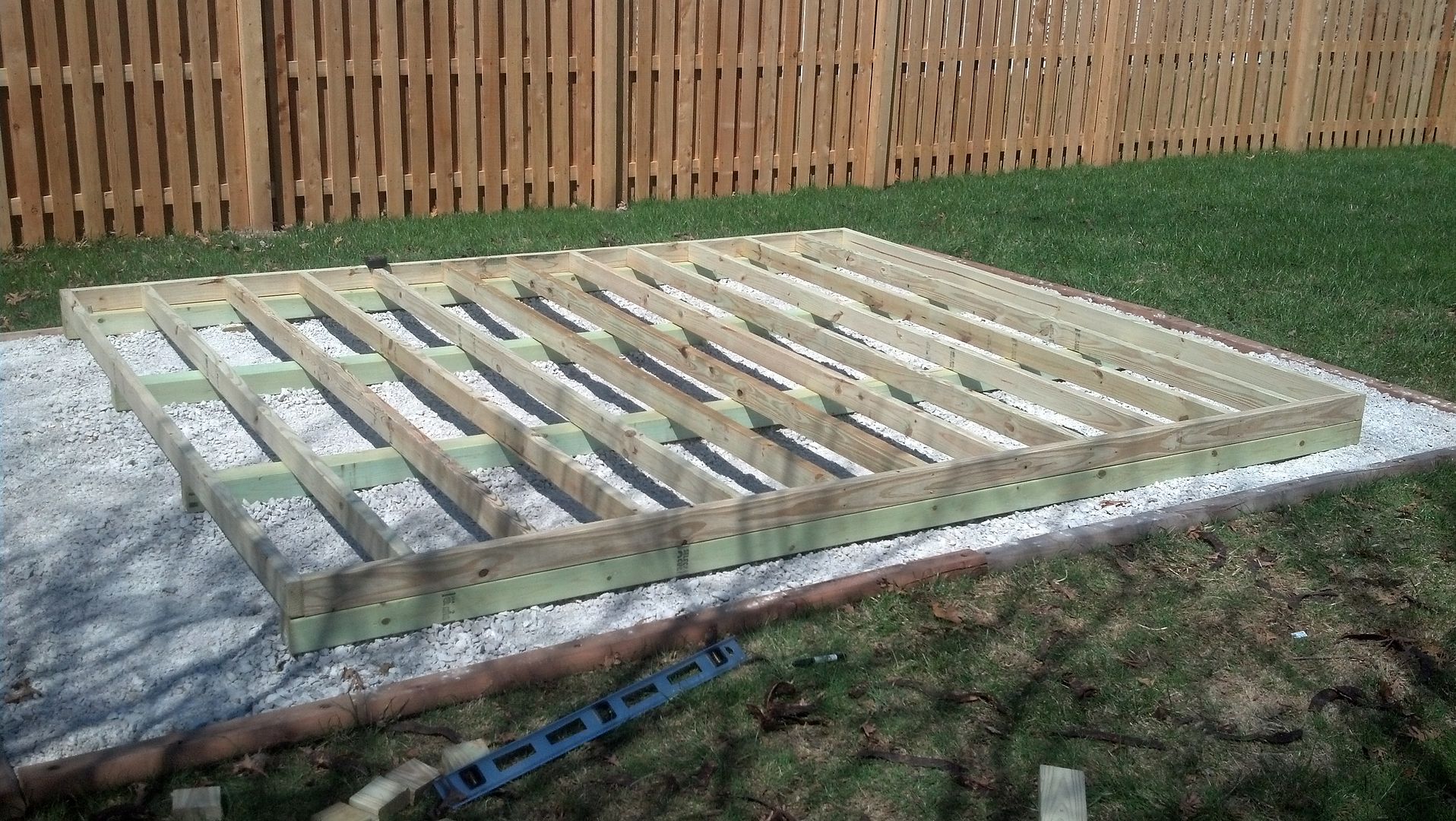
Crush limestone
Once it gets wet a few times with the garden hose is gets pretty solid
Once it gets wet a few times with the garden hose is gets pretty solid
D45
Well-known member
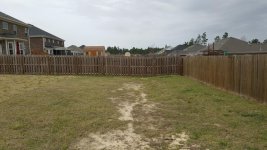
Attached is the area I would like to build. My back yard is sloped for drainage but that's the only area (non grass panted) I can build without interfering with my septic system. The steak driven into the ground represent 5ft set back from the property lines. I was gonna build there and come out 16 ft. Should be a foot or so away from the area that has sod.
Attachments
bczygan
Well-known member
Attached is the area I would like to build. My back yard is sloped for drainage but that's the only area (non grass panted) I can build without interfering with my septic system. The steak driven into the ground represent 5ft set back from the property lines. I was gonna build there and come out 16 ft. Should be a foot or so away from the area that has sod.
If you have a location that is NOT over the septic, then I don't understand why you cannot use a concrete slab?
First, I doubt you will be allowed to build ANYTHING over any part of a septic system. So just don't. You will be pulling permits, right? So check all your zoning regs, design and locate it and pull permits and build.
I would NEVER do anything but a concrete slab unless forced to do so.
What are you using this shed for?
Bill
Kevin54
MEMBER EMERITUS
Do it like D45 shows. I have moved my shed three times and my joist is about the same as D45 is showing except my joist are all 4x4's. I use a gravel base about a foot thick, leveled and compacted using a gas powered plate tamper. BTW....my shed is 12 x 16 in size. It has never moved in the winter through summer with freezing and thawing. My doors have stayed lined up perfectly. The key is to tamp the stoned really good. And you want to make sure you use crushed stone with stone dust....limestone preferably.
theoldwizard1
Well-known member
Attached is the area I would like to build. My back yard is sloped for drainage but that's the only area (non grass planted) I can build without interfering with my septic system.
Build a border like D45 showed in his picture. PT wood is quick, but you need to fasten it to the ground (drill holes and use 3' sections of rebar). The back side will have to be twice as high so that you can make it level. If you want fancy, use garden wall block, but bury the first block about 3/4 deep.
Compacted 3/4" crushed limestone, at least 3" thick, is a GREAT base ! Build a floor frame like D45 and you will have no problems !
Hello I did something similar to what D45 did on my small 8x12 shed. Yes only
8x12. It would have been a lot bigger but my town wants everything under the building codes done if it's bigger then 100 sq feet. I dug two what you call trenches about 1-1-1/2 deep layed retaining wall material inside and filled it with stones. If once you dig and hit clay stop there and pack it before filling with stone. I packed it down I did one for front then for the back. I then used treated 6x6 placed them onto the trenched stones then built a 2x6 onto for floor of shed.
I would say do What D 45 did but use 2x6 lumber as a floor frame.
8x12. It would have been a lot bigger but my town wants everything under the building codes done if it's bigger then 100 sq feet. I dug two what you call trenches about 1-1-1/2 deep layed retaining wall material inside and filled it with stones. If once you dig and hit clay stop there and pack it before filling with stone. I packed it down I did one for front then for the back. I then used treated 6x6 placed them onto the trenched stones then built a 2x6 onto for floor of shed.
I would say do What D 45 did but use 2x6 lumber as a floor frame.
bczygan
Well-known member
One big problem with a wood floor, especially when framed on top of skids, is that the height above grade means you need a substantial ramp for access.
If you don't intend to move the shed, one way to minimize this height is to eliminate the skids and build the floor frame right on the gravel.
This requires that the gravel be perfectly flat and compacted and above surrounding grade for optimum drainage.
It also means that you can use 2x4's for joists. Of course all the framing must be treated.
You can increase the load capability of the floor by spacing the 2x's closely together.
But with all the work and expense, I would just place a concrete slab.
Bill
If you have a location that is NOT over the septic, then I don't understand why you cannot use a concrete slab?
First, I doubt you will be allowed to build ANYTHING over any part of a septic system. So just don't. You will be pulling permits, right? So check all your zoning regs, design and locate it and pull permits and build.
I would NEVER do anything but a concrete slab unless forced to do so.
What are you using this shed for?
Bill
First off I'm not building over any part of my system. Second off I can't pour a slab cause I have 10' clerance between my house an my neighbors fence. Fitting a concrete truck even a 4 cu/yd one will be tight and there is no way they won't run over my leech field. I'm using this for shed stuff, maybe an atv or two.
bczygan
Well-known member
First off I'm not building over any part of my system. Second off I can't pour a slab cause I have 10' clerance between my house an my neighbors fence. Fitting a concrete truck even a 4 cu/yd one will be tight and there is no way they won't run over my leech field. I'm using this for shed stuff, maybe an atv or two.
Then use buggies, pumper truck or even wheelbarrows.
I wheelbarrowed an 8x12 slab uphill 40' away by myself and floated and finished it.
4CY equals only 21 wheelbarrow loads filling a 6CF wheelbarrow to 5CF.
A couple friends, family or day laborers will do it.
Bill
Last edited:
Kevin54
MEMBER EMERITUS
It's not complicated. Just make a gravel ramp into the shed. The last place I had my shed sitting, I just ran a 2x4 frame attached to the front 4x4, dug down out a ways, then filled the frame with gravel. It worked perfectly.
You don't need blocks, you don't need concrete, you don't need a foundation. Just a bed of crushed limestone, a rake, a long level, and a plate tamper.
I'll take pics if you want to see what I have now.
You don't need blocks, you don't need concrete, you don't need a foundation. Just a bed of crushed limestone, a rake, a long level, and a plate tamper.
I'll take pics if you want to see what I have now.
bczygan
Well-known member
Why would you want to do the 4x4s opposed to just using like 2 x8s or whatever and build it on concrete blocks?
Good point.
You COULD simply set a grid pattern of those concrete pier blocks.
Instead of having to excavate the entire shed area and fill and compact the entire area with stone, you would only do it under each individual pier block.
You would set each block at a level with all the others.
Then run your 2x beams across then in one direction and then hang your joists (Going the other direction) from those beams with joist hangers.
Easy peasy. Just need to figure spacing and sizes, which I will do for you in a moment.
The big question is, will your authority allow a structure that big to be constructed without a foundation? Worth checking.
Bill
bczygan
Well-known member
OK,
Let's design your floor system.
The best way to do that is start with the floor sheathing, then size and space the joists. After that we size the beams which also spaces the piers.
Figuring a 50#/SF live load (Which is 10# more than a residential floor) and the typical 10#/SF dead load, a #2 and better hem-fir joist spaced at 16"o.c. (16"o.c. is good for the 3/4" T&G plywood floor sheathing you should use), and figuring a deflection limit of L/180, your 2x6 joists will span 8'-11".
So let us run 2 rows of 8 footers in the 16' direction.
This means you need 3 rows of beams running in the 24' direction.
Let's use 2 12' ones in each of the 3 rows of beams.
Now, let us size the beams. The more support piers you have, the smaller the beams must be, but there is a happy medium, where you don't have too many pier blocks to excavate for and set, yet the beams don't get too tall. Not that the joists hang off the side of the beams, rather than sit on top, so the height of the floor above surrounding grade is minimized. Also note that at one corner of where the structure sits, where the grade is highest, pier blocks here can just protrude above grade, with blocks elsewhere being more exposed as grade drops off.
So on to sizing. A beam is sized by the load of the contributing area it supports. The middle row of beams in this case, have the largest contributing area, so if we design for this condition, it will adequate for all of our beams. The middle beam has a contributing area of 8SF times the total load of 60#/SF, or a load of 480#/LF (Lineal foot). A hem-fir 2x8 will support 316#/LF at L/360 if pier supports are spaced at 6' o.c. so we need a doubled 2x8 beam for this center row of two beams. Since the outside beam rows have half the contributing area, they have half the load, and could possibly use a single 2x8. But that would only be true for a deck. Here we have walls and a roof sitting on these beams, so a double 2x8 should be used here as well. In fact, the first row of joists on each 16' end should also be 2 2x8's.
So you end up with 3 rows of piers spaced 8' apart and with piers spaced 6' apart along the beams. A total of 15 piers, which isn't unreasonable for this size structure.
Bill
Let's design your floor system.
The best way to do that is start with the floor sheathing, then size and space the joists. After that we size the beams which also spaces the piers.
Figuring a 50#/SF live load (Which is 10# more than a residential floor) and the typical 10#/SF dead load, a #2 and better hem-fir joist spaced at 16"o.c. (16"o.c. is good for the 3/4" T&G plywood floor sheathing you should use), and figuring a deflection limit of L/180, your 2x6 joists will span 8'-11".
So let us run 2 rows of 8 footers in the 16' direction.
This means you need 3 rows of beams running in the 24' direction.
Let's use 2 12' ones in each of the 3 rows of beams.
Now, let us size the beams. The more support piers you have, the smaller the beams must be, but there is a happy medium, where you don't have too many pier blocks to excavate for and set, yet the beams don't get too tall. Not that the joists hang off the side of the beams, rather than sit on top, so the height of the floor above surrounding grade is minimized. Also note that at one corner of where the structure sits, where the grade is highest, pier blocks here can just protrude above grade, with blocks elsewhere being more exposed as grade drops off.
So on to sizing. A beam is sized by the load of the contributing area it supports. The middle row of beams in this case, have the largest contributing area, so if we design for this condition, it will adequate for all of our beams. The middle beam has a contributing area of 8SF times the total load of 60#/SF, or a load of 480#/LF (Lineal foot). A hem-fir 2x8 will support 316#/LF at L/360 if pier supports are spaced at 6' o.c. so we need a doubled 2x8 beam for this center row of two beams. Since the outside beam rows have half the contributing area, they have half the load, and could possibly use a single 2x8. But that would only be true for a deck. Here we have walls and a roof sitting on these beams, so a double 2x8 should be used here as well. In fact, the first row of joists on each 16' end should also be 2 2x8's.
So you end up with 3 rows of piers spaced 8' apart and with piers spaced 6' apart along the beams. A total of 15 piers, which isn't unreasonable for this size structure.
Bill
Last edited:
bczygan
Well-known member
That all sounds good and goes along with my plan. Why would I know just get 2x10 for the sides/middle and 2 x 16's for the ends?
Don't understand quite what you are trying to say. But you could certainly use single 2x10's for all your beams.
Bill
Last edited:
LS6 Tommy
Well-known member
Mine is similar to D45's pic, but the 4 x 4's sit up on pavers. No slab. Around here, if a slab is used it's considered a permanent, taxable building. No gravel or weed block under mine. The grass died quickly and nothing has grown under it since. It's a little higher up for better air flow (no moisture problems or wood rot) and that also deters critters from thinking it's a good place to live. No permanent ramp to trip over. I used a 2 x 8 truck ramp kit. I hang the ramps on a nail inside the shed. They just get dropped on the edge of the door threshold to move heavy stuff like the snow blower.
Tommy
Tommy
Last edited:
Kevin54
MEMBER EMERITUS
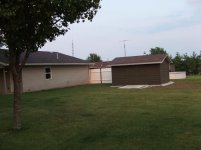
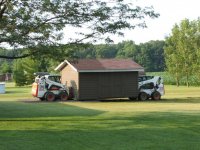
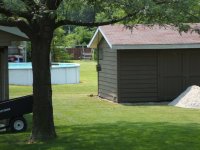
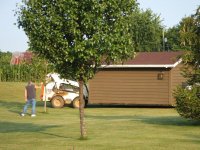
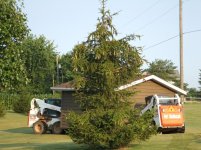
Here are some pics of moving the shed. This shed has been moved three times, three different ways. One time was with a wrecker with grappling hooks, this shows the skidsteers, and the last time (I have to find pics) was with a rollback. Every time, the shed was set on a base of gravel. And lifting the shed like it has been lifted shows how strong the shed is. Like I said, it's a 4x4 frame for the floor. 4x4's around the perimeter and 4x4 joist at 16" on center. The floor is tongue and groove pine screwed down with deck screws. the rest of the shed, including the roof rafters are all 2x4 construction. It's hard to tell, but the sod was taken out and the ground was dug down so we could put about a foot of gravel and level it. You can see where I put a ramp to the door. The shed had set in that spot for about 8 years until I decided to move it again.
Attachments

Last edited:
Kevin54
MEMBER EMERITUS
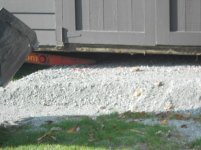
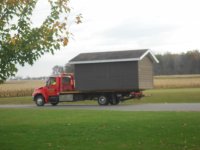
Found the other pics on the wife's computer. This was moving it with a rollback onto a bed of stone. After the shed was set, I extended the stone out to make a ramp up to the door like I did in the other previous set of pics. I don't have live loads figured out or anything like that, but I do know that the shed will withstand a hell of a lot. I live in Ohio, so it's been buried in snowm it's been all over the yard many of times by many means, and it has yet to twist, warp, leak, or come loose anywhere.
The only thing you want to make sure you do is to check and see what the maximum size you are allowed to build without a building permit. Then get some crushed limestone, level it out, compact it, and start building. BTW.....my shed is only 7' high at the walls. High enough to move around in there but not tall enough for overhead storage. If I would build another one, I would go with 8' tall walls, or else build a gambrel style of shed and put in a half loft for additional storage. My buddy has one like that and he has all sorts of overhead storage.
The only thing you want to make sure you do is to check and see what the maximum size you are allowed to build without a building permit. Then get some crushed limestone, level it out, compact it, and start building. BTW.....my shed is only 7' high at the walls. High enough to move around in there but not tall enough for overhead storage. If I would build another one, I would go with 8' tall walls, or else build a gambrel style of shed and put in a half loft for additional storage. My buddy has one like that and he has all sorts of overhead storage.
Attachments



Last edited:
bczygan
Well-known member
Sorry, My brain was not functioning. I was taking about the length, IE 2 x 8 x 10s for the sides and middle and 2 x 8 x 16's for the ends.
and I got mixed up on the length of the building. I thought it was going to be 24' long. So your piers can now be spaced 5' apart.
Bill
Last edited:
my shed is only 7' high at the walls. High enough to move around in there but not tall enough for overhead storage. If I would build another one, I would go with 8' tall walls, or else build a gambrel style of shed and put in a half loft for additional storage. My buddy has one like that and he has all sorts of overhead storage.
I built a shed for my mom at her new house. It's a small shed, but I built a ton of shelving in it. There are 3 large and heavy duty shelves towards the rear of the shed so that large bulky stuff could be back there. And then there are shelves on each side. And I built workbenches on either side which can be used for storage (stuff placed on top and below). The workbenches are made of 2x4's and I put in shelves below them (attached to the 2x4's).
My mom was surprised that it swallowed up all the crapton of her stuff and still there's a nice open spot in there so you can walk around. I didn't even need to place any items on one of the workbenches, so I mounted a small cheap vise on it to use on projects. And I installed pegboard on door to hang small misc. items.
I ran an extension cord out there so I could listen to music. I put a chair outside of the shed and would sit there and have a beer or 2.

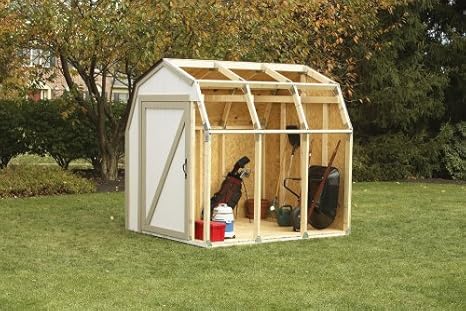
It was a 2x4Basics kit -- super easy to built. It has about 50 metal brackets that connect all the 2x4's together. And the instructions are super easy to follow. It tells you what length to cut all your lumber and how many of each. Then you label them and start building. A 1/4" impact driver, a chop saw, a level, tape measure, speed square, etc. is all you really need. I used Hardiboard for the siding. I built the smallest one -- 7'x8', but you can also buy 2 or 3 kits to double or triple the size, and the instructions have different sections in case you want to build the larger sizes. I used torx fasteners which are way better than Phillips or slotted.
The instructions say to use PT lumber for the floor so you can sit it on any level surface, but I went ahead and built a foundation out of piers for it.
Last edited:
bczygan
Well-known member
What would you guys recommend for shimming on the piers to make everything level. I heard singles are a good go to, any other recommendations?
Set them level. No shims.