To avoid these ads, REGISTER NOW!

shed foundation

truckman5000

Well-known member
Joined
Mar 11, 2008
Messages
1,440
Hi,
Im having a shed brought in, it comes on skids 10x16

? is:
I was going to build a crushed stone base.

The builder recommends them on blocks, with the shed over the dirt instead of stone. Said " moisture collects in the stone"...
 
To avoid these ads, REGISTER NOW!

LS6 Tommy

Well-known member
Joined
Dec 27, 2013
Messages
26,162
Location
Northern NJ
Hi,
Im having a shed brought in, it comes on skids 10x16

? is:
I was going to build a crushed stone base.

The builder recommends them on blocks, with the shed over the dirt instead of stone. Said " moisture collects in the stone"...

Mine's done the way your builder recommended. My builder recommended not to use stone because the shed will settle.

Tommy
 

txvwnut

Well-known member
Joined
Jan 1, 2015
Messages
7,601
Location
Bedford, Texas
Mines on blocks too, but I'm having settling issues due to me being sandy soil.

I don't think it's an issue with the stone collecting moisture as when it's compacted it lets it drain slower.
 

gregtwojeeps

Well-known member
Joined
Jul 30, 2013
Messages
5,096
Location
Ky
The guy's built the 8' x 12' shed at the house we moved from, by laying
4" x 4" CCA posts on 4"x 8" x 16"' solid cap block. Then, they laid 2"x4"'s across them upright on 16" o.c. with 1/2" cdx plywood floor deck.

I loaded that shed to the gills and the double doors never sagged or bound ....and the floor was not on the dirt. No riding mower in it, just a push mower, tiller, hoes, shovels, rakes, snow blower, gas trimmer, chainsaw, and 5500 watt gen along with every wall covered with bins full of hardware, cans, chains etc. .
 
Last edited:

CJ7VFR

Well-known member
Joined
Jan 13, 2015
Messages
2,939
Location
Central New Jersey
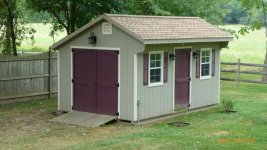
I have that exact same size shed as you, 10x16. It was built by the Amish in Lancaster PA and delivered to my house.

In my area you need permits for sheds, which are cheap and only cost $50.00. One of the requirements of a shed foundation is that it has to be either a solid foundation (concrete) or made of pressure treated wood (6x6's) which have to have 3/4 inch gravel in there that is at least 5 inches deep to keep out critters. Yes, the shed permit uses the word "critters"!

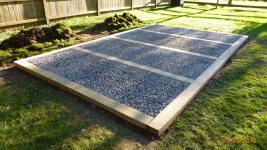
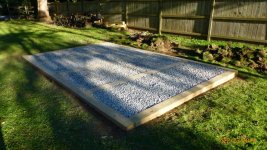
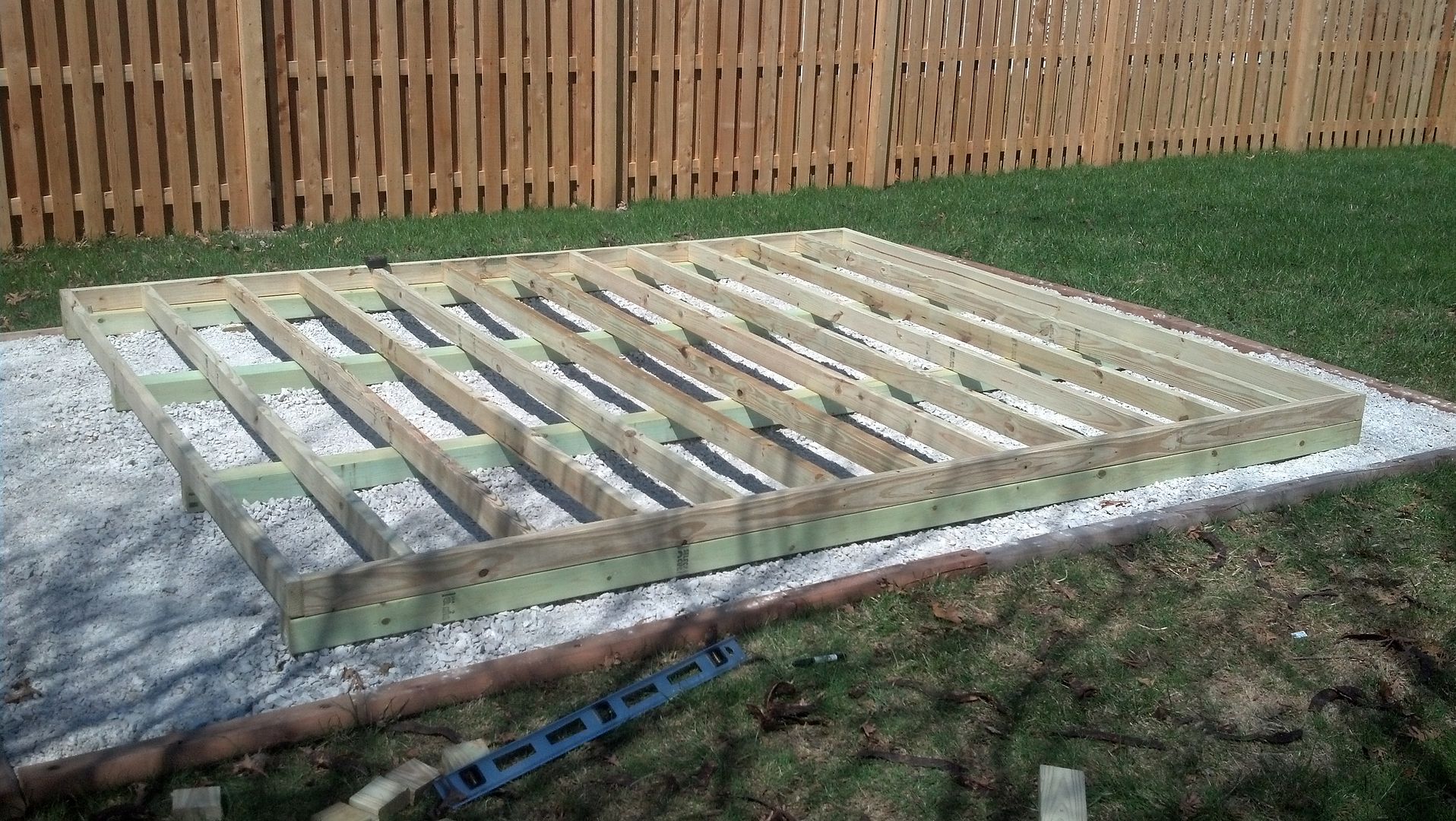
Anyway, what I did was I built a frame work out of the pressure treated 6x6's and then filled in the areas inside the frame work with 3/4 inch gravel that I compacted down nice and tight. The only difference I made with mine was that I have the 4x4 skids that are installed on the bottom of the shed sitting right on the 6x6's and stone.

I did this for two reasons. One was the settling issue. Since I tied all the 6x6's together with brackets and bolts, if they settle, it will not be much, and it will all want to settle at the same time.

The second reason was that I didn't want the shed skids to sit right on the gravel only because of any possible moisture that might be there.

When the township came out to inspect the shed, the inspector said it looked really good, and that he will make sure other people can have the option of doing that. The other thing that was cool was that when the Amish guy came to deliver the shed, he had to drive the trailer wheels part way onto my foundation, and his exact comment was "Your base didn't move much when I put the wheels on it. You did a fine job".

Coming from and Amish craftsman, I was honored.

Here are a few pics of my foundation for reference.

Jim
 

Attachments

  • P1010256.jpg
    P1010256.jpg
    153.4 KB · Views: 161
  • P1010257.jpg
    P1010257.jpg
    153 KB · Views: 139
  • P1030389.jpg
    P1030389.jpg
    152.8 KB · Views: 137

jd_1138

Well-known member
Joined
May 8, 2013
Messages
17,042
Location
NE Ohio
I'd get a concrete pad poured (shouldn't be too much). And still use PT wood for the base wood. Kinda overkill but a nice belt and suspenders approach. Or just use piers or pour some footings using forms.

Be sure to make sure a pad is allowed under zoning. They may require the building to be portable.
 
Last edited:

theoldwizard1

Well-known member
Joined
Feb 22, 2011
Messages
43,106
Location
SE MI
Even on skids, you are better off having a gravel base.

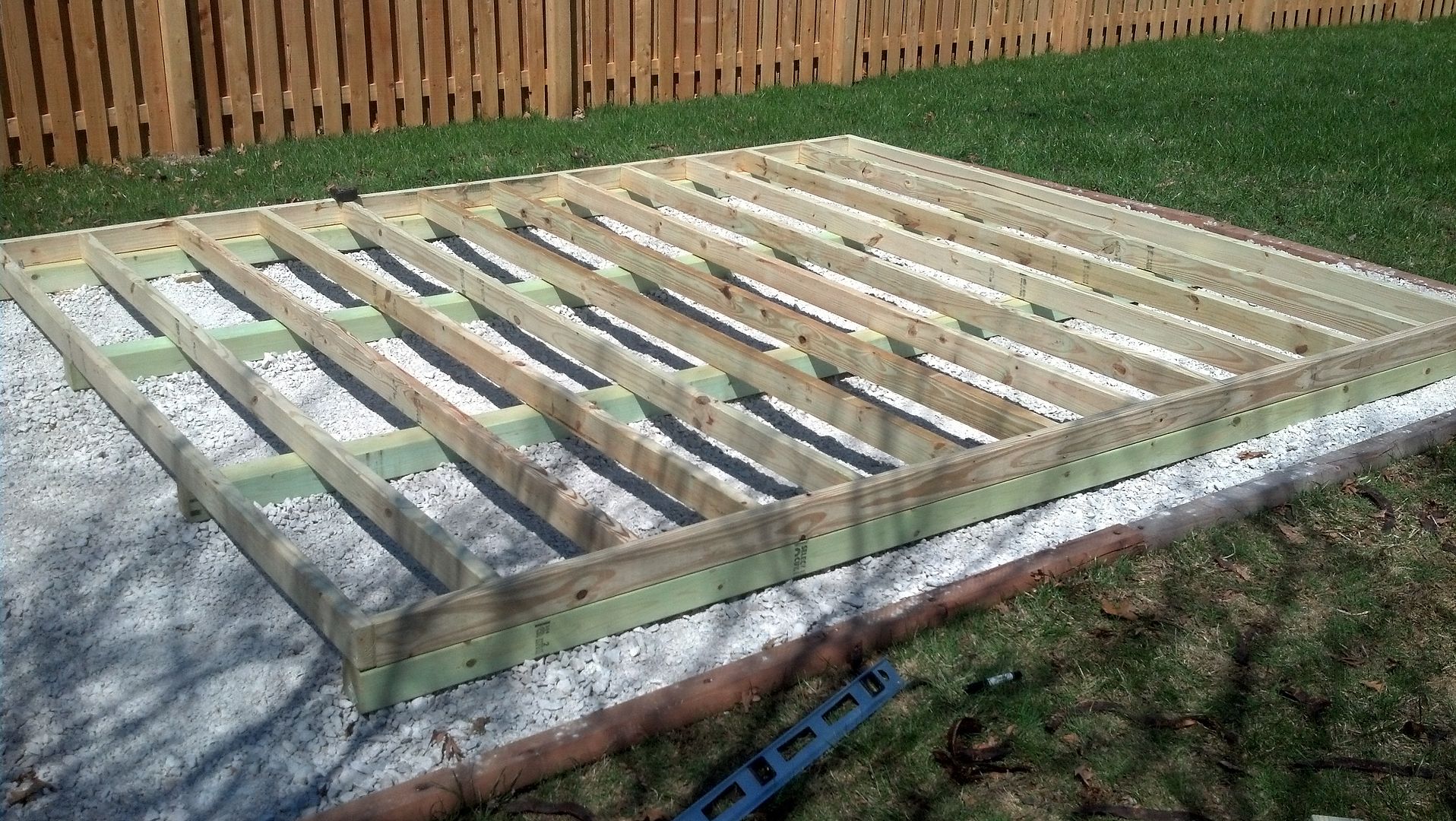
Remove sod on top soil down about 6". Make the area >1' larger on all sides. Add gravel/crush limestone. Round gravel (river rock/pea gravel) looks nice, but it will not compact well. Crushed lime stone can be compacted with a hand tamper and give you a more solid feeling base.
 

tcianci

Well-known member
Joined
Feb 7, 2009
Messages
4,242
Location
Walpole, Ma
The reason for the gravel is that moisture migrates out of the ground. The moisture condenses on surfaces that are lower in temperature than the dew point. An ample bed of crushed stone provides a tremendous amount of surface area of a surface impervious to water and that has excellent heat conducting capabilities.

In English, the moisture from the ground condenses on the stone which has multiple air paths through it allowing normal air currents to evaporate the humidity before it ever reaches the wood frame of the building. It has nothing to do with support or weight bearing capability. It doesn't even need to be compacted, sufficient stone on grade or better yet on undisturbed ground after the topsoil is removed merely transmits the load of the building to the ground below.

The thickness of the bed of stone (gravel as some call it) is necessary to keep the stone from wanting to shift to the side as weight is applied, that's the direction to be concerned about, the stone doesn't compress, it transmits the weight of the structure to the soil below.
Admittedly, building footings for skyscrapers is somewhat more involved, many people around here can't tell the difference so they waste time and money buy not being able to match the technique to the task.

The photo that CJ7 posted illustrates what not to do for a shed foundation: The building is either footed on the PT or the stone, not both. Also the PT perimeter restricts air flow through the stone. Finally whether the PT in the footing or the PT in the skids of the building fails, it's about the same amount of work: you're under a building a few inches off the ground trying to replace rotted stuff.
 
Last edited:

D45

Well-known member
Joined
Mar 21, 2014
Messages
4,834
Location
NW INDIANA
Crushed limestone base here. No issues
IMG_20140426_143201_947_zpsmxj9lreq.jpg


IMG_20140426_143207_556_zpsmv1gnlot.jpg
 

LS6 Tommy

Well-known member
Joined
Dec 27, 2013
Messages
26,162
Location
Northern NJ
I have that exact same size shed as you, 10x16. It was built by the Amish in Lancaster PA and delivered to my house.

In my area you need permits for sheds, which are cheap and only cost $50.00. One of the requirements of a shed foundation is that it has to be either a solid foundation (concrete) or made of pressure treated wood (6x6's) which have to have 3/4 inch gravel in there that is at least 5 inches deep to keep out critters. Yes, the shed permit uses the word "critters"!

Anyway, what I did was I built a frame work out of the pressure treated 6x6's and then filled in the areas inside the frame work with 3/4 inch gravel that I compacted down nice and tight. The only difference I made with mine was that I have the 4x4 skids that are installed on the bottom of the shed sitting right on the 6x6's and stone.

I did this for two reasons. One was the settling issue. Since I tied all the 6x6's together with brackets and bolts, if they settle, it will not be much, and it will all want to settle at the same time.

The second reason was that I didn't want the shed skids to sit right on the gravel only because of any possible moisture that might be there.

When the township came out to inspect the shed, the inspector said it looked really good, and that he will make sure other people can have the option of doing that. The other thing that was cool was that when the Amish guy came to deliver the shed, he had to drive the trailer wheels part way onto my foundation, and his exact comment was "Your base didn't move much when I put the wheels on it. You did a fine job".

Coming from and Amish craftsman, I was honored.

Here are a few pics of my foundation for reference.

Jim

Around here, if you pour a slab or foundation the shed gets taxed as "living space". IDK why the permit requires stone for "critters". It does ZERO to deter them. They dig right through it...

Tommy
 
To avoid these ads, REGISTER NOW!

CJ7VFR

Well-known member
Joined
Jan 13, 2015
Messages
2,939
Location
Central New Jersey
Around here, if you pour a slab or foundation the shed gets taxed as "living space". IDK why the permit requires stone for "critters". It does ZERO to deter them. They dig right through it...

Tommy

That is why I didn't go with a poured foundation. If it was what they deemed "permanent", like a concrete slab, then the shed would have been added to my tax assessment. The alternative was to use 6x6's as a frame and then filled with 3/4 inch gravel. That type is considered "non-permanent".

And I asked the local zoning guy about the gravel and "critters". He said that a gravel base of at least 5.5 inches helps to deter critters and sometimes even ground hogs from trying to dig to make their borrows. Apparently at that depth of gravel they don't like the feeling and they must get tired of digging in stuff that beats up their paws.

The zoning officer did state that nothing is guaranteed, and that I should check the base from time to time to make sure no critters or ground hogs got under there.

The actual permit I have for the shed states that any "non-permanent" foundation has to contain no less than 5.5 inches of 3/4 crushed gravel. That is why he recommended the 6x6's, since they are about that size.

Jim
 
Last edited:

CJ7VFR

Well-known member
Joined
Jan 13, 2015
Messages
2,939
Location
Central New Jersey
.....The photo that CJ7 posted illustrates what not to do for a shed foundation: The building is either footed on the PT or the stone, not both. Also the PT perimeter restricts air flow through the stone. Finally whether the PT in the footing or the PT in the skids of the building fails, it's about the same amount of work: you're under a building a few inches off the ground trying to replace rotted stuff.

I am a bit confused by your reply.

My gravel base is made pretty much the same way everyone else who has a shed with this type base makes them.

Mine is a frame of pressure treated wood (6x6's) that surround the gravel to keep it from moving. See D45's picture. He made a pressure treated wood base and then filled that base with gravel.

My shed is then placed on top of the gravel with the same amount of air flow to the gravel under the shed as any other shed that is placed with the pressure treated skids on the bottom of it, directly on top of the gravel. The air flow is created by the shed skids making pathways under the shed to allow air to circulate. Mine has the same thing.

The only difference in my construction is that besides placing the shed skids directly into the gravel, that I also have them resting on the 6x6's. I can't tell you how many times I have seen sheds that are a few years old that were placed on just the gravel, and over the years the sheds have sunk into the gravel, some to the point where the underside of the shed floor is actually now sitting on the gravel! In those cases there is zero air flow.

I wanted to avoid that.

If the foundation I made for my shed is incorrect as you say, can you tell me a bit more as I am curious, since I have the same amount of air flow under the shed as most people do, and I wanted to help keep my shed from sinking into the gravel, so I also placed it onto the 6x6's as well.

Thanks for your input. I do appreciate it, and if I truly did make a mistake, I would like to know so that if it ever fails, I will correct it.

Jim
 
Last edited:

LS6 Tommy

Well-known member
Joined
Dec 27, 2013
Messages
26,162
Location
Northern NJ
That is why I didn't go with a poured foundation. If it was what they deemed "permanent", like a concrete slab, then the shed would have been added to my tax assessment. The alternative was to use 6x6's as a frame and then filled with 3/4 inch gravel. That type is considered "non-permanent".

And I asked the local zoning guy about the gravel and "critters". He said that a gravel base of at least 5.5 inches helps to deter ground hogs from trying to dig to make their borrows. Apparently at that depth of gravel they don't like the feeling and they must think it will go on like that forever.

The zoning officer did state that nothing is guaranteed, and that I should check the base from time to time to make sure no ground hogs got under there.

Jim

My BIL's sheds are both on about 6" of 3/4". He has about 5 groundhogs living under them...

Tommy
 
Last edited:

CJ7VFR

Well-known member
Joined
Jan 13, 2015
Messages
2,939
Location
Central New Jersey
My BIL's sheds are both on about 6" of 3/4". He has about 5 groundhogs living under them...

Tommy

He must have big ground hogs!!!

That is what the zoning officer said also. That the gravel might deter them, but if they want in, they get in.

I think the best deterrent to them is a dog....

Jim
 

LS6 Tommy

Well-known member
Joined
Dec 27, 2013
Messages
26,162
Location
Northern NJ
He must have big ground hogs!!!

That is what the zoning officer said also. That the gravel might deter them, but if they want in, they get in.

I think the best deterrent to them is a dog....

Jim

I think the best deterrent is to have your shed high enough and clear underneath so as to not be an inviting potential "cave".

Tommy
 

tcianci

Well-known member
Joined
Feb 7, 2009
Messages
4,242
Location
Walpole, Ma
I guess that I was too harsh in calling it "not what to do" It's just overkill of gravel that's all. The gravel between the PT doesn't really do anything, your shed is in essence transferring its weight to the PT and then to the gravel. The stuff in the middle looks nice though.

In any type of foundation, the idea is to spread the load of the building over enough area so that it doesn't settle, that's why you see sheds on blocks sinking into the ground if there aren't enough blocks to distribute the weight of the building, this is especially true if the blocks are oriented with the cores vertically.
 
Last edited:

Electric

Active member
Joined
Nov 19, 2015
Messages
25
Location
Kingston, Ontario, Canada
I used six Redi-footings, which use Schedule 40 PVC (sewer) pipe as structural members. My shed is 9x12', which was the maximum size I could build without a permit.

With the Redi-footings, you just excavate a hole below the frost line (48" where I am), put in the foot with the pipe, and backfill. After you have installed all the footings, you shoot a horizontal line with a rotating laser level to mark the pipes, then you cut them all off and install brackets that take 4x4" posts as beams. At that point, each footing will take an incredible amount of weight, I think it is around 10 000 lb.

2016.07.05.jpg

Shed.2016-2.jpg

Shed.2016-5.jpg

Shed.2016-10.jpg

Shed.2016-11.jpg

Shed.2016-12.jpg
 

jd_1138

Well-known member
Joined
May 8, 2013
Messages
17,042
Location
NE Ohio
Wow, Electric, that's a beautiful little structure (built to house standards). If It were twice the size, I could live nicely in that. :)
 

chruler

Well-known member
Joined
Oct 31, 2014
Messages
1,508
Location
Vermont
I leveled 24 cinder blocks and built my floor, 12 x 16 with 2 x 8's on 16" centers and 3/4" plywood 20 years ago.
I used wood sealer on all the lumber and underside of the plywood, and sealed the ends after each saw cut.

The floor still feels solid as the day I built it.
 
To avoid these ads, REGISTER NOW!
Top Bottom