To avoid these ads, REGISTER NOW!

Sheet metal surface for workbench?

old_smokey

Well-known member
Joined
May 16, 2018
Messages
409
Location
Manitoba
I've got 1/8" steel with a 90 bent at the back for a back splash, and bent down of the front edge of my bench. Been five years now. I've built engines and beat on all sorts of stuff on that bench. It is exactly as smooth and perfect as day 1. Just mild hot-rolled steel. The mill scale has kept it rust-free. I just give it the occasional WD40 wipe-down when cleaning up the shop. I did leave a bottle of muriatic acid on it once, and that ate through the mill scale the way a coffee cup mug stains a counter.

Under the steel I put some 3/4" plywood, then a thin layer of hardboard and bonded the steel to it with contact cement. That was sorta tricky to instal, but a helping hand made it much easier. It also deadened the sound output.
 
To avoid these ads, REGISTER NOW!

4 Ever-Fish N

Well-known member
Joined
Jul 20, 2011
Messages
350
Location
Deep East Texas
I used to build custom work benches. I know that 16 gauge (1/16") is as light as you want to go.
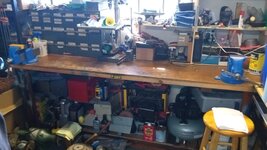
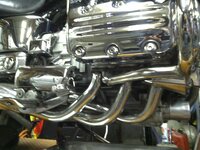
I do not recommend stainless. If you need stainless steel, that is a different situation. Stainless will show a mark every time your touch it. I call the marks, personality. I do not have stainless tops in my shop. My favorite workbench has hydraulic lift cylinders. I can go from 3" to almost 48". It is made with 14 gauge steel diamond plate. I have a half sheet of hot rolled steel that I put on the bench to give a flat surface. (pictures 2&3)
Google for METAL SUPERMARKET. They are in over 100 locations across North America.
Sounds like a good idea on the metal. Love the bike. Can't enlarge so not sure what it is. Valkarie?
 

isb cornbinder

Well-known member
Joined
Nov 3, 2010
Messages
7,073
Location
Pacific South West, BC, Canada
Yes, 24ga is way too thin. Ever been around a carport, or an old tin shed? That's about the thickness.

I'd go as thick as you can possibly go (smaller number), preferably 1/8" (10-11ga).

You don't have to bend it on 90's either. Have it cut the same size as your top now, center it up, and screw it down. Drill, countersink, and the screwheads will be flush with the top.
If I may, I would suggest the top should be made about 4 inches wider for overhang. This gives a good place to clamp to.
 

Jim greengo

Well-known member
Joined
Sep 3, 2018
Messages
7,415
Location
Behind my house
If you're going to mount it over the top of the wood I'd say 16-18g is plenty heavy for normal use,if you have them put a back on it maybe have them throw a little cross break on there to stiffen it up a little.
Stainless weighs more than galvanized,harder to work with/repair if something happens to it.
 

LopezBart

Well-known member
Joined
Oct 13, 2023
Messages
2,519
Location
Lopez Island, WA
I've always found a sheet of tempered hardboard (Masonite) is a good workbench cover, and is readily and cheaply replaced when it gets damaged. Otherwise, a steel sheet over a solid wood top works pretty well; it doesn't have to be that thick - 18 gauge is likely fine.
 

isb cornbinder

Well-known member
Joined
Nov 3, 2010
Messages
7,073
Location
Pacific South West, BC, Canada
If you're going to mount it over the top of the wood I'd say 16-18g is plenty heavy for normal use, if you have them put a back on it maybe have them throw a little cross break on there to stiffen it up a little.
Stainless weighs more than galvanized, harder to work with/repair if something happens to it.
The cross break is a bad idea. Two things. The working surface is no longer flat, 2) the sheetmetal will not lay flat on the workbench. I used to build work benches for an engine tear-down business. The cross break worked well for collecting oil for the drain.
 

ZRX61

Well-known member
Joined
Aug 15, 2006
Messages
28,716
Location
Solar Blight Valley, SoCal
I've always found a sheet of tempered hardboard (Masonite) is a good workbench cover, and is readily and cheaply replaced when it gets damaged. Otherwise, a steel sheet over a solid wood top works pretty well; it doesn't have to be that thick - 18 gauge is likely fine.
I was looking at the masonite on my bench just today & realized that it's probably been on there 20 years. Under it is a sheet of ply & under the ply are 2x10's. I did give it a coat or two of varnish back when it was new.

IMG_20231030_144658604.jpg
 

Jim greengo

Well-known member
Joined
Sep 3, 2018
Messages
7,415
Location
Behind my house
The cross break is a bad idea. Two things. The working surface is no longer flat, 2) the sheetmetal will not lay flat on the workbench. I used to build work benches for an engine tear-down business. The cross break worked well for collecting oil for the drain.
I said to cross break the back if you fold it up to stiffen it up a little,not the work surface area.
 

bwringer

Well-known member
Joined
Jan 1, 2013
Messages
10,245
Location
Indianapolis
I'd personally avoid galvanized as I wouldn't want to be breathing bad fumes if I heated the metal. Keep the normal finish from a cold/hot rolled product and it should last well with minimal maintenance; just be sure to never leave standing water on the surface. You can easily clean up rust with a grinder but once the hard finish from the rolling process is gone your maintenance could increase.

Same. The zinc on galvanized steel is a bit of a serious but hidden hazard, and I would never want to use it for a general garage work surface.

Bad Things can also happen with zinc (and aluminum) if you use or spill common acids like battery acid or vinegar. And zinc can react with and contaminate other materials in sometimes unexpected ways.

In a former office, we had a gigantic conference table with a galvanized top made by a local sheet metal company, and an artsy base we made with plywood covered in tile. It had a cool retro-industrial sort of look, but obviously it wasn't used with chemicals. We had a wax/cleaner spray we used to keep it protected and clean so the coating stayed fairly bright. Still, we were told not to leave things sitting on the table long-term because the zinc could react and stain the table and the object.

Personally, I'd go with the stainless if plain wood doesn't do the trick. Steel and aluminum can also react with materials and objects more than stainless.

You could also just cover part of the bench and have the best of both worlds.
 

WildBill

ALLIANCE MEMBER
Joined
Aug 20, 2021
Messages
1,976
Location
PNW
I have a 2" thick plywood top and then use stainless baking sheets for messy projects. Full sheets hold anything I'm working on and contain a decent amount of oil/gas etc. I used little angle brackets to hold the sheets out of the way under my workbench when not in use. Super easy to clean up and don't lose small parts or liquid because of the roughly 3/8" edge. I also have one of those silicone mats with built in pockets designed for taking apart electronic devices, it's pretty handy.
 
To avoid these ads, REGISTER NOW!

isb cornbinder

Well-known member
Joined
Nov 3, 2010
Messages
7,073
Location
Pacific South West, BC, Canada
I said to cross break the back if you fold it up to stiffen it up a little,not the work surface area.
You did? I was not sure where you focused your comment. It is very likely that a cross-break in that area will make the back twist. More minor work is necessary. My first trade was sheetmetal. I graduated from trades school in 1966.
 

Jim greengo

Well-known member
Joined
Sep 3, 2018
Messages
7,415
Location
Behind my house
You did? I was not sure where you focused your comment. It is very likely that a cross-break in that area will make the back twist. More minor work is necessary. My first trade was sheetmetal. I graduated from trades school in 1966.
Good for you,then you know how to put a plenum hem across the top edge above the cross break.
I've been in the trades since around 1970 myself.
Mostly retired,but I still hold a few master plumbers licenses and 2 electrical contractors licenses to keep from getting bored.
Sheetmetal work ain't that hard guys,neither is anything else if you don't over think things.
 

Jim greengo

Well-known member
Joined
Sep 3, 2018
Messages
7,415
Location
Behind my house
If you're going to mount it over the top of the wood I'd say 16-18g is plenty heavy for normal use,if you have them put a back on it maybe have them throw a little cross break on there to stiffen it up a little.
Stainless weighs more than galvanized,harder to work with/repair if something happens to it.

Same. The zinc on galvanized steel is a bit of a serious but hidden hazard, and I would never want to use it for a general garage work surface.

Bad Things can also happen with zinc (and aluminum) if you use or spill common acids like battery acid or vinegar. And zinc can react with and contaminate other materials in sometimes unexpected ways.

In a former office, we had a gigantic conference table with a galvanized top made by a local sheet metal company, and an artsy base we made with plywood covered in tile. It had a cool retro-industrial sort of look, but obviously it wasn't used with chemicals. We had a wax/cleaner spray we used to keep it protected and clean so the coating stayed fairly bright. Still, we were told not to leave things sitting on the table long-term because the zinc could react and stain the table and the object.

Personally, I'd go with the stainless if plain wood doesn't do the trick. Steel and aluminum can also react with materials and objects more than stainless.

You could also just cover part of the bench and have the best of both worlds.
Have you guys ever welded stainless?
It gives off really nasty fumes also.
 

tjansson

Well-known member
Joined
Apr 25, 2018
Messages
196
Location
Northern Vermont
I've had 3/4 melamine as my work bench top for about 15 years. Easy to clean, surprisingly durable even to sparks. I haven't found a chemical that melts it yet. Easy to find parts in the white background. It's about time to replace it now.
 

Crazyjake8493

Well-known member
Joined
Sep 26, 2014
Messages
3,948
Location
Upstate NY
I can't imagine sheet metal being good for any kind of work bench. I put cheap hardboard on mine and replace it when it gets too bad. I have a clean mat I use for electronics and other fine work.

For a metal top, I'd either go thick enough to use it as a welding table (3/8"+) or no metal at all.
 

Jazz1

Well-known member
Joined
Jan 3, 2016
Messages
4,184
Location
Thunder Bay On.
I put 3/16” steel (sourced from scrapyard) on my 1 1/2” plywood workbench. You need a reasonable thickness to not dent,,not sure what that is but 3/16” has not dented as yet
 

lolaetype

Well-known member
Joined
Dec 11, 2019
Messages
2,062
Location
North Western Arkansas
I prefer 1" MDF
That is what I used on two workbenches I now have back to back in the garage for a 4' X4' work surface. I brushed on coats of polyurethane until it stopped soaking in, maybe 15 coats, edges too. That makes a hard, durable, stain resistant surface. For dirty jobs I have a 2' X 5' workbench, 1" MDF covered with 18ga. galvanized sheet. It's held up well.
 

dmittz

Well-known member
Joined
Dec 2, 2016
Messages
1,294
I just found this thread which has been timely since i'm just building my work benches now. Thanks for all the advice/opinions. Helped me think though my benchtop construction.
 
To avoid these ads, REGISTER NOW!
Top Bottom