To avoid these ads, REGISTER NOW!

Shop Compressor Line Layout

RedStar101

Member
Joined
Sep 17, 2010
Messages
7
So, I know that there are a ton of answers on this if I search, but every thread has conflicting answers and none seem to have the same answer or each layout is different. So here mine goes (I don't post much, but frequent here quite a bit just to read).

I've added a picture below of my shop and layout idea:
ShopLayout_zpsd94f00c8.png


So my shop as you can see is approx 45'x45'. The yellow square is the garage door/opening and the Red wall is my plan of where to run the compressor along the wall. I do most my work in front of that wall and my lift is going to installed in front of the wall as well. I rent the shop, so I'm not doing anything crazy or too permanent, but still want it done correctly.

So here's the links/info on what I currently have and thinking about buying:
Air Compressor:
http://www.northerntool.com/shop/tools/product_200479713_200479713
3.5 HP, 60 Gallon, 12.4 CFM @ 100 PSI

Main Piping:
I'm up in the air between 1/2" and 3/4"?
Should I do galvanized steel or black iron?
Any suggestions where to source this in my area (Asheville, NC) should I check plumbing stores?
Piping after Tees/Drop:
3/8" galvanized steel or black iron.

Brass Ball Valves:
http://www.mcmaster.com/#ball-valves/=kwqjko
Standard with lever up to 600 PSI
Is my placement of these correct?
Will be a combination of 3/4, 1/2, and 3/8 depending on locations.

Tees:
http://www.mcmaster.com/#steel-pipe-fittings/=kwqn3c
Adapt from either 3/4 or 1/2 (depending what size I decide) to 3/8.
Which direction should the tee face? I've seen and read a bunch of info, The piping will be spaced off the wall. So I can face them up, down or out. Up being to keep more moisture down in the main line and can be forced out the last drain? Or should the face outward towards me, or just down?

Drains:
Just leave these open or do I cap them in case of ball valve failure?
The idea of the drain is you can just open the ball valve and force any moisture out from pressure at the low point in the system correct?

Aluminum Flex Hose:
Mislabeled it, but something similar to this?:
http://www.aircomparts-air-compressors.com/connectors-flex-stainless-steel/
18" stainless steel flexible hose MNPT fitting either 1/2" or 3/4" depending other piping size.

Regulator:
My compressor has one off the compressor, I was just planning on using this one and setting it between 95-100 PSI. I'm not painting, just an occasional DA or grinder, mainly just impacts.
Does this sound right or okay? Maybe one day in the future adding regulator/filter combos at each drop?

Filter:
I came across this one and liked it, relatively cheap and sounds like its easy to work on and change filters.
http://www.northerntool.com/shop/tools/product_200392575_200392575
Is this enough for my whole system?

Hose:
3/8 Rubber hose, any kinds I should avoid or look for?

Shop tool fittings:
1/4 or 3/8?
Milton seem like to be the best, Type M or what? Links to where to get them?

Also for the 30 ft run of the piping, should I angle it down 2-3 degrees over the hole run for any left over moisture to collect at the other end?

Please critique my layout or add any comments that may help me.
I'm new to all this so anything will help.

Thanks in advance, Marty
 
To avoid these ads, REGISTER NOW!
OP
R

RedStar101

Member
Joined
Sep 17, 2010
Messages
7
Also, is using rubber and a wood structure fine for mounting? Not mounting it to the floor?
 

trvshonda

Active member
Joined
Oct 19, 2012
Messages
39
If you look around at air line setups you will find out that ALOT of people say stay away from Galv pipe. The zinc flacks off after awhile and can cause damage to your air tools if you dont have a filter before your tools. I would also use 3/4" for the whole system and use 3/4" water seperator and regulator at the end of you piping. You dont need to cap the end of the ball valves they are fine with the pressure. The smallest pipe you should ever use for supply line would be 1/2" and only if it not real long. If you run a long air system and your air line is to small then you will have a pressure drop and your air pressure will not be a steady pressure, but like you said you wont be painting so thats not a huge deal but if your doing it its worth doing right the first time.
 
Last edited:

larry_g

Well-known member
Joined
Apr 28, 2007
Messages
16,874
Location
oregon
I would suggest that for a rented building that you investigate the Rapid Air system. Should be easy install and removal to take with you when you leave. One could also di a hybrid system where the main trunk is copper or steel and the branch lines in rapid air.

lg
no neat sig line
 

Torque1st

MEMBER EMERITUS
Joined
Sep 14, 2008
Messages
5,668
Location
KC Metro, Kansas
If you look around at air line setups you will find out that ALOT of people say stay away from Galv pipe. The zinc flacks off after awhile and can cause damage to your air tools if you dont have a filter before your tools. I would also use 3/4" for the whole system and use 3/4" water seperator and regulator at the end of you piping. You dont need to cap the end of the ball valves they are fine with the pressure. The smallest pipe you should ever use for supply line would be 1/2" and only if it not real long. If you run a long air system and your air line is to small then you will have a pressure drop and your air pressure will not be a steady pressure, but like you said you wont be painting so thats not a huge deal but if your doing it its worth doing right the first time.

A LOT of people keep repeating old wives tales also. The zinc does not flake off unless the pipe is deformed severely. ANY pipe system will need to be assembled with some care and blown out before use which will remove the thread shavings, rust or zinc flakes, thread sealant, solder, dust, dirt, and flux.

For a small shop 1/2" is quite sufficient. The restriction points are couplers and the 1/4-3/8" rubber hose and 1/4" nylon coil hoses typically used.

Some more reading on pressure loss etc:
http://www.tptools.com/StaticText/AirConsum.aspx

Steel pipe can be disassembled easily and removed for use elsewhere.
 
Last edited:

trvshonda

Active member
Joined
Oct 19, 2012
Messages
39
A LOT of people keep repeating old wives tales also. The zinc does not flake off unless the pipe is deformed severely. ANY pipe system will need to be assembled with some care and blown out before use which will remove the thread shavings, rust or zinc flakes, thread sealant, solder, dust, dirt, and flux.

For a small shop 1/2" is quite sufficient. The restriction points are couplers and the 1/4-3/8" rubber hose and 1/4" nylon coil hoses typically used.

Some more reading on pressure loss etc:
http://www.tptools.com/StaticText/AirConsum.aspx

Steel pipe can be disassembled easily and removed for use elsewhere.

How are couplers restrictive when they have a bigger id then the pipe you are using?? I realize 1/2" is big enough for a small shop and that why i said i would never use anything smaller then 1/2" for your main supply. The longer your line is the bigger your supply should be. Hook a 50 foot garden hose up and see how far it sprays and then hook up 150' of hose and see the difference. There is friction lose and the pressure drops. Thats all i was pointing out. Ive built plenty of air systems and each material has its pluses and minuses. Black steel is one i the easiest and mos durable and also helps get rid of the moisture. Like i said since he is not painting the size of pipe is plenty big but i would also do the drops in 1/2" and not 3/8" just to be safe from any pressure drop.
 
OP
R

RedStar101

Member
Joined
Sep 17, 2010
Messages
7
Thanks for the help, probably going to end up with 1/2". Should I go 1/2" on the drop too or 3/8"?

Also, this question is going to sound stupid, but my impact requires a 1/4" NPT fitting. So say I end up with Milton Type M 1/4" NPT fitting. My hose would have to have 1/4" NPT couplers correct? A 3/8 NPT coupler and 1/4 NPT coupler are different sizes right?
And if I'm right, would I have to run either an adapter at some point to reduce down the piping to 3/8" or increase the gun to 3/8"?

Thanks, Marty
 

trvshonda

Active member
Joined
Oct 19, 2012
Messages
39
Thanks for the help, probably going to end up with 1/2". Should I go 1/2" on the drop too or 3/8"?

Also, this question is going to sound stupid, but my impact requires a 1/4" NPT fitting. So say I end up with Milton Type M 1/4" NPT fitting. My hose would have to have 1/4" NPT couplers correct? A 3/8 NPT coupler and 1/4 NPT coupler are different sizes right?
And if I'm right, would I have to run either an adapter at some point to reduce down the piping to 3/8" or increase the gun to 3/8"?

Thanks, Marty
I would stick with 1/2" line for your drops as well. As for the fittings, you can use a 1/4" if you want or you can use a 3/8" connector and your impact will have alittle more power to it since the 1/4" is alittle more restrictive but no the two will not connect together. Both 1/4" and 3/8" will have 1/4" threads to thread right into your tools just the connector its self is bigger and less restrictive. Hope that makes sense. lol
Good luck!
 

Torque1st

MEMBER EMERITUS
Joined
Sep 14, 2008
Messages
5,668
Location
KC Metro, Kansas
Stick with the 1/2" pipe all the way for commonality of parts. You will need a bushing to go from 1/2"NPT to 1/4"NPT at the coupler. The coupler itself has small internal passages providing some restriction both in the male plugs and female bodies.. Don't worry about it though. trvshonda must use strange couplers (maybe $$$ hydraulic couplers?) if they truly have large flow passages.

Couplers are available with a number of sizes for the threaded connection 1/4"NPT both male and female being the most commonly available. The M-style is a size designation and is also probably the most common. Your hose will probably have 1/4"NPT fittings.

Most air tools will be fine with 1/4" couplers. A 3/4" or 1" impact would be an example of a place where larger couplings would be used.
 
Last edited:

trvshonda

Active member
Joined
Oct 19, 2012
Messages
39
Nope not using anything special. I will get you a picture of the difference in the size between 1/4" and 3/8" couplers. The 3/8" gives paint guns better flow and will also give impacts alittle more grunt.
 
OP
R

RedStar101

Member
Joined
Sep 17, 2010
Messages
7
Thanks again for the help, so last questions before I start assembly. The output on my compressor is 3/4" NPT, change that to 1/2" NPT and run a flexible braided hose to all my 1/2" hardlines.

At my drops, I'll have 1/2" piping. The hose I was planning on using was 3/8" hose with either 3/8" NPT or 1/4" NPT. I haven't purchased yet and both are about the same price so I can go either direction depending on whats better. If I choose 1/4" NPT fittings I'll need an adapter at my drops to convert from 1/2" to 1/4" fitting for the coupler right? Then the hose has 1/4" NPT fittings so just get 1/4" couplers/plug for it and then 1/4" plug on my impact correct?

And If I choose 3/8" NPT fittings I'll need an adapter at my drops to convert from 1/2" to 3/8" fitting for the coupler right? Then the hose has 3/8" NPT fittings so just get 3/8" couplers/plug for it and then 1/4" to 3/8" adapter on my impact with a 3/8" plug correct?

Sorry for the confusion, I just want to get this right the first time.

Thanks again, Marty
 
To avoid these ads, REGISTER NOW!

sfckiddo

Well-known member
Joined
Jan 15, 2011
Messages
93
make sure you put your water trap filter as far from the air source as possible before any drops. even if you have to run it down and back to gain length. air comes out hot and needs to condense before hitting the trap or it won't due it's job
 

Torque1st

MEMBER EMERITUS
Joined
Sep 14, 2008
Messages
5,668
Location
KC Metro, Kansas
You would need adapters for 3/8" NPT fittings. 3/8" pipe thread is different from 3/8" nominal couplers just like 1/4"NPT pipe thread is different from 1/4" nominal couplers.

You don't need the 3/8" nominal couplers.

I have seen all the couplers sizes and variants, from pneumatic to hydraulic. I have a big Aeroquip series 10 hydraulic coupler sitting on my desk at the moment.
 

trvshonda

Active member
Joined
Oct 19, 2012
Messages
39
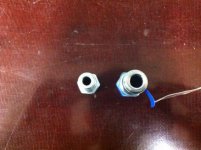
Here is a 1/4" male and a 3/8" male and you can see how much more air the 3/8" will flow. Both thread into 1/4" air tools. You have to use one or the other since they do not interchange. I use one drop on my system that use the 3/8" fittings and do all my painting through that drop or if i have a stubborn bolt i can use a impact with that drop and have alittle extra grunt from the impact. For the majority of my system i just use the 1/4" automotive style couplings. You can pick the one up from the picture at Menards.
 

Attachments

  • air.jpg
    air.jpg
    51.3 KB · Views: 69

Motofixxer

Well-known member
Joined
Oct 10, 2009
Messages
681
Try to find hoses with 3/8" NPT, it will help in the long run with your flow. Many of the good hose reels come with 3/8" hose and 3/8" NPT.

I would recommend the Milton Type V High Flow couplers. They are all the same size where the couplers actually connect, but are available in 1/4" and 3/8" NPT for your various tools. The female coupler will also accept the standard Type M male couplers for versatility. The couplers are also available in male and female threads for almost any pipe combination.

There is a noticeable difference in your impact, grinders, or cutoff type tools, with just the coupler change. Everyone that grabs my impact and zips off their first lugnut with it says Damn that's fast. Literally, half a second tap of trigger and the nut's going flying.
 
Last edited:

Torque1st

MEMBER EMERITUS
Joined
Sep 14, 2008
Messages
5,668
Location
KC Metro, Kansas
attachment.php


Look at the OTHER end.

The 'basic size' refers to the nominal hole size through the plug. The convoluted and complex path the air follows through the coupler restricts the air flow more than the plug. The thread size has very little to do with the airflow.

From Milton catalog page 35:
Do not confuse basic size with thread size. Thread size specifies only the size of the pipe fitting the coupler or plug is to be attached to, and has nothing to do with air volume.
Read page 35 here:
https://miltonindustries.com/uploads/Milton_Catalog_August_2011.pdf

The above catalog has a lot of information in it. Be sure to read the section above the quote where disconnection under pressure is discussed.

The Milton V-style connectors make a slight improvement in airflow over the standard 1/4" coupling systems.
 
Last edited:

trvshonda

Active member
Joined
Oct 19, 2012
Messages
39
attachment.php


Look at the OTHER end.

The 'basic size' refers to the nominal hole size through the plug. The convoluted and complex path the air follows through the coupler restricts the air flow more than the plug. The thread size has very little to do with the airflow.

From Milton catalog page 35:
Read page 35 here:
https://miltonindustries.com/uploads/Milton_Catalog_August_2011.pdf

The above catalog has a lot of information in it. Be sure to read the section above the quote where disconnection under pressure is discussed.
This is NOT the threaded side! This is the side that goes into the coupler. Would you like me to pull out the calipers if you really want to get technical. Both will thread into a 1/4" NPT and you can clearly see the 3/8" one would flow more air.
 

Torque1st

MEMBER EMERITUS
Joined
Sep 14, 2008
Messages
5,668
Location
KC Metro, Kansas
Sorry the picture was poor and it looked like the threaded end. And yes the BASIC 3/8 coupler will flow more than a BASIC 1/4" unit, -read the catalog. The basic sizes will not interchange of course. One can make up adapters but then you have two couplers restricting flow.
 

trvshonda

Active member
Joined
Oct 19, 2012
Messages
39
Sorry the picture was poor and it looked like the threaded end. And yes the BASIC 3/8 coupler will flow more than a BASIC 1/4" unit, -read the catalog. The basic sizes will not interchange of course. One can make up adapters but then you have two couplers restricting flow.

Yep thats all i was saying. I was just letting the OP know that the 3/8" will flow more air but they do not interchange with the 1/4" ones. So i simply said that in my shop i use one of my drops that i use a 3/8" coupling on that i use for painting and have noticed that if i use a impact on that drop with the 3/8" coupling on it then the impact has alittle more grunt. There is also a company out there that makes some 3/8" couplings that flow 75 cfm but are made for painting and used with HVLP guns but are a bit pricey and i really dont see the need for 75 cfm when my gun is only 20 cfm.
 

Torque1st

MEMBER EMERITUS
Joined
Sep 14, 2008
Messages
5,668
Location
KC Metro, Kansas
People seemed to be confused about basic coupler sizes and pipe thread sizes.

BTW, those coupler and plug flow specs are usually with a 100PSI pressure drop across the fitting which does not mean much in the real world. I wish they would spec them for flow at a 10PSI drop.

The coupling body is where the real pressure drop happens. The plugs are basically a straight shot through.
 

bcos

Well-known member
Joined
Aug 12, 2013
Messages
69
I installed 3/4 inch copper around my shop with 3/4 inch copper drops to waist level. At this point I installed ball valves, regulators, water separators and hose connections. It has worked great. I like to think that running the 3/4 inch copper pipe to the point of use helps with air cooling and pressure drop.
My dream - to have a shop so big that I need larger air pipes to make it all work!!!!
 

59 wagon man

Well-known member
Joined
Oct 25, 2010
Messages
1,589
Location
hollywood fla
in my shop i use copper as i am a plumbing contractor so it was an easy choice . due to the fact that it is a rented shop i would keep it simple . come out of the compressor with a ****** and ball valve, now depending on the angle you may need a 2 elbow swing to level out . next comes a tee, right into the middle or "bull " side , cap off or another vale to drain down is also good. now out of the top of the tee run close to the ceiling and another 2 elbow swing , and now run 10 ft of pipe sloping slightly downward from the elbows . on the end of this pipe put a tee with the bull facing up towards the ceiling and pipe the run down towards the floor and put another ball valve for a drain. out of the bull use a few ******* and elbows swings connect your reg and a 50' x 3/8" hose reel hung from the ceiling and you will eliminate moisture and have minimal cost. it is similar in thoery to the tp drawings. i have one reel by each end of my garage so i can reach anywhere in the garage and almost 50' outside the garage
 
To avoid these ads, REGISTER NOW!
Top Bottom