I've been told by several people including people claiming to be mechanics that using a torque wrench to change out automotive brake pads is not necessary even to the point that I should use a professional if I can't "feel" the torque. This is specifically for caliper pins, caliper bracket bolts, and lug nuts. Although some claim if they have a torque wrench or torque stick they will use it on the lug nuts but none of the brake components.


You are using an out of date browser. It may not display this or other websites correctly.
You should upgrade or use an alternative browser.
You should upgrade or use an alternative browser.
Should a Torque Wrench Be Used When Changing Brake Pads
- Thread starter AR15Texan
- Start date
devoncoolman
Well-known member
Been doing it so long no real need to torque anything brake related. But i do torque lug nuts or at least use a torque stick.
Murphy4570
Well-known member
You can if you like. Almost every fastener in an automobile has a specified torque. You'll have to buy an OEM service manual to find out the oddball ones though.
You'll need a 3/8 and 1/2" torque wrench.
You'll need a 3/8 and 1/2" torque wrench.
You can use a torque wrench, but seems a little overkill. I always do a quarter turn past tight. If I feel iffy I go half. But caliper pins shouldn't be tighten to much, risk of breaking. Its a personal choice, but I never use a torque wrench. Plus you would have to get the right torque specification for each bolt.
Anarius
Well-known member
For the wheels.
The only time I use a tq wrench on brake work is reassembly of multi-piece calipers....and I don't have to do that very often at all.
The only time I use a tq wrench on brake work is reassembly of multi-piece calipers....and I don't have to do that very often at all.
Jarhead0408
Well-known member
I'm no mechanic, but I just torque the lug nuts.
You can if you like. Almost every fastener in an automobile has a specified torque. You'll have to buy an OEM service manual to find out the oddball ones though.
You'll need a 3/8 and 1/2" torque wrench.
Exactly. Those of us who have wrenched either a good deal on our own or professionally sort of figure out how tight some things should be just by experience. I only torque critical components these days.
Caliper bracket bolts should be torqued. Most have a spec much higher than snugged with a ratchet. Its a common cause for comebacks because guys don't tighten them enough.
I know flat rate doesn't allow for it but in my opinion a new guy should be torqueing to spec almost everything to get an idea of whats proper.
I know flat rate doesn't allow for it but in my opinion a new guy should be torqueing to spec almost everything to get an idea of whats proper.
JonDick13926
Well-known member
I don't and haven't seen anyone do it...ever. Impact on and off the bracket bolts, and ratchet on and off the caliper pin bolts.
If I can't fit an impact in, I use a long 1/2" ratchet and some force.
Zero problems up to this point. But I do torque the lug nuts.
If I can't fit an impact in, I use a long 1/2" ratchet and some force.
Zero problems up to this point. But I do torque the lug nuts.
SMKS
Well-known member
I always torque almost everything to spec. Even an aftermarket service manual should have the torque spec for these brake parts.
I like knowing the job is done right and I don't work in a shop so I'm not trying to crank out as much work as possible in as little time as possible.
I did the go-by-feel method for years, but I now have torque wrenches so I use them.
I like knowing the job is done right and I don't work in a shop so I'm not trying to crank out as much work as possible in as little time as possible.
I did the go-by-feel method for years, but I now have torque wrenches so I use them.
G_P
Well-known member
I've never used a torque wrench on the brakes. I use one when I put the lug nuts back on though. Thats so they dont end up so tight that its impossible to remove them on the side of the road.
shampoop
Well-known member
Use a torque wrench when you're worried about breaking the fastener. Otherwise not used for most things outside of special fasteners like lugnuts etc.
malykaii
Well-known member
Being a pro mechanic, I torque everything. There's one finger tight, two finger tight, and full hand tight. Then factor in 1/4 ratchet, 3/8 long, and 3/8 short. That's 12 torque settings. Then there's 1/2 which is only available in full tight. Look at the bolt and decide which of the 13 available torque settings would be best, guestimating encouraged.
1/2 gun you first snug the bolt, then two clicks of the trigger, three clicks, or 3-4 seconds of continuous fire. Example, little elantra steelies get 2 clicks, e250 wheels get 3 clicks, and 27mm box truck lugs get the last option.
1/2 gun you first snug the bolt, then two clicks of the trigger, three clicks, or 3-4 seconds of continuous fire. Example, little elantra steelies get 2 clicks, e250 wheels get 3 clicks, and 27mm box truck lugs get the last option.
sam.coll
Well-known member
I say if you want to use a torque wrench, use it! F*** what anyone else thinks.
rcjoy
Well-known member
The manufacturer torques them to spec at the factory, so you should also do so. Get the factory service manual; every bolt and nut is given a torque spec.
General Geoff
Well-known member
If you have the time, inclination, and correct torque specs, go ahead and use a torque wrench.
AndyCBR
Well-known member
I've been told by several people including people claiming to be mechanics that using a torque wrench to change out automotive brake pads is not necessary even to the point that I should use a professional if I can't "feel" the torque. This is specifically for caliper pins, caliper bracket bolts, and lug nuts. Although some claim if they have a torque wrench or torque stick they will use it on the lug nuts but none of the brake components.
Where and when you have to use a torque wrench is like an oil thread. You'll get every answer out there.
If you feel inclined to use a torque wrench it certainly can't hurt. Just make sure you have the right specs.
Yes. In each example given no mechanical locking is typically used. The fasteners maintain their torque only via their stretch, which functions like a spring washer.
Loss of torque in caliper bolts can lead to catastrophic failure of the system. Were the system to fail, and injury or property damage resulted, a design defect lawsuit between the injured party and the vehicle manufacturer would very quickly include the repair shop. In that moment, the repair shop must be able to say they replaced the system components with suitable parts in accordance with the factory manuals. In short, if you are aren't torquing fasteners in your shop, you are taking shortcuts to save yourself money, and you are providing your shop a competitive advantage at the expense of the customers' safety. That is where every attorney and judge will go.
Beside the risk of system failure, which I personally believe to be SUPER rare, under torquing and over torquing can lead to corrosion, and or reducing the lifespan of the components.
Regarding lug nuts, improper torquing can lead to premature rotor warppage and failure of other components.
Here's what you need to know about torque:
1) Formula 1 teams torque everything. Its the right thing to do. It's what good mechanics do.
2) Threads, mating parts, and the interface between the underside of the head and the bolt or screw head must all be CLEAN and lubed with something. DRY torque means factory lubrication (like when the parts were brand new). WET means coated with paint, sealant, grease etc. There are no torque values for chalky, corroded, rusted bolts. The friction associated with the threads and the area under the head could react more than HALF of the total torque you apply. Forget about good torque wrenches or good torque wrench technique. If your hardware isn't clean and slightly oily, your torque values could be WAY off (i.e. zero preload- see next point)
3) Engineers don't care about torque. We care only about bolt preload. And we really do need what we say we need. We preload bolts to prevent parts from seperating. Technically, if you applied no torque (bolt head just touching or hand tight) ANY load would seperate the parts. In a head, when you have 20,000lbs (force) from cylinder pressure trying to lift the head off the block, the mechanic must produce 20,000lbs of clamping force by preloading the fasteners to keep the head on the block.
Some parts can fail mechanically when seperated. They are bolted together because they are stronger together. Some parts require contact pressure for sealing (water pumps). Sometimes we need contact pressure to keep moisture, which causes corrosion, out.
4) Think of bolts as a row of buttons on a tufted sofa back. Pull the buttons too hard, and the material festoons between the buttons. That can happen with metal. Too much preload can produce gaps. So more isn't better,
5) Now think about your lug nuts/bolts. When you are driving and turn the steering wheel, the lugs keep the outside wheels on the car. Each lug in turn will see a greater percentage of that total load. The tighter bolts loads will be higher. Under torqued bolts could go from no load to load, no load to load. This is tremendously worse for the fatigue life of the bolt. Its better to have fatigue cycles above zero, than tension and compression (positive and negative load). All the components that fastener is attached to feels this same sensation.
Conclusion:
Improper torquing is a big deal about to get bigger. Manufacturers are designing lighter weight engine componnents to save weight. They are using more non-ferrous materials in cars. Composites, especially carbon, are very sensitive to torque, corrosion, and require careful sealing.
If you are a pro, suggest your shop hosts a "Torque Stand Down". Spend one hour of shop time to reinforce the importance of working clean, using your torque wrenches, and knowing where to find the correct torque specs. You could easily put a poster on the wall with the basics - dry torque vs socket size. Pretty sure I have already posted such info. Entitle your poster "We take longer to fix your car because we care about your family's safety".
No mechanic has hands sensitive enough to produce reliably torqued fasteners. Any mechanic who resists, challenge him to torque a bolt to 65 NM. Give him a generous +/-10Nm (way too much). Check the torque by tightening with a Snap On digital. If it moves at 55 he failed. Now loosen it. If it doesn't move at 75 he failed. (this is slightly unscientific but it will make the point).
Loss of torque in caliper bolts can lead to catastrophic failure of the system. Were the system to fail, and injury or property damage resulted, a design defect lawsuit between the injured party and the vehicle manufacturer would very quickly include the repair shop. In that moment, the repair shop must be able to say they replaced the system components with suitable parts in accordance with the factory manuals. In short, if you are aren't torquing fasteners in your shop, you are taking shortcuts to save yourself money, and you are providing your shop a competitive advantage at the expense of the customers' safety. That is where every attorney and judge will go.
Beside the risk of system failure, which I personally believe to be SUPER rare, under torquing and over torquing can lead to corrosion, and or reducing the lifespan of the components.
Regarding lug nuts, improper torquing can lead to premature rotor warppage and failure of other components.
Here's what you need to know about torque:
1) Formula 1 teams torque everything. Its the right thing to do. It's what good mechanics do.
2) Threads, mating parts, and the interface between the underside of the head and the bolt or screw head must all be CLEAN and lubed with something. DRY torque means factory lubrication (like when the parts were brand new). WET means coated with paint, sealant, grease etc. There are no torque values for chalky, corroded, rusted bolts. The friction associated with the threads and the area under the head could react more than HALF of the total torque you apply. Forget about good torque wrenches or good torque wrench technique. If your hardware isn't clean and slightly oily, your torque values could be WAY off (i.e. zero preload- see next point)
3) Engineers don't care about torque. We care only about bolt preload. And we really do need what we say we need. We preload bolts to prevent parts from seperating. Technically, if you applied no torque (bolt head just touching or hand tight) ANY load would seperate the parts. In a head, when you have 20,000lbs (force) from cylinder pressure trying to lift the head off the block, the mechanic must produce 20,000lbs of clamping force by preloading the fasteners to keep the head on the block.
Some parts can fail mechanically when seperated. They are bolted together because they are stronger together. Some parts require contact pressure for sealing (water pumps). Sometimes we need contact pressure to keep moisture, which causes corrosion, out.
4) Think of bolts as a row of buttons on a tufted sofa back. Pull the buttons too hard, and the material festoons between the buttons. That can happen with metal. Too much preload can produce gaps. So more isn't better,
5) Now think about your lug nuts/bolts. When you are driving and turn the steering wheel, the lugs keep the outside wheels on the car. Each lug in turn will see a greater percentage of that total load. The tighter bolts loads will be higher. Under torqued bolts could go from no load to load, no load to load. This is tremendously worse for the fatigue life of the bolt. Its better to have fatigue cycles above zero, than tension and compression (positive and negative load). All the components that fastener is attached to feels this same sensation.
Conclusion:
Improper torquing is a big deal about to get bigger. Manufacturers are designing lighter weight engine componnents to save weight. They are using more non-ferrous materials in cars. Composites, especially carbon, are very sensitive to torque, corrosion, and require careful sealing.
If you are a pro, suggest your shop hosts a "Torque Stand Down". Spend one hour of shop time to reinforce the importance of working clean, using your torque wrenches, and knowing where to find the correct torque specs. You could easily put a poster on the wall with the basics - dry torque vs socket size. Pretty sure I have already posted such info. Entitle your poster "We take longer to fix your car because we care about your family's safety".
No mechanic has hands sensitive enough to produce reliably torqued fasteners. Any mechanic who resists, challenge him to torque a bolt to 65 NM. Give him a generous +/-10Nm (way too much). Check the torque by tightening with a Snap On digital. If it moves at 55 he failed. Now loosen it. If it doesn't move at 75 he failed. (this is slightly unscientific but it will make the point).
rapid robert
Well-known member
Always a good idea to use a torque wrench. How could putting in a little extra effort hurt. Sure most of us can do a brake job without using a torque wrench if we have to, but the result will never be "better" than using a torque wrench to ensure the bolts are tightened to spec.
SPtoolLover
Well-known member
Sam'sAutoParts
Well-known member
I always torque brakes and wheels. Same with suspension, only I add thread locker, but I'm not flat-rate.
Chevy-SS
Well-known member
Yes. In each example given no mechanical locking is typically used. The fasteners maintain their torque only via their stretch, which functions like a spring washer.
Loss of torque in caliper bolts can lead to catastrophic failure of the system. Were the system to fail, and injury or property damage resulted, a design defect lawsuit between the injured party and the vehicle manufacturer would very quickly include the repair shop. In that moment, the repair shop must be able to say they replaced the system components with suitable parts in accordance with the factory manuals. In short, if you are aren't torquing fasteners in your shop, you are taking shortcuts to save yourself money, and you are providing your shop a competitive advantage at the expense of the customers' safety. That is where every attorney and judge will go.
.................
This is a great post and it's why I try to torque virtually everything at all times.
On brake jobs, I also use dial caliper to check for rotor runout. Here's a pic showing how I do it. This particular vehicle was a Ford F150 with two-wheel drive, the hub, rotor and bearings are all new. IF the rotor was loose on there, I would have secured it with lug nuts - then rotate and verify that it's within specs (.001" - .002").
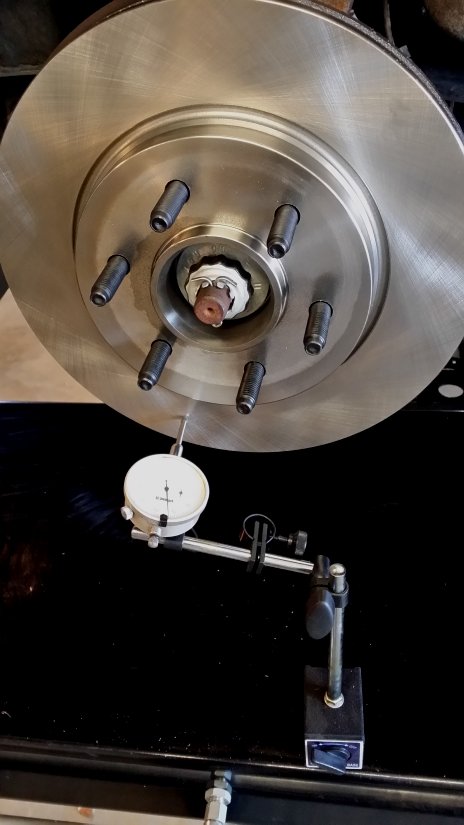
And finally, regarding lug nuts, IMHO it's crucial to torque these to specs. It's also important to do the tightening in a couple of passes, using criss-cross pattern. If you toss the wheel on and then start hammering lug nuts home with airgun, there's a good chance you'll warp wheel or rotor slightly, which may cause vibrations eventually.
Do it right the first time - for all the reasons that Adam.C mentioned.

-
sberry
Banned
Good write up especially about clean and light lube. Modern penetrating sprays are really pretty good for this, Kroil or similar being great.
For the Op, I agree its good practice but few do it. We have seen tests that show chronic under torque by most and gutentite is good along with farmer tight. Those 2 are pretty close and guys with some engine building background have some real comparison to get some feel.
Torque sup some bolts, go back with common wrenches and do some comparison. Learn what 35# really feels like.
For the Op, I agree its good practice but few do it. We have seen tests that show chronic under torque by most and gutentite is good along with farmer tight. Those 2 are pretty close and guys with some engine building background have some real comparison to get some feel.
Torque sup some bolts, go back with common wrenches and do some comparison. Learn what 35# really feels like.
u118224
Well-known member
Not a pro and I do torque brake and suspension parts.
Same here.
sberry
Banned
Great write up BTW Like you said, its unscientific and so is torque but we can come pretty close and for general work well within the parameters, this is assuming these are truly skilled men.No mechanic has hands sensitive enough to produce reliably torqued fasteners. Any mechanic who resists, challenge him to torque a bolt to 65 NM. Give him a generous +/-10Nm (way too much). Check the torque by tightening with a Snap On digital. If it moves at 55 he failed. Now loosen it. If it doesn't move at 75 he failed. (this is slightly unscientific but it will make the point).
We had a full set of stuck lug nuts, we aint sure what happened. But with care we can come close with air guns, at least as good as some pos torque stick and if we apply the now I got a tool factor so I got to use less care then its way above.
I checked a set the other day, 18 within 5%, 2 within 10, one being hi aqnd one low. I walked around to a set my brother did and I quit checking, got half way thru second wheel and within about 5# and one on each other wheel the same.
In the service worlds,,, slightly different than engineering but with the same concern number 1 thing we find is dry bolt stuck, didn't provide the clamp, number 1 fuggin thing by far and then some, the rest of the issues being almost miniscule in comparison.
Torque would have been false. This is hugely amplified by dipsticks in tire stores with hot air guns and fine dry threads.
sberry
Banned
All a torque wrench on a dry lug nut tells is it stopped turning, nothing about how tight it is.
sberry
Banned
An over torque on a wheel may distort the bolt hole but it doesn't do squat to a rotor or any other parts, the hub on a rotor like this is simply sandwiched to another plate that is the wheel hub. Can tighten it till it ruins the bolt.
orangelefty
Member
- Joined
- Dec 1, 2014
- Messages
- 6
I am a pro, heavy duty mechanic, and I use torque wrench as much as I can when it comes to brakes, suspension, steering, and other safety components. Why take unnecessary risks, when it's so easy to double check. Helps me sleep at night and keeps my 'come back' numbers very low.
This is a great post and it's why I try to torque virtually everything at all times.
On brake jobs, I also use dial caliper to check for rotor runout. Here's a pic showing how I do it. This particular vehicle was a Ford F150 with two-wheel drive, the hub, rotor and bearings are all new. IF the rotor was loose on there, I would have secured it with lug nuts - then rotate and verify that it's within specs (.001" - .002").
And finally, regarding lug nuts, IMHO it's crucial to torque these to specs. It's also important to do the tightening in a couple of passes, using criss-cross pattern. If you toss the wheel on and then start hammering lug nuts home with airgun, there's a good chance you'll warp wheel or rotor slightly, which may cause vibrations eventually.
Do it right the first time - for all the reasons that Adam.C mentioned.
-
I was told that not having the rotor fastened down would lead to inaccurate readings, is this not correct?
The reason I am asking is that I have the "acorn" style nuts on my cars so I would have to buy sets of "regular" open ended nuts to accomplish this.
TheRobotCow
Well-known member
- Joined
- Dec 11, 2014
- Messages
- 176
I torque everything. Maybe i'm just ocd about things like this. I work at Toyota and i know 2 tech, Tech A is slower but takes the time to torque everything down to spec. Tech B is really fast and zaps everything in(unless its in the engine or lug nuts, thats the only 2 things he torques to spec). Well guess who has zero comebacks and who gets them all the time?
sberry
Banned
I was told that not having the rotor fastened down would lead to inaccurate readings, is this not correct?
The reason I am asking is that I have the "acorn" style nuts on my cars so I would have to buy sets of "regular" open ended nuts to accomplish this.
You can only squeeze one piece of steel so tight to another. You can flip a couple nuts over, snug it to it to take reading but, I wanna know, whats a guy gonna do about all this anyway?
I do have a dial indicator but never put one on a rotor. These are mostly common cars here, not formula 1. We don't fuss over most of this and don't have the problems others seem to. Never torqued a brake part, never a steering part and never had one come off. I have seen a ball joint or 2 done by the shade tree crowd usually by hand come loose, simply not tight enough.
sberry
Banned
A torque wrench would discipline the operator to take some care instead of tossing things at it. Lots of careless fugs in the world working on cars, half the mechanics are below average, lots of them with no training at all working on cars.Well guess who has zero comebacks and who gets them all the time?
TheRobotCow
Well-known member
- Joined
- Dec 11, 2014
- Messages
- 176
A torque wrench would discipline the operator to take some care instead of tossing things at it. Lots of careless fugs in the world working on cars, half the mechanics are below average, lots of them with no training at all working on cars.
I couldn't agree more.
Honestly i prefer high quality work over high volume but my place of work would disagree in a heartbeat.
6MocoA
Banned
Whats the matter OP, you dont trust the collective wisdom of ARFCOM GD? 
You can only squeeze one piece of steel so tight to another. You can flip a couple nuts over, snug it to it to take reading but, I wanna know, whats a guy gonna do about all this anyway?
I do have a dial indicator but never put one on a rotor. These are mostly common cars here, not formula 1. We don't fuss over most of this and don't have the problems others seem to. Never torqued a brake part, never a steering part and never had one come off. I have seen a ball joint or 2 done by the shade tree crowd usually by hand come loose, simply not tight enough.
If rotor runout is bad, remove rotor and clean the goobers off the wheel hub.