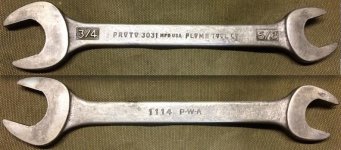
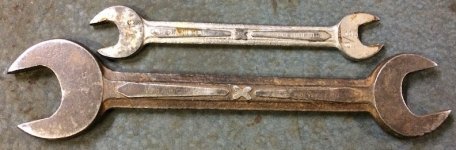
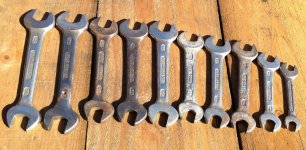
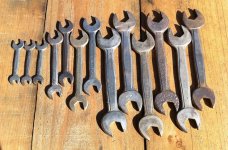
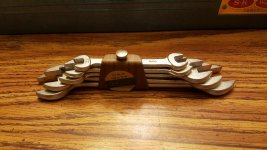
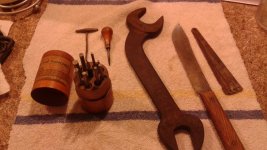
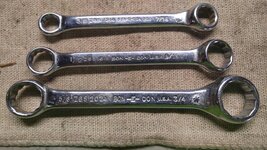
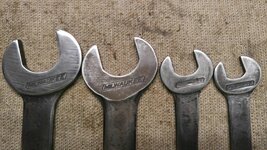
A couple weeks ago I purchased a large lot of tools, much of it military surplus, much of that NOS, mainly from the 1940's and 1950's. Over 1,000 pieces, and over 100 DOE engineers wrenches. I thought I would share some of them here.
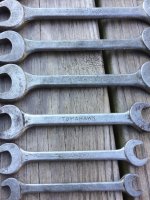
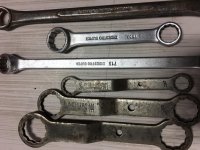
All of these Herbrand Industry Standard Number (ISN) 723/1723 (3/8 x 7/16) DOE engineers wrenches were in the lot, and they make a nice study case together.
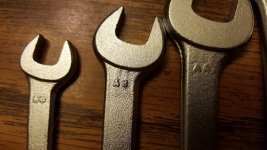
The three (3) bulkier styles can be identified as carbon steel wrenches probably even without the AISI steel grade number that Herbrand was fond of forging into their wrenches during the war, probably as a demonstration of their compliance with wartime alloy restrictions, but AISI 1038 is a carbon steel grade composition. I am thinking the bottom two are wartime.
I would guess that the third one, on top, without any AISI steel grade number, but obviously the same model wrench, was either made just before 1942, or just after 1945, based on the markings (on the shank, not the face of a jaw, and HERBRAND in block letters instead of fancy script).
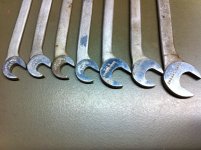
The other three wrenches of a sleeker design are alloy wrenches. I have them arranged in what I think is their chronological order of manufacture.
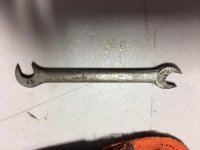
The 1723 on top has the fancy script Herbrand logo on the face of the jaw. It is a VAN CHROME (made of high-end chromium vanadium.) It is either nickel or chrome-plated. Probably late 1930's up to 1941.
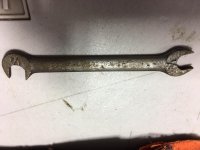
The 1723 in the middle, with the AISI 1340 mark, is wartime. AISI 1340 is a manganese based alloy they used during the war on many tools, along with other "New Emergency" (low content triple alloy) steel compositions in the AISI 86XX and 87XX range.
I am guessing that the 1723 at the bottom is post-war. It does not have an AISI number, has a slightly more modern shape (look at the edges on the shank), and is very similar to other wrenches acquired by the Army in the late 1940's with a black oxide treatment (Billings Vitalloy, Fairmount with the name on the shank, etc)