
You are using an out of date browser. It may not display this or other websites correctly.
You should upgrade or use an alternative browser.
You should upgrade or use an alternative browser.
Show off your DOE's!
- Thread starter Outlawmws
- Start date
Private Lugnutz
Well-known member
My libido must have embellished that part in my deep memory banks. 
Provincial
Well-known member
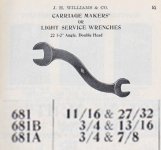
681B is an industry standard number for a light service "S" wrench with 3/4 x 13/16 openings. Others used the same number, starting with Williams. All the "S" wrenches had a standard number (675, 677, 679, etc, and later, in the late 30's and 40's it was 75, 77, 79, etc), with suffixes for milled openings. They made several "681" wrenches, all with the same die, then milled in different openings. A 681 was 11/16 x 27/32, for example. A 681A was 3/4 x 7/8. All of them would've had the "681" on the shank. Not saying it's not a Herbrand. But you might have to look at Williams and others, too.
RagTopTA posted a Norvell-Shapleigh (brief 1900-1917 partnership) "S" wrench with a Diamond-Edge logo on this thread, linked here.
My reply with some additional Shapleigh D-E info is linked here.
I used this for my research:
http://www.wrenchingnews.com/industry-standard-wrenches/chart.html
It didn't show any others but Herbrand, but it may be incomplete.
I guess you guys didn't see the sarcasm in my "English teacher" post!

Private Lugnutz
Well-known member
It's not incomplete; unfortunately, it's just wrong, Jock. The model number series they are using for Williams and Armstrong are for different "S" wrenches. They made short "S" wrenches with flat handles (66x), short "S" wrenches with concave handles (86x), long "S" wrenches they called car wrenches (3xx), and light service (also called carriage makers') "S" wrenches (67x, 68x). All of them had 22-1/2* angle heads. Herbrand got its model numbers from Williams for the longer "S" wrenches, as did Bonney and many others.I used this for my research:
http://www.wrenchingnews.com/industry-standard-wrenches/chart.html
It didn't show any others but Herbrand, but it may be incomplete.
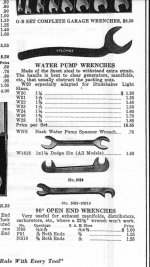
Pic 1 are excerpts from page 51 of the 1912 Williams catalog.
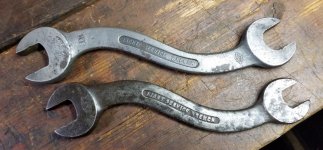
Pic 2 are a pair of Williams light service "S" wrenches, including a 681.
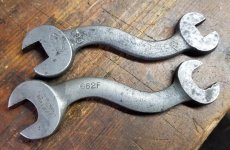
Pic 3 are a pair of the shorter Williams 662 "S" wrenches, which Wrenching News is erroneously associating with the Herbrand version of the Williams 68x series light service wrenches.
Attachments
Provincial
Well-known member
What? Something wrong posted on the Internet!!!! Can't be.
EDIT: The photos of other 680-series Herbrand S-wrenches posted on Alloy Artifacts show the same forged-in number size/font as my wrench, unlike the Williams you posted.
EDIT: The photos of other 680-series Herbrand S-wrenches posted on Alloy Artifacts show the same forged-in number size/font as my wrench, unlike the Williams you posted.
Last edited:
Private Lugnutz
Well-known member
Yes, Williams put their model numbers closer to the heads on their older wrenches and the Superior line. Glad you found something more corroborating.
Provincial
Well-known member
d42jeep
Well-known member


Provincial
Well-known member
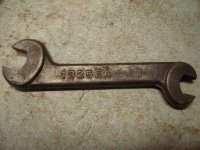

Slackmaster G
Well-known member
- Joined
- Jan 19, 2017
- Messages
- 93
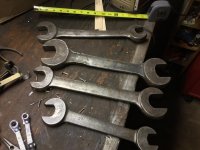
Land Rover 109
Well-known member
So who made the last "S" shaped wrench, and when?
The last? Can you not still buy them? I know Gearwrench still offer them, dare say a Google search should show up a few more.
The last? Can you not still buy them? I know Gearwrench still offer them, dare say a Google search should show up a few more.
He is probably asking about 'S' DOE wrenches.
Land Rover 109
Well-known member
So here is where I am, so far with Peugeot - I't a bit lopsided, as I only have the one 8-10 from an Eprey buy. The clip is something I just grabbed from the collections of trays and holders. it's not Peugeot, and I'v already outgrown it...
So I'm still going to be looking for 8-10's and the "inter" sizes I don't have...
Just found a replacement 13-15 for my own set. Will come with a 17-19 and a 21-23.
Perhaps missed by others because they were advertised as Geugeot not Peugeot.

Just have to await their arrival now.

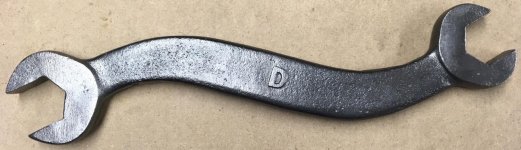
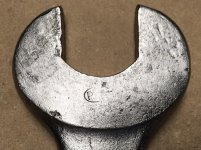
I was wirewheeling the rust off some DOEs this afternoon, and revealed some interesting marks. IHC G3172, “D”, and a 665B - the other end has a faintly-stamped oval with a P. I wonder what else was in that oval? Almost looks like PEXTO would fit, but did they make DOEs?
I also managed to wirewheel a good bit of insulation off the power cord of my block grinder (there was a loop sticking up behind the wheel-no guard, of course)...dumb, dumb, dumb! Now it matches my other one, with a stretch of vinyl tape wrapped around it.
I also managed to wirewheel a good bit of insulation off the power cord of my block grinder (there was a loop sticking up behind the wheel-no guard, of course)...dumb, dumb, dumb! Now it matches my other one, with a stretch of vinyl tape wrapped around it.
Attachments
-
 DB5110BF-534C-4685-9A23-ED9F79D06451.jpg121.9 KB · Views: 14
 -
 634DC4A5-CF7D-4300-8EA8-9E531A3A6057.jpg117.8 KB · Views: 12
 -
 23CE9281-8858-4881-93CC-0F7F0739355B.jpg134.6 KB · Views: 10
 -
 FC681A79-C2A3-4332-ACB3-E97936B592B2.jpg160.5 KB · Views: 12
 -
 8BC4E423-71CF-4A68-A60C-5939BBC69F80.jpg158.4 KB · Views: 14
Last edited:
r_olson_06
Well-known member
Looking for some info on these?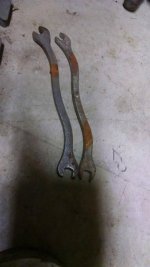

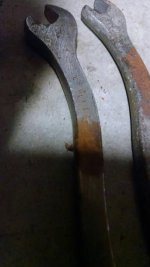
Looking for the following Plomb Pebbles Wrenches 3061, 3070,
Looking for the following Plomb Pebbles Wrenches 3061, 3070,
r_olson_06
Well-known member
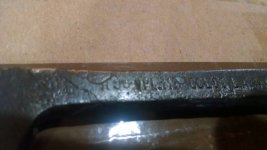
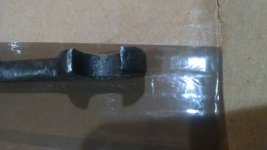
Also a mid to early 20s Plomb exhaust manifold wrench.
Looking for the following Plomb Pebbles Wrenches 3061, 3070,
Looking for the following Plomb Pebbles Wrenches 3061, 3070,
...... and a 665B - the other end has a faintly-stamped oval with a P. I wonder what else was in that oval? Almost looks like PEXTO would fit, but did they make DOEs?
(Sorry, I haven't figured out how to use 'quote' and include pictures.)
This could be a Page-Storms wrench.
Looking for some info on these?
Look to be blacksmith made. Possibly by a RR shop.
Does the stamping have a manual look to it?
r_olson_06
Well-known member
The one that has not been ground has a raised stamping that would have been forged in.Look to be blacksmith made. Possibly by a RR shop.
Does the stamping have a manual look to it?
Looking for the following Plomb Pebbles Wrenches 3061, 3070,
DriftwoodAg
Member


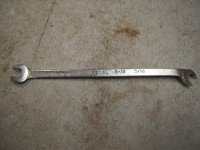
I've had this forever and never thought to research it until joining this site. The best I can tell Brugnago tools were made in Italy starting in 1948 and may have been made for Alfa Romeo
Last edited:
Provincial
Well-known member

DriftwoodAg
Member
I didn't realize my pics didn't post. I may need a few more posts before I can do that


I've had this forever and never thought to research it until joining this site. The best I can tell Brugnago tools were made in Italy starting in 1948 and may have been made for Alfa Romeo
Like this, Outlaw?
Provincial
Well-known member
This weekend there was a flood of Fairmount obstruction DOE wrenches at the sales. I don't remember seeing this type of wrench in the Fairmount brand before. I have seen it in Martin, which is a later branding of the same wrench.
I know that Fairmount was a older brand, but these seem to be post-WWII, and likely less than 50 years old. I know that Fairmount was bought by Houdaille Industries during the period I think these were made, and sold to Martin Sprocket and Gear in 1984. I have never seen a Fairmount distributor in my area, and the Martin brand tools were generally sold through dealers who mainly sold the sprockets and gears.
The first photo is of three I found this morning. 1-1/2", 1", and 7/8" sizes. The second photo shows another 1-1/2" wrench I found at a later sale.
I know that Fairmount was a older brand, but these seem to be post-WWII, and likely less than 50 years old. I know that Fairmount was bought by Houdaille Industries during the period I think these were made, and sold to Martin Sprocket and Gear in 1984. I have never seen a Fairmount distributor in my area, and the Martin brand tools were generally sold through dealers who mainly sold the sprockets and gears.
The first photo is of three I found this morning. 1-1/2", 1", and 7/8" sizes. The second photo shows another 1-1/2" wrench I found at a later sale.
Attachments


Land Rover 109
Well-known member
So here is where I am, so far with Peugeot - I't a bit lopsided, as I only have the one 8-10 from an Eprey buy. The clip is something I just grabbed from the collections of trays and holders. it's not Peugeot, and I'v already outgrown it...
So I'm still going to be looking for 8-10's and the "inter" sizes I don't have...
Here are my latest deliveries- two sets of three from different sellers.


BarryWells
Well-known member
Does anyone make a DOE with "teeth"?
Land Rover 109
Well-known member
Does anyone make a DOE with "teeth"?
Yep- they are called mother inlaws.
Private Lugnutz
Well-known member
That was a good one!
But the answer is yes, if by "teeth" you mean tiny pipe-wrench-like serrations on the inner jaws, near the throat. Search on WrightGrip. They are in production today. EDIT: As for vintage, I don't think so. Adjustable pipe wrenches and alligator wrenches, but not wrenches meant for nuts and bolts.
But the answer is yes, if by "teeth" you mean tiny pipe-wrench-like serrations on the inner jaws, near the throat. Search on WrightGrip. They are in production today. EDIT: As for vintage, I don't think so. Adjustable pipe wrenches and alligator wrenches, but not wrenches meant for nuts and bolts.
Last edited:
Private Lugnutz
Well-known member
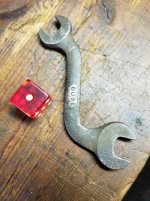
I thought I had a strange variant in this very early Billings wrench, but the 1409 model number maps to a standard "S" wrench with 22-1/2* angles and 1/4" Hex Cap x 5/16" Hex Cap openings. A PO decided he needed a heckuva lot more than a 22-1/2* angle on the one end, but the bend was so expertly accomplished, I thought it was factory that way.
Attachments
Private Lugnutz
Well-known member
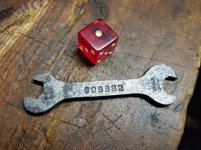
I also picked this one up at the flea market today. I don't know who made it. Mossberg made wrenches like this, with crazy milled sizes, but they are usually marked Mossberg or with the < M >. This just has a stock number ("809982") on it. I like it.
Attachments
Private Lugnutz
Well-known member
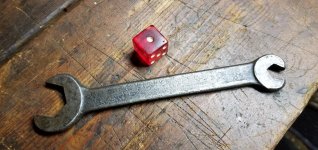
Spotted this at the flea market this morning.


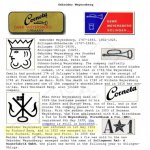
Picked it up solely because of the intriguing logo on the flip side.

As a militaria guy, I was familiar with Weyersberg-Kirschbaum Co., in Solingen, Germany. At the turn of the century through the end of WWI, they supplied most of the armies around the world with bayonets, among other things. I knew it was the merger, in 1883, of two legendary families and blade makers. And I knew that they used a king's head and knight's head, respectively, as export markings.
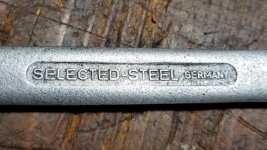
Seeing only the Weyersberg name and a cornet logo on an export wrench marked "SELECTED- STEEL" and "GERMANY" with imperial size markings threw me.
A little research revealed that some members of the family re-established Gebruder Weyersberg as a separate entity in 1920, and they apparently made mechanics tools as well as cutting tools.

Picked it up solely because of the intriguing logo on the flip side.
As a militaria guy, I was familiar with Weyersberg-Kirschbaum Co., in Solingen, Germany. At the turn of the century through the end of WWI, they supplied most of the armies around the world with bayonets, among other things. I knew it was the merger, in 1883, of two legendary families and blade makers. And I knew that they used a king's head and knight's head, respectively, as export markings.
Seeing only the Weyersberg name and a cornet logo on an export wrench marked "SELECTED- STEEL" and "GERMANY" with imperial size markings threw me.
A little research revealed that some members of the family re-established Gebruder Weyersberg as a separate entity in 1920, and they apparently made mechanics tools as well as cutting tools.
Attachments


Last edited:
Dibiase77
Well-known member
That's really co. That's why I like old tools. They have history to them. Just curious... How is the quality on that wrench?Spotted this at the flea market this morning.
Picked it up solely because of the intriguing logo on the flip side.
As a militaria guy, I was familiar with Weyersberg-Kirschbaum Co., in Solingen, Germany. At the turn of the century through the end of WWI, they supplied most of the armies around the world with bayonets, among other things. I knew it was the merger, in 1883, of two legendary families and blade makers. And I knew that they used a king's head and knight's head, respectively, as export markings.
Seeing only the Weyersberg name and a cornet logo on a wrench marked "SELECTED- STEEL" and "GERMANY" with imperial size markings threw me.
A little research revealed that some members of the family re-established Gebruder Weyersberg as a separate entity in 1920, and they apparently made mechanics tools as well as cutting tools.
Sent from my Alcatel_5044R using Tapatalk
Private Lugnutz
Well-known member
Excellent. Almost too good. Dating it is a little challenging, in fact. Normally, I would automatically think that it had to have been made before 1949 with the "Germany" marking. After 1949 most products were marked "Western Germany" or "West Germany," until 1990, when the wall came down and it became obsolete again. It almost seems too sleek for prewar. But it seems too vintage for 1990's. So for now I am leaning toward late 1930's when companies like Fairmount and others taking advantage of alloys were making pear head sharps. Or perhaps they were one of those few companies that refused to use the "West Germany" marking and it's from the 50's or 60's.
Private Lugnutz
Well-known member

Dibiase77
Well-known member
Interesting. Also very clever of you to use the Berlin Wall as sort of a date marker. Definitely a cool find. I doubt I'll see any around here but I'm gonna keep my eyes open.
Sent from my Alcatel_5044R using Tapatalk
Sent from my Alcatel_5044R using Tapatalk
Private Lugnutz
Well-known member
Thanks, but I can't take credit. Those dates and markings (pre-1949, and 1990) are well-established in other German antique and vintage collectibles markets, i.e., glassware, figurines, etc. Those kinds of resources and references can be very useful to antique and vintage tool collectors.
Here's an oddity I also picked up. Check out the small hex throat opening. That has not been deformed from use. That would splay the jaws, as is often seen in older wrenches. It was milled that way.
I expect that vintage would have been milled, but either milled or broached, that would be a more involved operation.
Maybe user modified?
An industrial setting could provide a means to squeeze the end to reduce the opening.
Looks kind of like they needed a smaller wrench but this didn't work out too well either. Notice the raised deformation.
d42jeep
Well-known member
Here is an early Cornwell obstruction wrench I found recently. It took a while to get the rust off.
-Don
-Don
Last edited: