Cleave
Well-known member
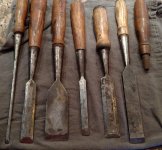
Share your vintage woodworking chisels you've restored to a new life!
Ok, if you have cool vintage chisels you didn't re-handle,feel free to post those too.
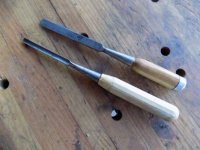
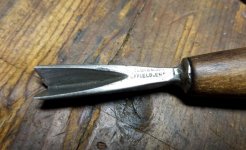
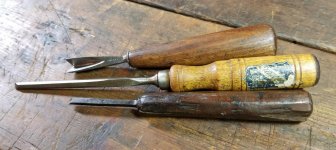
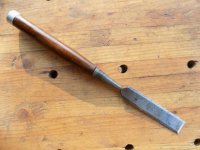
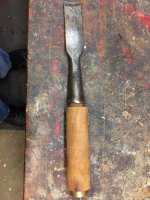
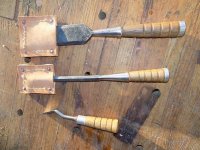
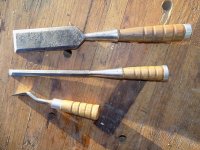
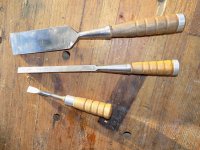
Here are two PS&W Co. chisels.
One is a 5/8" timber framing chisel I got for $1. It had some blue overheating on the edge, and Mr Bozo had hammered on the socket without a handle. A bit of filing and careful grinding took care of both issues, with a slightly shorter blade and socket. I found a handy chunk of honey locust and worked it round with hand tools (drawknife, plane, spoke shave). To fit the socket, you just whittle it with a knife, checking it in the socket. Push it into the socket, twist it around, and it marks the high spots. Continually check alignment to be sure the blade and handle are coaxial. Finish up with sandpaper, and a collar from aluminum tubing scrap.
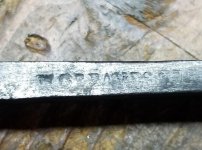
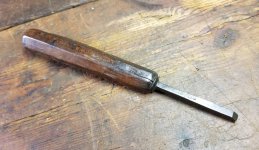
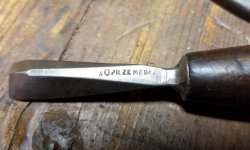
The second is a narrow gouge, it says PS&W Co. No 1 Ex. It was also $1, and just needed a bit of cleanup and sharpening. Handle is from a small (2" dia) piece of scrub oak I brought home from a camping trip. No sanding on this one, the facets give good grip and tool control. No collar needed since I don't expect to hammer on a gouge very much.
Install handle in socket with a bit of linseed oil and a few firm blows with a mallet. Don't glue it in, or you'll never get it back out to replace the handle again.
Interestingly, I do have a really old metal lathe (flat belt era). I have a tool rest for turning wood on it. But for simple jobs like a tool handle, where roundness isn't mission critical, why bother cleaning the wood chips out of the ways, gears, and screws? Also turning wood at 300 rpm is kinda funny.
Ok, if you have cool vintage chisels you didn't re-handle,feel free to post those too.
Here are two PS&W Co. chisels.
One is a 5/8" timber framing chisel I got for $1. It had some blue overheating on the edge, and Mr Bozo had hammered on the socket without a handle. A bit of filing and careful grinding took care of both issues, with a slightly shorter blade and socket. I found a handy chunk of honey locust and worked it round with hand tools (drawknife, plane, spoke shave). To fit the socket, you just whittle it with a knife, checking it in the socket. Push it into the socket, twist it around, and it marks the high spots. Continually check alignment to be sure the blade and handle are coaxial. Finish up with sandpaper, and a collar from aluminum tubing scrap.
The second is a narrow gouge, it says PS&W Co. No 1 Ex. It was also $1, and just needed a bit of cleanup and sharpening. Handle is from a small (2" dia) piece of scrub oak I brought home from a camping trip. No sanding on this one, the facets give good grip and tool control. No collar needed since I don't expect to hammer on a gouge very much.
Install handle in socket with a bit of linseed oil and a few firm blows with a mallet. Don't glue it in, or you'll never get it back out to replace the handle again.
Interestingly, I do have a really old metal lathe (flat belt era). I have a tool rest for turning wood on it. But for simple jobs like a tool handle, where roundness isn't mission critical, why bother cleaning the wood chips out of the ways, gears, and screws? Also turning wood at 300 rpm is kinda funny.