
You are using an out of date browser. It may not display this or other websites correctly.
You should upgrade or use an alternative browser.
You should upgrade or use an alternative browser.
Show us your handplanes
- Thread starter trainman1385
- Start date
txlonghorn1989
Well-known member
- Joined
- Feb 27, 2017
- Messages
- 2,786
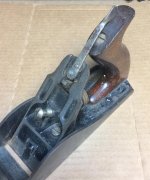
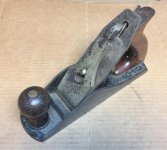
I'd like to identify this No 4 plane. I've had it for months and months. Had it in my hands more than a few times and only yesterday noticed that it is not marked Stanley and/or Bailey. It has "Made in USA" between the frog and the tote. "No 4" on the toe. The lever cap is from a Stanley Handyman thus isn't original to the plane. The iron is a Stanley but of a more recent vintage stamped with the notched rectangle, "H1204(12-204)" and then "Made in U.S.A.". Finally, the frog is ogee shaped with no numbers to be found anywhere on the frog and the lateral adjustment lever has no "Stanley" stamped on it and it has a whale tail. Let me know if the pics don't answer any questions you might have. Thanks!
Attachments



CRSINMICH
Well-known member
tx: Sorry, I don't have any definite information for you. I have seen a lot of planes that have Stanley features with only MADE IN USA cast into the bed and I never found any information about them. The lateral adjustment lever with a twist is a feature most often found on planes that were not 'top shelf' such as HANDYMAN. It would probably be a good user, just not for finish work. Give it a try.
txlonghorn1989
Well-known member
- Joined
- Feb 27, 2017
- Messages
- 2,786
CRS: The body is really solid and is thicker than most. It makes me think it could even be a wartime body. Maybe it truly is a frankenplane.
CRSINMICH
Well-known member

txlonghorn1989
Well-known member
- Joined
- Feb 27, 2017
- Messages
- 2,786
tx: I just found this photo while looking for something else. Look what is and what is not cast into the bed. The lateral adjustment lever is folded not twisted. This is the only photo I have and I don't own the plane anymore.
CRS: That appears to be a Stanley Handyman. Yep, it's got that folded over lateral adj lever and body just looks cheap and cheesy in my eyes. Might not be but it sure looks nothing like that No 4 I've got. That No 4 body is as solidly built as any Stanley Bailey I've ever held. I'll try to remember to post a pic or two of that No 4 and maybe measure the thickness of the sides and sole and compare with some of my other planes. I've got Stanley with 0, 1, 2 & 3 dates but not sure I've got anything earlier than a type 9 or 10. But I'll be curious to see how it compares. Thanks for posting that pic.
Hoping someone here has seen a plane like this one and can tell me about it. I got it at an estate sale a few years ago because it was unusual, but I've never done anything with it; it's just been sitting on a cabinet in my shop.
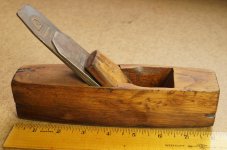
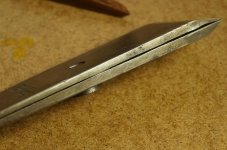
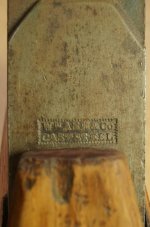
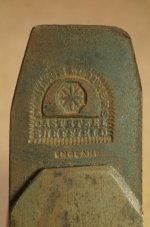
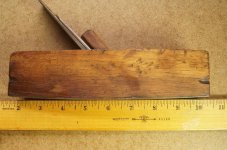
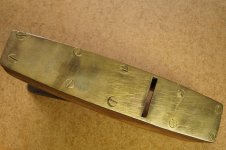
The pictures tell the story, in order 1) it's wooden-bodied, coffin-style, about 8" long, 2) it has a 1/16"-thick brass sole, 3) the sole is curved along its length, 4) the iron is marked Moulson Brothers / Cast Steel / Sheffield / England, 5) the chipbreaker is marked Wm. Ash & Co. / Cast Steel, 6) the mouth opening in the body is much larger than the mouth in the brass sole, 7) the iron is tapered.
The iron appears to be in great shape and should sharpen easily, but the fit between the chipbreaker and the iron needs some work to fix a gap at one end. To describe the amount of curve in the sole, if I rock one end of the plane down to touch the bench, the curve puts the other end about 1/4" off the bench. It also has a very slight curve across its width, but it's hard to tell if that's intentional or not. I can't find any maker's marks on the plane. I've looked up Moulson Brothers and Wm. Ash, so I don't need any info on them.
My curiosity is mostly about what the brass bottom and the curved sole tell about its purpose, and possibly the maker.
The pictures tell the story, in order 1) it's wooden-bodied, coffin-style, about 8" long, 2) it has a 1/16"-thick brass sole, 3) the sole is curved along its length, 4) the iron is marked Moulson Brothers / Cast Steel / Sheffield / England, 5) the chipbreaker is marked Wm. Ash & Co. / Cast Steel, 6) the mouth opening in the body is much larger than the mouth in the brass sole, 7) the iron is tapered.
The iron appears to be in great shape and should sharpen easily, but the fit between the chipbreaker and the iron needs some work to fix a gap at one end. To describe the amount of curve in the sole, if I rock one end of the plane down to touch the bench, the curve puts the other end about 1/4" off the bench. It also has a very slight curve across its width, but it's hard to tell if that's intentional or not. I can't find any maker's marks on the plane. I've looked up Moulson Brothers and Wm. Ash, so I don't need any info on them.
My curiosity is mostly about what the brass bottom and the curved sole tell about its purpose, and possibly the maker.
Attachments
Last edited:
RTM
Well-known member
Commonly called a compass plane if the curve front to back is intentional. I wouldn’t sweat the gap between the plane and the chip breaker. I don’t know if that is worn down and repurposed, based on the add on mouth.
Will check the dimensions of some of my coffin planes, height to length.
I have a couple of mitre planes that look like yours (aspect ratio), but not with that gaping of a mouth.
Will check the dimensions of some of my coffin planes, height to length.
I have a couple of mitre planes that look like yours (aspect ratio), but not with that gaping of a mouth.
I'm familiar with compass planes, but two things about this one are odd. First, when I search online for "wooden compass plane", I find very few with metal soles; they're just solid wood. If they do have a metal sole, it's usually adjustable for different radii, which this one isn't. Second, they almost always have a greater curvature than this one. It seems as though it must be for a specialized task, so I was hoping someone here might have run across a similar one sometime. It's possible it might be useful for something like hollowing a seat, but other tools would probably do it better.
RTM
Well-known member
I am sure the sole was added later in its life. As huge as that mouth is without the sole, it wasN’t factory. The only question in my mind is whether it was a standard coffin, or something else prior to being resoled.
Hawki
New member
I am humbled ... I'm not sure I've ever seen so much Stanley eye candy under one roof.Like I was saying, there's some pretty amazing hand plane collections out there...... This particular collection consists of mostly mint, NOS original condition, Stanley hand planes.
Jim C.
I wouldn’t sweat the gap between the plane and the chip breaker.
I have a couple of mitre planes that look like yours (aspect ratio), but not with that gaping of a mouth.
The gap between the chip breaker and iron is big enough that it would be constantly jamming with shavings. This picture doesn't quite show how large it is.
The body varies in dimensions along its length, but it's overall pretty slim. For width, it's about 1-1/2" at the toe, 1-3/4" at the mouth, and down to only 1-1/4" at the heel. For height, it's 1-3/4" at the toe, 2" in the middle, and 1-7/8" at the heel. The iron is just about 1-7/16" wide.
Attachments

RTM
Well-known member
Oops, was looking at the side view. That one is fine to sweat.
I am humbled ... I'm not sure I've ever seen so much Stanley eye candy under one roof.

Attachments
I've been getting more and more interested in forming moldings with hollows and rounds and have had a half set ("harlequin") of H&R for probably twenty years.
Here are a few planes I've picked up lately to help in that goal. First is a matched set of snipe bill planes from 1820, seconds is a mismatched set of side rounds, lastly a nice moving fillester plane.
Wooden planes aren't that expensive and work every bit as well, in some cases better than metal bodies planes.


Here are a few planes I've picked up lately to help in that goal. First is a matched set of snipe bill planes from 1820, seconds is a mismatched set of side rounds, lastly a nice moving fillester plane.
Wooden planes aren't that expensive and work every bit as well, in some cases better than metal bodies planes.
I am sure the sole was added later in its life. As huge as that mouth is without the sole, it wasN’t factory. The only question in my mind is whether it was a standard coffin, or something else prior to being resoled.
I examined it some more and found evidence that you're right. Let's see if I can explain this.
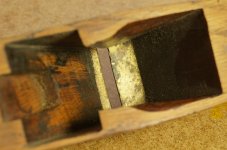
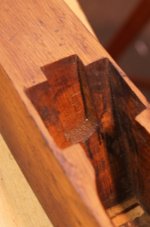
The plane has a cap iron with a fairly large screw attaching it to the iron (first photo). In the body of the plane, the bed for the iron has an extra channel cut into it to provide clearance for the cap iron screw to slide into (second photo).
Inspection revealed that when the iron is installed for a typical cut, the cap iron screw is only a short distance down into its channel. I was able to determine that it could go about 7/16" farther down into the body, if the brass sole didn't stop it.
This is completely consistent with the body having originally been taller, and, of course, with a smaller mouth.
So, it's safe to say someone cut down a small bench plane (smoother?) to convert it into a compass plane, and added the brass sole out of necessity to create a new mouth.
I still can't picture what job it would be used for, since the curvature of the sole is so slight. I didn't mention it before, but the iron is ground perfectly straight across, no curvature to it at all, so it wouldn't be any good at creating a hollow, like a chair seat.
Attachments

RTM
Well-known member
Glad you figured it out. I was in the garage last night, and took some pics of some coffin compass planes and miter (mitre) planes, hoping to show you my logic, but you got there without me. Here are some pics anyway, just for showing that I did do something last night. (Besides getting a STanley #5 functioning, but not quite clean yet)
Summary, I am not sure if yours is a cut down coffin, coffin compass, or miter plane. I guess you could extrapolate the blade projection, and figure out how tall it needs to be. My compasses are about 2-1/2 - 2-5/8" at their tallest point.
Two coffin compass planes, note the difference in radius at the back ends. E Nutting is the shorter, G.A Benton the taller. Have not worked out the radii yet.

Both tight mouths, G. A Benton at 1-7/8" wide on top, E. Nutting at 2-1/8" wide at the bottom. Some reshaping of that sole a long time ago.

Gratuitous shot

And then some miter planes. 3 mitre (miter) planes, essentially coffin, but lower body, and often lower blade angle. The coffin shape is called Smooth in Chapin, if squared, Square.


Summary, I am not sure if yours is a cut down coffin, coffin compass, or miter plane. I guess you could extrapolate the blade projection, and figure out how tall it needs to be. My compasses are about 2-1/2 - 2-5/8" at their tallest point.
Two coffin compass planes, note the difference in radius at the back ends. E Nutting is the shorter, G.A Benton the taller. Have not worked out the radii yet.
Both tight mouths, G. A Benton at 1-7/8" wide on top, E. Nutting at 2-1/8" wide at the bottom. Some reshaping of that sole a long time ago.
Gratuitous shot
And then some miter planes. 3 mitre (miter) planes, essentially coffin, but lower body, and often lower blade angle. The coffin shape is called Smooth in Chapin, if squared, Square.
CRSINMICH
Well-known member
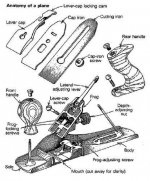
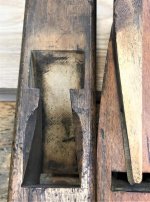
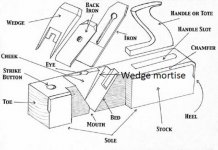
When I "refreshed"the finish on some wooden planes, I noticed that the beds, wedge mortices, (see illustration) and the sections of the wedges that normally sit below the body of the planes seemed to be raw wood. It wasn't just a color difference due to the fact that they hadn't oxidized because they were inside the body of the plane. I looked at every wooden plane I have and only one seemed to have finish on those parts. My thought is that if the wedge and it's matching part on the plane both had finish on them then, after a period of time, they may chemically bond to each other making it difficult to impossible to get the wedge out.
I've looked online and in a book about wooden planes and did not find anything about it. There are lots of Youtubes about plane making and mostly they just slather on the finish without a second thought but it seems like that may not have been standard practice 100 years ago and more.
What do you think? It probably doesn't make any difference one way or the other, but I'll continue to leave those areas dry. I don't want to be the guy who gets cursed for "cementing the damned thing in place" even if it is 100 years post mortem.
I've looked online and in a book about wooden planes and did not find anything about it. There are lots of Youtubes about plane making and mostly they just slather on the finish without a second thought but it seems like that may not have been standard practice 100 years ago and more.
What do you think? It probably doesn't make any difference one way or the other, but I'll continue to leave those areas dry. I don't want to be the guy who gets cursed for "cementing the damned thing in place" even if it is 100 years post mortem.
Attachments

RTM
Well-known member
I am in the don't finish those surfaces camp. Seems that the "slipperiness" of those surfaces shouldn't be messed with. Turn them from rough to slippery or sticky?
What books have you looked at, I can look at others in my library to see if they same anything?
And I think 100% of mine has those surfaces un-finished. But I'm not going out to look.
What books have you looked at, I can look at others in my library to see if they same anything?
And I think 100% of mine has those surfaces un-finished. But I'm not going out to look.
CRSINMICH
Well-known member
The book is, The Wooden Plane Its History, Form, and Function by John M. Whelan. It is a very detailed look at wooden planes from around the world but any mention of construction methods is incidental. I would need to look at books about making planes but I don't have any. It's such a curious and small detail that it may have been overlooked; or else it doesn't make any difference.
Anyone else have an opinion?
EDIT: I just googled "BLO on wooden plane wedge". The results all say, "Do it" except for the ones that say, "Don't do it". Please, take your pick and share your opinion.
Anyone else have an opinion?
EDIT: I just googled "BLO on wooden plane wedge". The results all say, "Do it" except for the ones that say, "Don't do it". Please, take your pick and share your opinion.
Last edited:
RTM
Well-known member
There was an old WW tale of standing a new wooden plane on end in a bowl, or dropping it in a vat of linseed oil, paying by the weight increase for how much oil you took.
Capillary action will **** the oil up.
I just did a quick peruse of Schwarz, Wilson and Hack, nothing on the subject.
Capillary action will **** the oil up.
I just did a quick peruse of Schwarz, Wilson and Hack, nothing on the subject.
Last edited:
CRSINMICH
Well-known member
SHORT BLADE HOLDER
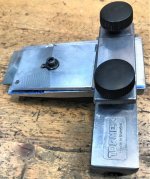
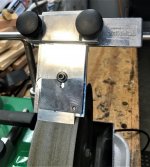
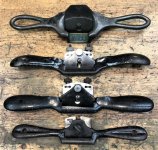
I asked a machinist friend to make a prototype short blade holder so that I could sharpen spokeshave blades with a Tormek. He put this one together using scraps of aluminum. He milled a shallow recess into the end of one face of the thickest piece. The side shoulder of the recess is parallel to the side of the holder and the back shoulder is perpendicular to it. When inserted and clamped, the iron will be held square to the side of the holder too. The holder can then be inserted into a standard Tormek jig and the newly ground bevel will be perpendicular to the side of the iron.So far this system has worked well. Each of these spokeshaves has had their iron sharpened and each will produce wispy shavings.
TOP TO BOTTOM
Stanley #68 Rebate shave
Stanley #151 Gull wing curved handles
Stanley #152 Same as 151 except the handles are flat
Stanley #64 Small shave with flat handles
Attachments


Last edited:
RTM
Well-known member
SHORT BLADE HOLDERI asked a machinist friend to make a prototype short blade holder so that I could sharpen spokeshave blades with a Tormek. He put this one together using scraps of aluminum. He milled a shallow recess into the end of one face of the thickest piece. The side shoulder of the recess is parallel to the side of the holder and the back shoulder is perpendicular to it. When inserted and clamped, the iron will be held square to the side of the holder too. The holder can then be inserted into a standard Tormek jig and the newly ground bevel will be perpendicular to the side of the iron.
Short blades are a bear. I like your square edge guide.
I have this, and yours looks like a nice step or two up.
https://www.leevalley.com/en-us/sho...ts-and-rests/44484-veritas-small-blade-holder
bmwrd0
Well-known member
So, I picked this guy up the other day:

Found it at a Restore I only hit once or so a month, mostly because they don't have much, but they were rearranging the place, and I saw this on a shelf. $30 and I am pretty happy with that price.
Found it at a Restore I only hit once or so a month, mostly because they don't have much, but they were rearranging the place, and I saw this on a shelf. $30 and I am pretty happy with that price.
RTM
Well-known member
And even a decent amount of blade left.
txlonghorn1989
Well-known member
- Joined
- Feb 27, 2017
- Messages
- 2,786
So, I picked this guy up the other day:
Found it at a Restore I only hit once or so a month, mostly because they don't have much, but they were rearranging the place, and I saw this on a shelf. $30 and I am pretty happy with that price.
I sure wish I could find much of anything at our Restore. Pretty much all garbage, all the time. Nice find bmw.
CRSINMICH
Well-known member
MICRO PLANE AND MICRO SPOKESHAVE
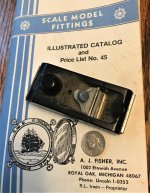
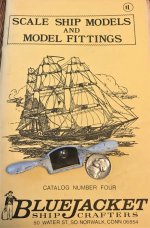
I made an unplanned stop at an estate sale and ended up with these tools and booklets. I assume that the booklets explain the micro tools. The plane is an X-acto but the shave has no name on it. For some reason, someone painted the shave with what looks to be latex primer.Now I'm going to have to invent a holder for even shorter blades.
Attachments
Last edited:
Shiftless
Well-known member
Nice score CRS 
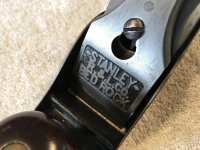
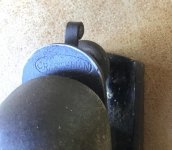
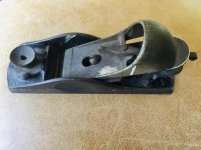
Does anybody have any insight about this block plane I picked up prior to the lockdown? It has an interesting curved Craftsman logo seen in the closeup.
Does anybody have any insight about this block plane I picked up prior to the lockdown? It has an interesting curved Craftsman logo seen in the closeup.
Attachments
CRSINMICH
Well-known member
Joe Huld
Well-known member
Nice score CRS
Does anybody have any insight about this block plane I picked up prior to the lockdown? It has an interesting curved Craftsman logo seen in the closeup.
Made by Sargent 1930's-40's
Private Lugnutz
Well-known member
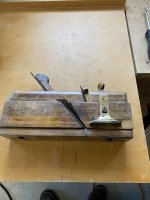
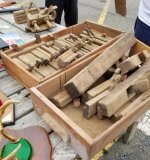
Every year I inevitably run into a bunch of these antique moulding planes. I should get smarter on them so I know if they're worth buying or not to re-supply to collectors. I know that some are, and I know they're marked, but I don't know what names to look for.
Attachments
Shiftless
Well-known member
Made by Sargent 1930's-40's
Thanks J.H.
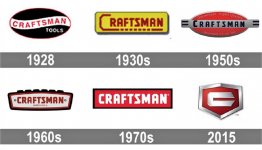
Those dates don’t match up with the curved logo date chart CRS posted earlier indicating pre 1930..
RTM
Well-known member
Every year I inevitably run into a bunch of these antique moulding planes. I should get smarter on them so I know if they're worth buying or not to re-supply to collectors. I know that some are, and I know they're marked, but I don't know what names to look for.
Collectors.... Good luck. Like most, its finding who is looking for what at the moment. I had a friend buy a couple of planes he knew a collector was looking for. Turns out he had just upgraded, these were his "discards". Apparently awkward moment when he tried to sell them to him at the next show.
Without carrying a book with you, its hard to keep track of the rare or valued brands that might be a big score. (A Guide To The Makers of American Wooden Planes, 4th Edition*) Not all the rare ones are marked. Like you can ID a socket by its looks, some plane guys can too. Not me.
Most of the moulding planes are lucky if they can get $15 on the open market anymore (fleas etc), so if you can grab them for <$5 might be worth it. In decent shape, un modified, with blade, correct wedge, and undamaged sole
they will occasionally go for more. Fancy woods like Ebony will add to the value.
For my uses, I don't buy the fancy shapes, I stick to squares (rabbets and dadoes), and simple curves (beads, half rounds, hollows and rounds etc). None of this ogee, reverse ogee, grecian etc for me, so I don't know the market that well.
Here is a page showing some common shapes, there are many more
https://www.mvr1.com/Ohiowoodenplanes.html
If you can get matched pairs (Tongue and groove by the same mfg in the same size) they are often worth more. That second box might have matched sets in it, as the widths on a few, and the wedge shape, seem to match. A set of hollows and rounds is a great find, especially if they all match, and the previous owner is the same on all of them. Some collectors go nuts for them. (I found a set at an estate sale, and found 10 pairs, and 2 solos, at opposite ends of the set, missing 1 #1 and 1 #12. I had to pull out six other moulders out of the chest before I realized I was on to a full set.)
There are great users, brands like Ohio, Sandusky etc that made tons, and small brands like Chapin, Barton, Varvill, and really small like Arrowmamett, Sym, Pond etc. Then you add in the European mfgs like Goldenberg, LaChappelle, Braun.....
I am approaching 100 of them, and I look at quality of build, and ability to put back to work, rather than brand, when I buy. But I am not planning to flip.
The bench planes are a harder market still, as they are really equaled or surpassed by standard metal bench planes for working. For these, quality of the sole / mouth is king in my book. Those that looked like they rolled in the mud would have to be pretty special to get me to get out my wallet. To be useful, the mouths must be pretty tight (when the blade is installed correctly), the iron and wedge must be somewhat appropriate, and no huge splits in the ends. The handle must be comfortable. Again, brands are all over the map. I have a ~20 vintage ones, and they are either odd configurations (razee jack), extra dense, or really big or small. I have one which is about #4 sized, which has a grip made special for right handed people. Who could pass it up for $10? I think I've only paid over $30 for a few, mostly big ones or oddballs, like a double ended mitre shooting plane.
The armed plane in the back is a **** shoot as a user. That style, with the threaded arms, are especially fragile. Parts are often not interchangeable between planes, especially the threads, but sometimes the irons are odd shaped. The type with wedged arms are less fragile, but less cool, and a bit harder to set up to use. Anything with brass might add a few dollars, Ivory tips etc will add $$$.
*https://toolsforworkingwood.com/store/item/AP-GAWP
Last edited:
hsvtoolfool
Well-known member
I should get smarter on them so I know if they're worth buying or not to re-supply to collectors.
Oh, I like that. "Re-supply To Collectors" as opposed to "Flip on Ebay".
Buy what you need or like and leave the rest. There's just not enough profit in most "in the wild" antique planes to make it worth the time and effort. It's extremely unlikey to find some "lottery ticket" plane for $5 at a local yard sale or whatever. I can't find the thread, but someone in the forum recently paid about $20 for a Stanley #10 bench rabbet plane at a local Habitat For Humanity "ReStore". That was an incredibly rare find at that price. That plane was worth more than $20 just in parts. Personally, I would have donated $50 since the plane is worth at least $120 once it's restored.
But man, I wish I had a dollar for every clueless seller trying to flip common antique tools to newbie wood workers for crazy money.
There's a local antique store trying to sell five common-as-dirt 1950s era Stanley #5 planes as a "matched set" because they supposedly came out of a nearby Mennonite shop. Of course they're in terrible shape, including drilled at the heel to hang on wooden pegs. The guy thinks "Mennonite collectors" will buy this garbage for $500. Are "Mennonite collectors" really a thing? Actual value for these five planes: $100 max.
The same "tool expert" had a decent mass-produced wooden 1/2" dado plane with brass depth stops and full nickers. I have a soft spot for dado planes, so I have several and follow typically prices. Natually, I assumed the $200 price tag had the decimal in the wrong place. Nope. This fool actually wanted $200 for a plane I can buy for $25 on Ebay.
Private Lugnutz
Well-known member
Same holds true for some mechanics tools. And in may cases, the "books" are wrong. I got into tools about 13 years ago when I bought a 1943 Willys MB. First generation collectors relied on first generation guides (e.g., Nabholz, JeepDraw/G503.com stickie) and forums, which were less than informed/substantiated. So I dove deeper and co-authored a guide with a likeminded CJ2 expert. Did the same for the GMTK with a folding "cheat sheet" guide. Antique and vintage tools are one of the most complex, intricate collecting hobbies there is, in my opinion. And there's only so many niches you can become expert in before you are saturated, burned out, and most likely, divorced.Without carrying a book with you, its hard to keep track of the rare or valued brands that might be a big score.
 There are sub-niches (e.g., vises, wood saws, anvils) that are all just a bridge too far or a rabbit hole too deep for me right now. Having said that, I wouldn't mind knowing a few good names to look for.
 Thanks for the mini-tutorial.
Oh, I like that. "Re-supply To Collectors" as opposed to "Flip on Ebay".


Well, I do like to think the difference is a little more than fancy semantics. There is a loose affiliation among collectors even here among GJ guys where someone mainly collecting Plomb will pick up things for a guy mainly collecting Blackhawk, and vice versa. And integrity and awareness of how hard picking in the wild is and a feeling of mutual respect usually commands that items "re-supplied" (i.e., sold or traded) are done so at a friendly but fair value. If I can find a hen's tooth moulding plane that I have no desire to keep, I'd be happy to move it on to someone at a reasonable going-rate price. If only to stay in the black for collecting. And some of us (I refuse to use the word "gift" as a verb...) send things to others for free, common or maybe even uncommon, just because in the long run we're probably getting things back, or if only for the good karma. So, yeah, I very casually wish I was smarter about planes because I could be leaving gems behind.
Provincial
Well-known member
I recently bought a Wards Master No. 5 plane at an estate sale. It was 1/2 price day, and the only bad thing about the plane was the tip of the rear handle had been knocked off, probably by dropping it on the floor decades ago. The front fastener of the rear handle was missing, with a #12 stud sticking out. I put a washer and nut on the stud and tightened the slotted nut on the handle.
Within a week, I had to replace a corner on a door to my daughter's play house by trimming off a corner of a 13/16" thick fir board where the mice had chewed an access hole. I roughed out a piece of old-growth scrap 2x4, leaving it a little thick, and used this plane (without sharpening it!) to finish planing it to thickness.
I trimmed the corner to 45 degrees and glued on the patch using two finish nails to hold it while the glue set. I sanded it to match the lines of the door and it was ready to paint.
I figure I got my $7.50 back from that one job. This is one benefit of the old tool hobby.
Within a week, I had to replace a corner on a door to my daughter's play house by trimming off a corner of a 13/16" thick fir board where the mice had chewed an access hole. I roughed out a piece of old-growth scrap 2x4, leaving it a little thick, and used this plane (without sharpening it!) to finish planing it to thickness.
I trimmed the corner to 45 degrees and glued on the patch using two finish nails to hold it while the glue set. I sanded it to match the lines of the door and it was ready to paint.
I figure I got my $7.50 back from that one job. This is one benefit of the old tool hobby.
crguy
Well-known member
I can't find the thread, but someone in the forum recently paid about $20 for a Stanley #10 bench rabbet plane at a local Habitat For Humanity "ReStore". That was an incredibly rare find at that price. That plane was worth more than $20 just in parts. Personally, I would have donated $50 since the plane is worth at least $120 once it's restored.
Personally, I think that's a bit of an exaggeration. There is nothing "incredibly rare" about finding a #10 at any price.
Second: Paying $50. for a plane then spending however much time to "restore it" to make it worth $120. is no bargain IMO.
Selling one for $120. on Ebay will net you about $100. after the fees, etc.
WisJim
Well-known member
I've been collecting wood working tools for over 40 years, and when I started I probably spent as much on books, dealer catalogs, and catalog reprints etc as I did on planes in my early years of collecting.. I was lucky and got some great deals at auctions and garage sales by buying tools that looked interesting at low prices. Back then there was no internet and the only experts were usually members of tool collecting clubs, and even finding information on these collectors' organizations was difficult. Much of the info that I had to spend money to get is available online now and easy to access. I feel that if you are genuinely interested in collectible tools it is worth joining the Mid-West Tool Collectors Association and the Early American Industries Association, and attending the local or regional meetings of the M-WTCA just to see what is available and how things are priced and what might be in demand, if you are interested in reselling. The M-WTCA meetings are basically members-only tool flea markets with some educational stuff thrown in, all provided by members. I personally still buy tools that either I will use, or are interesting mechanically, and I focus more on drilling tools now than on planes.
Personally, I think that's a bit of an exaggeration. There is nothing "incredibly rare" about finding a #10 at any price.
Second: Paying $50. for a plane then spending however much time to "restore it" to make it worth $120. is no bargain IMO.
Selling one for $120. on Ebay will net you about $100. after the fees, etc.
If we’re talking about the #10 above, I’d take it one step further..... $30 in its unrestored condition was high. Replacing the cracked rear tote is an easy $20. And “restoring” the plane can actually de-value it. At this point, I doubt the plane in any condition will ever be worth anywhere near $120. In order to get even close to that price, it would have to be in significantly better, original, unrestored shape. That’s just my opinion. If it’s a #10C, you might have something. Still it’s in rough shape and restoring It doesn’t necessarily make it appealing to collectors.
Jim C.
Last edited:
3baygarage
Well-known member
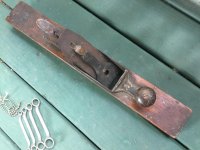
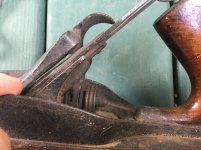
Can you guys tell me more about this plane that I mentioned a ways back? It’s a Stanley Rule & Level Co., 22” long.
The bottom has a brass plate with 50 screws holding it. User mod?
The bottom has a brass plate with 50 screws holding it. User mod?
Attachments
-
 AED0B952-59CD-4610-BFE7-7C917B9C9FD0.jpg135.4 KB · Views: 26
 -
 77FEC7D5-4D94-4543-AC39-6342F274F275.jpg147.5 KB · Views: 22
 -
 96EECBE6-4834-4584-A681-92726CEF4D22.jpg147.9 KB · Views: 20
 -
 FCBD0A03-57D9-489F-9A03-54D63902E1A1.jpg150.1 KB · Views: 20
 -
 9900DF0D-28A8-4D77-A19D-2D56E0195470.jpg148.8 KB · Views: 23
 -
 D5CD2851-47DD-4E7D-8E59-B49948C02E88.jpg137.5 KB · Views: 28
 -
 A11D235C-C842-43BE-A05B-19B6C4E31BC7.jpg147.9 KB · Views: 31