To avoid these ads, REGISTER NOW!

Show us your sewing projects!

rlitman

Well-known member
Joined
Oct 18, 2010
Messages
24,582
Location
Long Island
Here's a 45 second slow-mo video showing the inside of a Singer 401 working from pattern disc to foot. It can be a good technique to use to see any issues happening while running.

What sort of lighting was that in? I ask, because the other night we had the Pie Face game out and a couple of cans of whipped cream, and one of the kids suggested filming it in slow-mo, and I got the same strobe effect from led "filament" style lights. I had assumed that LED wouldn't flicker much, if at all (fluorescent flickers badly), but it seems that filament LEDs don't have a DC power supply, so they flicker even worse than fluorescent.
 
To avoid these ads, REGISTER NOW!

macgee

Well-known member
Joined
Jan 11, 2014
Messages
2,834
Location
Sepulveda Pass, CA
It's a mix of fluorescent and LED, you can see the different colors flicking, one more blue than the other. Both LED and Flour. can be bad and hence hard on the eyes compared to incandescent/halogen, even though we cant tell because its moving so fast to see with naked eye but still feels it.
 

dscheidt

Well-known member
Joined
Apr 26, 2017
Messages
2,885
I've got a bunch of those antique thimble sized wooden spools. Yeah, I could see those being much more forgiving. Maybe a teflon washer (like those some people use under bobbins) might help. I wonder if the old Singer thread intentionally came with tighter twist specifically to work on their machines and get around this issue ... I wouldn't put it past them to use a strategy like this to lock you into their consumables.
:)

It's a matter of how the thread is wound on the spool. The small spools (and you can still buy small spools like this) have the thread wound on straight, from top to bottom, and then back to the top, much the same way your bobbins are wound. Bigger spools and cones have the thread wound on at an angle, top to bottom, and then back to the bottom at an angle 90 degrees to that, in a fashion generally called 'crosswound'.

Straight wound thread is intended to be pulled off the spool straight to the side; if you pull it up over the top, you usually introduce a twist, and a tangle. Crosswound thread needs to be pull straight up off the end; if you pull it off the side, it ends up with a twist in it, and it tangles. Most modern domestic machines have provisions for using both styles of thread. Older domestic stuff (and really old industrial machines) just expects straight wound thread; for cross wound stuff, you need an external thread stand. Industrial machines are all set up for crosswound thread, if you need to use straight thread on them, you have to rig something up.

It's much easier to build high speed winding machines that put thread on spools crosswound, and the machines are faster. A substantial fraction of the cost of thread is spooling it onto a cone or spool, so the faster it can be done, the better.
 

macgee

Well-known member
Joined
Jan 11, 2014
Messages
2,834
Location
Sepulveda Pass, CA
Nice dscheidt,

Good info and well described.

Can't tell you how often I see people buy a vintage domestic, go to Joann's, buy some nice Gutermann and set it up like a straight wound. Me included until I was able to figure it out (the hard way). It's amazing all the little nuances that can mean the difference between a good & reliable stitch and a total cluster F.
 

isb cornbinder

Well-known member
Joined
Nov 3, 2010
Messages
7,073
Location
Pacific South West, BC, Canada
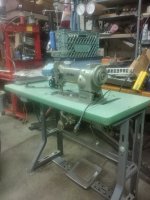
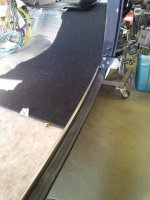
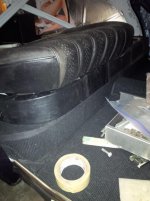
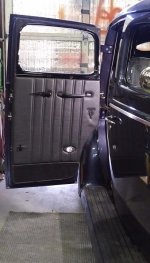
I bought a used JUKI 562 and did all of the interior of my 1940 Ford. This was my first time sewing leather.
 

Attachments

  • JUKI 562 (3).jpg
    JUKI 562 (3).jpg
    77.3 KB · Views: 126
  • passenger carpet and reproduction stainless molding and seal.jpg
    passenger carpet and reproduction stainless molding and seal.jpg
    140.9 KB · Views: 87
  • rear seat right 2.jpg
    rear seat right 2.jpg
    71.7 KB · Views: 88
  • POWER WINDOW RR THE LAST ONE.jpg
    POWER WINDOW RR THE LAST ONE.jpg
    109.4 KB · Views: 84
  • LF DOOR FIRST FIT-UP.jpg
    LF DOOR FIRST FIT-UP.jpg
    64.5 KB · Views: 84
  • IMG_20141101_173817.jpg
    IMG_20141101_173817.jpg
    78.7 KB · Views: 86
  • DRIVERS DOOR 2.jpg
    DRIVERS DOOR 2.jpg
    76.6 KB · Views: 94

WoodsTruck

Well-known member
Joined
Jan 12, 2013
Messages
1,019
I recently made some hand guards and a bar bag for my sled.
 

Attachments

  • Grip angle.JPG
    Grip angle.JPG
    57.1 KB · Views: 88

steel 35

Well-known member
Joined
Feb 20, 2011
Messages
2,105
Location
Between the PNW and the Emerald Triangle
Go ahead rlitman, borrow away for yourself.

Here's a 45 second slow-mo video showing the inside of a Singer 401 working from pattern disc to foot. It can be a good technique to use to see any issues happening while running.

https://imgur.com/PrBYnfv Click on sound


`

Thank You!
I have a 401a & baby in the box as well, do you do house calls :D

Didn't see left Twist, In the Thread?

This was my first test and glad this thread got me out to check it!
Ice puddle and a 120 gallon bucket for size, remember this is a fishing boat pictures can be posed :p
I did turn the dial up and see it run full speed but here are the result's
Seam didn't leak or tear yet :lol_hitti
 

Attachments

  • Boat top.jpg
    Boat top.jpg
    86.6 KB · Views: 85

macgee

Well-known member
Joined
Jan 11, 2014
Messages
2,834
Location
Sepulveda Pass, CA
Thank You!
I have a 401a & baby in the box as well, do you do house calls :D

Didn't see left Twist, In the Thread?

This was my first test and glad this thread got me out to check it!
Ice puddle and a 120 gallon bucket for size, remember this is a fishing boat pictures can be posed :p
I did turn the dial up and see it run full speed but here are the result's
Seam didn't leak or tear yet :lol_hitti

Nice Steel,

So cool to see these real purposed projects posted above. I know its not as cool as a lathe or mill but a sewing machine can be very handy to have for a shop and property. So many things that can be made to help us around the shop and doing thing like car interiors (respect!), boat covers and other items.

Finding good sewing machine during covid has been getting tougher and way more expensive but definitely can still find good deals out there, Love it when they pretty much give it way but its locked up and only really needs a good soak to loosen the grease that's hardened up and cleaning. Industrial machines seem to be getting easier to find cheap as pole want the space back.

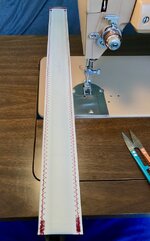
It's not much to look at and not the prettiest but last night I pulled out the sewing machine and made a protective sleeve with a cover flap for my 36" Starrett straight edge out of sail dacron and maroon Gutermann Tera 40 thread, I sewed in magnets into the top of the sleeve above the opening to hang/stick to my Vidmar tool cabinet so it can hang there and easy access when when needed. Also need to start making again Dyneema backpacks and waterproof duffle bags.

50963349322_8e2c9805b2_b.jpg
 

Modern Garage

Well-known member
Joined
Mar 26, 2015
Messages
583
Location
Southern Minnesota
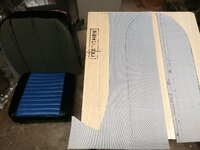
I recently was given a sewing machine, not industrial but pretty heavy duty. Was in a flood so I had to disassemble everything and clean and lube it all. A good education I thought.
I'm diving into the deep end of the pool and sewing new upholstery for my '72 MG. Its really rough so even as a beginner I can't make it any worse.
My question is how to decide how tight to make the covers - in other words how much "preload" to put on the foam rubber as I install the new covers. Is there some rule of thumb for how much smaller than the foam to sew the covers? I tried to measure the existing material as the seams were easily ripped out, but the original vinyl is so badly stretched (huh, after fifty years, who'd a thunk it) that I can't trust them for exact size. I did manage to sew the bottom and matched the size of the foam cushion but its just ok and not very tight. That's what made me realize that I'm missing something.
 

Attachments

  • 0324221446.jpg
    0324221446.jpg
    316.1 KB · Views: 70

harley jim

Well-known member
Joined
Dec 6, 2013
Messages
11,399
Location
Cleveland Tn..........out in the sticks
On a seat like that the padding is thin anyway so I would go ⅜" to ½" smaller all the way around, that just a guess since I cant see and feel the materials. One saving grace that I have used on a seat is add a layer of fiber fill over the foam this will bulk up the foam and make the seat cover tighter if it is loose.
received_3845784338850039.jpeg
I did this last year after taking a 15 year break, It got a tear and I patched it, that's the pucker in the corner.
I hope this helps a bit. Like I said I'm a hobbyist not a pro.
 

Outlawmws

Well-known member
Joined
Aug 9, 2011
Messages
39,131
Location
The Badlands
That sounds about right

The other approach is to use the old covers as a "pattern" and cut and stitch to match - meaning cut oversize, but the stitch lines match the corners of the old pastern exactly.

if the padding is good (not rotty) but "tired" (has taken a set) you can steam the foam padding and it with recover.
 

WoodsTruck

Well-known member
Joined
Jan 12, 2013
Messages
1,019
I have a small garment steamer that I used for quite a few years. I bought an industrial steamer a couple years ago. I'm not gonna lie. Man does it put out a lot of steam. Makes old foam jump to life real quick.
 

WoodsTruck

Well-known member
Joined
Jan 12, 2013
Messages
1,019
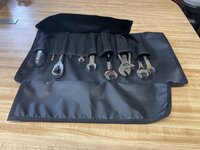
I'm more of a utilitarian type. I build things to fill a need, not necessarily pretty. I do SAR - over the snow for the local Sheriff so I built a headlamp mount for the front of my helmet, a big duffle bag for the rear of my sled to put my backpack, snow shoes and survival gear in for searches, plus some small pouches and 20 radio holsters for the SAR members to put on their hi-viz vests. Made a chest harness for a handheld data recorder, but no pictures yet. Tool roll is self explanatory.
 

Attachments

  • IMG_8136.jpg
    IMG_8136.jpg
    139.1 KB · Views: 57
  • IMG_8205.jpg
    IMG_8205.jpg
    112.4 KB · Views: 46
  • IMG_8253.jpg
    IMG_8253.jpg
    298.9 KB · Views: 44
  • IMG_8276.jpg
    IMG_8276.jpg
    145.1 KB · Views: 42
  • IMG_8292.jpg
    IMG_8292.jpg
    70.9 KB · Views: 45
  • IMG_8452.jpg
    IMG_8452.jpg
    131.2 KB · Views: 45
  • IMG_8456.jpg
    IMG_8456.jpg
    115.1 KB · Views: 44

Modern Garage

Well-known member
Joined
Mar 26, 2015
Messages
583
Location
Southern Minnesota
Thanks for the advice. I've been using 1/2 inch seam allowance but I'm more confident in my ability to sew a straight line now so I'm going to go to 3/8 in seam allowance, then I can cut the material to match the foam size and count on the lost 3/8 in to tighten it up. That will actually mean 3/4 total on each seam but from what I can tell with the old stretched out vinyl I should be close.
Joe
 

WoodsTruck

Well-known member
Joined
Jan 12, 2013
Messages
1,019
Sounds about right. The upholsterer I worked for used a 1" oversize on foam for cushions. Spray a little silicon on it so it would slide in an enclosed cover if you had to.
 

harley jim

Well-known member
Joined
Dec 6, 2013
Messages
11,399
Location
Cleveland Tn..........out in the sticks
Sounds good Joe, like others have said and I didnt mention, steam is your friend. Not only dose it revive foam but it will help you stretch out a wrinkle in your finished seat cover as your trying to smooth it out. Remember that you can add fiber fill batting to fill a hollow spot if your seat cover it loose fitting,
Screenshot_20220326-100129_Chrome.jpg
It will also work in an old original seat that has stretched a bit.
Post some pics when you get them going. We like pics!
 
To avoid these ads, REGISTER NOW!

Modern Garage

Well-known member
Joined
Mar 26, 2015
Messages
583
Location
Southern Minnesota
Thanks for the notes. I've been away from home for a bit but hope to be back to work on this project late this week.
I'll have to keep my eye out for a steamer. Hmmm, I wonder if I can make one without blowing up the house?
Joe
 

Modern Garage

Well-known member
Joined
Mar 26, 2015
Messages
583
Location
Southern Minnesota
I have to say (now that I'm home on something bigger than my phone) I'm glad I woke this thread up instead of asking my one question separately. It's fun to see all the projects. I'll post more pics soon.
Joe
 

Milton Shaw

Well-known member
Joined
Feb 11, 2011
Messages
4,835
I have been doing my own sewing for over 40 years now. I used a Singer home machine on my first upholstery job and ruined it. I bought a Sewmaster (Consew) clone walking foot machine and have used it ever since. I made sofa's and chairs for home, re upholstered three cars, and have done numerous cushions, stools etc. over the years. I made curtains for the entire house. That required a much lighter duty machine so I bought a Singer commercial machine and a Consew blind stitch hemmer machine and still use them frequently. The Sewmaster walking foot machine does car upholstery where you sew through two layers of material, two layers 1/2 inch sew foam, gimp and then double that count up in corners like it was shirt material with ease. I don't have much left of what I have sewn as I drove the cars daily for 10 or more years after restoring them, same for furniture but do have curtains still up and a lot of cushions.
 

Outlawmws

Well-known member
Joined
Aug 9, 2011
Messages
39,131
Location
The Badlands
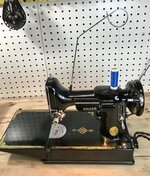
I picked his Singer 221 feather weight up cheap (came with the carry case too! ) a month back:

Today I fixed the plug and wiring - Plug parts (to the machine - half the Bakelite shell was gone, and one of the brass receptacle pieces) from Eprey, one wire from a YS find yesterday that is the same sheathe 18 Ga wire the Singer used from what appears to be a Sony PS plug? Everything is operational from an electrical standpoint Now I need some bobbins and possibly a bobbin carrier, or parts for one; not sure but the machine runs as smooth as a, Heh - sewing machine! :lol:

Singer 221 featherweight.jpg
 

mharmon

Well-known member
Joined
Oct 10, 2012
Messages
204
Location
Salt Lake City
I picked his Singer 221 feather weight up cheap (came with the carry case too! ) a month back:

Today I fixed the plug and wiring - Plug parts (to the machine - half the Bakelite shell was gone, and one of the brass receptacle pieces) from Eprey, one wire from a YS find yesterday that is the same sheathe 18 Ga wire the Singer used from what appears to be a Sony PS plug? Everything is operational from an electrical standpoint Now I need some bobbins and possibly a bobbin carrier, or parts for one; not sure but the machine runs as smooth as a, Heh - sewing machine! :lol:

Singer 221 featherweight.jpg
That machine is great. Awesome job saving it. I’m sure you already know this but those featherweights have quite the following and are worth some money. You say you got it cheap. Maybe flip it?
 

macgee

Well-known member
Joined
Jan 11, 2014
Messages
2,834
Location
Sepulveda Pass, CA
Nope; Keep it and flip a couple Of my "newer" bigger machines - not as valuable, but space is worth something too.
Nice score Outlaw and good choice on keeping it. Despite there dainty look and how small it is; they're not toys and very useful.

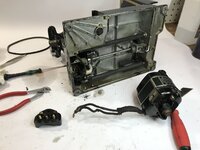
I've rebuilt several Singer 401's and canvas sailmaking machines. I scored my 221 Featherweight for $45 at a second hand store just before Covid (1st pic). I'm glad I peeked inside before using it. The whole inside and gears were caked with rock hard grease (more like glue), leaded flakes falling into the gears that needed to be removed, After doing a rebuild, including the motor and electrical, new cables, I love the feel of this machine when stitching and prefer it to my 401A; I can definitely see why there's such a demand and price for them. Like you said, very smooth!

If you need to replace the lamp I recommend getting an LED version, it was brighter and cooler than the incandescent version.

I tried pushing to see what it could handle and was very surprised, I've tested the tiny 221 with several layers of coated sail dacron and heavy stitch and did just fine when not pushing it and using a fresh & correct sized needle is a must. It's no HD sailmaking machine but very respectable for the size.

I have two Sailrite sewing machines that I now need to tackle and rebuild, I have way too many machines that really need to be sold off but the 221 is a keeper.

Definitely recommend Tri-Flow and Bluecreeper lubricants for sewing machines.

IMG_3156.jpegIMG_3327.jpegIMG_3232.jpegIMG_3340.jpeg IMG_3346.jpegIMG_3681.jpegIMG_3397.jpegIMG_3393.jpeg
 
Last edited:

Copymutt

Well-known member
Joined
Sep 3, 2016
Messages
3,383
Location
Colorado
I can get by when the problem demands it. Made a few leather items that were enjoyable.
This was a custom seat cover that stitching pulled out due to sliding in and out of the truck.
Came out good considering my lack of experience.
E70313D5-87F8-4F6C-B494-E586D99A9EBD.png
 

macgee

Well-known member
Joined
Jan 11, 2014
Messages
2,834
Location
Sepulveda Pass, CA
I picked his Singer 221 feather........

Now I need some bobbins and possibly a bobbin carrier, or parts for one;

Outlaws,

If your looking for a bobbin case, try to find an original one in good condition (if possible) as there's a ton of China knock-offs, The orig. part number stamped on them is #45750. Having a good one can make the difference between smooth operation or rats nests. However, I just looked the prices they're now commanding and it's totally insane. They should now be called "Retirement Bobbins" as there almost the same price as a Rockwell Delta lamp : )
I'll have to keep an eye out for them at the swap meets

Here's a link describing the correct ones for the 221.

https://singer-featherweight.com/blogs/schoolhouse/bobbin-case-history
 

Outlawmws

Well-known member
Joined
Aug 9, 2011
Messages
39,131
Location
The Badlands
Yep, I was perusing Eprey yesterday and was more than surprised! 221, 222, and 302 bobbin case.

I should go through the local antique stores as well...

I did find a box of attachments I'd picked up cheap a while back just because - I'm pretty sure they will work if I ever need them. I'm wondering which is the one that does the zig zag?
 

macgee

Well-known member
Joined
Jan 11, 2014
Messages
2,834
Location
Sepulveda Pass, CA
Yep, I was perusing Eprey yesterday and was more than surprised! 221, 222, and 302 bobbin case.

I should go through the local antique stores as well...

I did find a box of attachments I'd picked up cheap a while back just because - I'm pretty sure they will work if I ever need them.
To find out which of your attachments work on the 221, check out this really good list of which ones work on them and their part numbers and what they're for. Featherweights can only use the low shank versions and there isn't a ton to choose from unlike what you see for other Singer models. The binder and zipper foot can be useful.

https://singer-featherweight.com/blogs/schoolhouse/vintage-singer-attachments-accessories

I'm wondering which is the one that does the zig zag?

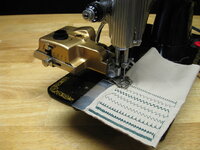
As you know, 221 Featherweights can only do straight stitch but if you want to do some light zigzag work, check out the "Greist Automatic Decorator in GOLD" attachment. I found these to be the best ones but pretty sure only the "gold" version works on the 221. I think it will be the same issue as a retirement bobbin, they go for a lot of money of fleabay or probably can be bought for $5 at you local Salvation Army or flea market if you hunt hard and get lucky.

Just don't expect to make a sail or backpack with it. It's more for the dainty stuff but can be useful.
732970_orig.jpg


Lastly, here's a link to view a PDF of the original 221 Featherweight Manual:

https://cdn.shopify.com/s/files/1/0992/8814/files/FW221Manual.pdf?3897131758827484458


`
 
Last edited:

Outlawmws

Well-known member
Joined
Aug 9, 2011
Messages
39,131
Location
The Badlands
Very helpful! Thanks! At least 4 attachments identified and fit. Some were not listed there so I'll google them and see... and 2 don't have numbers stamped anywhere I can find...

That Featherweight site has very good info, but can be a bit of a trick to navigate directly I've found.

I did find their S/N date list, and mine is a 1950 probably made in the middle of May.
 
Last edited:

kerrynzl

Well-known member
Joined
Nov 8, 2013
Messages
5,054
Location
Tauranga, New Zealand
My latest sewing project.
I used some UV resistant PVC and cut the shape using a paper template
20210731_133755.jpg

20210731_133917.jpg

Then I hot-air welded some reinforcing patches in the corners
20210731_134014.jpg

Then I boxed all the corners and hemmed it with a sewing machine, and also sewed straps onto the reinforcing patches.
The end result is a UV Proof and Weatherproof winch cover for my trailer
20210806_145253.jpg

Color matching the PVC to the trailer took some skill [actually I purchased the PVC first and color matched the paint to the PVC
Finished.PNG
 

macgee

Well-known member
Joined
Jan 11, 2014
Messages
2,834
Location
Sepulveda Pass, CA
My latest sewing project.


Color matching the PVC to the trailer took some skill [actually I purchased the PVC first and color matched the paint to the PVC

Nice job Kerry and also, that's a really nice galvanized trailer (looks fresh) but don't lose that cover, as that might cost you another paint job to match : )
 
To avoid these ads, REGISTER NOW!
Top Bottom