To avoid these ads, REGISTER NOW!

Show us your VFD conversions/installations

ndnchf

Well-known member
Joined
Jan 9, 2012
Messages
1,556
Location
Fredericksburg, Virginia
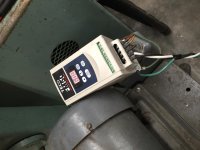
FWIW, the WT900 drill press with the small TECO VFD I showed earlier uses a 230 3ph motor. The VFD uses simple 115 single phase input. I was a little skeptical of this when another fellow showed me his similar set up. But I've been using it for 4-5 years in my home shop and it has worked beautifully. No problems at all.
 
To avoid these ads, REGISTER NOW!

manwithtools

ALLIANCE MEMBER
Joined
Aug 24, 2015
Messages
13,639
Location
Lebanon, TN
There are some rules of thumb regarding enclosure volume and material vs the VFD size. With mine mounted in a steel enclosure with 4 times the volume of the VFD should be close to being able to cool on its own without fans. My installation is "sealed" and so far I have had no issues, but I would check the manual of your specific model to see what the cooling recommendations are.


Here is my installation on an older Delta drill press. I wanted to be able to see the screen on the VFD, but wanted all remote buttons and potentiometer to prevent the built in potentiometer from wearing out. The buttons are set up as a standard 3 wire control scheme.

The "door" on the enclosure allows me to access the hard buttons and terminals on the VFD due to the odd sideways installation. The door is sealed with a foam gasket and held down with a strong magnet. So far it has done well at keeping debris out of the enclosure.

One word of caution regarding mounting method, some VFD's rely on conductive cooling through the rear mounting surface to the panel they are mounted on. Yours appears to be DIN rail mount capable so it is using more convection cooling and should be fine as used. Be sure to read the manufacturers instructions regarding mounting and cooling.

Nice job on you enclosure BTW. It's important to keep these in a clean environment.
 

manwithtools

ALLIANCE MEMBER
Joined
Aug 24, 2015
Messages
13,639
Location
Lebanon, TN
For all of you who have your VFD's mounted in open air on your equipment I'll give a word of caution against this.

The VFD's you are using are not rated for open installation in a shop environment. You need to consider that all the dust we create in our shops (particularly metal dust) is very conductive and over time will settle on the circuit boards inside the VFD's potentially shortening the life span.

They really should be mounted inside an enclosure that will keep them dry and clean as much as possible. Yes I know they have been working fine and yes I know that many times in industrial applications they are in big enclosures that have the doors left open and they are filthy. These are little different from other electronics (computers, etc.) as they have some fairly large power circuits that could short out if enough garbage finds it way in there.

I'm just mentioning this to insure you get the longest life from them. Also most of the cheaper units have somewhat exposed electrical terminals which are not a good thing if you have young inquisitive folks around.
 
OP
T

Techie1961

Well-known member
Joined
Feb 18, 2014
Messages
1,520
Location
Pickering Ontario Canada
Now that I have drunk the Koolaid and am getting into these things, I am thinking that I really should have done this sooner. They seem intimidating but really aren't and I think that practically anyone on this forum (being what it is) can do them.

It's a pretty cool feeling when you get into it, make a few parameter changes and TADA, it works.
 

manwithtools

ALLIANCE MEMBER
Joined
Aug 24, 2015
Messages
13,639
Location
Lebanon, TN
Do VFD's have the same issues? I'm a complete electrical ignoramus when it comes to understanding the underlying engineering of how this works. Is there a VFD's for dummies out there ?

Now I'm wondering if I shouldn't be looking into running a VFD on things like my compressor and other things that have large electrical motors on them to save some power.

A properly rated single phase input, three phase output VFD will produce full HP based on it's sizing. For example a 2HP VFD will run a 2HP motor. There are also three phase in, three phase out VFD's which can operate on single phase input but have to be de-rated in that application, confusing I know and can only suggest you read carefully the specs. on the unit you might be considering.

The great thing about a VFD is that you only are powering the piece of equipment you need. Most folks that use a rotary phase converter will size it to run the largest load they own, or think they might someday own. Not the most efficient thing to do.

VFD's excel at applications where you want variable speed:
  • Lathes
  • Drill presses
  • Mills
  • Bandsaws
  • Swimming pool pumps
  • Fans

They will work for constant speed applications too as in compressors or hydraulic pumps but don't offer much energy savings in those applications as the motor ultimately runs a full speed and load.
 
Last edited:

manwithtools

ALLIANCE MEMBER
Joined
Aug 24, 2015
Messages
13,639
Location
Lebanon, TN
It's a pretty cool feeling when you get into it, make a few parameter changes and TADA, it works.

Yeah, try that on a high end 150 hp drive that has 1500 parameters and then "****" out comes the smoke. DAMHIKT.

Just need to be sure we are changing the right parameters.....
 
OP
T

Techie1961

Well-known member
Joined
Feb 18, 2014
Messages
1,520
Location
Pickering Ontario Canada
Yeah, try that on a high end 150 hp drive that has 1500 parameters and then "****" out comes the smoke. DAMHIKT.

Just need to be sure we are changing the right parameters.....

No kidding eh! Once the magic smoke escapes, there ain't no going back. I installed a 230V machine on a 575v line once not realizing that they even had 575 and out came the smoke. I hadn't even started it up and only turned on the power. Never did that again. Now I don't trust labelled boxes or anything else.
 

J king

Well-known member
Joined
Jun 1, 2013
Messages
786
Location
Ne oh
Here are my set up controls to be kept like factory setup.


All short vids of operation. Not a good movie producer but you'll get the idea.Lol
 
Last edited:
OP
T

Techie1961

Well-known member
Joined
Feb 18, 2014
Messages
1,520
Location
Pickering Ontario Canada
A couple of things that I have learned while diving into this.

1) It's not as complicated and scary as you might think
2) While they're very capable of some cool things, you really only need to adjust a few simple things to make them work for a home shop application
3) They are great for utilizing 3 phase equipment in a residential power grid.
4) Three phase motors are cheap and easy to come by and much more dependable than single phase motors.
5) They are fairly cheap devices and anything less than 5hp are considered to throw away devices and not worth fixing.
6) Because of the softer starting characteristics, there is a lower starting current needed.
7) They're cool to play with.

Let's see if I can start the FAQs since I have had so many as I get into this.

Q What is a VFD?
A VFD stands for Variable Frequency Drive. It is a device that takes alternating current at the standard 50 or 60 hertz and first converts that to Direct Current. Once direct current is created, the drive will simulate alternating current on the output side. Since the device is creating alternating current, it can then produce it in whatever frequency is needed as well as voltage.

Q Do I need to be a programmer or automations expert to install one?
A Nope, if you have a new drive that is made for the motor you're using, hook it up and try it.

Q Can I run three phase motors on a single phase power line?
A Yes, VFDs come in two versions - single phase and three phase.

Q Can I run a 3p VFD on a 1p power line?
A Yes you can (usually) but you will be lowering the output capability of the drive by about 60-70%.

Q Is a Inverter Class Motor absolutely needed?
A Usually not. The inverter class motors are capable of staying cooler, and at low speeds, this is important. A regular duty motor will be adequate for most less demanding applications.

Q Can a VFD be installed in the open?
A Not really but often done. These drives are very sensitive to conductive dust that might short out the internals of the drive as well as obstruct its cooling ability. It's preferable to install in an enclosure. If the enclosure is small, a fan and filter should be used. If it is larger, it should be okay for light duty applications.

Q Does it affect radio reception in my shop?
A If you listen to AM radio, you will likely have problems with interference.

Q Do I need to install a filter for the incoming electricity?
A You will probably be okay without it but most will recommend that you do. Small surges could damage the drive.

Q Can they be used to slow the motor down at a controlled rate?
A Yes but very rapid deceleration will require an external add on. The energy being fed back into the power line has to be dissipated somehow. Usually a large resistive device is added.
 

Steve from Socal

Well-known member
Joined
Jan 27, 2009
Messages
3,490
Location
Hutchinson Ks.
Regarding enclosures; many small inverters or VFD's should be enclosed, there are several types of enclosures available however and, some are designed for outdoor and dirty areas. A non-vented space should be no less than 4X the volume of the drive.

One thing not mentioned is wire routing, on simple installations with a single motor controlled by the key pad it is basic. In systems where there are inductive coils and logic it becomes more important to shield and route wiring to minimize interference. Inductive devices should have some form of choke. Another important note, there should be no switching on the output side of the VFD between the VFD and motor. A three phase machine with a motor starter as an example, the starter should be ignored. The VFD is the motor protection as well as the motor controller.

Steve
 

TheGrooveking

Well-known member
Joined
Dec 30, 2007
Messages
3,233
Location
An alternate reality in a parallel universe.
No kidding eh! Once the magic smoke escapes, there ain't no going back. I installed a 230V machine on a 575v line once not realizing that they even had 575 and out came the smoke. I hadn't even started it up and only turned on the power. Never did that again. Now I don't trust labelled boxes or anything else.

I've done similar, in the mid 80's, had a wet process micro-etch and coat line where some *** bag had run a separate 480V3p line into a 230V3p panel because he didn't have enough current for a pump he added, everything was labeled 230V, I changed that seized 5hp motor on that pump, wired it up for 230V hit the power and about 20 minutes later the operator called and said it stopped working.

Boss gave me a dose of ****, until I showed him that I had found the 480V run into the panel, after that we found kinds of stupid **** on that factory.

TheGrooveking
 

svtride

Well-known member
Joined
Sep 6, 2009
Messages
196
Been running my Teco controlled DP in my home shop for a couple years and have had no issues. I'm sure there's a lot more engineering involved then I was aware of when I put it together. But hey, it worked and I have an awesome DP. Can't say how it would hold up in a production shop environment.
 
OP
T

Techie1961

Well-known member
Joined
Feb 18, 2014
Messages
1,520
Location
Pickering Ontario Canada
I have an old Hameg oscilloscope and have used it for a couple of things but it is more or less a tool that's cool that have but I don't know enough about them. I know there are others here that will have some experience with them so here's a question; can I use this to check the condition of a VFD? I'd like to be able to hook it up to each phase and see the condition of the signal. I can manage the adjustments okay just not sure if you just put the probe on the live line or do you need to isolate some how?

Oh, and if anyone knows where I can get some parts to fix it up, I'd appreciate it.
24756303550_3bc25cdd1b_c.jpg
 

housedad

Well-known member
Joined
Jun 28, 2012
Messages
80
I'm currently finally finishing a controller/VFD for my Bridgeport after working on it off and on for a year of design and build. It has been a steep learning curve but a lot of fun. The pic below is real close to final bench assembly. I did some more work on it this weekend. Looking forward to getting it on the machine next month.

I haven't updated the blog pages on it for a while, but at least you can see the schematics and wiring diagrams there. you'll have to zoom in on the PDF's at the website. There is a lot of detail.

http://www.thebionicuniverse.com/vfd-design-and-implementation/

View media item 58176View media item 58174
 
Last edited:
OP
T

Techie1961

Well-known member
Joined
Feb 18, 2014
Messages
1,520
Location
Pickering Ontario Canada
I'm currently finally finishing a controller/VFD for my Bridgeport after working on it off and on for a year of design and build. It has been a steep learning curve but a lot of fun. The pic below is real close to final bench assembly. I did some more work on it this weekend. Looking forward to getting it on the machine next month.

I haven't updated the blog pages on it for a while, but at least you can see the schematics and wiring diagrams there. you'll have to zoom in on the PDF's at the website. There is a lot of detail.

That's some seriously beautiful work. Very professional looking.:rocker:

Is the red box a safety relay of some sort? When I get some time, I'm definitely having a look at your website.
 
To avoid these ads, REGISTER NOW!
OP
T

Techie1961

Well-known member
Joined
Feb 18, 2014
Messages
1,520
Location
Pickering Ontario Canada
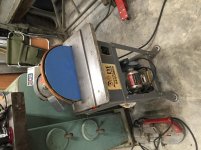
This is the progress on my belt sander installation. I decided to install the VFD on a back panel inside the stand. It's on 16g steel while the sides are brushed stainless steel about 22g. I figure the motor will be pulling air in the shaft end and expelling it out the back so there should be good ventilation. I am going to seal up some of the holes as well to try to keep the dust to a minimum.

This is from a salvaged piece from a machine.
24684194399_c3047a0e72_c.jpg


25051735845_6f82e0b85e_c.jpg


25025356136_90d9df6d7d_c.jpg


24933547912_af034a3a58_c.jpg
 

housedad

Well-known member
Joined
Jun 28, 2012
Messages
80
OP
T

Techie1961

Well-known member
Joined
Feb 18, 2014
Messages
1,520
Location
Pickering Ontario Canada
The red box is a Allen Bradley safety relay with timer. It is used to perform a couple of functions in this circuit. It allows me to have a four wire E-stop, and handles timing and relay operations during a emergency stop.

The concept behind it's use here is discussed in the operations manual that I wrote up. (under notes and observations near the end of the document) http://www.thebionicuniverse.com/wp-content/uploads/2015/05/MACHINE-CONTROL-SYSTEM-DOCUMENTATION.doc

Nicely done on the operations manual and documentation. That is something that I used to enjoy doing a lot when I was in automotive manufacturing. Do you have a background in this?
 

housedad

Well-known member
Joined
Jun 28, 2012
Messages
80
Thank you for the compliments.

As far as training, None, nada. zero. But I have read a couple of books on documentation for manufacturing.

I'm a housedad, like my moniker. Been disabled since my first Job at 18, 39 years ago. So, I have had a lot of time to read and learn things. College may have stopped for me, but the drive to learn just kept going on forever.
 
OP
T

Techie1961

Well-known member
Joined
Feb 18, 2014
Messages
1,520
Location
Pickering Ontario Canada
Thank you for the compliments.

As far as training, None, nada. zero. But I have read a couple of books on documentation for manufacturing.

I'm a housedad, like my moniker. Been disabled since my first Job at 18, 39 years ago. So, I have had a lot of time to read and learn things. College may have stopped for me, but the drive to learn just kept going on forever.

Very sorry about the disability and kudos on the stay at home raising your kids.:rocker: Yeah, I know what you mean about the continued learning; I've never stopped.
 

jallyn

Well-known member
Joined
Jun 29, 2015
Messages
448
Location
Fort Wayne, Indiana
I have an old Hameg oscilloscope and have used it for a couple of things but it is more or less a tool that's cool that have but I don't know enough about them. I know there are others here that will have some experience with them so here's a question; can I use this to check the condition of a VFD? I'd like to be able to hook it up to each phase and see the condition of the signal. I can manage the adjustments okay just not sure if you just put the probe on the live line or do you need to isolate some how?

Oh, and if anyone knows where I can get some parts to fix it up, I'd appreciate it.
24756303550_3bc25cdd1b_c.jpg

You can use your o-scope to look at the waveforms. You will want to connect a motor to load up the VFD. Just be careful to not put more voltage into the oscilloscope than it is rated for, or good-bye scope. If, for example, you are wanting to look at voltage on a 120-volt motor running on a VFD you need to attenuate the signal to below what the scope is rated for. It may be possible with a 10x attenuator probe. Or if you are cheap and not concerned with absolute accuracy you could make a 10x voltage divider with a 9 megohm and 1 megohm resistor to be used with your standard probe.
 
OP
T

Techie1961

Well-known member
Joined
Feb 18, 2014
Messages
1,520
Location
Pickering Ontario Canada
You can use your o-scope to look at the waveforms. You will want to connect a motor to load up the VFD. Just be careful to not put more voltage into the oscilloscope than it is rated for, or good-bye scope. If, for example, you are wanting to look at voltage on a 120-volt motor running on a VFD you need to attenuate the signal to below what the scope is rated for. It may be possible with a 10x attenuator probe. Or if you are cheap and not concerned with absolute accuracy you could make a 10x voltage divider with a 9 megohm and 1 megohm resistor to be used with your standard probe.

Thanks Jallyn! I'll have to look up a couple of the things that you said but that's all part of the fun ain't it.:dunno:
 
OP
T

Techie1961

Well-known member
Joined
Feb 18, 2014
Messages
1,520
Location
Pickering Ontario Canada
So I've got most of the machine back together but still have to finish off the wiring. I am leaning towards a foot pedal for it and would like to find one with a potentiometer in it. Anyone know of some that are affordable and can recommend?
24821421170_ddb521aa95_c.jpg

25117023995_ebbbc1b7da_c.jpg
 

slow

Well-known member
Joined
Feb 26, 2006
Messages
2,596
Location
near Orlando
Is there any way to reduce or get rid of that noise? I'm building out my shop - but I still haven't had the final electrical installed in my barn to support everything. I wondering if there is some way I could get the electician to design in some protection for the things like TV sets and computers if I have a device or two running a VFD in my shop.

You can get a line reactor to prevent some of this noise.

I had 3 of these leftover from a previous installation (similar look, different brand)

http://www.galco.com/buy/MTE/RL-08013?source=googleshopping&gclid=CLGDzIT5hMsCFVhZhgodCFIIhg

Thanks,

Ryan
 

manwithtools

ALLIANCE MEMBER
Joined
Aug 24, 2015
Messages
13,639
Location
Lebanon, TN
Here is brief explanation of Line Reactors that I borrowed from the Lenze web site, it's better than my explanation would be:

"An input or line reactor helps protect a variable frequency drive (VFD) from input power line disturbances that couldcause nuisance tripping or damage to the drive. An input (line) reactor also reduces the harmonics that the VFD generates back onto the line. Line reactors are sized based on the HP and voltage ratings of the drive in use. Input (line) reactors should be used in these circumstances:
  • The input line power is prone to have disturbances such as surges, spikes, transients, etc.
  • The supply line power is very stiff (greater than 10 times the kVA rating of the connected VFD).
  • Where harmonic distortion is a concern. (IEEE-519 Harmonic Control in Electrical Power Systems)"


My further thoughts - While line reactors can reduce the noise reflected back into your shop/house electrical system, they are primarily used to lessen the inrush current to the drive on startup. When first powered on the drive can "appear" to be a short circuit to the supplying electrical system while it's capacitors charge, this can result in a large in-rush spike that "can" damage a drive. In my experience line reactors on larger motors are good protection in an industrial environment where the electrical system has the potential to momentarily supply hundreds or thousands of amps to the input of the drive. Industrial electrical systems can be very "dirty" as well so the reactor smooths out the fluctuation on the supply.

It's less of an issue with smaller VFD's that we might use in a home shop (5hp or less) because our available current potential is less. It's limited by our incoming utility transformer size. All that being said, there is no reason not to install a line reactor if you can source one for a reasonable price. It can't hurt anything and it may help as well.

There are also "load" reactors as well. These go between the VFD and motor and again from the Lenze site:

"An output (load) reactor, on the other hand, is used to protect the motor if the wiring distance between the VFD and motor is very long. The drive generates a high frequency PWM three-phase output and noise spikes are generated on the leading edge of these signals. These noise spikes get amplified due to the long cable lengths and the additional capacitance of the cable. The resulting voltage can exceed the motor’s peak voltage rating where insulation breakdown occurs. The general rule of thumb is that an output reactor should be used if the motor wiring is over 100 feet, but this value varies depending on the motor. If the motor meets the NEMA MG-1 Part 31 standard, it is possible to have as much as 300 ft of cabling without a reactor. If it does not meet the standard, the maximum cable length should be 100 ft. Also, if the distance is between 300 and 500 ft, a load reactor must be installed"

As you can see we home shop guys don't need load reactors as our wiring distances are typically very short.
 

Steve from Socal

Well-known member
Joined
Jan 27, 2009
Messages
3,490
Location
Hutchinson Ks.
You can see a line reactor in the photos of my lathe install, I have 600 amp 480 service. In talking with a few folks my service is small in industrial terms, even so for 50-60 buck on ebay it is peace of mind. In a residential setting I wouldn't bother.

Steve
 

the spyder

Well-known member
Joined
Jan 1, 2007
Messages
589
Location
Oregon
This weekend I temporarily installed a Teco FM-50 to my 12" Rockwell disc sander I purchased from a local high school. It's a 3ph 1HP motor. I mainly wanted to verify the heath of the motor and I was happy to find it ran quiet and smooth. I still need to order some parts and make a mount/control panel.
 

Attachments

  • IMG_9335.jpg
    IMG_9335.jpg
    141.4 KB · Views: 233
  • IMG_9331.jpg
    IMG_9331.jpg
    129 KB · Views: 215
OP
T

Techie1961

Well-known member
Joined
Feb 18, 2014
Messages
1,520
Location
Pickering Ontario Canada
This weekend I temporarily installed a Teco FM-50 to my 12" Rockwell disc sander I purchased from a local high school. It's a 3ph 1HP motor. I mainly wanted to verify the heath of the motor and I was happy to find it ran quiet and smooth. I still need to order some parts and make a mount/control panel.

That will be a nice application for a VFD. If you can, I highly recommend a foot pedal to start it. I've been using my belt sander for a short bit and it is really sweet to have a foot switch when you walk over to it.
 

jdwilson44

Well-known member
Joined
May 7, 2005
Messages
128
Location
Chelmsford, Massachusetts
You can get a line reactor to prevent some of this noise.

I had 3 of these leftover from a previous installation (similar look, different brand)

http://www.galco.com/buy/MTE/RL-08013?source=googleshopping&gclid=CLGDzIT5hMsCFVhZhgodCFIIhg

Thanks,

Ryan

Thanks for the info.

I'm adding equipment to my shop - which is located in a residential neighborhood and I only have single phase power. I'm thinking of adding a large grinder - and I'm noticing that many of them only come in 3 phase versions. Having the ability to stop and start the sander with a foot pedal (as mentioned in one of the earlier posts) - would be a really nice usability enhancement IMHO. I just don't want to ****** up all the computers and other stuff that is running in my house if I start adding VFD's to the mix.

This may have been answered earlier in the thread - but what effect does a VFD have on motor HP output - like if I try to run a 3phase motor on single phase with a VFD?
 
OP
T

Techie1961

Well-known member
Joined
Feb 18, 2014
Messages
1,520
Location
Pickering Ontario Canada
Thanks for the info.

I'm adding equipment to my shop - which is located in a residential neighborhood and I only have single phase power. I'm thinking of adding a large grinder - and I'm noticing that many of them only come in 3 phase versions. Having the ability to stop and start the sander with a foot pedal (as mentioned in one of the earlier posts) - would be a really nice usability enhancement IMHO. I just don't want to ****** up all the computers and other stuff that is running in my house if I start adding VFD's to the mix.

This may have been answered earlier in the thread - but what effect does a VFD have on motor HP output - like if I try to run a 3phase motor on single phase with a VFD?

From what I know, there won't be any HP loss when you run a VFD. It will give you the full output that it is rated at. For example, a 3HP, 3P VFD will allow a 3HP motor to run at full output. The only thing that I have heard of in lower rated HP is when you run a VFD rated for example, at 3HP and it's a 3P unit and you connect it to single phase. The Drive won't be able to output for the 3HP motor and would derate to approximately 2HP.
 
To avoid these ads, REGISTER NOW!
Top Bottom