To avoid these ads, REGISTER NOW!

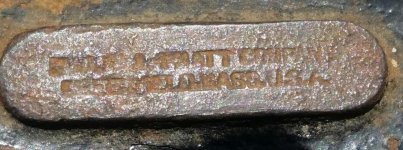
Show Your Goodell-Pratt tools

davethorik

Well-known member
Joined
Sep 14, 2013
Messages
4,992
Location
Norka, Ohio
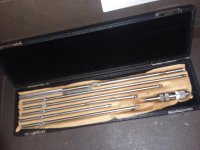
In the thread I made about the OTC breaker bar, lugz mentioned it interesting it was still in use. Here is I believe the oldest machinist tool I personally own... might be hard to see in pic but it is calibrated and used, too.
:beer:

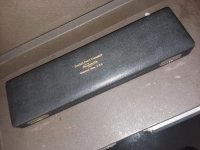
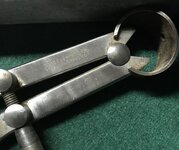
Goodell-Pratt no. 1218 inside micrometer, I believe 2-12" range. I love the gold leaf lettering on the lid, and black velvet inside. In good shape. Put some nox rust paper in the case, as the tool is polished bare steel. This company was bought by Miller's Falls in 1931, so older than that.

Very well-made. Needed only a few minor adjustments and it's good to go. I have some others I'll show later, but this is one of my favorites.
 

Attachments

  • 20180522_142125.jpg
    20180522_142125.jpg
    148.2 KB · Views: 34
  • 20180522_142154.jpg
    20180522_142154.jpg
    110.6 KB · Views: 38
To avoid these ads, REGISTER NOW!
OP
D

davethorik

Well-known member
Joined
Sep 14, 2013
Messages
4,992
Location
Norka, Ohio
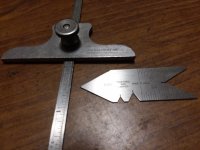
Here are a couple others. Angle/depth gage, and a no. 438 center gage that looks new. It was hard to photograph these with my phone.
 

Attachments

  • 20180524_230016.jpg
    20180524_230016.jpg
    107.2 KB · Views: 25
  • 20180524_230149.jpg
    20180524_230149.jpg
    125.9 KB · Views: 13

paulm12

Well-known member
Joined
Apr 29, 2015
Messages
584
Location
NW Chicago 'burbs
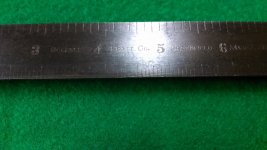
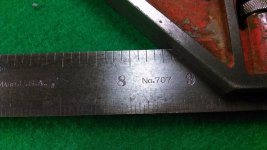
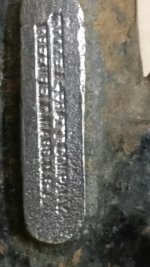
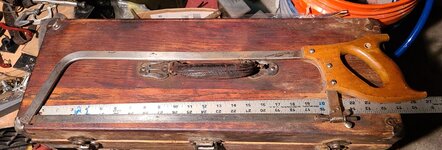
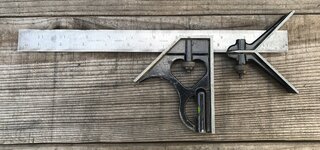
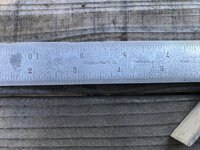
A Goodell-Pratt machinist square that I had not seen before.
 

Attachments

  • IMG_20180524_220716064.jpg
    IMG_20180524_220716064.jpg
    146.7 KB · Views: 14
  • IMG_20180524_220707610.jpg
    IMG_20180524_220707610.jpg
    145.2 KB · Views: 11
  • IMG_20180524_220759268.jpg
    IMG_20180524_220759268.jpg
    124.3 KB · Views: 9
  • IMG_20180524_220804609.jpg
    IMG_20180524_220804609.jpg
    148.1 KB · Views: 7

454ragtop

Well-known member
Joined
Mar 24, 2008
Messages
5,011
Location
Carver, MA
A little vise I have.
 

Attachments

  • goodell5.jpg
    goodell5.jpg
    64.3 KB · Views: 11
  • goodell4.jpg
    goodell4.jpg
    143.4 KB · Views: 11
  • goodell3.jpg
    goodell3.jpg
    51.3 KB · Views: 7
  • goodell2.jpg
    goodell2.jpg
    63.9 KB · Views: 7
  • goodell1.jpg
    goodell1.jpg
    58.2 KB · Views: 11
OP
D

davethorik

Well-known member
Joined
Sep 14, 2013
Messages
4,992
Location
Norka, Ohio
Nice stuff!
Here are the only other items I have.

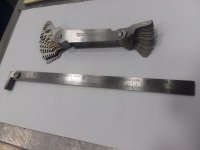
No. 436 thread pitch gage, 4-42 tpi
No. 10 hook rule...odd size, 6"×.370"×.05" thick
 

Attachments

  • 20180525_094230.jpg
    20180525_094230.jpg
    90.9 KB · Views: 12

MikeRock

Member
Joined
Nov 26, 2014
Messages
17
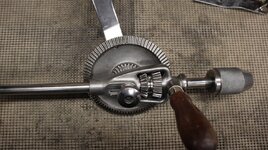
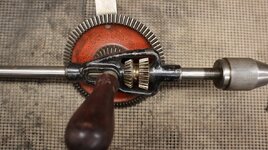
Here is a Goodell-Pratt drill. As Dave said, they were purchased by Millers Falls in 1931, so more than 80 years old. I guess this drill to be older. The handle has a patent date of March 31, 1896. I think the chuck has a patent date of 1895, but its hard to read. The style seems very old ... the spokes on the main wheel are curved in 3D. It's very well made. Two speed. Oil holes. Ball thrust bearing (just visible behind the chuck). The knurled knob to the side is the speed shifter, which selects the inner or outer gears. I keep a counter sink in it and use it in slow speed for countersinking. How many of today's drills will be working in 100 years? Cordless drills ... the batteries probably won't exist.
 

Attachments

  • GPdrill.jpg
    GPdrill.jpg
    106.2 KB · Views: 15
  • GP2speed.jpg
    GP2speed.jpg
    129.2 KB · Views: 15
Last edited:

Private Lugnutz

Well-known member
Joined
Mar 30, 2012
Messages
30,522
Location
The Authentic Jersey Shore
This company was bought by Miller's Falls in 1931, so older than that.
Here is a Goodell-Pratt drill. As Dave said, they were purchased by Millers Falls in 1931, so more than 80 years old.
I am not saying those two tools aren't pre-1931, but dating Goodell-Pratt tools is a little trickier than the acquisition date. Millers Falls didn't cut them off right away, wisely, due no doubt to their reputation, treating them like a subsidiary or a managed brand. My entrée into this dilemma was WWII collecting. I have yet to find anything substantive on when exactly Millers Falls stopped using the brand, but note that Goodell-Pratt Company, Greenfield, Mass., is listed in several WWII references, including the War Production Board's Major War Supply Contracts Listing, covering 1940 to 1945, published in 1946. It's a little fuzzy. Way down my list of things to figure out, but if someone knows better, please pipe up.
 
To avoid these ads, REGISTER NOW!

WisJim

Well-known member
Joined
Dec 20, 2010
Messages
2,271
Location
Menomonie, WI
Some of my Goodell-Pratt breast drills. Not enough room for hand drills or braces or other G-P tools that I have sitting in totes somewhere.IMG_20210927_135004433.jpg
 

Eric Brown

ALLIANCE MEMBER
Joined
Jun 14, 2024
Messages
672
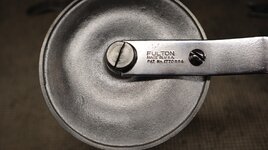
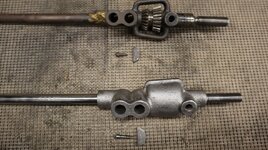
Working on my Fulton collection, which includes breast drills made by Goodell-Pratt and Shelbourne. Just got one though that is a puzzle. It may be a prototype. The seller told me he got it in Ohio and the handle was loose. So it may not go with this drill at all. It does fit though. Comparing this "Fulton" to a Goodell-Prat 477 because they share a similar method of securing the main gear shaft. Here are some pictures. (Goodell top, Fulton bottom). A picture of breast plates Shelbourne, 3 Fulton, Millers Falls No. 12. Then there are some pictures of a Shelbourne and two other Fulton's. On this "Fulton", notice it has a one-piece gear set and the other have two separate gears. The gears are enclosed on the auxiliary handle side. The main gear securing plate is thicker and uses a peened pin to secure, where the Goodell has a screw. The main chuck shaft is small in diameter and does not match any others in my collection. The casting is very rough. Also, the Fulton stamp on the crank is oriented different from all the others. It's possible it was made by someone else, but I have looked a a bunch of Sears catalog pages and do not find this version. (Sears sold Fulton tools as one of their tradenames).
 

Attachments

  • Compare 10.jpg
    Compare 10.jpg
    511 KB · Views: 6
  • Compare 9.jpg
    Compare 9.jpg
    426.6 KB · Views: 4
  • Compare 8.jpg
    Compare 8.jpg
    466.7 KB · Views: 3
  • Compare 7.jpg
    Compare 7.jpg
    581.8 KB · Views: 3
  • Compare 6.jpg
    Compare 6.jpg
    478.5 KB · Views: 3
  • Compare 5.jpg
    Compare 5.jpg
    507.3 KB · Views: 3
  • Compare 4.jpg
    Compare 4.jpg
    534 KB · Views: 4
  • Compare 3.jpg
    Compare 3.jpg
    488.3 KB · Views: 4
  • Compare 2.jpg
    Compare 2.jpg
    466.8 KB · Views: 4
  • Compare 1.jpg
    Compare 1.jpg
    522.4 KB · Views: 5

Eric Brown

ALLIANCE MEMBER
Joined
Jun 14, 2024
Messages
672
That Fulton arm is wearing a GP used patent number, so maybe they downgraded the specs for Sears

Sorry for the confusing pictures. The one you looked at is for one other Fultons. The handle off the one in question is paired with a handle from Goodell-Pratt. You will see it doesn't have a patent number. It says "FULTON, MADE IN USA, A-1" three lines.
 
  • Sad
Reactions: RTM

Eric Brown

ALLIANCE MEMBER
Joined
Jun 14, 2024
Messages
672
Goodell-Pratt 2510 Brace.
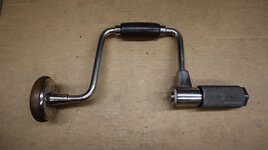
2510-1.jpg
The OLDTOOLHEAVEN site (Goodell-Pratt Bit Braces (oldtoolheaven.com) has information on this brace. Actually a very nice brace, the one I got though had problems. Rust (of course), but more of an issue was that both the chuck spindle and top handle did not rotate smoothly. Decided a full disassembly was needed.

Before I get into the disassembly, a few thoughts about why we collect. First, it’s something we enjoy. Finding a new version brings you joy. Second, we like to clean them up and help with the preservation. Third, we hope the value goes up. Fourth, and maybe the most important, is education. Not just for ourselves, but we hope others study the designs and learn something.

Going back to the second reason, preservation, this can take many forms. At a minimum, light scraping of rust and then some oil, maybe some wood finish. Then there are the “original” collectors, who insist that the preservation not disturb any original paint and all parts are correct. Patina must be original. To be honest, these are usually rare to find. Usually tools have been cleaned a little further than the original collectors would want. However, the tools still represent what the manufacturer made. Something I question is who is going to take care of or appreciate these tools in the future when we are gone? So now lets consider finish. Steel and iron, will rust, unless it is kept oiled or a protective coating applied. This coating many times was jappaning, a thick tar-like paint. Not easy to find or apply, but is correct for some restored tools. Modern enamel works, and is easier to find. It does not change the function of the tool. Then there is nickel-plating. Usually used on higher quality tools or for details, it is more durable than the other finishes. More expensive and more steps involved, but it adds a touch of quality to the tool.

Now the fourth reason, education, requires the preserver to determine how what they are doing will spark interest in the tool. Personally I feel that nickel-plated tools reinforce the idea that the tool is important to keep. Less likely to be put in the scrap bin because it looks valuable. We need to get the younger generations interested and maybe shiny tools will help.

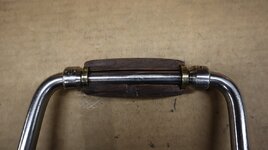
With that thought, I decided to re-plate this brace. That meant the wood handles had to come off and a full disassembly. This is where experience and tools come into play. I know the wrist handles are slid onto the shaft before they are bent. There is no way to remove the handle the way it went on. Usually when I make this kind of decision, I come up with Plan A, B, C as needed. My plan A for the handle was to use a razor saw and make a couple cuts down the length of the handle, in the hope of glueing the pieces back together after the plating. My plan B is to make a new handle and put it together like on a Spofford brace, with pewter rings cast around them. Plan C, is to use a more modern approach and use a spiral external retaining ring. So far it looks like plan A will be tried first. If it doesn’t work, then on to the other plans.

Now anytime you are taking something apart this far, you risk damaging it, beyond repair. So read the following and then ask if you would be comfortable doing it. Not everyone has the skills or tools to do all that I am going to show. However, I think my showing what is typically hidden may provide information for someone in the future.

Starting with the wrist handle, I made several cuts, using a razor saw and a straight edge. Made several cuts. Note the collars retaining the handle have screws, to maintain the handle position. These can be moved outward, giving more room to cut the handle. There are also two brass rings that act as a bearing point for the collars. Being careful not to cut though the brass rings, I eventually was able to split the wood away from the frame. I was then able to clean that part of the frame.
2510-2.jpg

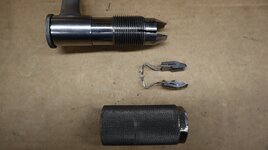
Next is the chuck. Like most, it simply unscrews, exposing the two spring loaded jaws. This was Loyd Millers patent. The jaws and springs pull out the end. Mine were tight on the springs and required some effort to pull out.
2510-3.jpg

Removing the chuck spindle (Farley patent) required unscrewing the screw going through the selector ring. Under this ring is a thin steel washer with special holes. These holes line up over the two ratchet plates. Once the screw, selector ring and washer are removed, the spindle will slide out the end. (No loose parts). The spindle itself has two ratchet plates that are held by a small spring that wraps around the spindle in a groove. If needed, the spring can be carefully unhooked, and the plates removed. I tried putting the spindle back in without the ratchet plates and discovered some burrs on the spindle that made it feel rough. This was smoothed.

2510-4.jpg

2510-5.jpg

2510-6.jpg

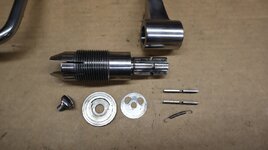
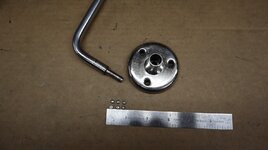
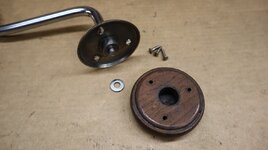
Next is the top handle. According to Randy’s site, this model has either roller or ball bearings in the hub. Taking the wood handle off (three wood screws), the hub felt very rough. If yours feels rough, I suggest soaking that end in a rust dissolver. Then put some oil on it. Hopefully it will spin freely. If not, then you might not be able to fix it. To do a proper nickel plate, I needed to remove the top handle bearings. I ground off some of the frame until I could pry the washer off. Now comes the tricky part. The washer sits on a shoulder. The shoulder on mine was deformed a little when the washer was staked on. So I needed to use a punch to help the shaft out. But wait, there are bearings in there. So I put a plastic bag over the end and then used the punch to move the shaft out of the hub. The bearings fell into the bag. On mine there are six roller bearings. To describe them like a car wheel, they are round in the rolling direction, but one side is flat, to go against the shaft, and the other side is rounded like a Baby Moon hubcap. This rounded side matches the inside diameter of the hub. Don’t lose these as replacements may be impossible to find (except in another Goodell brace with this type of bearing). Out of curiosity, I did try some ball bearings. The smallest I had were 3/32” and they felt tight. Would not recommend changing types of bearings.
2510-7.jpg

2510-8.jpg

2510-9.jpg


My next steps are to further clean and polish, then nickel-plate. May be a while before I post pictures of the finished brace.
 

RTM

Well-known member
Joined
May 13, 2019
Messages
13,108
Location
SF Bay Area
Removing the chuck spindle (Farley patent) required unscrewing the screw going through the selector ring. Under this ring is a thin steel washer with special holes. These holes line up over the two ratchet plates. Once the screw, selector ring and washer are removed, the spindle will slide out the end. (No loose parts). The spindle itself has two ratchet plates that are held by a small spring that wraps around the spindle in a groove. If needed, the spring can be carefully unhooked, and the plates removed. I tried putting the spindle back in without the ratchet plates and discovered some burrs on the spindle that made it feel rough. This was smoothed
I have a couple of braces where I need to dig into this area. Marking so I can't find it. Thanks for a great tutorial.

. I know the wrist handles are slid onto the shaft before they are bent. There is no way to remove the handle the way it went on.
Have you seen the video from the Millers Falls plant where this process is shown? Makes it look so easy (with the help of an ** ton press).
 

Eric Brown

ALLIANCE MEMBER
Joined
Jun 14, 2024
Messages
672
I have a couple of braces where I need to dig into this area. Marking so I can't find it. Thanks for a great tutorial.


Have you seen the video from the Millers Falls plant where this process is shown? Makes it look so easy (with the help of an ** ton press).
The method of putting the handle on and then bending was patented by H.S Bartholomew on May 24, 1861 (32347)
 

Eric Brown

ALLIANCE MEMBER
Joined
Jun 14, 2024
Messages
672
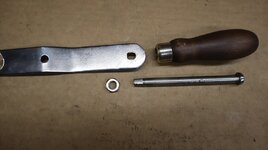
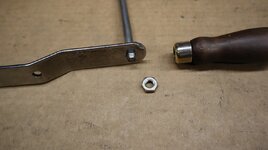
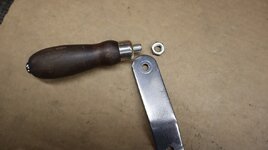
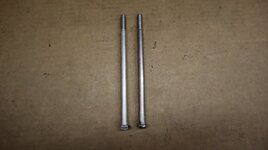
Repairing a Fulton breast drill handle. This drill was made by Mohawk Shelbourne, a Goodell-Pratt company. In this case the crank lever was very rusty and I wanted to nickel plate it. So the wood handle had to come off. Grinding on the backside removed the peened upset, allowing the handle shaft to be removed. The crank handle was then cleaned up. To repair, I used a method I noticed on a Millers Falls No. 12 drill. The handle shaft had a flat on each side of it's threaded end, and the crank lever had a matching squarish hole with rounded ends. These flats prevent the shaft from rotation and locks solid when the nut is put on. On this project the shaft was 5/16" diameter and where it had been peened over was a 1/4" hole. Perfect. Used a 5/16" x 6" long stainless bolt. I ground the hex head on a belt sander making it into a rounded dome, similar to the original. Next was cutting it to length. Decided on using a 5/16-24 jam nut for the finer threads and lower profile. After cutting to length the end was beveled a little to aid in threading. (Done by hand because I don't have a metal lathe). After threading, the flats were put onto the shaft. Next was making the square hole. I used a 1/4" round file, filing both up and down to make the hole more like a slot. Then using a smaller round file, the four corners were opened up. Several tries and more filing until it fit. Because I threaded a little too far on the shaft, I ended up using a Forstner bit to sink the hole on the end of the handle. Took several adjustments until the handle was free to rotate without much side slop. (This drill was not of a collector quality, so this modification was appropriate. This same drill has another issue discussed in the next post).
 

Attachments

  • Handle Repair 8.jpg
    Handle Repair 8.jpg
    326.7 KB · Views: 2
  • Handle Repair 7.jpg
    Handle Repair 7.jpg
    326.4 KB · Views: 1
  • Handle Repair 6.jpg
    Handle Repair 6.jpg
    342.6 KB · Views: 1
  • Handle Repair 5.jpg
    Handle Repair 5.jpg
    320.8 KB · Views: 1
  • Handle Repair 4.jpg
    Handle Repair 4.jpg
    283.7 KB · Views: 1
  • Handle Repair 3.jpg
    Handle Repair 3.jpg
    247 KB · Views: 1
  • Handle Repair 2.jpg
    Handle Repair 2.jpg
    347.1 KB · Views: 1
  • Handle Repair 1.jpg
    Handle Repair 1.jpg
    311 KB · Views: 1

Eric Brown

ALLIANCE MEMBER
Joined
Jun 14, 2024
Messages
672
Fulton drill repairs continued. Looking at the first few pictures it's had to see the problem. Look closely at the two small gears and you will see either a gap in the middle or at one end. (Note: I have already removed the pin that goes between the gears.) The problem, which was hiding behind the big gear, is that part of the main frame casting was broke. This created a sharp edge that cut into the end of the smaller gear. All the pressure of pushing is on this area. Measuring the gap, I decided to purchase a 1/16" thick bronze thrust bearing. After a few adjustments it fits the area nicely. It will provide better support for the small gear to press against. The last picture shows it assembled.
Not shown is the pin that locks the two gears to the main shaft. This originally was a steel pin with a head on one end. The other end was hollow and then a center punch mushroomed it out. I had some 5/32" stainless pins 1" long. I drill a hole in the end and will peen it over after painting. One thing to watch out for is that the original hole went through at an angle. This means you have to get both gears and the shaft back to their original positions.
 

Attachments

  • Broke 5.jpg
    Broke 5.jpg
    261.3 KB · Views: 2
  • Broke 4.jpg
    Broke 4.jpg
    322.7 KB · Views: 2
  • Broke 3.jpg
    Broke 3.jpg
    288.5 KB · Views: 2
  • Broke 2.jpg
    Broke 2.jpg
    332.2 KB · Views: 2
  • Broke 1.jpg
    Broke 1.jpg
    371.7 KB · Views: 2
  • Broke 6.jpg
    Broke 6.jpg
    382.4 KB · Views: 2
To avoid these ads, REGISTER NOW!
Top Bottom