To avoid these ads, REGISTER NOW!

Siding on a new pole barn

2old2soon

New member
Joined
Oct 1, 2015
Messages
4
Location
South Ga
Long time lurker here, first time poster so please be gentle. I just finished the first phase of my pole barn a couple of weeks ago and am planning to enclose it next month. Instead of using girts on the outside of the poles, I want to use conventional framing methods with the walls sitting on the concrete slab. I have two questions;

1. I plan to put house wrap directly on the studs and nail the Hardie Panels on top of that without sheathing underneath. Is this acceptable? Are there any negative consequences down the road?

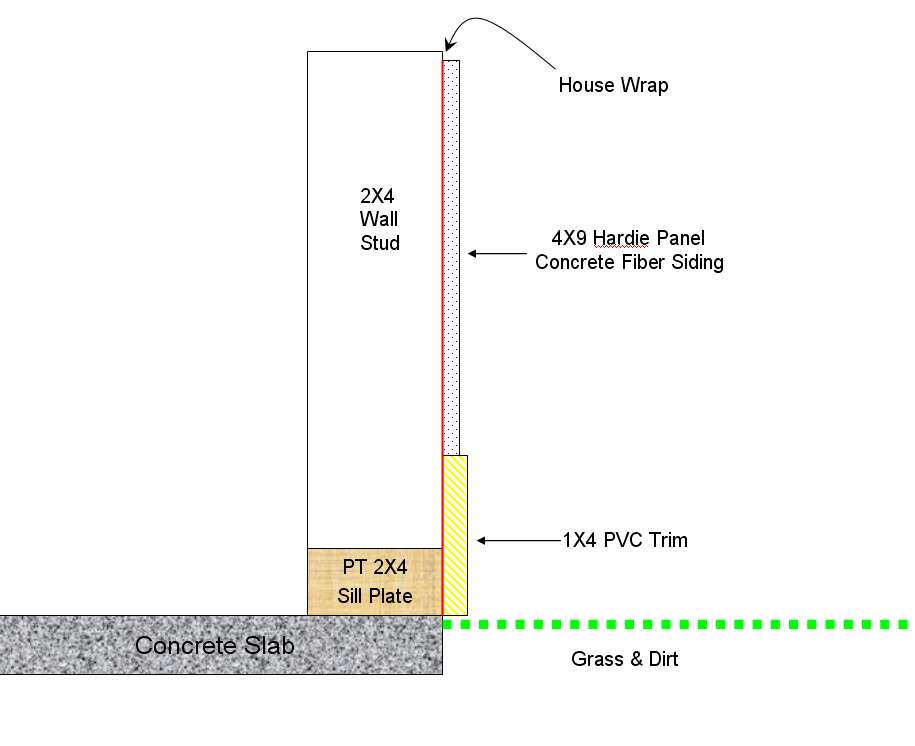
2. My slab is pretty much on grade with very little elevation. Hardie Panel calls for 6” clearance above ground level as the edges will wick up moisture. My plan is to use PCV dimensional lumber around the bottom and set the siding on top of it (see pic). Again, any issues with doing it this way? Should I do it another way?

Thanx in advance for your input.

Jerry
09481035309417.jpg


SidingCutaway-vi.jpg
 
To avoid these ads, REGISTER NOW!

jwhcars

Well-known member
Joined
Nov 18, 2007
Messages
756
Location
Central PA
I would be concerned that water is going to find its way inside. I Would have some kind of water proof barrier down the lower side walls and into the ground.
 

matt_i

Well-known member
Joined
Mar 14, 2008
Messages
10,725
Location
SE Michigan
Seems decent, always have to be mindful that termites are present in GA and are hungry for wood. I would just make sure you have an air gap large enough to detect their presence/activity if you don't have active monitoring. I am not 100% sure if concrete has been poured yet, if not, L-shaped bolts are cheapest, if it has been poured, then I'd recommend epoxy anchors to reduce stress on the edge of the slab.
 

astroracer

Well-known member
Joined
Jun 22, 2005
Messages
3,001
Location
Mid_Michigan
I would be concerned that water is going to find its way inside. I Would have some kind of water proof barrier down the lower side walls and into the ground.

This^^^
A rat wall around the entire perimeter would be a good idea. Just to deflect any ground water that may collect during hard rains. A good french drain around the perimeter would help keep the lower areas dry also.
Mark
P.S. Looking at your pic I see no headers around the top of the building. I don't know if this is an engineered structure but I would think about sheathing it in under the hardie board just to give it some wind shear strength. Hardie board will not do that by itself. Maybe ask your builder about it. If the posts are designed to carry that load then you are probably fine...
 
Last edited:

MushCreek

Well-known member
Joined
Jan 14, 2015
Messages
9,763
Location
Upstate South Carolina
You need some kind of flashing that goes under the Hardi, and over the 1X4. I'd go bigger than a 1X4, too, to get the Hardi further from the ground. A 1X4 is only 3-1/2" to begin with.

As for the siding- I don't think the Hardi is considered structural, so you would either need to sheathe it first, or install diagonal bracing. South GA isn't that far from hurricane country, and you sometimes get some violent T'storms, so I'd build to a pretty stout wind rating if it were me.
 

jives

Well-known member
Joined
Jan 4, 2013
Messages
2,805
Location
Central NY
Hardiboard does not need backing with sheathing, but the wall does need bracing if not sheathed. I would use sheathing underneath to protect the Hardiboard from both inside and outside trauma.

http://www.jameshardie.com/d2w/installation/hardieplank-hz5-us-en.pdf

If you insist on standard stud framing, your best bet would be: 1) Be sure the bottom plate is PT with a water intrusion barrier underneath (foam or caulk). 2) Sheath the wall with plywood, but sheath the lower part with PT plywood. Use house wrap. 3) Use at least an 8" wide (1 x 8) PVC trim piece around the bottom with a rat guard underneath to divert water. The PVC trim piece, if done right, can look nice like a classic water table board seen on older houses. 4) Use a drain around the perimeter with anti-splash fill (i.e., gravel). 5) Good gutters.
 
To avoid these ads, REGISTER NOW!

rebelranger

Well-known member
Joined
Sep 18, 2012
Messages
188
I like your idea because I want to do the same but with horzontial girts then rigid foam then vertical girts then cheap vinyl siding. Thus I have a few questions. What is the size or your main building? It looks 20 x 30ish. Why did you go metal truses? Why no headers? Do you plan any overhead garage doors?
 

lakeroadster

Well-known member
Joined
Jan 19, 2015
Messages
5,166
Location
Central Colorado
Man, that's an awesome looking barn you have got started there. With regard to your query......

In theory:

  • The concrete floor, aka a slab on grade, of a pole barn will move in relationship to the support columns (poles).
  • The interior walls should be designed as floating. The exterior barn siding needs to attach to girts. The girts should be supported only by the columns (poles).


Lots of folks ignore this, many have no issues, but it is something to keep in mind.
 

astroracer

Well-known member
Joined
Jun 22, 2005
Messages
3,001
Location
Mid_Michigan
Man, that's an awesome looking barn you have got started there. With regard to your query......

In theory:

  • The concrete floor, aka a slab on grade, of a pole barn will move in relationship to the support columns (poles).
  • The interior walls should be designed as floating. The exterior barn siding needs to attach to girts. The girts should be supported only by the columns (poles).


Lots of folks ignore this, many have no issues, but it is something to keep in mind.

This will never be required in GA. Frost heave is not an issue. I have never had an issue with my "regular" walls here in MI for the 31 years the walls have been there, sitting right on the concrete. My pad has not moved at all.
Mark
 

lakeroadster

Well-known member
Joined
Jan 19, 2015
Messages
5,166
Location
Central Colorado
This will never be required in GA. Frost heave is not an issue. I have never had an issue with my "regular" walls here in MI for the 31 years the walls have been there, sitting right on the concrete. My pad has not moved at all.
Mark

Ya know, on a barn, I don't know if it is ever a requirement. I just posted it as a good practice.

Kind of why in my post above I stated:

Lots of folks ignore this, many have no issues, but it is something to keep in mind.

I had a slab in my garage here in Denver that lifted about 1-1/2" after about 10 years and stayed that way. The slab on the other side of the garage never lifted at all.

If it had been of the design such that sill plate attaches to the slab I likely would never have been able to get the man door open due to all the stress on the wall.
 
Last edited:
OP
2

2old2soon

New member
Joined
Oct 1, 2015
Messages
4
Location
South Ga
Thanx for all the feedback and the kind words, see attached pic for my planned changes. Although it’s natural to sheath any wall I build, I’m going to go with the James Hardie installation guidance, cross brace the walls for shear strength and attached the hardi panels directly to the studs. Thanx again.

2O2S
SidingCutawayR1-vi.jpg
 

MushCreek

Well-known member
Joined
Jan 14, 2015
Messages
9,763
Location
Upstate South Carolina
You really should 1) Put 'Z' flashing under the Hardi and over the PVC trim, and 2) leave a gap (1/4" or so) under the bottom of the Hardi so it can dry. Install the trim, then the Z flashing, then use spacers under the bottom of the Hardi so it doesn't sit hard on the flashing.
 

chaosracing

Well-known member
Joined
Nov 14, 2015
Messages
585
Location
Kutztown, Pa
You will want a Z or L with drip flashing in between the Hardie siding and trim. You will also want to leave at least an 1/8" gap (I would do 1/4") from bottom of Hardie siding and flashing to prevent wicking of water.
TRUST ME cement siding will **** up water faster than wood will. And over time it will deteriorate.

I just helped dispose of primed Hardie lap siding that was stored outside for at least 10 years, but under rubber roofing tarps. The pile was massive (we filled a 30 yd dumpster, plus 2 dump trailers) even the stuff in the center had gotten damp from the water getting under the pile, and the siding was on pallets. The stuff on the bottom was very brittle.
 
To avoid these ads, REGISTER NOW!
Top Bottom