To avoid these ads, REGISTER NOW!

Silly question about single phase 240

KinzeMech

Well-known member
Joined
Jul 15, 2012
Messages
1,164
I've been doing a little reading on three phase power, and it has caused me to have a simple question about single phase power.

If three phase power is called such, because there are three voltage lines, each 120 degrees out of phase with the other two, why is common single phase 240 not considered "two phase"? It has two voltage lines, 180 degrees out of phase with each other.
 
To avoid these ads, REGISTER NOW!

Stuff

Well-known member
Joined
Aug 31, 2013
Messages
572
Simplistic answer: 3-phase is normally supplied by 3 transformers. 1-phase supplied by a single transformer. Single transformer is center tapped/split so has 3 wires so can more properly be called split-phase.
 

Kevin C

Well-known member
Joined
Aug 4, 2011
Messages
1,653
Location
Portland OR
How it comes from a transformer isnt the issue, what matters is the separation angle. We have two voltages that are 180° out of phase.

When two waves differ in phase by 180 degrees (-180 is technically the same as +180), the waves are said to be in phase opposition .
http://whatis.techtarget.com/definition/phase

Perhaps, our 120/240 system should be called opposite phase.

Or we only consider the relative voltage between the legs. Then it looks like a single voltage ( two phases added up). You can do the same thing with three phase, take the differential voltage between two legs. Relative to ground that differential voltage is single phase and gets you 208 V from a 240 three phase system.

If you just look at the relative voltage between the two legs its single phase.

Single phase 120/240 is commonly seen as the source for AC power to household cloths driers. It may also be
called Split Phase 240.
http://www.programmablepower.com/support/FAQs/DF_AC_Distribution.pdf

EDIT: I found a nice phase definition: "Two sine waves are mutually shifted in phase, if the time points of its zero passages do not coincide"

http://www.sengpielaudio.com/calculator-timedelayphase.htm

According to that definition It's the zero crossing that count... No shift in the zero crossing says its single phase.
 
Last edited:

larry_g

Well-known member
Joined
Apr 28, 2007
Messages
16,867
Location
oregon
l21756701-1.png


So how many phases does the secondary of the above transformer have? On our normal household power we have a secondary of a transformer at the box that provides 240v with a center tap that has 120volt measurement from the center tap to each end of the winding. If each 120 volt leg is a 'phase' then the above transformer could have 6 phases, yes? Or is it a single phase multi-tap transformer?

lg
no neat sig line
 

theoldwizard1

Well-known member
Joined
Feb 22, 2011
Messages
43,077
Location
SE MI
l21756701-1.png


So how many phases does the secondary of the above transformer have?

1 phase !

On our normal household power we have a secondary of a transformer at the box that provides 240v with a center tap that has 120volt measurement from the center tap to each end of the winding. If each 120 volt leg is a 'phase' then the above transformer could have 6 phases, yes? Or is it a single phase multi-tap transformer?

Single phase, center tap.


In the picture above, all voltages are referenced to the "A" tap (A tp B - 3v; A to C - 6v; A to D - 12v). You could also get 6v between C and D !
 
OP
K

KinzeMech

Well-known member
Joined
Jul 15, 2012
Messages
1,164
l21756701-1.png


So how many phases does the secondary of the above transformer have? On our normal household power we have a secondary of a transformer at the box that provides 240v with a center tap that has 120volt measurement from the center tap to each end of the winding. If each 120 volt leg is a 'phase' then the above transformer could have 6 phases, yes? Or is it a single phase multi-tap transformer?

lg
no neat sig line

What would the output waveform look like from that transformer?
 

LS6 Tommy

Well-known member
Joined
Dec 27, 2013
Messages
26,162
Location
Northern NJ
l21756701-1.png


So how many phases does the secondary of the above transformer have? On our normal household power we have a secondary of a transformer at the box that provides 240v with a center tap that has 120volt measurement from the center tap to each end of the winding. If each 120 volt leg is a 'phase' then the above transformer could have 6 phases, yes? Or is it a single phase multi-tap transformer?

lg
no neat sig line

You sort of answered your own question. That is single phase, center-tap secondary. Each 120V leg is not a phase.

Tommy
 

91bronc300

Well-known member
Joined
Oct 19, 2009
Messages
2,559
So in that diagram A-C and D-C are 180 degrees out of phase with each other? Is B-C 90 degrees out of phase with A-C and 270 degrees out of phase of D-C?
 

lametec

Well-known member
Joined
May 5, 2008
Messages
2,099
Location
Michigan
Another easy way to look at it is how many different ways are there to measure the voltage with a voltmeter?

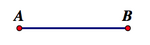
For single phase, you have two wires. Let's call 'em wire A and wire B. You can measure voltage between these one way, and that's between wire A and wire B. If you put your meter probes no the opposite wires, you're still just measuring voltage between A and B. So one way to measure voltage, one phase.

150px-Segm_AB.png


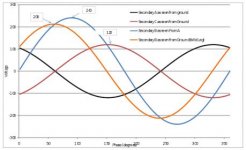
With 3 phase, you have 3 wires. Let's call 'em wire A, B and C. You can measure voltage between A and B, between B and C, and between A and C. Three ways to measure voltage, 3 phases.

u_sfig7.gif
 

KenC

Well-known member
Joined
Dec 20, 2009
Messages
2,577
How about a discussion of 3ph 240v supplied from 2 transformers with one phase 218v to ground and the other two 125 to ground. Those are the measured voltages at my shop. I've never really grasped the 3phase for 2 transformer thing.
 
To avoid these ads, REGISTER NOW!

404

Well-known member
Joined
Aug 23, 2014
Messages
3,463
Location
Mass
So in that diagram A-C and D-C are 180 degrees out of phase with each other? Is B-C 90 degrees out of phase with A-C and 270 degrees out of phase of D-C?

Of the points A B C D all of them are 180 out of phase with each other no matter which combination of 2 you measure.

To put it another way, all combinations of these points one of them is at a positive voltage while the other is at a negative voltage and they switch from positive to negative at 60 cycles per second in USA

Regards,
404
 

91bronc300

Well-known member
Joined
Oct 19, 2009
Messages
2,559
Of the points A B C D all of them are 180 out of phase with each other no matter which combination of 2 you measure.

To put it another way, all combinations of these points one of them is at a positive voltage while the other is at a negative voltage and they switch from positive to negative at 60 cycles per second in USA

Regards,
404


So if every single possible combination of taps

A-B
A-C
A-D
B-C
B-D
C-D

were connected to separate loads at once, which ones would be in sync with each other and which would be 180 out? Just trying to understand and thanks for the previous answer.
 

Leadberry

Well-known member
Joined
Apr 8, 2013
Messages
182
Location
Akron, OH
I've been doing a little reading on three phase power, and it has caused me to have a simple question about single phase power.

If three phase power is called such, because there are three voltage lines, each 120 degrees out of phase with the other two, why is common single phase 240 not considered "two phase"? It has two voltage lines, 180 degrees out of phase with each other.

Three phase is three phase because there are three voltage supply lines. Single phase has only one voltage supply line. The neutral line is not a supply line, it's a return.

In the USA, transformers may have a 2.4kV input. The transformer will step down the voltage by a factor of 10/1, giving you a supply of 240V. They then center tap the transformer to give you two 120V supply lines.

And to confuse things......three phase is found in delta and wye configuration

Bob

Delta and wye can be mathematically equated to each other. Delta represents systems that do not contain a neutral line.

l21756701-1.png


So how many phases does the secondary of the above transformer have? On our normal household power we have a secondary of a transformer at the box that provides 240v with a center tap that has 120volt measurement from the center tap to each end of the winding. If each 120 volt leg is a 'phase' then the above transformer could have 6 phases, yes? Or is it a single phase multi-tap transformer?

lg
no neat sig line

A transformer has one phase.

So in that diagram A-C and D-C are 180 degrees out of phase with each other? Is B-C 90 degrees out of phase with A-C and 270 degrees out of phase of D-C?

No no no. A difference in voltage does not imply a difference in phase. Every single point on the secondary of that transformer has the same phase angle.

Another easy way to look at it is how many different ways are there to measure the voltage with a voltmeter?

For single phase, you have two wires. Let's call 'em wire A and wire B. You can measure voltage between these one way, and that's between wire A and wire B. If you put your meter probes no the opposite wires, you're still just measuring voltage between A and B. So one way to measure voltage, one phase.

150px-Segm_AB.png


With 3 phase, you have 3 wires. Let's call 'em wire A, B and C. You can measure voltage between A and B, between B and C, and between A and C. Three ways to measure voltage, 3 phases.

u_sfig7.gif

Three phase can also contain a neutral line, providing four lines. Line-to-line voltages in a delta-source can be mathematically converted to their line-to-neutral or phase wye equivalents by dividing by the square root of 3 and subtracting 30 degrees from the phase angle.

Of the points A B C D all of them are 180 out of phase with each other no matter which combination of 2 you measure.

To put it another way, all combinations of these points one of them is at a positive voltage while the other is at a negative voltage and they switch from positive to negative at 60 cycles per second in USA

Regards,
404

NOOOOOOOO. Between two points, a voltage is in reference to another point. If there is +12V between two points, there is +12V at one point and 0V at the other point. If you reverse the direction of your measurement, there will be -12V at the second point and 0V at the first point.

Also, again voltage and phase shift are two entirely different concepts! Every point on that secondary is at one phase!

So if every single possible combination of taps

A-B
A-C
A-D
B-C
B-D
C-D

were connected to separate loads at once, which ones would be in sync with each other and which would be 180 out? Just trying to understand and thanks for the previous answer.

The supplies across the secondary coil of that transformer will always have the same phase. Different loads will have different phase angles depending on the inductance or capacitance of the loads. The phase angle could be anywhere between 0 and 360 degrees...it does not have to be strictly 0 or 180 degrees.

Edit: Clearly this was not a silly question, because a lot of people here have misconceptions about what voltage and phase angle are and how they work. That's totally understandable, as they're highly mathematical concepts. I'll be more than happy to answer more questions for you guys, but I'm drunk and tired and need to be up early, so I'll check back here tomorrow evening.

Gonna give this another go! :shocking:
 
Last edited:
OP
K

KinzeMech

Well-known member
Joined
Jul 15, 2012
Messages
1,164
Sine wave.

lol...good point, although what I meant by the question wasn't that basic. You asked how many phases the secondary of that transformer would have. I was visualizing a graph of the output waveform while considering the answer to that question. Sine wave is the obvious answer, but more what I was looking for is how many phases would show on a graph of all the voltages of those output lines. I think each output would show as a sine wave of varying amplitude, with all of them having a common phase angle.


Three phase is three phase because there are three voltage supply lines. Single phase has only one voltage supply line. The neutral line is not a supply line, it's a return.
What about the case of single phase 220? Then there are two voltage supply lines. A graph of the voltage waveform shows wo lines with a 180 degree phase angle between them.


Thank you for that detailed reply. There was a lot of interesting information in it, and I will reread it at least two more times when I'm not quick out the door to work.
 

404

Well-known member
Joined
Aug 23, 2014
Messages
3,463
Location
Mass
My replies in red

Three phase is three phase because there are three voltage supply lines. Single phase has only one voltage supply line. The neutral line is not a supply line, it's a return.

In the USA, transformers may have a 2.4kV input. The transformer will step down the voltage by a factor of 10/1, giving you a supply of 240V. They then center tap the transformer to give you two 120V supply lines.
Agree with the center tap part.


Delta and wye can be mathematically equated to each other. Delta represents systems that do not contain a neutral line.


A transformer has one phase.


No no no. A difference in voltage does not imply a difference in phase. Every single point on the secondary of that transformer has the same phase angle.

No, when one of the points is at maximum possible voltage, the other point is at maximum negative voltage. It is valid to refer to them as 180 out of phase.


Three phase can also contain a neutral line, providing four lines. Line-to-line voltages in a delta-source can be mathematically converted to their line-to-neutral or phase wye equivalents by dividing by the square root of 3 and subtracting 30 degrees from the phase angle.
Not going to check your math.


NOOOOOOOO. Between two points, a voltage is in reference to another point. If there is +12V between two points, there is +12V at one point and 0V at the other point. If you reverse the direction of your measurement, there will be -12V at the second point and 0V at the first point. That is true for DC. In AC the voltage is reversing at the line frequency. No one is reversing the direction of the measurement. The current wants to go in the opposite direction.

Also, again voltage and phase shift are two entirely different concepts! Every point on that secondary is at one phase!

Put two of those 2 taps on a two channel scope with a tap between them as the ground and the sine waves are clearly 180 out of phase. No question of that.


The supplies across the secondary coil of that transformer will always have the same phase. Different loads will have different phase angles depending on the inductance or capacitance of the loads. The phase angle could be anywhere between 0 and 360 degrees. This reply not accurate because it is incomplete. Loads may have a phase angel between the VOLTAGE being fed to them and the CURRENT they draw.


..it does not have to be strictly 0 or 180 degrees.

Edit: Clearly this was not a silly question, because a lot of people here have misconceptions about what voltage and phase angle are and how they work. That's totally understandable, as they're highly mathematical concepts. I'll be more than happy to answer more questions for you guys, but I'm drunk Agree. ;)

and tired and need to be up early, so I'll check back here tomorrow evening.
 

404

Well-known member
Joined
Aug 23, 2014
Messages
3,463
Location
Mass
So if every single possible combination of taps

A-B
A-C
A-D
B-C
B-D
C-D

were connected to separate loads at once, which ones would be in sync with each other and which would be 180 out? Just trying to understand and thanks for the previous answer.

Lets talk about the direction the current wants to travel. It is easier to explain. Assume the standard usage where current is said to travel from a higher voltage to a lower voltage.

Assume that at the moment in the waveform we take our measurement the the terminal A is at maximum positive voltage and the terminal D is max neg voltage. For any combination of taps the one that is at or closest to A will have current wanting to flow out of it.

The tap that is at or closest to D will have that current wanting to flow into it. So in your list in every case the measurement is taken with the terminal A or near A first and terminal D or near D last, so in every case the current wants to travel out of those taps in the same direction.


I hope that explanation work for you.
 

Leadberry

Well-known member
Joined
Apr 8, 2013
Messages
182
Location
Akron, OH
My replies in red

Wow, I decided to check in on here and can't believe I blindly posted some of that **** last night without thinking about what was happening. I just wanna come out right now and apologize. Thank you for correcting me 404.
 

Stroonzo

Member
Joined
Jun 23, 2014
Messages
19
This is the way my brain handles it (and I will steal some graphics from the web to help explain):

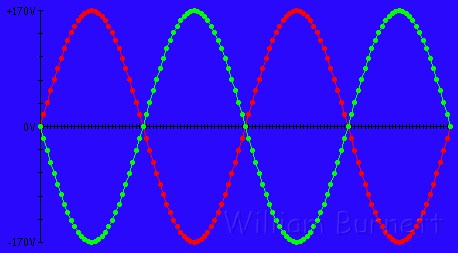
Split phase 240v = the total distance between 120v above the x axis and 120v below the x axis occurring simultaneously because the two 60hz sine waves are occurring simultaneously but in opposing positions to each other on the X axis (or @ 180°).
split-phase-sine-wave.gif


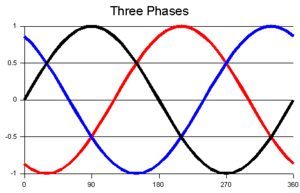
Now three phase is the same concept but instead of two sine waves running 180° opposed (making that pretty 1990's sweater design), you have THREE sine waves occurring but in a different spacing from each other along the X axis (or 120°) making them not ever exactly opposite to one another.
th1501threephasesinewave.jpg


The total measure of voltage is simply differential. The differential in split phase is 240v RMS. In three phase, it is 208v RMS.

On a side note, the voltage in the US in your home is 120 / 240 (NOT 110 / 220).

If you look closely, you can see why 3 phase is better for industrial applications. At any point in time (simply draw a vertical bar on the graph), 3 phase electricity is always 208v.
 
Last edited:

Leadberry

Well-known member
Joined
Apr 8, 2013
Messages
182
Location
Akron, OH
I think I've got it right now. Trying to think strictly about multiple waveforms in one coil was throwing me off (among other things :p).

1. Let's say the transformer has a 7.2kV single phase input and steps that down to 240V output.

2. There is 240V total across the entire secondary, from top tap to bottom tap, and our center tap is tied to ground/neutral.

3. Since the center tap cuts the secondary winding in half, the top tap will read +120V with reference to the center tap (half of +240V).

4. At the same time, the bottom tap will be at -120V with reference to the center tap, because the magnitude of the voltage will be the same, but opposite in sign since it's on the opposite side of the reference point.

5. Because these two voltages are equal in magnitude but opposite in sign, this is equivalent to having two sinusoidal voltages 180 degrees out of phase, as shown in Stroonzo's pic above.

6. This is also equivalent to each line supplying +120V with a time delay of half of a period between them, or 1/120th of a second. On a single 120V circuit, we don't care about the other supply line, and the phase/time difference between them is irrelevant. Thus we see that each line supplies 120V to their respective circuits.

6. If we measure the total voltage across the secondary, we will get

Vtop - Vbottom = +120V - (-120V) = 120V + 120V = 240V

7. Therefore, in the case of a circuit where we have a supply line connected in reference to the neutral we will have 120V. When we have a supply line connected in reference to the other supply line, we will have 240V.

Feel free to correct me if I'm wrong. :beer:
 
Last edited:

Pantsfall_McFixit

Well-known member
Joined
Oct 8, 2012
Messages
167
With a standard 120v circuit you have one "hot" or one line pushing and pulling depending on where you are in the phase (the degrees). Also there's a neutral along for the ride, not really caring what's going on.

With 240 you have two "hots", one pushing while the other's pulling. They're always going the opposite direction in the phase, but helping each other out like two guys sawing down a tree with those big saws. There can also be a indifferent neutral, but always a seperate ground.

Modern 240v outlets in houses have two hots, a neutral, and a separate ground. With the neutral you can take one hot leg and the neutral and get 120v to run some smaller parts of the appliance, like a bulb or motor or something.
 
Last edited:

miner

Well-known member
Joined
Oct 3, 2012
Messages
96
Voltage is a measure of potential *difference* --- that is, you need *two* conductors to have any voltage of any kind. So it is totally meaningless to talk about the voltage of a single wire.

Three phase power is not called three phase because it has three wires, but because there are three pairs of conductors: AB, AC, BC. Again, it has nothing to do with "the voltage of line A" since there is no such thing. Single phase has two conductors with only one pairing (pairings with neutral are not separate phases either in single or three phase). A real two phase supply has four wires that make 2 circuits.
 

larry_g

Well-known member
Joined
Apr 28, 2007
Messages
16,867
Location
oregon
Voltage is a measure of potential *difference* --- that is, you need *two* conductors to have any voltage of any kind. So it is totally meaningless to talk about the voltage of a single wire.

Three phase power is not called three phase because it has three wires, but because there are three pairs of conductors: AB, AC, BC. Again, it has nothing to do with "the voltage of line A" since there is no such thing. Single phase has two conductors with only one pairing (pairings with neutral are not separate phases either in single or three phase). A real two phase supply has four wires that make 2 circuits.

bronc posted the following aboutthe multi tap transformer I posted a picture of

l21756701-1.png


So if every single possible combination of taps

A-B
A-C
A-D
B-C
B-D
C-D

were connected to separate loads at once, which ones would be in sync with each other and which would be 180 out? Just trying to understand and thanks for the previous answer.

So according to Miner it has 6 phases?

lg
no neat sig line
 

miner

Well-known member
Joined
Oct 3, 2012
Messages
96
So according to Miner it has 6 phases?

No, not according to me it doesn't. You can measure the potential difference between any two conductors, as in that diagram, or even the voltage drop along a single conductor (again, a difference), but that doesn't mean you have separate phases.
 

larry_g

Well-known member
Joined
Apr 28, 2007
Messages
16,867
Location
oregon
No, not according to me it doesn't. You can measure the potential difference between any two conductors, as in that diagram, or even the voltage drop along a single conductor (again, a difference), but that doesn't mean you have separate phases.

Quoting yourpost#30 :
Three phase power is not called three phase because it has three wires, but because there are three pairs of conductors: AB, AC, BC.

Can't have it both ways...

lg
no neat sig line
 
To avoid these ads, REGISTER NOW!
Top Bottom