To avoid these ads, REGISTER NOW!

"Simple" AC install

Fireguy50

Well-known member
Joined
Sep 28, 2020
Messages
81
Location
Michigan
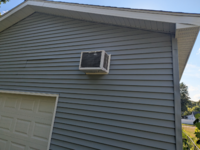
All the AC units on the market have Wi-Fi, remote controls, displays, and unnecessary Chinese phone apps! I opened up my new AC and tore out the circuit board; this disabled all of the nonsense nobody wants!

Then I installed a standard contactor in the same compartment and kept the capacitor, them I wired it up just like a typical House AC unit compressor with the 2 wires for a regular wall thermostat and wire colors. No more lost remote or the buttons stop working in the future, just Standard AC to go with my Mr Heater Nat-Gas furnace.
Picsart_25-08-10_20-40-22-700.png
Picsart_25-08-10_20-39-58-581.png
Picsart_25-08-10_20-40-42-157.png
6384089649661486749947726.png
 
Last edited:
To avoid these ads, REGISTER NOW!

Bert_

Well-known member
Joined
Dec 24, 2016
Messages
9,701
Location
NW Iowa
I did the same thing a little over a year ago.

I wanted to get rid of my 18,000 BTU window AC for something more appropriately sized. I ended up with a 8,000 BTU with a bad circuit board.

I put the contactor in my breaker panel. The contactor is powered by the transformer in my furnace and uses the same thermostat. It controls the outlet right under the air conditioner. The air conditioner itself has no controls inside, just a compressor and fan wired directly to the cord.
 
OP
F

Fireguy50

Well-known member
Joined
Sep 28, 2020
Messages
81
Location
Michigan
I did the same thing a little over a year ago.

I wanted to get rid of my 18,000 BTU window AC for something more appropriately sized. I ended up with a 8,000 BTU with a bad circuit board.

I put the contactor in my breaker panel. The contactor is powered by the transformer in my furnace and uses the same thermostat. It controls the outlet right under the air conditioner. The air conditioner itself has no controls inside, just a compressor and fan wired directly to the cord.
I'm assuming you still used a capacitor inside the AC unit? I wanted it self contained and didn't want to add extra parts in the electrical panel that could get a fail from the inspectors. So you have the 24VAC transformer and contactor inside the main electrical panel? That's against code to mix low voltage wires inside the panel. I'd advise using a separate 8x8 box next to the electrical panel to avoid problems.

I'm using the 24VAC transformer that is a part of the Mr Heater Nat-Gas furnace, it can run everything in the HVAC system, along and thermostat.

Mine now has the exact same wiring and parts as every central AC outdoor compressor unit in North America.🍻
nice hack ! thanks for sharing
makes me wonder how many ac units get trashed because they lost the remote or the board went bad etc.
As soon as I showed my father-in-law what I was doing; he wanted pictures and instructions, because he apparently has a couple AC units that "stopped" working for these exact reasons: lost remote or the overly complex circuit board had a failure. When these don't need all of that nonsense, these can be run with a any wall thermostat!

Before my garage burned down I remember one day I couldn't find that remote and climbed over a car I was doing body work on to push the buttons on the display. Now it's the same 2 wire connection as every central AC unit in North America, and my wall thermostat is 4ft from the door!😂👍
Being simple myself, I like your style of keeping it simple
Thanks, this will now run on the standard 5 wire thermostat wire for this AC Unit, my Mr Heater Nat-Gas furnace, and because of the square footage of the garage I'm going to add a circulation fan on the ceiling that will be controlled by the thermostat just like a blower fan in a house (to prevent the HVAC from having warm/cold spots in the garage).😁
  • Red - 24VAC
  • Blue - Common (24VAC neg)
  • White - Heat
  • Yellow - AC
  • Green - Fan
 
Last edited:

yatg

Well-known member
Joined
Aug 16, 2019
Messages
2,755
Location
Southern Oregon
Interesting

I assume the buttons on the unit no longer do anything?
Buttons? What buttons?
They're all soft push pads connected to a circuit board.
Its now cheaper to have all electronic controls than use anything mechanical, except in the long run most electronic controls are generally and economically unrepairable.

Awesome hack @Fireguy50
 

Bert_

Well-known member
Joined
Dec 24, 2016
Messages
9,701
Location
NW Iowa
I'm assuming you still used a capacitor inside the AC unit? I wanted it self contained and didn't want to add extra parts in the electrical panel that could get a fail from the inspectors. So you have the 24VAC transformer and contactor inside the main electrical panel? That's against code to mix low voltage wires inside the panel. I'd advise using a separate 8x8 box next to the electrical panel to avoid problems.

I'm using the 24VAC transformer that is a part of the Mr Heater Nat-Gas furnace, it can run everything in the HVAC system, along and thermostat.

Yes the capacitor is still there. The fan and compressor wouldn't even start without it.

The transformer I use to power it is the one in my furnace. It was already there and is already supplying 24v to the thermostat, no reason to buy another one.

You can mix different voltages in the same panel. The issue is the insulation on the wire. I'm using regular old stat wire listed for a class 2 circuit. So yes it's a violation but I'm not going to change it.

If I was going to wire it for a customer I'd do it right. But at my own house, it's good enough.
 

bonneyman

Well-known member
Joined
Apr 22, 2010
Messages
8,759
Location
Desert SW
Buttons? What buttons?
They're all soft push pads connected to a circuit board.
Its now cheaper to have all electronic controls than use anything mechanical, except in the long run most electronic controls are generally and economically unrepairable.

Awesome hack @Fireguy50
Big 10-4. Manufacturers went to as much digital controls as they could to reduce cost and simplify inventory. Though I have yet to see a digital run capacitor! Probably because run caps are so cheap nobody would swap in an expensive electronic one.
Only time I would consider an electronic add-in was when they came out with electronic contactors. Old analog contactors would not hold in reliably if the voltage went below 17-18VAC. On really long runs the voltage might drop enough to cause chattering. Only thing we could do was pull another t-stat wire bundle (with thicker wires) to make sure 24VAC got out there. Electronic contactors would have solved that issue. But didn't run across a job that I could have tried it before I closed the business.
 
OP
F

Fireguy50

Well-known member
Joined
Sep 28, 2020
Messages
81
Location
Michigan
Interesting

I assume the buttons on the unit no longer do anything?
Absolutely nothing, but it's ~8ft in the air and 35ft in the back of the garage; I have no desire to walk back there and reach up to operate the AC unit. I have a traditional thermostat on the wall near the door that now turns this ON/OFF just like the Central AC in any house. Those buttons were connected to that small gray wire that I pulled off the circuit board and I don't need anymore. I didn't cut anything, just pulled it off the cheap circuit board and it plugged onto the standard contractor if you look at the photo. I moved the high speed fan wire to the FAN terminal on the capacitor.

Buttons? What buttons?
They're all soft push pads connected to a circuit board.
Its now cheaper to have all electronic controls than use anything mechanical, except in the long run most electronic controls are generally and economically unrepairable.

Awesome hack @Fireguy50
Thanks!🍻 Yes everything about the electronics are cheap, I'm glad I pulled it all out before it developed a fault. Now it runs like a standard AC unit and thermostat.
Yes the capacitor is still there. The fan and compressor wouldn't even start without it.

The transformer I use to power it is the one in my furnace. It was already there and is already supplying 24v to the thermostat, no reason to buy another one.

You can mix different voltages in the same panel. The issue is the insulation on the wire. I'm using regular old stat wire listed for a class 2 circuit. So yes it's a violation but I'm not going to change it.

If I was going to wire it for a customer I'd do it right. But at my own house, it's good enough.
Building Code NEC Article 725 specifically emphasizing the need for separation between low voltage and line voltage wiring. It won't pass an inspection. I'd advise moving the contactor into the AC unit and not have extra devices inside the electrical panel.
Big 10-4. Manufacturers went to as much digital controls as they could to reduce cost and simplify inventory. Though I have yet to see a digital run capacitor! Probably because run caps are so cheap nobody would swap in an expensive electronic one.
Only time I would consider an electronic add-in was when they came out with electronic contactors. Old analog contactors would not hold in reliably if the voltage went below 17-18VAC. On really long runs the voltage might drop enough to cause chattering. Only thing we could do was pull another t-stat wire bundle (with thicker wires) to make sure 24VAC got out there. Electronic contactors would have solved that issue. But didn't run across a job that I could have tried it before I closed the business.
It was painfully simple to tear out the old electrics and . There were 2 relays on the circuit board for the compressor and fan motors, and 2 tiny plugs for the front display buttons and Wi-Fi nonsense. Without that circuit board, I just need that traditional contractor, which is a high current "relay" used in all AC units outside buildings. Using that will last decades longer than the circuit board relays I pulled out. The only function I lost was medium and slow fan speed; but those are dumb, we don't need slow fan speed in our house central HVAC, the thermoset on the wall will turn this ON/OFF no different. 👍
 

Bert_

Well-known member
Joined
Dec 24, 2016
Messages
9,701
Location
NW Iowa
Building Code NEC Article 725 specifically emphasizing the need for separation between low voltage and line voltage wiring. It won't pass an inspection. I'd advise moving the contactor into the AC unit and not have extra devices inside the electrical panel.

I'm familiar with it, I've got an "MA" on my license.

I don't want the contactor in the ac. I would have to disconnect the thermostat wire every year when I put the air conditioner away.
 

bonneyman

Well-known member
Joined
Apr 22, 2010
Messages
8,759
Location
Desert SW
It was painfully simple to tear out the old electrics and . There were 2 relays on the circuit board for the compressor and fan motors, and 2 tiny plugs for the front display buttons and Wi-Fi nonsense. Without that circuit board, I just need that traditional contractor, which is a high current "relay" used in all AC units outside buildings. Using that will last decades longer than the circuit board relays I pulled out. The only function I lost was medium and slow fan speed; but those are dumb, we don't need slow fan speed in our house central HVAC, the thermoset on the wall will turn this ON/OFF no different. 👍
(y)

10-4 So long as you can delete the CB's easily then your conversion is simple. Manufacturers have responded by implanting sensors in compressors and motors to thwart this kind of move, or make the thermostat a special kind that you have to use in order to get the unit to work. (Trane was big on this. Stat went bad, you had to buy their replacement. Regular stats wouldn't interface). Or they integrate all the monitoring functions into one big master board so the unit can't run without it. One function fails (say low speed drops out) - you have to replace the whole board to get high speed.
 
To avoid these ads, REGISTER NOW!
OP
F

Fireguy50

Well-known member
Joined
Sep 28, 2020
Messages
81
Location
Michigan
I'm familiar with it, I've got an "MA" on my license.

I don't want the contactor in the ac. I would have to disconnect the thermostat wire every year when I put the air conditioner away.
Oh! I assumed you're HVAC was permanently installed, how do you put it away each year? Does it leave a hole in the wall, or what, I'm curious?🤔
(y)

10-4 So long as you can delete the CB's easily then your conversion is simple. Manufacturers have responded by implanting sensors in compressors and motors to thwart this kind of move, or make the thermostat a special kind that you have to use in order to get the unit to work. (Trane was big on this. Stat went bad, you had to buy their replacement. Regular stats wouldn't interface). Or they integrate all the monitoring functions into one big master board so the unit can't run without it. One function fails (say low speed drops out) - you have to replace the whole board to get high speed.
The compressor and fan were stranded equipment, the only additional wires were a Low fan speed (which I didn't need). I left those wires in the unit but disconnected. But I can't promise every Unit will have enough room in that circuit board cavity for the new components. If mine didn't have enough room I would have removed that aluminum housing for the electronics and moved the capacitor and contractor to a new location inside the unit. There are lots of unused spots in that can be used if you need to add a new box.🍻
Follow standard AC Unit wiring:
6384089649661486749947726.png
Picsart_25-08-13_11-53-44-578.png
 
Last edited:

Bert_

Well-known member
Joined
Dec 24, 2016
Messages
9,701
Location
NW Iowa
Oh! I assumed you're HVAC was permanently installed, how do you put it away each year? Does it leave a hole in the wall, or what, I'm curious?🤔

The compressor and fan were stranded equipment, the only additional wires were a Low fan speed (which I didn't need). I left those wires in the unit but disconnected. But I can't promise every Unit will have enough room in that circuit board cavity for the new components. If mine didn't have enough room I would have removed that aluminum housing for the electronics and moved the capacitor and contractor to a new location inside the unit. There are lots of unused spots in that can be used if you need to add a new box.🍻
Follow standard AC Unit wiring:
6384089649661486749947726.png
Picsart_25-08-13_11-53-44-578.png
It goes in a window.

I have lived in a house with a window unit mounted through the wall. It leaked a ton of air, I had to cover the inside and outside with plastic to cut down on the draft. It ended up leaking water too when the caulk cracked. They have no flange to flash under the siding.

The house I own now had an ac unit in the wall. There was evidence of water leaking into the wall. I removed it before I moved into the house.

I kept the 18,000 unit that was mounted in the wall and used it in a window for several years. It's heavy and I got tired of carrying it up from the basement. So I found an 8,000 that is much lighter and still does a fine job cooling my ~950sqft main floor
 
OP
F

Fireguy50

Well-known member
Joined
Sep 28, 2020
Messages
81
Location
Michigan
This will make the "Simple Garage AC" more complicated; but it is part of my complete HVAC plan. Because this is for an 840 sq/ft (x 12ft tall ceiling) garage: is 10,800 Cubic Feet of air in the space (after I close up the rafters with insulation), the structure needs more circulation in this large space with a residential wall mounted AC in the corner and a Nat-Gas Mr Heater ceiling furnace in the opposite corner; both with smaller residential fans (not designed to blow 35ft+ easily). So... I also wired the shop fan to the wall thermostat, it will now come on to make sure the both units are able to fully circulate throughout the garage; preventing warm/cold spots. (This will prevent the furnace being 75°F+ on the ceiling before any snow melts off the tires and snowblower on the floor)👍

4,000+ CFM ceiling mounted fan:
Picsart_25-08-13_20-37-13-398.png
Special Receptical on the ceiling just for the shop fan:
Picsart_25-08-13_20-37-54-333.png24V to 240V relay inside this 4inch box, that lets the thermostat low voltage control the line voltage high speed shop fan:
Picsart_25-08-13_20-38-38-793.png
 
Last edited:

Bert_

Well-known member
Joined
Dec 24, 2016
Messages
9,701
Location
NW Iowa
This will make the "Simple Garage AC" more complicated; but it is part of my complete HVAC plan. Because this is for an 840 sq/ft (x 12ft tall ceiling) garage: is 10,800 Cubic Feet of air in the space (after I close up the rafters with insulation), the structure needs more circulation in this large space with a residential wall mounted AC in the corner and a Nat-Gas Mr Heater ceiling furnace in the opposite corner; both with smaller residential fans (not designed to blow 35ft+ easily). So... I also wired the shop fan to the wall thermostat, it will now come on to make sure the both units are able to fully circulate throughout the garage; preventing warm/cold spots. (This will prevent the furnace being 75°F+ on the ceiling before any snow melts off the tires and snowblower on the floor)👍

4,000+ CFM ceiling mounted fan:
Picsart_25-08-13_20-37-13-398.png
Special Receptical on the ceiling just for the shop fan:
Picsart_25-08-13_20-37-54-333.png24V to 240V relay inside this 4inch box, that lets the thermostat low voltage control the line voltage high speed shop fan:
Picsart_25-08-13_20-38-38-793.png

I do the same thing with a fan. I use it to blow air back towards the first floor bedroom. My fan is just plugged into the same outlet as the air conditioner because it's controlled by the thermostat.

Somebody recently told me that you're not supposed to mix low voltage class 2 wiring with line voltage like you're doing in that 4" square box. :)
 

Bert_

Well-known member
Joined
Dec 24, 2016
Messages
9,701
Location
NW Iowa
I really do like the fan. I just couldn't resist giving you a hard time about the wiring.

How do you have it wired so the fan comes on with the heating and the cooling? Looks like just the one relay?
 
OP
F

Fireguy50

Well-known member
Joined
Sep 28, 2020
Messages
81
Location
Michigan
I really do like the fan. I just couldn't resist giving you a hard time about the wiring.

How do you have it wired so the fan comes on with the heating and the cooling? Looks like just the one relay?
😂 No problems, I believe the only way to connect this per "code" is to purchase a box that has separate sides for low voltage and line voltage separated. Unfortunately I only found those type of electrical boxes in plastic, they seem to be meant for wall mount TV applications, 🙄🫤 definitely NOT for us looking to install a cheap HVAC in our garage!😂

I'd still prefer to use the factory transformer inside the furnace, the AC window unit won't fail code (it's got better parts than required now). But this relay installed in an electrical outlet box 12ft on the ceiling is far away from the electrical panel. I've got a good chance an inspection won't get out a ladder and inspected every box 12ft on the ceiling.😬🤦🏻‍♂️
However am I inspector is definitely going to look inside the electrical panel; and with my AFCI breakers, the inspection likely won't check each outlet...🤷🏻‍♂️🤦🏻‍♂️

I suspect it's not possible to install as "Cheap Garage HVAC" and pass code. We're supposed to get proper HVAC equipment with a blower enclosure and ducting. Not a transformer inside the electrical panel, no low voltage relay inside a 120VAC receptacle box. I definitely voided my Frigidaire AC warranty, and doubt Mr Heater would approve their transformer is also powering all the functions on the wall thermostat YEL & GRN wires (for the AC contactor or circulation Fan relay).🤷🏻‍♂️🫤
 

yatg

Well-known member
Joined
Aug 16, 2019
Messages
2,755
Location
Southern Oregon
You can get a metal divider for a metal 4x4 box, but it doesn't do much good for this because you've got the relay block with both voltage wires attached to it. The divider is more for separating power and comm cables. I think there's something in the code that allows both high and low voltages together if they are "functionally associated". You may need to splice some THHN to the tstat wire and come into the box on THHN - wire insulation ratings.

And hook the ground wire to the metal box.

1755493942423.png

Previous house I connected a relay to the garage door opener light, when the door opened a couple of t8 fixtures came on. Put the relay in a box in the ceiling near the opener. Many years later the relay crapped out and having the box in the ceiling was a huge mistake, standing on a ladder and working overhead. Much easier to work on stuff at ground level.
 

Bert_

Well-known member
Joined
Dec 24, 2016
Messages
9,701
Location
NW Iowa
You may need to splice some THHN to the tstat wire and come into the box on THHN - wire insulation ratings.

You commonly see this in HVAC equipment. I think they are using MTW for all the area's where low voltage and line voltage are together. This wire is run to a separate compartment where class 2 wire is field spliced.

The code doesn't prevent mixing different voltages. The issue is the rating of the wire.
 

4x4Pete

Well-known member
Joined
Aug 26, 2019
Messages
791
Location
Stroud
Simple A/C install- jamb window unit in window, plug in, turn on, enjoy. Much beyond this and it ain't simple!😄
 
OP
F

Fireguy50

Well-known member
Joined
Sep 28, 2020
Messages
81
Location
Michigan
Dang. He was okay with that? :LOL:
Thanks; fixed that spelling error, definitely no contractor involved!🙃🍻
Simple A/C install- jamb window unit in window, plug in, turn on, enjoy. Much beyond this and it ain't simple!😄
The window AC Unit is one of the worst security vulnerabilities. Easy to pull out or open the window; then a thief has unlimited access to our collection of tools bought, gifted & handed down. Stealing and/or vandalizing our project (and) vehicles, which we've spent weeks to decades working on.

I should have kept the old window unit that was (outside) during the fire. Yes, the front was a little melty, the buttons and display were ruined. But it was hanging outside the old window (I no longer have windows in my new garage 🎉), a and I bet this would have fixed that unit so it could keep working for years in the new garage. But I tossed it, let them pull it out to a "recycle" pile during demolition. Something I'll never know; but my father-in-law has multiple "dead" window units this could resurrect back to life!🤔🤷🏻‍♂️
 

Bert_

Well-known member
Joined
Dec 24, 2016
Messages
9,701
Location
NW Iowa
The window AC Unit is one of the worst security vulnerabilities. Easy to pull out or open the window; then a thief has unlimited access to our collection of tools bought, gifted & handed down. Stealing and/or vandalizing our project (and) vehicles, which we've spent weeks to decades working on.

Worse than the unlocked doors on my house and garage? I don't even have keys that fit, except for one single door.
 
Last edited:

reader2580

Well-known member
Joined
Dec 31, 2014
Messages
14,516
Location
Minneapolis, MN
Somebody recently told me that you're not supposed to mix low voltage class 2 wiring with line voltage like you're doing in that 4" square box. :)
I asked the local inspector if I could run the low voltage control wires for my generator in the same conduit as the 240 volt. He said it was okay so long as the wire was rated the same as the 240 volt wire. I used THHN with the 600 volt rating for the control wiring.
 

Bert_

Well-known member
Joined
Dec 24, 2016
Messages
9,701
Location
NW Iowa
I asked the local inspector if I could run the low voltage control wires for my generator in the same conduit as the 240 volt. He said it was okay so long as the wire was rated the same as the 240 volt wire. I used THHN with the 600 volt rating for the control wiring.
You are 100% correct. The rating of the wire is important, not the voltage of the circuit.

My comment was a little tongue in cheek. Earlier fireguy50 and I had been discussing the contactor I mounted in my breaker panel.
 
To avoid these ads, REGISTER NOW!
Top Bottom