To avoid these ads, REGISTER NOW!

Simple open loop radiant heat system.

HandyRyan

Member
Joined
Oct 27, 2020
Messages
8
Location
WA
Hello, my name is Ryan. This is my first post here. I'm looking for some critique of my garage radiant floor heat plan.

I'm building an ADU in Renton WA. It has an 800 sq foot apartment upstairs and an 800 sq foot garage on the first floor.

In the garage, I already have three 100' loops of 1/2" oxygen barrier pex in the 4" slab, and a Rinnai ru80 152,000 BTU tankless water heater installed. I plan on using a mini-split heater upstairs. City water pressure is coming in at 74 psi from a brand new 1" water meter. I've never had problems with contaminants in the water supply.

I don't need heat in the garage very often it's really just a luxury, so I want to keep this system, as simple, compact, and cost-effective as possible. I don't care if it's not the most efficient.

It's an open system one zone I've opted to eliminate the mixing valves. The default temperature on the tankless is 140 I believe that should be fine for both the floor and potable use.

Will this system work, is there anything required that I'm missing?

Thanks everyone
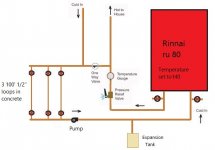
heat plan3.jpg
 
Last edited:
To avoid these ads, REGISTER NOW!

kj_mustang

Well-known member
Joined
Feb 9, 2011
Messages
1,214
Location
Harrisonburg, VA
Not even going to discuss the open vs closed loop part of your discussion. 140 F water temperature is too high for a concrete floor. You need to stay about 120 F.
 

Jackfre

Well-known member
Joined
Dec 26, 2010
Messages
4,418
Location
N CA
The set point temp supplied with youR RU 80 Is 120*. Operating the WATER HEATER at 140 will create problems with hot water delivery at low flow fixtures, virtually everything in your home other than the tub/shower. GPM x Delta T x 500= Btu. Your minimum fire on that unit is 15,000 btu.
Rinnai, while excellent water htrs, the best in my experience, are not suitable as a boiler. Closed loop systems were approved back in about ‘00-‘06. The listing was then changed to eliminate closed loop, but Rinnai continued to authorize open loop systems. As the factory rep in a six state area I did thousands of open loop hydro-air systems in properties like yours. One reason they worked is that there was a limited amount of water to recirculate in the system. Should you move ahead with your system you need to ensure that the water in the slab is regularly exchanged through the system. The air handler systems have programs to operate the circulator to move that water through, almost hourly, so no bugs grew in it. You will have approx 2.5gpm of water in 300’ of tubing. In the low temp ranges of 120 and under you are prime for Legionella. So, can this work. Yes, but the devils are in the details.
 

Firebrick43

Well-known member
Joined
May 12, 2015
Messages
14,247
Location
West central Indiana
The health risk already mentioned above as is a few mechanical issue but there is a lot more. Open systems bring in constant oxygen, sediment, and calcium/magnesium. Oxygen is hell on equipment. Cast iron is not that resistant to corrosion but a hydronic heating system made out of it can last 40 years if there are no leaks. Leaks mean makeup water is needed, makeup water brings oxygen. The the calcium and magnesium is going to precipitate out in the r80 and plug things up.

Second, the expansion tank goes after the heater, and the pump should be as close as possible after that. Never pump to the heater/tank.

Why eliminate the tempering valve? It maintains the temp automatically in the slab. And as mention before 140 is WAY to high. Anything above 100 is to high and 75-80 is common/recommended. 140 is baseboard heater range.

Are your loops exactly equal in length? Are they on a manifold, or as depicted? Are those balancing valves at the beginning/end?

Also Handy is a derogatory term in the trades.
 
OP
H

HandyRyan

Member
Joined
Oct 27, 2020
Messages
8
Location
WA
Addressing the legionella issue the loops contain about 4 gallons of water, and with people living in the two bathroom unit upstairs, there should be new water in this system daily. The three loops are not exact, they are between 90'- 100'. I plan on using a bluefin 3 loop manifold to balance the loops, which includes temperatures gauges and an air bleed.

I've updated the plan to move the expansion tank and pump to the hot side. You guys are right 120 is the default temperature. I hope that won't be too hot for the floor. This system won't see a lot of use.
I don't understand how a tempering valve would be able to reduce the temperature to the floor without a hot faucet being open to allow space for cold water to enter the system.
heat plan6.jpg
 
Last edited:
OP
H

HandyRyan

Member
Joined
Oct 27, 2020
Messages
8
Location
WA
One other question do I need to add a one-way valve or backflow preventer on the cold water inlet?
 

Firebrick43

Well-known member
Joined
May 12, 2015
Messages
14,247
Location
West central Indiana
You need a back flow preventer by code if you are on a municipal water supply. It’s a good idea on everything however.

Run your Dhw line from a tee right after the expansion tank. Immediately after that you would place a thermostatic mixing valve with a high cv rating, suggest califfi and to get the rating you will need a 1” or 1 1/4 model, not a 3/4” model. Your main loop should be at least 1” if not 1-1/4 to handle flow of the floor and flow of DHW at the same time. Incoming cold water and out going hot water can be 3/4”.

https://www.caleffi.com/sites/default/files/file/03587_15a-r1.pdf
I would use a 5231 in 1” for the higher cv rating. Do not use a 5213, the cv is to low and they are only suitable for antiscald on a tub/shower.

The cold input of the mixing valve goes to the return side before the R80. This valve takes the hot water(I would set at 130) and mixes it with return water automatically. It would make the one way. Also the mixing valve has a check valve built into the input flanges if you order it that way saving some money from the check you have shown.

Note to others, do NOT do this if your boiler is a non condensing model. You will destroy it in short order. A non condensing boiler should use a primary/secondary loops with closely spaced tees and each loop has their own circulator.

Also you keep mentioning that it won’t be used often. High mass hydronic heat is not something to just turn on and off. It days a couple of days to warm up and cool off. Even if you keep the floor at 60 degrees (which should have an air temp of 50 ish) that’s okay but it should be turned on in the fall and ran into spring.
 
Last edited:
OP
H

HandyRyan

Member
Joined
Oct 27, 2020
Messages
8
Location
WA
Ok I've moved the dhw line before the pump, increased the loop pipe size(however the RU80 only has 3/4" connections), and added a backflow preventer.

I understand now how a mixing valve would lower the loop temperature by getting its cold input from after the loop. However, the califfi 5231 you recommend is $630. That's just too expensive, I want this system as simple as possible. Is a mixing valve mandatory if the temperature is set on the heater to 120?

Keeping the floor temperature set to 60 sounds reasonable.
heat plan7.jpg
 
To avoid these ads, REGISTER NOW!

Tduby

Well-known member
Joined
Apr 5, 2016
Messages
496
Location
Da U.P.
You do know you will have to use stainless water pumps and everything will have to be no lead including your solder and fittings which are lot more expensive. I think I’ll be the third person in this thread to tell you not to do it this way so take that to heart.
Honestly I can’t begin to help with your issues here because the whole idea is going to be more expensive to build and operate and I doubt it will preform like you want.
 
OP
H

HandyRyan

Member
Joined
Oct 27, 2020
Messages
8
Location
WA
Thanks for the input so you recommend I use a heat exchanger or a second water heater?
 
OP
H

HandyRyan

Member
Joined
Oct 27, 2020
Messages
8
Location
WA
I was originally thinking of using a heat exchanger, but if I can make this open system work I think it will be the cheapest option.
I was hoping to use this $164 stainless steel pump

It's $60 more than the cast iron version and I only need one. As for the fittings, I was planning on using copper in between all the components. What other non-potable components could I use that would have a significant cost saving. Isn't Lead-free solder pretty standard? Sorry, I've only ever done supply pumping on potable lines I'm not very familiar with closed-loop systems.

I could plumb a closed-loop system with black iron pipe, but that sounds like a pain in the *** for the I'm guessing $100 I would save over copper.
 
Last edited:

Flail

Well-known member
Joined
Aug 5, 2016
Messages
412
Location
Kin folk said, “Californias the place you wanna be
So you mention the garage loops are a luxury. Does this mean you won’t heat the garage most of the time? Heating slabs are like driving a ship. You need to decide where you are going to be in the future. Meaning: your garage won’t heat up in a few minutes or a few hours if you want to use it today. Then there is the problem of freezing if you don’t use it. You can always run water/glycol in the garage floor with a closed loop/heat exchanger system but that doesn’t deal with the lag time. You could also run the garage all the time at 50 degrees but will waste energy if you don’t need to go in there often. Might be reasonable to add water to air heat exchanger if you need to use the garage occasionally.
 

Firebrick43

Well-known member
Joined
May 12, 2015
Messages
14,247
Location
West central Indiana
I am sorry. I didn’t mean to say which mixing valve like that and that upper model is ridiculous. As originally said don’t get the 5213 as it only has a cv of 2.

The 521* series has a higher flow of cv3.

https://www.supplyhouse.com/Caleffi-521619AC-1-Sweat-MixCal-3-way-Thermostatic-Mixing-Valve-w-Temp-Gauge-and-Inlet-Port-Check-Valves

This valve has the checks built in and thermometer which saves money as you don’t need to by these as separate devices.

https://www.supplyhouse.com/Caleffi-521609A-1-Sweat-Connection-MixingCal-3-Way-Thermostatic-Mixing-Valve

Same valve without the check or thermometer.

It does seem odd at first to use 1” when the DWH is only 3/4”. But not only are their quite a few devices to flow through but some of them are restrictive. Buy upsizing the loop to 1” you help tremendously with pumping losses, which seem small but add over the life of the system. The savings in electricity will pay several times over the extra cost of properly sized pipe and devices over the systems life.

Tduby wasn’t referring so much to the pipe or the solder being lead free but all the brass valves and devices. Many heating only components uses brass and bronze with a percent or two of lead in the alloy as it makes machining much easier and faster as it machines like butter. lead free brass takes longer to machine and different tooling and therefore cost more. Drinking water safe items will have a UPC logo or NFS
 

Wheelingit

Well-known member
Joined
Jul 28, 2020
Messages
330
Location
Maryland USA
You should utilize a heat exchanger. There is a real health risk with an open system. And the open system is illegal in many areas because of just that. You do not want to risk someone getting very sick from that. There is a very real risk present without a heat exchanger.
 

Firebrick43

Well-known member
Joined
May 12, 2015
Messages
14,247
Location
West central Indiana
I am against an open system and others have beat that
Horse so I will not any more.

As far as heat exchanger vs separate system. First issue is in a garage there is the possibility of freezing, especially near the door. It’s always recommended to use antifreeze in these systems. The issue with that is if the heat exchanger fails, and I have seen enough of them fail, it will contaminate the drinking water. For that reason the antifreeze side has to be double isolated which kills the efficiently. It also greatly complicated the system requiring a second pump, and more complicated control system, second set of purge valve/expansion tank, etc.

To that point I would say if your going down that road I would just have a separate system.

Something else to think about. You are using a mini split for the apartment and that is good. I have one in my house for cooling and shoulder season heat. And if insulated decently it seams reasonably sized. I don’t know what brand but the better brands produce heat down to 15 degrees and some better down to 5. HOWEVER what many don’t realize is that it is significantly derated as you go below freezing. For example a 15k unit may only produce 3-4K btus at 15 degrees which is when you need heat the most. Also many will freeze the condenser up if it’s cold and wet. Looking up your climate those temps are not super common but have been been recorded in 2006,2007,and ,2008 so they do happen. Have you thought about supplemental heat in the apartment?
 

Tduby

Well-known member
Joined
Apr 5, 2016
Messages
496
Location
Da U.P.
If it was me I would ditch the tankless water heater they are nothing but headaches they require lots of maintenance and aren’t very comfortable for the end user nothing like being in the middle of a nice hot shower adjusting a shower head and having the unit kick off and give you 6 seconds of freezing water to wake you up.

I would do a boiler with an indirect tank they are very efficient because they have super low standby losses and since the boiler put out a lot more heat than a conventional heater they recover fast.
 

stokefire7

Well-known member
Joined
Oct 5, 2011
Messages
616
Hello, my name is Ryan. This is my first post here. I'm looking for some critique of my garage radiant floor heat plan.

I'm building an ADU in Renton WA. It has an 800 sq foot apartment upstairs and an 800 sq foot garage on the first floor.

In the garage, I already have three 100' loops of 1/2" oxygen barrier pex in the 4" slab, and a Rinnai ru80 152,000 BTU tankless water heater installed. I plan on using a mini-split heater upstairs. City water pressure is coming in at 74 psi from a brand new 1" water meter. I've never had problems with contaminants in the water supply.

I don't need heat in the garage very often it's really just a luxury, so I want to keep this system, as simple, compact, and cost-effective as possible. I don't care if it's not the most efficient.

It's an open system one zone I've opted to eliminate the mixing valves. The default temperature on the tankless is 140 I believe that should be fine for both the floor and potable use.

Will this system work, is there anything required that I'm missing?

Thanks everyone
heat plan3.jpg

Tell me about your control strategy.
 
To avoid these ads, REGISTER NOW!
Top Bottom