To avoid these ads, REGISTER NOW!

Simplex vise slide question and attempted repair

desertforge

Member
Joined
Apr 16, 2019
Messages
10
Location
el paso
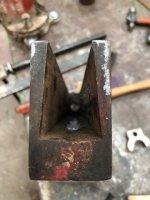
I posted this a couple days ago in the vise repair thread and got no replies so I'm posting here again with pics. As you'll see in the last picture I've moved ahead with a start of a repair kind of aggressively...
Below is a pasted quote of my original post.

Anyone know how the steel slide in a Simplex vise is attached to the active jaw?... I might have discovered the weak point of these vises and why the steel slide isn't an advantage:

It looks as if the active jaw casting has a "key" cast in (with the bore for the screw) that fits a dovetail in the interior of the slide. It may be simply press fit. The action of tightening the vise levers the active jaw away from the passive, the force of rotation tending to bend the slide down and resisted only by the cast key in that dovetail. The key on mine appears to be broken about half way from the end and the slide bent at that point. I'm trying to figure if there's any reasonable fix or if it's junk...


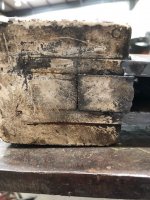
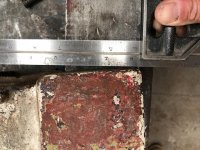
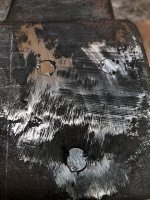
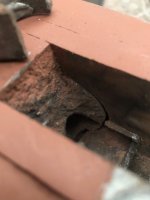
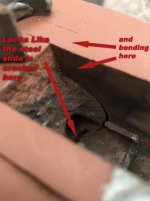
In the first couple of pictures you can see the deflection in the slide and the point where the casting is broken. What you don't see is that under a load it keeps moving- that is the active jaw keeps rotating away from the work. I might have located a pin about 3/16" in diameter that holds the slide in place, but if so, the active jaw is either rotating around it, or it's broken.

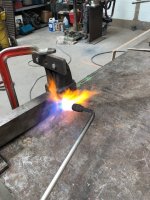
My first attempt toward getting it back was to cut a couple of spacers which I placed below the screw between the active and passive jaws and tightened against them as much as I could without bending the handle. Did some but not enough. With heat I got the deflection down from about 3/16" to about a 32nd over a foot which I think is acceptable.

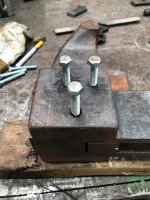
I've decided against trying to remove the slide so now that it is close to straight unstressed, I plan to drill and tap several pins to keep the jaw casting from moving against the slide.
Tell me why that's a terrible idea.
 

Attachments

  • IMG_3420.jpg
    IMG_3420.jpg
    76.6 KB · Views: 86
  • IMG_3429.jpg
    IMG_3429.jpg
    123.8 KB · Views: 81
  • IMG_3425.jpg
    IMG_3425.jpg
    127.5 KB · Views: 74
  • IMG_3424.jpg
    IMG_3424.jpg
    130.9 KB · Views: 74
  • IMG_3423.jpg
    IMG_3423.jpg
    113.8 KB · Views: 74
  • IMG_3422.jpg
    IMG_3422.jpg
    126.5 KB · Views: 80
  • IMG_3421.jpg
    IMG_3421.jpg
    141.7 KB · Views: 93
To avoid these ads, REGISTER NOW!

BFBOB

Well-known member
Joined
Sep 20, 2011
Messages
5,073
I think I would try brazing it. Get it good and hot in your gas barbecue grill (all GJ'ers have one, right?) AFTER a throuough cleaning degreasing and paint removal, then get it up to brazing temperature with an aceytylene torch. I talked to a machinist about a similar situation on a vise of mine, and he said there are special brazing rods available that are much less viscous than normal and will penetrate small cracks much better. I think you probably want that, not a built-up bead on the surface. Maybe both? Follow up with a normal rod like Oxweld 25, but you want the maximum penetration of the thin stuff for sure. Sorry, I didn't get a rod number for the superflow stuff.
Let cool very slowly.

Following up with pins isn't a bad idea either.

....aaaaannnnd let us know how it went! I have a couple of vises awaiting similar repairs.
 
OP
D

desertforge

Member
Joined
Apr 16, 2019
Messages
10
Location
el paso
Re: Simplex vise slide question and attempted repair UPDATE

BFBOB: You know... I thought about trying to braze it. Brazing is a great repair on cast iron or for joining steel to cast iron, but in my limited experience 50+ year old machine iron is really hard to get clean enough for a good joint. I might have tried brazing if I'd been confident I could get the slide out of the casting and put it back. I might still if the pins fail...
See below:

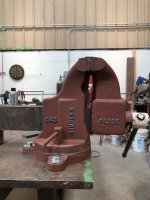
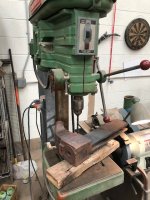
I ended up chemically stripping the whole thing and then heating everything except the bottom swivel plate to get them good and clean. Then I drilled and tapped six 3/8" - 16 holes (I thought about going up to 1/2"-13 but in the end decided to leave more land around all the holes.) I put six bolts in with loctite and then cut them off flush. For good measure I put a couple center marks around the perimeter of each to keep them from spinning. Red oxide primer works for me. And nickel anti-seize lube to put it all back together.

So far I like it. I've torqued it pretty well but only time will tell. Seems good for a daily driver. I'd still like to know how that slide is put together if anyone knows.
 

Attachments

  • IMG_3448.jpg
    IMG_3448.jpg
    94.4 KB · Views: 70
  • IMG_3447.jpg
    IMG_3447.jpg
    89.1 KB · Views: 72
  • IMG_3441.jpg
    IMG_3441.jpg
    124.2 KB · Views: 62
  • IMG_3440.jpg
    IMG_3440.jpg
    140.5 KB · Views: 62
  • IMG_3439.jpg
    IMG_3439.jpg
    108 KB · Views: 66
  • IMG_3435.jpg
    IMG_3435.jpg
    119.7 KB · Views: 60

ganymede

Well-known member
Joined
Nov 29, 2012
Messages
2,332
Location
New England
Looks like a great repair !
Somewhere on garage journal there's a pic of an old simplex catalog .
Its got a ghost view of the slide and if I remember there's what looks
Like a big round disc/pin on either side that goes through where both parts meet.
Yours is a combo model so its more vulnerable to being bent like it was.
Still must have taken a lot of force though.
 

Fierljeppen

Well-known member
Joined
Jan 26, 2018
Messages
1,159
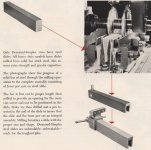
I don't have any first-hand knowledge with your vise, but I do have some cutaway drawings that may help.

Real nice job on providing quality photos!


attachment.php

attachment.php
 

Attachments

  • 1952_desmond_simplex-04_GJ.jpg
    1952_desmond_simplex-04_GJ.jpg
    101.3 KB · Views: 217
  • 1952_desmond_simplex-05_GJ.jpg
    1952_desmond_simplex-05_GJ.jpg
    121.9 KB · Views: 214
OP
D

desertforge

Member
Joined
Apr 16, 2019
Messages
10
Location
el paso
Wow! Thanks Fierljeppen! That's really cool. Looks stouter than I'd have guessed from the condition mine was in. Mine's a little different I'm sure, and as ganymede noted, the pipe jaws make it taller and more vulnerable. Makes me wonder if my repair is stout enough. But if that's a big cast pin as I read the picture, the bore for the screw would have to go right through it which would relieve a considerable portion of its mass.

Really like how the pic shows them set up to mill one side of two at a time. So cool. Thanks again.
 
OP
D

desertforge

Member
Joined
Apr 16, 2019
Messages
10
Location
el paso
@Fierljeppen: side note - did you see the fixed base swivel jaw 4 1/2" for sale on MKE craigslist? (I've got family around there so I keep tabs from time to time on what's available.)
 
To avoid these ads, REGISTER NOW!

2oolhound

Well-known member
Joined
Dec 18, 2010
Messages
5,918
Location
BC Canada
It looks like one pin from the top and would it be 2 separate wide diameter buttons inserted from each side?

Is the broken off part of your 1/2 nut still stuck in there?

Nice vise.
 
OP
D

desertforge

Member
Joined
Apr 16, 2019
Messages
10
Location
el paso
So that was a complete failure. That is, the repair I made didn't fail but it failed to address the problem which is worse than I had guessed.

The vise handle still feels as if it could turn forever. The front jaw still racks out of parallel and the deflection in the slide is back without much force. Based on the catalog page posted above and what I saw when I removed the broken chunk inside the slide, I believe the steel slide is actually broken through the meat at the top in the space where those large buttons are cast in.

As the catalog page above says, "...complete jaw assembly consisting of front jaw cast on steel slide." The front jaw is actually cast onto the steel slide with cast iron partially filling the void in the hollow of the slide giving mechanical strength by physically locking the jaw to the dovetail of the slide and creating the large diameter "pins" with the casting filling the holes machined in the sides of the slide. Of course, it's also completely unserviceable. I had a hard time believing that when I read the page and I read it differently, but I see now that the simplest reading of the sentence is correct. "Cast onto.." Also, the large diameter holes in the slide apparently makes a weak spot by thinning the thickest part of the slide, where mine has sheared. You have to imagine it for now, but to visualize, it will be as if there is a "v" crack in the sides of the slide that's open above the large diameter pins, the thickest part of the slide having sheared open. That's the only explanation I have for how such little force could bend the slide, and it makes sense since I can now see the hole in the slide through which the pins are cast and the opening gap at their edge.

So it goes. Brazing may still be an option but I expect it's junk, barring an awful lot of work which I might start to undertake just to see. I'm considering drilling and grinding out the cast pins to see the crack, but it would remove a lot of material from the cheeks of the jaw. Of course, it's junk as it is, so nothing to lose.
 

Attachments

  • IMG_3468.jpg
    IMG_3468.jpg
    75.6 KB · Views: 36
  • IMG_3469.jpg
    IMG_3469.jpg
    80 KB · Views: 32

2oolhound

Well-known member
Joined
Dec 18, 2010
Messages
5,918
Location
BC Canada
****, I thought the main nut was broken and that is what the broken piece wedged into the slide was.

I'm no welder but I suppose it could be ni-rodded almost everywhere except the bottom flat where it slides.

If you could get the slide out of the casting it could be cut down and new holes drilled.

attachment.php


Or am I wrong and that is just some cast that's broken away? The slide is quite thick on the top.

If you do gouge out those cast buttons new buttons could be made by taking 3/4" or 1" plate the same form size as the cheeks then turning them to create a button for 1/2 the thickness. These steel plates would have a button pin on one side and could be through bolted on each side against the cheeks. They could be drilled through and bolted together sandwiching the cast between them. You would have to grind off the word "slide" on one cheek.

I know this may not be worth that much work but it still beats watching tv.
 

Attachments

  • simplex.jpg
    simplex.jpg
    27.7 KB · Views: 138
OP
D

desertforge

Member
Joined
Apr 16, 2019
Messages
10
Location
el paso
I think you're on the right track. The break you've indicated in the picture is actually part of the casting but I believe the slide is also cracked in the same general vicinity beyond the casting we see. I can't get that part of the casting out yet even though it's broken because it's keyed into the hole in the slide.
As for potential repairs, I'm a decent welder, for an ornamental/miscellaneous guy. The weld surface for Ni rod would be the vertical edges on either side and the bottom outsides, but I'd expect that without repairing the slide that would be fragile as Ni rod tends brittle. Brazing would be the same with some possible capillary type draw if the mating surfaces could be well enough cleaned.
Removing the slide to either repair or shorten it would involve drilling and grinding out those big cast pins in the cheeks but also drilling out the vertical steel pin shown in the cutaway which would involve removing most of what is left of the casting inside the dovetail of the slide, if you follow me.
 

2oolhound

Well-known member
Joined
Dec 18, 2010
Messages
5,918
Location
BC Canada
Yes, I see what you are saying but like you pointed out -it's garbage in it's current state anyway so there is nothing to lose except time and a bit of money for materials. A guy could also fabricate a whole new dynamic jaw welded up from the slide. You'd just have to start with the 2 jaws bolted together to ensure the alignment.
 

dthompson1179

New member
Joined
Apr 18, 2021
Messages
2
Location
RI
Hi Desertforge, I have come across this thread as I have recently inherited the same Simplex vise as you have from my grandfather. The slide and the dynamic jaw have a slight wiggle relative to one another - I came upon this thread looking for a way to disassemble the two hoping to be able to tighten them up and put back together, but I've learned from the images here that the slide and the jaw seem to have been cast in place together and are not to be taken apart. I don't see a visible crack in the underside of mine like you have, so I don't know if its possible that the cast iron and steel sections have just worn against one another over the years, wearing the holes larger/pins smaller to create the wiggle...or what may be more likely is I have a V shaped crack where the slide has cracked at the top and opened up around the cast buttons at the top but the bottom is still intact, so I don't see a visible crack. For right now, i think I will just put in some shim stock between the jaw and the slide to take out the wiggle. But I plan to use this vise regularly so I'm afraid it may only be a matter of time before the crack opens up and I have a bigger problem to fix. This vise has considerable sentimental value so I'd do whatever it takes to fix it when the time comes. Curious to hear if you ever got yours fixed and how you went about it.

Also, I'm having trouble removing my swivel base. On mine the head of the swivel pin is round with two flats on it. I've tried wrenching on best I can but cannot get it to move. Curious to know if you removed your swivel base, and if you found the swivel pin is threaded, press fit, or otherwise.

Thanks
Dan
 

ALTEREGO

Well-known member
Joined
May 15, 2018
Messages
420
Location
@HOME
Hi Desertforge, I have come across this thread as I have recently inherited the same Simplex vise as you have from my grandfather. The slide and the dynamic jaw have a slight wiggle relative to one another - I came upon this thread looking for a way to disassemble the two hoping to be able to tighten them up and put back together, but I've learned from the images here that the slide and the jaw seem to have been cast in place together and are not to be taken apart. I don't see a visible crack in the underside of mine like you have, so I don't know if its possible that the cast iron and steel sections have just worn against one another over the years, wearing the holes larger/pins smaller to create the wiggle...or what may be more likely is I have a V shaped crack where the slide has cracked at the top and opened up around the cast buttons at the top but the bottom is still intact, so I don't see a visible crack. For right now, i think I will just put in some shim stock between the jaw and the slide to take out the wiggle. But I plan to use this vise regularly so I'm afraid it may only be a matter of time before the crack opens up and I have a bigger problem to fix. This vise has considerable sentimental value so I'd do whatever it takes to fix it when the time comes. Curious to hear if you ever got yours fixed and how you went about it.

Also, I'm having trouble removing my swivel base. On mine the head of the swivel pin is round with two flats on it. I've tried wrenching on best I can but cannot get it to move. Curious to know if you removed your swivel base, and if you found the swivel pin is threaded, press fit, or otherwise.

Thanks
Dan
Hi Dan,

Do you have pictures of the swivel pins that you are trying to remove? Do you have pictures of your vise? If I remember correctly (chances are I'm wrong so don't take my advise too seriously) I have the same model vise as the OP and the base is held by a large nut in the middle of the base that unscrews from underneath. You'll need to unscrew the two (my vise only has one) nut locks on the sides of the base and then the middle nut that goes in the middle of the round base. Let me know if I'm understanding your question correctly in regards of the base, not sure about the loose jaw so sad that is an issue, it looks like a such a sturdy vise otherwise!
 
To avoid these ads, REGISTER NOW!
Top Bottom