To avoid these ads, REGISTER NOW!

Singer 591 New Toy

gte718p

Well-known member
Joined
Mar 12, 2009
Messages
3,972
I need to do some repair on my boat cover and sails. After getting a couple of quotes, I decided to take up a new hobby. I picked up a Singer 591 sewing machine.

The problem is I know very little about sewing machines and even less about industrial sewing machines. This thing is a beast. It is amazingly quiet and smooth compared to the home owner machines I am used it. It is also scary fast. Despite my complete lack of knowledge I figure the 1/2 motor is worth the $60 I payed for it.

It was stored outside for a couple of weeks so the particle board table is destroyed. I'm going to have to make a new table as project one. After that I want to do standard preventative maintenance and a tune up before really diving into this. Can anyone point me to a good website for maintenance and tuning of this beast?
 
To avoid these ads, REGISTER NOW!

bpjr

Well-known member
Joined
Sep 2, 2013
Messages
554
Location
Florida east coast
Sounds like you got a deal on a commercial machine. I would recommend finding a sewing machine or fabric shop that gives lessons. Boat canvas is simple stuff after you learn the basics. Learning on your own can be frustrating but is doable. I would try utube and buy a marine canvas book from Sailrite, Lipe or Street. Each has something the others don't but if buying only one book Sailrite is the overall best. Used ones are cheap on ebay. I learned sewing boat canvas years back on my own (no computers, no how to marine canvas books back then) but would do it differently if starting out today.
 

dscheidt

Well-known member
Joined
Apr 26, 2017
Messages
2,888
I need to do some repair on my boat cover and sails. After getting a couple of quotes, I decided to take up a new hobby. I picked up a Singer 591 sewing machine.

The problem is I know very little about sewing machines and even less about industrial sewing machines. This thing is a beast. It is amazingly quiet and smooth compared to the home owner machines I am used it. It is also scary fast. Despite my complete lack of knowledge I figure the 1/2 motor is worth the $60 I payed for it.

It was stored outside for a couple of weeks so the particle board table is destroyed. I'm going to have to make a new table as project one. After that I want to do standard preventative maintenance and a tune up before really diving into this. Can anyone point me to a good website for maintenance and tuning of this beast?

You bought the wrong tool for the job. The 591 is a garment machine, not terribly suitable for sail making. You can make it work, but a heavier compound feed machine will do a better job with less stress (on it and the operator).

Find the manual. it will have the dimensions of the cutout. You can probably buy one cut for less than the material to do it yourself, though. The manual will also tell you how to adjust and time it. Discard the boat anchor clutch motor, install a servo. that will give you much better speed control than clutch motor does, even if the clutch isn't worn out.
 

bpjr

Well-known member
Joined
Sep 2, 2013
Messages
554
Location
Florida east coast
I don't consider myself an "expert" but can speak from my experience. For a home hobby machine the 591 and standard motor/clutch should do boat canvas and sail repair just fine. As a result of flipping sailboats I started (1975) a marine canvas shop with an industrial pfaff 138 "garment machine" with stand/motor/clutch purchased from a bankrupt sail loft (back in those days the 138 was used in many sail lofts throughout the country). I believe it was actually lighter duty than your 591. It wasn't the "best" for sunbrella or slippery dacron sails but got us through full time sewing quite easily...just at a slower pace. It would do everything from curtains to cushion covers to awnings. The 138 was our primary machine for about 2 yrs until we expanded and needed bigger, faster walking foot machines...heavy duty consews and adlers which were not well suited for delicate sail work. During the early yrs our backup machines were home brew metal gear types and an old 1928 industrial Singer 95-1 purchased from a men's tailor shop...short straight stitchs and no reverse but never the less for garments. All the smaller machines handle up to size v92 bonded dac thread (which was standard in the marine canvas trade). Our larger machines used the bigger v138 thread. Unless you just want to have the latest and greatest electronic gizmos I wouldn't sweat using the 591 or the old fashioned clutch style for home hobby stuff.

Good luck with it.
I sold the shop in 1981 but continued to sew canvas as a boat hobby, however the 95-1 is still with me and has sewn a shxxload of large sailboat awnings (100s of yds of sunbrella with v92 thread). About 15 yrs ago I bought one of the cheap portable china mini walkers and that's my go to machine now.
 

bpjr

Well-known member
Joined
Sep 2, 2013
Messages
554
Location
Florida east coast
find a sail-rite unit and never look back...

Or buy a $300 clone and save $500. Side by side my clone is identical (except for paint color) to the Sailrite. I can add their accessories to my clone but they really aren't enough improvement to make it worthwhile at any price. Sailrite actually cloned the Thompson machine and then overly hype up their modifications to make them sound better. Newbies don't understand the differences and drink the Koolaid. Most everything Sailrite sells can be had for at least 1/2 cost with very little searching too.
 

rlitman

Well-known member
Joined
Oct 18, 2010
Messages
24,589
Location
Long Island
Or buy a $300 clone and save $500. Side by side my clone is identical (except for paint color) to the Sailrite. I can add their accessories to my clone but they really aren't enough improvement to make it worthwhile at any price. Sailrite actually cloned the Thompson machine and then overly hype up their modifications to make them sound better. Newbies don't understand the differences and drink the Koolaid. Most everything Sailrite sells can be had for at least 1/2 cost with very little searching too.

The clones have notoriously bad quality control. and even worse customer support. If you're good with the mechanics of a machine like this, then you can support yourself. If you just want to sew, then a clone may not be such a good choice.
 

1foxracing

Well-known member
Joined
May 14, 2014
Messages
1,086
Location
Tuscarawas Co, Ohio
I was a parachute maker for just under 10 years. If looking at new machines the only choice for me would be Juki. A friend of mine purchased a Sailrite Fabricator and had me set it up for her. For twice the price of Juki DDL-5550N I was totally unimpressed with it and would never recommend one for purchase.
 

bpjr

Well-known member
Joined
Sep 2, 2013
Messages
554
Location
Florida east coast
The clones have notoriously bad quality control. and even worse customer support. If you're good with the mechanics of a machine like this, then you can support yourself. If you just want to sew, then a clone may not be such a good choice.

Maybe I'm wrong but I think the "notoriously bad quality control" is long outdated and more unfounded hype than fact. 99% of the complaints I read are user caused (but they don't know how to operate the machine or sew and blame the machine) and would happen with any machine. Sailrite used to state (I spoke with the founder when looking to purchase a mini walker) they bought the machines offshore, disassembled, reworked the crude castings (essentially polished them for cosmetics) and re-painted them. Now they are selling plastic wheels and locking the machine with their "posi pin" while sewing. Both of these "improvements" are going backwards in my opinion. The lightweight plastic is more sensitive for speed control than the previous heavier steel wheel (but an excellent reason to lead a consumer into buying their heavy Monster Wheel accessory). The lack of a clutch while sewing is what breaks needles and machine parts...it isn't just a release for filling bobbins as they use it. Both of these mods are less user friendly than their previous stock machines. There are unspoken issues with other mods but I won't go there. It appears to me they invent problems that don't exist and make mods to fix them...great marketing tactic. As far as support, I've never needed it but the "clone" mini walkers have been out in numbers since before Sailrite and local sewing machine shops sell and support them. Last time I was in a local shop they had an Alpha Sew on display and parts available...this is local walk in support for $500 less than over the phone support.
 

IndyGarage

Well-known member
Joined
Apr 29, 2010
Messages
9,678
Location
Indy
Sewing machines are something you cannot understand until you've owned one of them.

Drop feed, needle feed, compound feed, walking foot, lockstitch, chainstitch, etc. - virtually all of them are mysterious until you start actually using a machine and understand what the various features do.

There are basically two types of common industrial machines - those high speed ones that are used to sew clothing - mostly two thread, single needle, drop feed machines; and the ones that are used to sew tarps, leather and other heavy materials - commonly called walking foot, or compound feed machines.

Most everything made is a copy or descendant of a few singer models from the first half of the 20th century. The newer machines have more features, but don't really stitch any better than the 50-70 year old machines.

If you are going to stitch many layers of thick materials a walking foot is preferable. Because of the design, the needle and feet feed the material better than a conventional machine.

That said, a conventional industrial machine like a 591 can sew heavy stuff that would destroy a home machine, it just takes more care and effort to make sure the material is feeding properly.
 
Last edited:
OP
G

gte718p

Well-known member
Joined
Mar 12, 2009
Messages
3,972
Cool I learn new stuff all the time. I'm familiar with Sailrite. I thought seriously about buying one of their machines. I did by a bunch of tools and materials from them as they were the cheapest with shipping to Hawaii. However, I could justify the cost of the machine for my level of experience. I had no idea there were clones.

I'm on travel, so I haven't had a chance to work with my machine. However, I'm aware of its limitations as a "garment" machine. It is however 10x the weight and rigidity of a the normal plastic home machine you get at Wally world. Lots of people do Sunbrella with those, thought it tends to destroy machines from what I read. I'm trying to sew 2 -3 layers of sunbrella or canvas and a little webibng. I'm not trying to sew 5 or six layers of leather. For $60 I thing, it will be a fine starter machine.

I probably will convert it to a servo machine. However, the cheapest servo setup I've seen is still 3x what I paid for the machine.

I do have the manual, it doesn't have the cut out dimensions, but it is not rocket science to measure the machine and the old table to make a new one. Next up table and machine tune up.
 

engineer2

Well-known member
Joined
Dec 13, 2009
Messages
11,795
Location
Chicago burbs
What do car upholstery guys use? What about shifter boots that need a dual needle and working in tight areas? Post type?
 

strength_and_power

Well-known member
Joined
Apr 26, 2015
Messages
1,394
What do car upholstery guys use? What about shifter boots that need a dual needle and working in tight areas? Post type?


Juki or Consew walking foot machines are used quite often in automotive upholstery.
A shifter boot would typically require 3 passes, the first joining the two pieces together, visible surfaces facing each other, second pass is with visible surfaces face up, the excess material folded back on itself and a row of stitches ran down using the first seam as a reference to space the stitches away from the original seam. Third pass would be on the other side of the original seam. In some cases, a strip of material may be put behind to give additional strength.
Double top stitch or French seam is what it is called. Most shifter boots would have 2 French seams and 2 standard seams. Ends up being sewn inside out and then turned right side out.

Working in tight spaces and small pieces is like any skilled trade, it takes time to learn and master.

This is an old friend of mine who I would consider beyond a master
https://stitchnbysteve.com/


Sent from my iPhone using Tapatalk
 
Last edited:
OP
G

gte718p

Well-known member
Joined
Mar 12, 2009
Messages
3,972
I've been on travel for two weeks, so not much progress has been made. I finally got home and caught up with the day to day chores that add up when you are gone and got a couple of hours to work on the table.

The old table is stripped and gone. Glued 1/8" melamine to a sheet of 3/4 marine grade plywood and cut/routed the hole. Turns out I can't cut straight with a jig saw so the gap is a little big and wavy in the back, but it will work.

The machine is in, but I need a bunch of new hardware to get everything mounted. Looking forward to using this machine.
 

Attachments

  • IMG_1477.jpg
    IMG_1477.jpg
    151.9 KB · Views: 95
  • IMG_1475.jpg
    IMG_1475.jpg
    151.7 KB · Views: 63
Last edited:
To avoid these ads, REGISTER NOW!

bpjr

Well-known member
Joined
Sep 2, 2013
Messages
554
Location
Florida east coast
Looks good. The bobbin winder is a real plus compared to winding on the machine. I don't see a drip guard, if not you may want to consider adding one to keep machine oil off your legs and feet. A simple one can be made by sewing multiple layers of cloth together and tacking two sides under the cut out. It can drape down and be open on the other two sides.

Keep us posted.

Hey, I just noticed that looks like a surfboard shaping room and surfboards or something in the back ground. What type sewing are you doing? I used to work in the surfboard industry here in FL back when I was a teen...
 
Last edited:
OP
G

gte718p

Well-known member
Joined
Mar 12, 2009
Messages
3,972
Hey, I just noticed that looks like a surfboard shaping room and surfboards or something in the back ground. What type sewing are you doing? I used to work in the surfboard industry here in FL back when I was a teen...

It is just my car port. The back ground is a collection of paddle boards and sailing paraphernalia. I do a lot of board repair in the garage but no shaping. That is something I want to try at some point, but to many hobbies right now.

I'm getting into this to do repair on may sail boat. The most important thing is it needs new covers. Because it is a none standard boat, no one has templates, so it is huge money. I also have some sail repair/customization that I want to do.
 
OP
G

gte718p

Well-known member
Joined
Mar 12, 2009
Messages
3,972
Table is done and everything works. Not my finest work, but it will work.

It took a long time to get the tension and timing dialed in. I'm sure that was entirely my lack of experience. I started out without enough needle tension and wrapped the needle string around the bobbin thing a couple of times. That was a mess.

Now that is dialed in, the 591 is a beast. It makes quick work of webbing and sunbrella. Didn't hesitate doing 5 and six layers of webbing. If I stick with this, I think I definitely want the servo. This thing is fast, and slipping the clutch is definitely a skill. I'll do good for a 15-20 minutes, then I will put just a little to much pressure on the pedal and it takes off.
 

Attachments

  • IMG_1489.jpg
    IMG_1489.jpg
    115.4 KB · Views: 59
  • IMG_1490.jpg
    IMG_1490.jpg
    156.1 KB · Views: 59
Last edited:

Lassen Forge

Well-known member
Joined
Apr 26, 2014
Messages
15,077
Location
The romantic hills of central Umbria, Italy,
Hardwood (oak) plywood makes a great tabletop for your machine. You whould sand it smooth as glass and finish it, but it will last years (if not decades).

Learn the machine. Find the maintenance diagram for it, hopefully the operators manual - most are on line. Start EASY - that machine will run stitches through your finger (bone and all) faster than you can say Jack Robinson... actually, faster than you can say "Jac"...

NEVER let your thoughts drift. I know it sounds :supergay:, but take a sewing class or 3. LEARN how to run that beast safely, and how to put cloth together so it stays together, and does what you want. Won't take much, but you need to know what you're doing.

Someone once said Sewing is like Sheetmetal (and vice versa) and in a way it's really true. Go to a fabric or hobby store, buy a few yards of medium weight cotton (or light canvas) to practice on, so if and when you're doing Leather or Naugha, you don't turn it into ruined swiss cheese.

All in all have fun!
 
OP
G

gte718p

Well-known member
Joined
Mar 12, 2009
Messages
3,972
Project two complete. Covers for the Big Green Eggs. I didn't take pictures of the boat cover I bought the machine to do. I did a couple of patches and replaced one big section. It came out really well, and I saved almost a $1000. Win.

I doubt anyone will be surprised, sewing is easy but doing the layout and and measuring to get everything prepared to sew is an art form. 90% of the work is in the prep. Turns out to be pretty much the same as woodworking and metal work.

All of my corners don't line up perfectly as I didn't spend enough time on the measuring. I'm getting better.

attachment.php
 

Attachments

  • IMG_1591.jpg
    IMG_1591.jpg
    150.1 KB · Views: 245

bpjr

Well-known member
Joined
Sep 2, 2013
Messages
554
Location
Florida east coast
Nice to see you have it working. Needle choice, correct tension and thread choice are major players in making it easy.

Before you give up on the foot control...I have old style foot controllers and they get "on/off" when the electrical contacts get dirty. The insides are a ceramic base with wires and a metal slider from the pedal. I take the covers off and spray the contacts with electronic contact spray. When clean it makes a world of difference for feathering speed up or down.
 
OP
G

gte718p

Well-known member
Joined
Mar 12, 2009
Messages
3,972
Nice to see you have it working. Needle choice, correct tension and thread choice are major players in making it easy.

Before you give up on the foot control...I have old style foot controllers and they get "on/off" when the electrical contacts get dirty. The insides are a ceramic base with wires and a metal slider from the pedal. I take the covers off and spray the contacts with electronic contact spray. When clean it makes a world of difference for feathering speed up or down.

The 591 is has an industrial clutch. No contacts. You basically slip the clutch to make it go slow. When it fully engages, the machine takes off. I'm actually getting much better and starting to like it.
 

bpjr

Well-known member
Joined
Sep 2, 2013
Messages
554
Location
Florida east coast
The 591 is has an industrial clutch. No contacts. You basically slip the clutch to make it go slow. When it fully engages, the machine takes off. I'm actually getting much better and starting to like it.

Yep, I had a senior moment on your clutch. I was thinking about my mini-walker's foot pedal instead of my Singer with the clutch like yours. Sorry.
 
OP
G

gte718p

Well-known member
Joined
Mar 12, 2009
Messages
3,972
I upgrade, down grade, or maybe made a lateral move with the Singer. I trade out the clutch motor for a servo. It is just a cheap $99 Consew Conversion available on Amazon. No instructions, but everything bolts right up, and the connections were obvious.

On the left, the new 3/4 HP Chinese servo motor. On the right the 1/2 HP clutched Japaneses motor. Who do you think is lying?

attachment.php


I definitely lost some power, and the controls are CHEAP. However, I really really like it. It is so much easier to control. Top speed is a little less, but you can dial it way way down. The potentiometer is vastly superior to slipping the clutch for speed control.

I did an hour or two of work on my boat cover. Short test, but so far it survived.
 

Attachments

  • IMG_1635.jpg
    IMG_1635.jpg
    150.2 KB · Views: 202
Last edited:
OP
G

gte718p

Well-known member
Joined
Mar 12, 2009
Messages
3,972
It has been almost a year on the new servo motor. It is still going strong. I highly recommend the upgrade. Slowing down the machine makes it 100x more manageable.

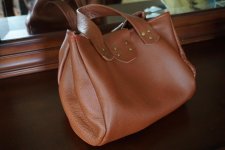
I ended up buying a cow hide of upholstery grade whole grain leather on ebay. I have done several bags for the wife, a chair and a wallet. The 591 eats it up. I have found the limit is 5 layers of leather.

In addition to the leather work, I have recovered the patio cushions with left over sunbrella, repaired my work pants a few times, and made several equipment covers and storage bags from an old sail.

If you don't have a good sewing machine, I can't recommend it enough. I really thought this was a one off to save money on my boat cover, but it contentiously proves itself useful.
 
OP
G

gte718p

Well-known member
Joined
Mar 12, 2009
Messages
3,972
attachment.php


attachment.php


attachment.php


I'm not at the level of lots of folks here, but I'm pretty happy. Both of the bags where made to order to dimensions my wife wanted and she is very happy.
 

Attachments

  • DSC00050.jpg
    DSC00050.jpg
    118.6 KB · Views: 183
  • DSC00051.jpg
    DSC00051.jpg
    102 KB · Views: 184
  • DSC00052.jpg
    DSC00052.jpg
    53.1 KB · Views: 184

bpjr

Well-known member
Joined
Sep 2, 2013
Messages
554
Location
Florida east coast
It has been almost a year on the new servo mo tor. It is still going strong. I highly recommend the upgrade. Slowing down the machine makes it 100x more manageable.

I ended up buying a cow hide of upholstery grade whole grain leather on ebay. I have done several bags for the wife, a chair and a wallet. The 591 eats it up. I have found the limit is 5 layers of leather.

In addition to the leather work, I have recovered the patio cushions with left over sunbrella, repaired my work pants a few times, and made several equipment covers and storage bags from an old sail.

If you don't have a good sewing machine, I can't recommend it enough. I really thought this was a one off to save money on my boat cover, but it contentiously proves itself useful.

Thanks for the update. It looks like you are learning the ins and outs of sewing. If that electronic control gives up on you I'd try that clutch/motor again. Small linkage adjustment make a big difference on feeling feathering and speed control. If memory is right, pulley size can also be changed to help. I've never noted difficulty with clutches in that regard.
 
OP
G

gte718p

Well-known member
Joined
Mar 12, 2009
Messages
3,972
Thanks for the update. It looks like you are learning the ins and outs of sewing. If that electronic control gives up on you I'd try that clutch/motor again. Small linkage adjustment make a big difference on feeling feathering and speed control. If memory is right, pulley size can also be changed to help. I've never noted difficulty with clutches in that regard.

I did save the original motor in case I ever want/need to switch back.

It has been 6 months, since my last post in this thread. I still absolutely love having this beast of a machine. It is kind of reminding me of having a lathe. I wanted one for a long time. I finally bought one when a specific project pushed me into needing it. Once I had a lathe, it seemed always to be in use.

Unfortunately I’m moving overseas and the sewing machine is in storage for a few years. It will be missed. I do think when I come back I’m going to pick up a knock off sail rite to be able to do zig zag stitches.
 

IndyGarage

Well-known member
Joined
Apr 29, 2010
Messages
9,678
Location
Indy
I use my sewing machines all the time. I have my big Pfaff walking foot for heavy stuff - leather, canvas, vinyl. I bought a cheap Brother 4 thread serger for finishing edges on cloth - amazing machine for $200. I have an old singer 66 that I bought rusty and locked up out of a junk pile - I fixed it up and it sews cloth perfectly - very nice stitches. I bought a cheap blind stitch machine to hem my pants - it works great - I have short stubby legs and a long torso, I have to hem all my pants.


I love the precision of nice machines. May not seem manly, but it's a great skill - I'm sewing some boat seats right now.
 

Crow Horse

Well-known member
Joined
Dec 22, 2011
Messages
312
Location
Southern Tier, NY
I loved using my sewing machine and miss it as it's in storage currently. It's a Singer 251 and I've used it to make tow straps and various other kinds of gear.
 

Attachments

  • Singer 251-12 006.jpg
    Singer 251-12 006.jpg
    127.8 KB · Views: 23
OP
G

gte718p

Well-known member
Joined
Mar 12, 2009
Messages
3,972
I loved using my sewing machine and miss it as it's in storage currently. It's a Singer 251 and I've used it to make tow straps and various other kinds of gear.

That is a good looking beast. I don't know why, but it never dawned on me to put it on wheels. That would be a huge upgrade for me.
 
To avoid these ads, REGISTER NOW!
Top Bottom