To avoid these ads, REGISTER NOW!

Sistering scissor trusses.

3rdgendslmech

Well-known member
Joined
Mar 12, 2017
Messages
499
Location
Maryland
So 4 years ago, when i bought my pole barn kit the MFG didnt offer scissor trusses. And me not knowing that I'd end up doing more side work than I had planned on would end up with a lift. Which dont get me wrong, even though I can't max it out.....is a hell of a lot better than laying under any vehicle on jack stands even if you're on a stool! But it'd be a lot nicer if I could get rid of 2, maybe 3 of the W trusses that are in the way and put in scissor trusses and get the full use of the lift.
My trusses are 4' O/C with 3 horizontal supports attached to the top of the bottom chords. 10 foot walls. The other day I started thinking about the idea of sistering 3 scissor trusses and once they're fastened cutting out the webbing of the traditional trusses. I know it's been talked about before but has anyone ever done something like this. I dont think it would be that hard given they're spaced 4' apart. My plan is support the roof at the 1st and 3rd truss, cut out the webbing and bottom chord to the truss supports. I'm pretty sure I'd have enough room then to hang the new trusses upside down then swing them up and scoot them into place and nail to the existing top chords. Once they're all nailed and tied, cut out the webbing of the 1st and 3rd truss.
Sound like a plan?
 
To avoid these ads, REGISTER NOW!

firebirdparts

Well-known member
Joined
Jun 8, 2016
Messages
10,633
Location
Kingsport, TN
If you can envision doing it, then yes, it’ll work fine, and you already know more than the people who can respond in a forum. It’s pretty simple to a person that’s got some sense. I think it’s all about spacing to do it this way. If the trusses are more than 4 feet tall, then it’s not easy to truly get that roof supported at a distance sufficient to flip a truss over.

your post makes it appear that the 2nd truss disappeared by magic and that solved that problem. You need support from the floor to do that,I think, but may conclude otherwise after looking at how long the purlins really are and deciding it’s not gonna snow.
 

theoldwizard1

Well-known member
Joined
Feb 22, 2011
Messages
43,210
Location
SE MI
If you are serious, you should plan on 2' O.C. Better than 2 trusses nailed together.

2 issues
Making sure you can get the trusses in place.
Use a come-a-long to hold the top of the wall in place before cutting any existing truss. Only remove ONE truss at a time.

In some parts of the country, a non-engineered structural change COULD make you liable for any future structural failures.
 

619DioFan

Well-known member
Joined
Apr 9, 2013
Messages
3,617
Location
San Diego , Ca.
Are you going to build the scissor trusses from scratch ? once you cut the bottom cord and cross pieces from the existing truss are you making that into a scissor truss ( I would ) or just adding collar ties up high ?

I would do this mod if it was me.
 

billconner

Well-known member
Joined
Jul 20, 2021
Messages
6,970
Location
Thousand Islands NYS
I have to disagree on the truss spacing issue. From Hansen Buildings:
"Double trusses provide greater reliability as your probability of having two adjacent trusses having a same ‘weak link’ is small. "

No two trusses are going to be identical and wood will have stronger and weaker points. Sistering them makes sense. Hansen's most common design seems to be sistered trusses every 12', always on posts.
 

56Mark

Well-known member
Joined
Oct 26, 2014
Messages
359
Location
Fall Branch, TN
So 4 years ago, when i bought my pole barn kit the MFG didnt offer scissor trusses. And me not knowing that I'd end up doing more side work than I had planned on would end up with a lift. Which dont get me wrong, even though I can't max it out.....is a hell of a lot better than laying under any vehicle on jack stands even if you're on a stool! But it'd be a lot nicer if I could get rid of 2, maybe 3 of the W trusses that are in the way and put in scissor trusses and get the full use of the lift.
My trusses are 4' O/C with 3 horizontal supports attached to the top of the bottom chords. 10 foot walls. The other day I started thinking about the idea of sistering 3 scissor trusses and once they're fastened cutting out the webbing of the traditional trusses. I know it's been talked about before but has anyone ever done something like this. I dont think it would be that hard given they're spaced 4' apart. My plan is support the roof at the 1st and 3rd truss, cut out the webbing and bottom chord to the truss supports. I'm pretty sure I'd have enough room then to hang the new trusses upside down then swing them up and scoot them into place and nail to the existing top chords. Once they're all nailed and tied, cut out the webbing of the 1st and 3rd truss.
Sound like a plan?
So, at the first truss to be modified, you are going to add a support(s) from the floor all the way to the peak or top cord of the truss to support the roof weight? Then removed the horizontal supports, bottom cord, and webbing of that truss? Then do the same at the 3rd truss to be removed? That way the roof is supported and the walls should not want to spread. Next remove the bottom cord and webbing of the center truss? That way you have 12' of open space to put up the 3 new scissor trusses and sister to the remaining parts of existing trusses, then remove the temporary supports from the floor to the top cords at the 1st and 3rd truss. If that is the plan, it would not bother me at all to do that.

I would want the new trusses to be setting on a support, like maybe a new 2x6 sistered onto the poles under the truss, or a big steel piece of angle bolted through the pole. I would not want to rely just on the nails/screws used to sister to support the vertical load over to the poles. Post pictures when you do it.
 
OP
3

3rdgendslmech

Well-known member
Joined
Mar 12, 2017
Messages
499
Location
Maryland
So, at the first truss to be modified, you are going to add a support(s) from the floor all the way to the peak or top cord of the truss to support the roof weight? Then removed the horizontal supports, bottom cord, and webbing of that truss? Then do the same at the 3rd truss to be removed? That way the roof is supported and the walls should not want to spread. Next remove the bottom cord and webbing of the center truss? That way you have 12' of open space to put up the 3 new scissor trusses and sister to the remaining parts of existing trusses, then remove the temporary supports from the floor to the top cords at the 1st and 3rd truss. If that is the plan, it would not bother me at all to do that.

I would want the new trusses to be setting on a support, like maybe a new 2x6 sistered onto the poles under the truss, or a big steel piece of angle bolted through the pole. I would not want to rely just on the nails/screws used to sister to support the vertical load over to the poles. Post pictures when you do it.
That's exactly my plan Mark. Im gonna take 4 4x4x12s stand them up on the side opposite of the truss that's getting sistered. I'm gonna take some 2x4s and nail the 4 of them together at the bottom so they can't kickout and go anywhere. I think I'm gonna take some heavy duty load straps or some chain and binders to the walls just to keep them from pushing out just in case.
The trusses sit on 2x10s nailed at the tops of the posts.
 

Skooterj

Well-known member
Joined
Mar 11, 2021
Messages
752
Location
Indiana
When I built my house 4 years ago, the truss manufacturer screwed up. My great room was supposed to have scissor trusses running north to south. I was on vacation when the trusses were installed and the roof sheathed. When I got back, the installed trusses, still running north to south, cathedraled? east to west, and only on the front half of the room. I immediately called the truss manufacturer rep I had worked with and sent him pictures. He agreed they had screwed up. He said it would get fixed. I assumed that meant they would rip the roof off and start over. Instead, he had his engineers design the correct scissor trusses to be sistered next to the existing trusses, bolted, nailed to the incorrect trusses, and any cords below the scissor bottom cord cut off. 3 different engineers all signed off on the repair. The truss manufacturer even sent their own crew to install them. My building inspector still threw a fit, but accepted it because of the engineers signing off on it. If I were you, I would defiantly get an engineered solution.
 

billconner

Well-known member
Joined
Jul 20, 2021
Messages
6,970
Location
Thousand Islands NYS
I was going to suggest what skooterj said. Just install a scissor truss adjacent to existing. Heel might have to be a quarter or eight inch shorter to push into position and then shimmed. Ought to fit diagonally in a bay and then pivot to sit on top plate. (needs to pivot centered). Bolt or structural screws. Maybe truss fabricator can provide the engineering.
 
To avoid these ads, REGISTER NOW!
OP
3

3rdgendslmech

Well-known member
Joined
Mar 12, 2017
Messages
499
Location
Maryland
Thanks guys, I'm gonna see if 84 Lumber can provide some information for me. There's a mom and pop lumber yard close to me that I'm gonna hit up also. I'm not in any kind of hurry to rush into this. Graber manufactured the kit, but it kinda went through a 3rd party type deal.
 

WNYflyer

Well-known member
Joined
Sep 13, 2009
Messages
2,120
Location
Lockport, NY
So 4 years ago, when i bought my pole barn kit the MFG didnt offer scissor trusses. And me not knowing that I'd end up doing more side work than I had planned on would end up with a lift. Which dont get me wrong, even though I can't max it out.....is a hell of a lot better than laying under any vehicle on jack stands even if you're on a stool! But it'd be a lot nicer if I could get rid of 2, maybe 3 of the W trusses that are in the way and put in scissor trusses and get the full use of the lift.
My trusses are 4' O/C with 3 horizontal supports attached to the top of the bottom chords. 10 foot walls. The other day I started thinking about the idea of sistering 3 scissor trusses and once they're fastened cutting out the webbing of the traditional trusses. I know it's been talked about before but has anyone ever done something like this. I dont think it would be that hard given they're spaced 4' apart. My plan is support the roof at the 1st and 3rd truss, cut out the webbing and bottom chord to the truss supports. I'm pretty sure I'd have enough room then to hang the new trusses upside down then swing them up and scoot them into place and nail to the existing top chords. Once they're all nailed and tied, cut out the webbing of the 1st and 3rd truss.
Sound like a plan?
Well with not knowing how the building was designed nor the construction details but in all probability the 3 horizontal members attached to the top of the bottom chords are what I call truss bottom chord "bridging" in my world of steel design, in this case of wood design I am assuming they serve the same purpose as in steel design. Go in almost any HD, Lowes, Walmarts, etc. and if you look up you would typically see runs of small steel angle on top of the bottom chords of the steel joists (light trusses). Typically they would run essentially continuously from one end wall to the other and be anchored there. They serve a couple purposes such as adding stability to the trusses/joist during erection and perhaps more importantly they are often required to brace the truss bottom chords from buckling should the bottom chords go into compression if the roof undergoes enough wind uplift to overcome the roof dead (gravity) loads. Whether your building would have enough wind uplift on the roof to cause the truss bottom chords to go into into compression............who knows but need to be aware.

The bottom chord bridging is most likely designed to carry tension only (no compression capacity) thus why it is essentially continuous from one end wall to the other and anchored there. Adding scissors trusses would probably (don't know plan layout) interrupt the continuity of the existing bottom chord bridging and thus the bridging would most likely have to be re-established in some manner. Also the new scissors trusses may also need bottom chord bridging and thus a concern on how to thread those through the existing trusses and anchored properly at their ends.
 
OP
3

3rdgendslmech

Well-known member
Joined
Mar 12, 2017
Messages
499
Location
Maryland
It's a 24x32 post frame pole barn. We don't get a lot of snow in the area of MD where I live ...but then again they could call for a dusting and you get 30 extra inches. I think, the middle truss is nailed to the posts, and the other 2 have truss blocks best I can remember when I built it. 6 months after I completed it, a damn 60 foot tall pine tree fell on top of it and only suffered some smashed gutters, and some wrinkled metal on the roof.
I watched a guy on YouTube do something like this ( he's an engineer btw). Same situation, wanted more head room for a lift. He sistered rafters every for every truss he took out ( they looked like they were 24" o/c, but then added a rafter between the old existing trusses also.
Im thinking about welding some plates and eyelets and using some 3/8 cable with turn buckles to connect the walls and just keep a little tension and leave it permanent.
I'll try to get down there and take some pictures tonight. I had a run of late shifts this week.
 

CraigStu

Well-known member
Joined
May 22, 2014
Messages
4,038
Location
Blacksburg, Va
I just skimmed this thread for the second time and have a question. Your existing trusses are 4ft OC. If you modify just one truss that gives you a little under an 8ft wide area. That is plenty for dang near any vehicle to fit up into. Of course that really narrows down lift location but could it work for you? I am thinking that modding just one truss makes all the structural concerns a bit simpler.
 

Michigan Mike

Well-known member
Joined
Sep 12, 2012
Messages
449
Location
Kalamazoo Mi.
You would probably be good just sistering the one truss and then cutting out anything below the bottom cord of the scissor truss. But this being Garage Journal I would buy three scissor trusses for every truss you wanted to modify set one two foot on each side of the one to be modified and the other sisstered to existing. Over kill but this is Garage Journal.
 

billconner

Well-known member
Joined
Jul 20, 2021
Messages
6,970
Location
Thousand Islands NYS
Speaking to the lower chord bracing, the "3 horizontal supports", I believe x-bracing the bay on either side of the removed ones will take care of that. It will effectively do same thing as the continuous braces. They may not even be necessary after roof is on. Lower chords are in tension and not subject to buckling.

An article I found that supports this: https://www.hansenpolebuildings.com/2013/10/bottom-chord-bracing/
 

WNYflyer

Well-known member
Joined
Sep 13, 2009
Messages
2,120
Location
Lockport, NY
Speaking to the lower chord bracing, the "3 horizontal supports", I believe x-bracing the bay on either side of the removed ones will take care of that. It will effectively do same thing as the continuous braces. They may not even be necessary after roof is on. Lower chords are in tension and not subject to buckling.

An article I found that supports this: https://www.hansenpolebuildings.com/2013/10/bottom-chord-bracing/
"Lower chords are in tension and not subject to buckling" - not necessarily always true. There can be cases where wind uplift overcomes the roof dead loads which ends up putting the truss bottom chords in compression. Don't ask me how I know because I plead the fifth ! :LOL: Of course it all depends on the roof geometry, winds speed, roof dead load, etc. with every building being unique.
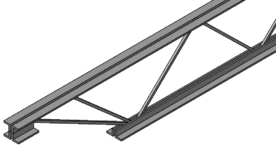
Per your linked Hansen article, "Modern engineered prefabricated roof trusses do take into account and recommend bracing. Oddly, the drawings will specify what appears to be a single 2x lateral brace, on truss spacings greater than 10 feet. Why I say “odd” is because a single 2x brace, of any size, which spans over ten feet, will buckle in the weak direction just like the trusses did."

I take issue with the general statement that a single 2x brace will buckle in the weak direction. I suspect more often than not that the straight row truss bottom bracing/bridging are designed as tension only members. For example say all the truss bottom chords want to buckling to the east then the bottom chord bracing/bridging will be subjected to tension forces heading west and those forces gather heading to the west where the bracing/bridging "should be" anchored substantially at the ends so as to stabilize the truss bottom chords and also to in someway send a majority of that load into the roof diaphragm. Now if the bracing/bridging is interrupted between anchor points at their ends by say a lift then yep, bottom chord truss bracing can be added to act as another anchor point for the remaining straight bracing/bridging. The bottom chord truss bracing essentially is a horizontal truss spanning from side wall to side wall and subjected to the horizontal point loads from the remaining interrupted straight bracing/bridging. Again every building is unique and can be designed appropriately in different ways.
 

billconner

Well-known member
Joined
Jul 20, 2021
Messages
6,970
Location
Thousand Islands NYS
It would seen if the bottom chord of the truss is in compression from wind lifting, the bottom chord bracing is probably in compression. The entire roof structure is collapsing inward at the lower chord elevation as the ridge arches upward.

In any case diagonals at the lower chords in the bays adjacent to where the lines of lower chord bracing is removed should solve it.

In the end, do what the truss designer says.

In steel truss joist buildings I've worked in, probably 100, every structural engineer was clear the lower chord bracing was only for erection and could be removed when roof deck was on. Most contractors disagree because it's extra work, but they can be removed. And on most steel truss joists, the bottom chord does not even extend to walls.

1632609070246.png
 
OP
3

3rdgendslmech

Well-known member
Joined
Mar 12, 2017
Messages
499
Location
Maryland
I just skimmed this thread for the second time and have a question. Your existing trusses are 4ft OC. If you modify just one truss that gives you a little under an 8ft wide area. That is plenty for dang near any vehicle to fit up into. Of course that really narrows down lift location but could it work for you? I am thinking that modding just one truss makes all the structural concerns a bit simpler.
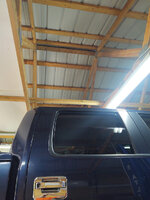
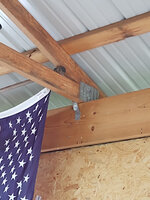
Somewhat yeah. The problem is I dont always work on the same vehicle. Most smaller sedans and sports go up no problem. Then you get into SUVs and trucks and positioning them in different ways. I'm gonna post some pictures I took this afternoon. I've got a co-workers truck up on the lift getting some broken exh studs out. After looking at it, I could probably get away with just removing and modifying 2 trusses.truck on lift.jpgmiddle and truss #3.jpgmiddle and truss #1.jpg
 

Attachments

  • truss #1.jpg
    truss #1.jpg
    32.7 KB · Views: 3
  • truss #3.jpg
    truss #3.jpg
    82.4 KB · Views: 3
To avoid these ads, REGISTER NOW!
Top Bottom