To avoid these ads, REGISTER NOW!

Sizes Above 19mm that are Skippable? Not Common?

AEAdam

Well-known member
Joined
May 27, 2023
Messages
2,788
Location
SE PA
Tools are definitely a better investment than meth, I agree with you there. The engine swap on 1977 Pontiac can be done with just basic SAE size tools. That job would have been much easier and more pleasant with a better kit- cordless impacts, swivel sockets, ratcheting wrenches and such. I had no idea going into it what tools would be needed, just figured I'd use dad's tools. I didn't know what I didn't know. All I really had going for me was determination and the physical flexibility of being young. I could repeat that same job today with the same limited tool selection, but i sure wouldn't want to. After that project was completed, I had a much better idea of what tools we didn't have that we really should have.

Modern cars require a lot more tools, agreed. It's not just convenience either, some of those specialty tools are mandatory. I regularly work my early 2000s BMW, early 2000s GM, my son's C4 Corvette, and more motorcycles than I want to list, so I need all the SAE and all the metric. Last year I had a fairly big job on the BMW and I didn't own any e-torx sockets, so I bought a set of them. I didn't need them for the previous 35 years of wrenching, so I didn't own them up until that point. Stuff like that I buy as needed. I usually have a few days to prepare and with the amount of info that's now at your fingertips, it's easy to know what tools are needed beforehand for most jobs. At my day job we occasionally run into a situation that needs a specific tool we don't have. Mcmaster-Carr, it shows up at 10:30 the next morning. I have the flexibility to work on something else until then.

I now own a fair number of motorcycle specialty tools because I use them. I don't own 1" drive sockets because I don't work on heavy equipment. Let your work guide your tools purchases is what I'm trying to say. OP doesn't know what he needs yet because he doesn't know what he'll be working on. He wants enough tools to be able to work on anything and everything, which I would argue is impossible. Get the basic stuff covered in SAE & Metric, then add as needed.
Love this. Thanks for sharing it.

I have a very similar story. My brother had a rusty 69 Camaro. He sold that, (after I got it running and stopping) and bought a Fiat spyder. He had convertible Fiats until the end of his life. I enjoyed working on them. My first car out of college was a 944S2. I’ve never stopped working on cars. Just slowed a little when my kids were small.

Just finished rebuilding my bridgeport milling machine. Present company excluded, guys on the internet said you can completely tear down and rebuild a bridgeport, with a set of wrenches and a folding set of Allen keys. Yeah, not true. I researched almost every operation and bought the tools needed second hand so I could progress smoothly through the build. I had to Amazon smaller snap ring pliers (and a huge pair). That’s just the way it goes. Can’t think of everything. I think that’s where @oldschoolcraft is coming from. Just trying to cover the basics.
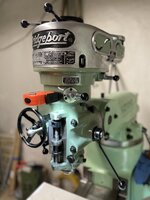
4E45CED7-6BCA-43D3-BDEF-2310CFA83AD9.jpeg
( taken a picture with the motor on I guess)

I’ve tried a couple times to post what I think is a basic automotive tool set. I really don’t have that many tools and really not many specialty tools. And my automotive boxes are 99% metric, and probably could be 100%. (I may have some dead woo, but not much).

My advice to all, before you go bigger, make sure you have 1/4” and 3/8” drives covered. For me that means at a minimum, 6pt shallows and semi deeps, & swivels, at least in 3/8”, Allens, ball Allen’s, torx, swivel torx, triple squares, and possibly stubbies of all. Plus a set of etorx. Then spark plug sockets, axle nut sockets, maybe a set of 12pt 1/2” drive. Then lots and lots of ratchets and extensions.

Too often I see guys’ toolbox tours where they have an entire drawer FULL of 6 and 12pt sockets, metric and SAE, in every drive size and depth. Not sure what car anyone is working on with a kit like that. Their torx are in some case in a lower drawer. Just not my reality. I use torx on every automotive job. On German cars triple squares show up when you least expect them: “Seat bolts! What the…”
 
Last edited:
To avoid these ads, REGISTER NOW!

Shoreline_

Well-known member
Joined
Aug 1, 2022
Messages
1,011
Location
Springfield, MA
I used a 20 mm Crowfoot just today. Had a leaking feed line on an injector on a John Deere tractor. How a 50 year old tractor ended up with metric injectors is beyond me, but the Crowfoot set that I had had a 20 mm in it and it saved the day. Standards were close but were going to round it off and it had a 19 and 21 mm flare wrench but it would have rounded it off before it got tight and stopped the leak.
It was probably a 25/32 wrench in sae. Which exist.
 
OP
O

oldschoolcraft

Well-known member
Joined
Dec 31, 2017
Messages
1,829
Location
Bay Area, California
I'm thinking my strategy might be, to get all Metric up to 24mm and then do every 1/16" SAE with no skips, substitute in equivalent metric sizes if they are cheaper.

22mm and 24mm are pretty close to SAE sizes of 7/8" and 15/16" but since I plan to work mostly on cars, I don't want to screw around with "pretty close" given 22 and 24 are common Metric sizes.

However once you get above that point:

1 1/16" = 27.13mm

1 3/16" = 30.16mm

1 1/4" = 31.75mm pretty close to 32

The only thing I'm not sure of still is if every single 1/16" SAE size from 1" to 2" is used in some capacity in any application, in any industry. I assume probably yes, but it seems odd that Metric skips around what is an industry standard by 3mm+ increments which is 1/8", so why would metric decide they only need to standardize on 1/8" intervals but SAE needs every fastener in 1/16"increments?
 

speed bump

Well-known member
Joined
May 28, 2008
Messages
6,317
Location
Butte Montana
Over 1" I would just say to get everything to 1-1/2 except 1-3/16.

Applications are:
1-1/6 hydraulics or 5/8 heavy hex
1-1/8 hydraulics and 3/4 hardware
1-3/16 place holder Mostly use your 27
1-1/4 plumbing and 3/4 heavy hex
1-5/16 7/8 hardware
1-3/8 plumbing
1-7/16 plumbing and 7/8 heavy hex
1-1/2. 1 inch hardware, primary use will be trailer balls.

I would generally skip 1-1/16 and 1-7/16 if I did it again because they aren't common for the home gamer.
 
OP
O

oldschoolcraft

Well-known member
Joined
Dec 31, 2017
Messages
1,829
Location
Bay Area, California
Over 1" I would just say to get everything to 1-1/2 except 1-3/16.

1-3/16 place holder Mostly use your 27

I would generally skip 1-1/16 and 1-7/16 if I did it again because they aren't common for the home gamer.
Thanks for the detailed info! I will add this to my notes.

Slight correction though, 27mm is 1 1/16"
You could use 30mm for 1 3/16" though.

1 1/16" = 27.13mm
1 3/16" = 30.16mm

As far as plumbing, I asked about using specific open end wrenches for plumbing here in the past and people said plumber just use adjustable wrenches because the fittings lack the tolerance to use a real wrench on. I have no experience there, just repeating what I read.
 

speed bump

Well-known member
Joined
May 28, 2008
Messages
6,317
Location
Butte Montana
Thanks for the detailed info! I will add this to my notes.

Slight correction though, 27mm is 1 1/16"
You could use 30mm for 1 3/16" though.

1 1/16" = 27.13mm
1 3/16" = 30.16mm

As far as plumbing, I asked about using specific open end wrenches for plumbing here in the past and people said plumber just use adjustable wrenches because the fittings lack the tolerance to use a real wrench on. I have no experience there, just repeating what I read.

Good catch.

I am primarily referring to hydraulics with those sizes but they translate across plumbing. For example I was working on a valve block yesterday and the O-ring boss fittings took an 1-1/4", a 1-7/16, and a 1-9/16. Since we were working on a bench next to the tool crib it was easy to grab the sockets. In the field an adjustable probably would have been the tool of choice.
 

steve855

Well-known member
Joined
Dec 30, 2019
Messages
65
Location
PA
The only thing I'm not sure of still is if every single 1/16" SAE size from 1" to 2" is used in some capacity in any application, in any industry.
You're in SF Bay area. If you find out they use 1-13/16" hex head bolts on a snowplow in upstate NY, are you gonna buy that socket just in case? I'd get both 1/2" and 3/4" drive to be safe. Impact and chrome!
Just giving you a hard time.

Ps
@AEAdam nice Bridgeport
 

Blind1

Well-known member
Joined
Mar 8, 2018
Messages
355
Thanks everyone the metric standards seem pretty clear and I'm on board with sticking with 21-22-24-27-30-32

Is there any SAE size standards? Or is everything in 1/16" increments fair game? I dont have any immediate plans to take apart CAT tractors, but who knows. If I wind up finding some dirt cheap high quality tools in like new condition, I'd buy them to keep in storage just in case I get into big boy stuff.

I got the idea from a poster here several years back that found a whole set of like 20 slugging wrenches for like $80. When retail price is $80 each. He had no idea what he'd use them for, but at that price, it's so cheap, it's hard to pass up.

Basically what I'm doing is making a wish list because while it sounds stupid to want tools I may never need, it will save me money in the long run. or so I tell myself. Because when I'm looking at some tools in an estate sale, and they are dirt cheap, if they aren't on my wish list, I can pass.

I've been very tempted by some deals I've seen recently like Snap On combination wrenches for $15 each in like new condition. But I'm not interested in trying to resell them and they dont fit in my collection. So by having a nice wish list, if I see stuff outside of it, I can safely pass on it.

Working on cars? Look up the axle nut sizes for your models.

30mm 12 point for Toyota FWD, 35, 36 are common amongst other brands as well. Otherwise your metric list will cover it.
 

mreisner

Well-known member
Joined
Jun 25, 2019
Messages
913
Location
North of Detroit
It was probably a 25/32 wrench in sae. Which exist.
That would make a lot more sense than metric fittings on a tractor that everything else is standard. I have newer Deere equipment that has both but this is well before that era. The 20 mm was ever so slightly snug, it worked well but a 25-32 probably would be perfect. Now where to find one!
 

Dave455

Well-known member
Joined
Mar 19, 2013
Messages
5,829
Location
Sussex, England
It’s worth re reading the post by AEAdam above.

I was going to make some similar points.

To give an example, I have both wrenches and sockets in 23mm. The reasons for these are historical, but if I was buying new tools I probably wouldn’t bother getting this size. I doubt I will use them again.

What I would do, is ensure I had all the options in the sizes I do use.

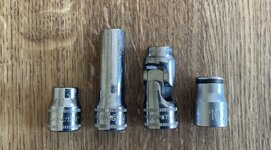
For example, in 10mm, I have shallow sockets, deep sockets, universal, and nut grip, in 3/8“ drive alone.
IMG_0109.jpeg

Much the same in 1/4” drive.
IMG_0110.jpeg

These are top quality sockets too, because you notice the difference more in the smaller sizes.

I also have lower grade tools, because I don’t want to use my best ones on some rusted fastener on a shed door or something.

The key is, leave out the stuff you are unlikely to use, but ensure you have the things you will.

AEAdam makes good points about hex, Torx and E Torx. You will certainly need the former two, possibly the latter.

Again, for what it’s worth, I don’t have anything like a “full” set of E Torx, despite two of my vehicles using them. What I do have, are regular, deep and universal sockets in most of the sizes I do use. Removing one of my starter motors, without a universal E Torx is just about impossible.

I’d certainly want a relatively complete set of male hex and Torx (within sensible range), before acquiring rare sizes of conventional socket.
 
Last edited:

Robinson1

Well-known member
Joined
Jun 22, 2015
Messages
834
Location
Kentucky
If you walk into any store that sells tools you’ll notice most of the metric wrench sets stop at 19mm. By this one could assume that the average person doesn’t commonly use metric tools larger than 19mm. By this same logic one could conclude that having a set of metric wrenches to 19mm will cover most common uses. In other words a “basic” set of metric tools covers to 19mm.

I don’t think the average home gamer will ever use anything bigger than 24mm which is 15/16 in SAE and is a fairly large wrench by most people’s standards.

I’ve got sockets to 36mm and wrenches to 32 mm. Of those tools I’ve only used a handful larger than 19mm. Being totally honest most of the sizes I’ve used larger than 19mm have SAE equivalents.

On the SAE side of things I think my largest socket is a 2-1/8 and my largest wrench is 1-1/2. The average person is never going to encounter anything larger than 1-1/2 and for the average person that’s only going to be found on hitch balls.

I use 15/16, 1-1/8, and 1-5/16 fairly regularly on farm equipment. The average person will probably never work on farm equipment. The fact of the matter is the average person that owns a tractor has a small sub compact usually a Kubota BX or Deere 1 series and I doubt there’s much on those larger than 19mm. As far as that goes there’s not much or a 5 series or 6 series Deere that’s larger than 24mm.

For the average person I feel like having a comprehensive 1/4” drive set is more useful that sizes over 19mm.

I feel like I’m rambling now but my point is the average person is most likely fine stopping at 19mm. What you have to decide is if you’re an average person!
 

honcho

Well-known member
Joined
Feb 2, 2011
Messages
2,304
Location
Near Sodom & Gommorah (aka Wash. DC)
you are from the bay area , that housing market aint never gonna crash , quit screwing around buying **** you are not gonna use and
get yourself a house first , then continue to piss away money on this hobby
I want to know where the OP finds estate sales with good deals on tool truck items. Bay area entrepreneurs dying young and their families clearing out the estate? Techs who cashed in on a good stock tip when the IPO hit and dumped their tools?

I think the OP's approach is reasonable. I try to keep a list of tools I'm looking but I usually end up buying a whole box to get one socket--not a good approach when my long-term goal is to reduce the ballast in my life.
 

545_days

Well-known member
Joined
Oct 30, 2016
Messages
586
Location
Texas
I like having no skips, but quite frankly, if I'm only going to use a socket once in a blue moon, an off-brand socket from Taiwan can be here in a day or two from Amazon.

I will also add that a 1-1/16" socket fits the anode rod on many RV water heaters. I use one to winterize my RV every year.
 
Last edited:

mikey03

Well-known member
Joined
May 17, 2024
Messages
2,156
20, 22, 23mm are practically pointless. Skipped on most wrench sets. I've bought most of the smaller increments above 1" one at a time as i needed them. Same can be said for a lot of tools actually.
22 is common for oxygen sensors I used a xl double box wrench 22 x 24 to change some sensors earlier this year. It worked real sweet and came right off.
 

rancherbill

Well-known member
Joined
Oct 18, 2007
Messages
5,335
Location
Foothills County, Alberta, Canada
I inevitably did not have the right size and went to CT or NAPA and got screwed. I watched the flyers at PA and bought both an imperial and metric kit. Each kit was about 70% of the price of an individual socket. I am set for life on sockets, now I am waiting for energy and ambition to go on sale. - I'll go get some.
 

ecotec

Well-known member
Joined
Oct 5, 2010
Messages
5,469
Don't forget the 69 mm impact socket. Sure, you won't use it, but it'll be a conversation piece. :ROFLMAO:


I would buy one, if I found it at an estate sale. Any wheel bearing locknut that it is made for could be removed other ways.
 

SwissMetric

Well-known member
Joined
Dec 28, 2024
Messages
186
Location
Switzerland
At the end of the Stahlwille catalog, both metric and imperial sizes are listed in the same very comprehensive table, there it is easy to see which values can be compatible. It also includes the corresponding thread diameters according to various standards.
Google can be used to find the PDF catalog (one PDF per language, English is currently still the 2020/2021 edition).
In some cases, depending on the random tolerance mix of the tool and the nut or bolt, a tigher match can be possible using the "wrong" tool (i.e. metric vs. imperial).

The problem is that sooner or later the skipped size will be required. Murphy's Law.

The oddest required sizes I know are for some Pg cable glands.
 
To avoid these ads, REGISTER NOW!

AJHD

Well-known member
Joined
Jan 4, 2020
Messages
3,042
Location
AZ
20, 22, 23mm are practically pointless. Skipped on most wrench sets. I've bought most of the smaller increments above 1" one at a time as i needed them. Same can be said for a lot of tools actually.

I agree with 20mm and 23mm, but 22mm is a common size.

Most oxygen sensors use 22mm (7/8") and the brake caliper bracket bolts on my Nissan use 22mm, those are just two examples.

I would never skip 22mm (or 21mm), and if my primary socket or wrench set that I actually use did skip that size, I would buy it separately. In fact, I have done exactly that on several occasions because most sets stop at 19mm.
 

Semi-hole mechanic

Well-known member
Joined
Feb 2, 2017
Messages
1,024
Have any specific examples? I can't recall using a 23mm wrench or socket.

I'd say for automotive 21mm, 22mm and 24mm I think is the largest I use, aside from common axle nut sizes. Not even sure the last time I used a 24mm.

Also unsure of the fastener size when using a pair of pliers or an adjustable wrench. Especially when working on hydraulics. Speaking of which, 30mm and to a lesser extent 36mm were commonly used sizes, at least on Caterpillar.

Can't really speak for SAE. Only sizes I really remember using were 1", 1-1/4" and 1-1/2" working on CAT.

When you get above 30mm wrenches get very large and sockets get heavy.
You need a 24mm wrench to put tension on the intake cam on a GM 1.4L when relieving tension on the timing chain. A 15/16” is close enough however.
 

Semi-hole mechanic

Well-known member
Joined
Feb 2, 2017
Messages
1,024
That would make a lot more sense than metric fittings on a tractor that everything else is standard. I have newer Deere equipment that has both but this is well before that era. The 20 mm was ever so slightly snug, it worked well but a 25-32 probably would be perfect. Now where to find one!
I have my dad’s old CMan DOEs and one of the larger wrenches has a 25/32 end, I also have it in a 1/2 drive 12pt socket. Dad farmed from the late 40s to the late 70s with IH equipment, so he had a lot of SAE tools with in 32nds. He was also a Ford guy and old Fords used some hardware in 32nds.
 

ecotec

Well-known member
Joined
Oct 5, 2010
Messages
5,469
I have my dad’s old CMan DOEs and one of the larger wrenches has a 25/32 end, I also have it in a 1/2 drive 12pt socket. Dad farmed from the late 40s to the late 70s with IH equipment, so he had a lot of SAE tools with in 32nds. He was also a Ford guy and old Fords used some hardware in 32nds.

I keep /32nds sockets and wrenches in a drawer with BS and Whitworth sockets and wrenches.
 

SwissMetric

Well-known member
Joined
Dec 28, 2024
Messages
186
Location
Switzerland
There should be standards forcing automotive manufacturers to use standardized parts wherever reasonably possible and not require proprietary tools wherever reasonably possible. Very often OEM parts are used just to annoy everyone. And also require an easy access for parts which will be likely to be replaced. Automotive engineers are a shame for all other (true) engineers!

A 13 mm Allen (INBUS) key required for an oil pan plug (didn't check if 1/2" (12.7 mm) would work). Sorry. And there are zillions of other examples.
 

Semi-hole mechanic

Well-known member
Joined
Feb 2, 2017
Messages
1,024
There should be standards forcing automotive manufacturers to use standardized parts wherever reasonably possible and not require proprietary tools wherever reasonably possible. Very often OEM parts are used just to annoy everyone. And also require an easy access for parts which will be likely to be replaced. Automotive engineers are a shame for all other (true) engineers!

A 13 mm Allen (INBUS) key required for an oil pan plug (didn't check if 1/2" (12.7 mm) would work). Sorry. And there are zillions of other examples.
How about 7mm Allen for brake caliper bolts? Had to buy a single socket at O’Reilly’s because none of my sets (sockets, t-handles, and keys) had a 7. Thanks Mopar.
 

SwissMetric

Well-known member
Joined
Dec 28, 2024
Messages
186
Location
Switzerland
7 mm INHEX (for Allen/INBUS) is not exotic, see the Stahlwille 49/7 (3/8" regular), 1049/7 (3/8" long), 1054/7 (1/2" regular), 2054/7 (1/2" long) and 54KK/7 (1/2" ball end, KK probaly for Kugelkopf or Kurz Kugelkopf). There is also a 1049/9 (9 mm 3/8" long INHEX).
Stahlwille dropped a lot of rarely used sizes, including also full imperial series of sockets and wrenches.

In another topic I posted a pic including a 1054/13 (13 mm 1/2" INHEX), it does not look like on page 145 of the PDF catalog, see page 396 of 399 of the PDF. 1054/13 is also written 1054-13 but best is to use the 8 digit code as there are even a few designation errors with the usual numbering (probably barely known) while the numerical system is univoque.

Also encoding is not always strict, e.g. SG designates a steel grip (Stahlgriff) ratchet while G alone designates a ratchet version with upper cover to reduce dirt ingress. I've even seen a part with a wrong identification stamped on it.

Less known is that Stahlwille manufactured also under an other brand name for a less classy socket line, I'm sure some know what I'm referring to.
 

Semi-hole mechanic

Well-known member
Joined
Feb 2, 2017
Messages
1,024
7 mm INHEX (for Allen/INBUS) is not exotic, see the Stahlwille 49/7 (3/8" regular), 1049/7 (3/8" long), 1054/7 (1/2" regular), 2054/7 (1/2" long) and 54KK/7 (1/2" ball end, KK probaly for Kugelkopf or Kurz Kugelkopf). There is also a 1049/9 (9 mm 3/8" long INHEX).
Stahlwille dropped a lot of rarely used sizes, including also full imperial series of sockets and wrenches.

In another topic I posted a pic including a 1054/13 (13 mm 1/2" INHEX), it does not look like on page 145 of the PDF catalog, see page 396 of 399 of the PDF. 1054/13 is also written 1054-13 but best is to use the 8 digit code as there are even a few designation errors with the usual numbering (probably barely known) while the numerical system is univoque.

Also encoding is not always strict, e.g. SG designates a steel grip (Stahlgriff) ratchet while G alone designates a ratchet version with upper cover to reduce dirt ingress. I've even seen a part with a wrong identification stamped on it.

Less known is that Stahlwille manufactured also under an other brand name for a less classy socket line, I'm sure some know what I'm referring to.
I didn’t say nobody made them, Gearwrench makes them, and whatever brand I bought at O’Reilley’s obviously makes them. My point is that Mopar used an uncommon size on a caliper bolt on Dakotas when they could have easily used a 6 or 8 which are more common and included in most sets. As a matter of fact one of the caliper bolts was an aftermarket with the same threads but with a 8mm head.
 

speed bump

Well-known member
Joined
May 28, 2008
Messages
6,317
Location
Butte Montana
There should be standards forcing automotive manufacturers to use standardized parts wherever reasonably possible and not require proprietary tools wherever reasonably possible. Very often OEM parts are used just to annoy everyone. And also require an easy access for parts which will be likely to be replaced. Automotive engineers are a shame for all other (true) engineers!

A 13 mm Allen (INBUS) key required for an oil pan plug (didn't check if 1/2" (12.7 mm) would work). Sorry. And there are zillions of other examples.

There are those standard's. Also automotive manufacturers use a lot of existing parts whenever they can. Its not like they are out their defining new standards for fasteners, typically someone else comes up with a fastener and says this will solve ** production line problem or give you YY improvement in this application and an engineer says "cool, an off the shelf solution to a problem I had" and then some expert says I can't believe they are using *** ******** they should all be M6 hex bolts with this sensor that cost $5 because this should be fixable in my garage with the tools I bought in 1990.
 

wantedabiggergarage

Member Emeritus
Joined
Feb 25, 2006
Messages
3,897
Location
Independence, MO, USA.
20mm flare nut wrench as we had a lot of fuel filters that used that size (didn't tend to use that size in sockets though).
Years ago, I found some snap-on 12 point crowsfeet in O2 sensor size for a dollar because they had been engraved. Bought them all and gave them to my fellow mechanics. They paid for themselves.
 

Tools4Me

Well-known member
Joined
Jun 22, 2021
Messages
546
A couple people have mentioned 23mm being a worthless size, but I use mine quite often. A couple times for non-automotive repairs, but I also have a Bostitch pass-through socket set that includes 3/8" and 1/2" drive equivalent pass-through sockets that go up to 27mm and 1-1/16" with no skips. The larger 1/2" pass-through sockets and the larger ratcheting box wrench that came with the set are all 23mm hex. I often use my 23mm combo wrench along with a pass-through socket to break a fastener loose, and then switch to the provided ratcheting box wrench to remove it the rest of the way. That setup has been very helpful for jobs like loosening the top nut when replacing the struts on multiple different vehicles.

You never know when an oddball size will pop up. If all you turn are bolts, or if all you work on are cars, a 23mm won't likely be needed because that isn't a standard bolt or nut size, but there are times in life when you need a less common wrench to grab and turn something that isn't a bolt head or a nut, so having complete sets up to 1" and 25mm isn't necessary but I would consider it a goal to work towards if you plan to work on various things here and there for many years.

The attached image is a picture I pulled from the internet, showing the Bostitch pass-through socket set I have.
 

Attachments

  • bostitch-65-piece-pass-through-socket-set.jpg
    bostitch-65-piece-pass-through-socket-set.jpg
    69 KB · Views: 5

ecotec

Well-known member
Joined
Oct 5, 2010
Messages
5,469
31, 33, 35.

I will check tomorrow which ones I actually have. I know that I don’t have those sizes in wrenches.
 

joel63

Well-known member
Joined
Oct 9, 2012
Messages
1,912
Location
Central FL
A couple people have mentioned 23mm being a worthless size, but I use mine quite often. A couple times for non-automotive repairs, but I also have a Bostitch pass-through socket set that includes 3/8" and 1/2" drive equivalent pass-through sockets that go up to 27mm and 1-1/16" with no skips. The larger 1/2" pass-through sockets and the larger ratcheting box wrench that came with the set are all 23mm hex. I often use my 23mm combo wrench along with a pass-through socket to break a fastener loose, and then switch to the provided ratcheting box wrench to remove it the rest of the way. That setup has been very helpful for jobs like loosening the top nut when replacing the struts on multiple different vehicles.

You never know when an oddball size will pop up. If all you turn are bolts, or if all you work on are cars, a 23mm won't likely be needed because that isn't a standard bolt or nut size, but there are times in life when you need a less common wrench to grab and turn something that isn't a bolt head or a nut, so having complete sets up to 1" and 25mm isn't necessary but I would consider it a goal to work towards if you plan to work on various things here and there for many years.

The attached image is a picture I pulled from the internet, showing the Bostitch pass-through socket set I have.

The one time I had to use a 23 mm socket was on was a 2013 Santa Fe PCV valve where the hex of the valve was recessed.
The sizing was dead on 23mm. Probably could have used something else, but the 23 did the job.
Haven't used it since. Just the same I prefer to have complete sets in sockets and wrenches.
 

ecotec

Well-known member
Joined
Oct 5, 2010
Messages
5,469
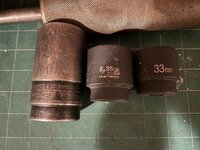
I just looked. In my main drawer I have 33mm and 35mm in shallow 1/2” and 35mm in deep 1/2”. I did not look in my cart or in my 3/4” sockets.

I did not find any 31mm sockets in my main drawer.

I do not remember ever using any of those 3 sizes.

IMG_4762.jpeg
 
Last edited:

LordLupulin

Member
Joined
May 5, 2019
Messages
18
Location
Earth for now
Work on newer German and Italian packaging and processing equipment. Run into 24, 27, 30, 32, 34, 36, 41, 46, and 52 regularly. Sometimes need 28 or 29 for damaged fateners. Equipment from Krones, KHS, Hilge, Netzsch, Comac, Comau, Fanuc, Alfa Laval, GEA Seperators, Thermoline, SEW, and Nord.
 

SwissMetric

Well-known member
Joined
Dec 28, 2024
Messages
186
Location
Switzerland
Pass-through sockets are very useful. I only know the ones from Kraftwerk, Stahlwille never made any and others I didn't check.

Before getting such sockets one should make sure that the corresponding metric or imperial threaded rod can easilypass through. There are some odd designs where the hole is too small which makes the whole concept sort of useless though I don't remember which brands.

A extremely useful tool would also be some hose clip pliers with a long (e.g. 610 mm (24")) Bowden cable, like for example the Stahlwille 10623/2, the Bowden cable is available as spare part. Does someone know who is the original manufacturer, it's made in Germany?
There are many similar tools, sort of a must have.

Also strong magnetic lifters are hand. Good larger ones can be preformed (and keep their form very well), for example the Stahwille 12600/270, 12600/500,12600/1800 and 12600/3000. Thee 2nd number indicates the permanent magnet force in [g] (gramme), just more convenient than using ca. 1/100 [N] as unit. The 270 g model can't really be preformed due to the small diameter. Magnets can be replaced but I never replaced any.
There are also many other manufacturers of course.

Various inspection mirrors are another must-have.

Endoscopic cameras are great but good ones tend to be expensive, can't recommend any as I don't use them often enough. Optical endoscopes can be great but are quite expensive.

I'll post a metric thread diameter coordination list of across flats dimensions in a separate post.
 
To avoid these ads, REGISTER NOW!
Top Bottom