

cbracer
Well-known member
For this comparison, three different manufacturers were selected. SK, Armstrong (similar to Craftsman) and Proto. All three are considered to be under the main top level brands of Snap-On, MAC and MATCO. They can be found online with decent discounts making them more affordable. The sets chosen for comparison were 3/8" deep 12 point. These are the hardest to manufacture, and as such should potentially show the most defects.
Before we begin, a word about detents. The detent is the ball and groove mechanism that keeps the socket on the ratchet. I discovered there are two different sizes of detent balls. The Craftsman ratchets all have small detent balls, while most others are large detent balls. This can create a problem with sockets that have large detent grooves when used on ratchets with a small detent balls. There is a noticeable amount of play as the sockets moves end to end. The opposite situation will always be safe as a small or large detent groove fits tightly with ratchets featuring large detent balls. So this is really only a concern when using Craftsman ratchets.
Note end to end play caused by the detent is different than normal wobble play which all sockets had. Wobble play is at an angle to the axis and most noticeable along the square drive sides. This is also different from rotational play if the square drive is not tight enough. All sockets tested here were relatively tight and very similar for wobble and rotational clearance.
The main reason for chrome is to prevent rust. When the chroming process doesn't go well, small defects exist and rust will grow. Almost all defects occur inside the socket where chrome is more difficult to adhere. When defects are found, most US companies will simply paint the inside to provide rust protection rather than rechrome it as the rest of the world does. Paint can scrape off as steel is harder than the paint itself, and this leads to rust . Sockets that are used often enough will get covered in grease to prevent most rust from forming.
Please excuse the quality of the photos. My full size camera broke and all I had was my point and shoot.
SK in front, Proto in the middle, Armstrong on the back row.


SK

Chrome: Advertised to have the best chrome, the SK set surely didn't have as good of chrome on the outside as the Proto set. It was shinier than the Armstrong, but more inconsistent. One socket had lots of specs in the outer surface. SK chrome was far better at penetrating the inside compared to the Proto.
Paint: Three of the sockets were painted inside, but none in the working surface of the points. 11, 16, 18mm shown in 2nd picture above.
Rust: A couple suffered from rust.


Inside: The smaller sizes suffered most from off-center drilled relief inside the socket. One had a large sliver sticking out inside. It doesn't effect function, but clearly shows lack of consistency in manufacturing. Another socket had the broaching left inside.


Size Markings: All sizes were stamped deep enough to be read easily, though some confusion exists from the other writing between the top and bottom lines/grooves. The SK text was as large as the size, while the part number and USA were slightly smaller. It would be more clear if the SK was smaller like the part number and spaced further away from the size!
Detents: The detents on the SK sockets are small, though some looked too small only because they weren't cut as deep. Detent depths were the most inconsistent of the group. One socket had very small detents, but all of them were there. One socket was nicely chromed in the detent area, but all others featured shavings or flashing left around the cut detent and un-chromed.

Double Blanks: Some sockets are made from the same blank stamping. For example, the 17mm and 18mm have identical outside diameters but used for two different sizes. Not something I like.
Broach Depth: The shortest broaching depth.
Socket Height: Three different heights are found on the SK deep set. From 16mm and up they are equal in length to the Armstrong but shorter than the Proto. Below 16mm the sockets are much shorter.
Problem Sockets going back for warranty:
9mm - broach left inside and not drilled out. Stress lines/cracks inside
10mm - rust in two spots. Large shaving left hanging inside
11mm - lots of pits in the chrome
15mm - rust in a corner of the square drive
Armstrong (Craftsman easy read sockets are made by Armstrong)

Chrome: The chrome is consistent but darker than the others. Many call this a nickle plating or nickel-chrome. The chrome penetrates inside the socket quite nicely.
Paint: None show any signs of paint inside.
Rust: Can be a problem with Armstrong or Craftsman. Some will have rust initially, and likely most will develop rust over time. As proven by my 7 year old Craftsman set. The square drive area is most susceptible.
This picture you can see rust spots, but the camera white balance doesn't shows them as dark spots rather than red spots.

Inside: The 12pt sockets have lots of specs of metal, like sand-paper on the inner sides. Not sure why or how this happens, but they are rough. It seems to be impossible to remove, and if you did then the chrome finish would be compromised. My older Craftsman set has the same sand-paper like finish. Most 6pt sockets seem fine.
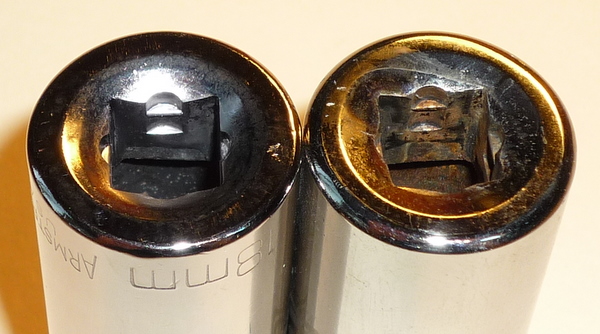
Below is an SK socket on the left showing the shallow broach, and the Armstrong on the right showing the specs of metal.

Size Markings: Armstrong sockets feature the laser etching of sizes clearly on the socket. Sizes are also stamped on the bottom so essentially dual marked and getting the best of both worlds. The stamping on the bottom is not very deep. (Craftsman brand have laser etching or stamping on the bottom, but not both).
Detents: The sockets are cut for a small detent ball, which works equally as well on large and small detent ball ratchets. These are the "double detents" which some dislike and others like. I have no reason to dislike them. All but one fit tightly and perfectly. That one was cut too long and gave more end to end play on rachets with a small detent ball. Large detent ball ratches were better on this problem socket.
Below the Armstrong socket on the left, and a Craftsman on the right which has rusted over the last 7 years of little use.
Double Blanks: None of the sockets share the same blanking size. Shows that Armstrong didn't cut any corners when designing the socket. However the 8mm and 9mm are very very close.
Broach Depth: Armstrong sockets feature the deepest broaching for super long nut retention.
Socket Height: All of the deep sockets have the same length. Very nice. Many companies make smaller ones for smaller sizes to save money.
Problem Sockets going back for warranty:
8mm - slightly taller than the rest but not going back for warranty
14mm - inside covered in rust
15mm - a little rust inside
18mm - specks of rust inside
19mm - detent was cut too long leading to excess play on the rachet
Proto

Chrome: The absolute best chrome on the outside. However, the chrome didn't reach all the way inside or as far as the SK set. The insides were still plated just not chrome.
Paint: None of the sockets had painting inside.
Rust: None of them showed any signs of rust.
Inside: All were clean, and drilled out nicely.
Size Markings: Size engravings are plenty deep enough. Brand, part number and USA are listed in smaller text height. Some sockets had different text size heights compared to others. The sizes are shown directly after the part number and brand which makes them harder to find. More spacing between the size and the part numbers would be a welcomed change!

Detents: Detents were nicely cut, and very similar in size for all the sockets. Two of them were cut too far inside, limiting the ability for the socket to properly lock onto the detent ball of the ratchet. Left one cut too far down.

Double Blanks: Some sockets are made from the same stampings. For example, the 15mm and 16mm have identical outside diameters but are cut for the two different sizes.
Broach Depth: Broaching depth is good, not the most or the least out of the bunch.
Socket Height: Two sizes in length exist, one shorter than the Armstrong, and the other taller than the Armstrong.
Problem Sockets going back for warranty:
15mm - detent cut too far inside, won't lock on some ratchets
19mm - same as above
Conclusion
I will be contacting each company about warranty tomorrow, reporting back how well each one does. Overall I like the Proto sockets the best. There are many brands and I don't have time or money to compare them all. There is a lot of talk about wanting American tools, but to be honest I don't see the quality (Snap-On, MAC, MATCO excluded) currently available from Europe, Japan and even Taiwan.
Before we begin, a word about detents. The detent is the ball and groove mechanism that keeps the socket on the ratchet. I discovered there are two different sizes of detent balls. The Craftsman ratchets all have small detent balls, while most others are large detent balls. This can create a problem with sockets that have large detent grooves when used on ratchets with a small detent balls. There is a noticeable amount of play as the sockets moves end to end. The opposite situation will always be safe as a small or large detent groove fits tightly with ratchets featuring large detent balls. So this is really only a concern when using Craftsman ratchets.
Note end to end play caused by the detent is different than normal wobble play which all sockets had. Wobble play is at an angle to the axis and most noticeable along the square drive sides. This is also different from rotational play if the square drive is not tight enough. All sockets tested here were relatively tight and very similar for wobble and rotational clearance.
The main reason for chrome is to prevent rust. When the chroming process doesn't go well, small defects exist and rust will grow. Almost all defects occur inside the socket where chrome is more difficult to adhere. When defects are found, most US companies will simply paint the inside to provide rust protection rather than rechrome it as the rest of the world does. Paint can scrape off as steel is harder than the paint itself, and this leads to rust . Sockets that are used often enough will get covered in grease to prevent most rust from forming.
Please excuse the quality of the photos. My full size camera broke and all I had was my point and shoot.
SK in front, Proto in the middle, Armstrong on the back row.
SK
Chrome: Advertised to have the best chrome, the SK set surely didn't have as good of chrome on the outside as the Proto set. It was shinier than the Armstrong, but more inconsistent. One socket had lots of specs in the outer surface. SK chrome was far better at penetrating the inside compared to the Proto.
Paint: Three of the sockets were painted inside, but none in the working surface of the points. 11, 16, 18mm shown in 2nd picture above.
Rust: A couple suffered from rust.
Inside: The smaller sizes suffered most from off-center drilled relief inside the socket. One had a large sliver sticking out inside. It doesn't effect function, but clearly shows lack of consistency in manufacturing. Another socket had the broaching left inside.
Size Markings: All sizes were stamped deep enough to be read easily, though some confusion exists from the other writing between the top and bottom lines/grooves. The SK text was as large as the size, while the part number and USA were slightly smaller. It would be more clear if the SK was smaller like the part number and spaced further away from the size!
Detents: The detents on the SK sockets are small, though some looked too small only because they weren't cut as deep. Detent depths were the most inconsistent of the group. One socket had very small detents, but all of them were there. One socket was nicely chromed in the detent area, but all others featured shavings or flashing left around the cut detent and un-chromed.
Double Blanks: Some sockets are made from the same blank stamping. For example, the 17mm and 18mm have identical outside diameters but used for two different sizes. Not something I like.
Broach Depth: The shortest broaching depth.
Socket Height: Three different heights are found on the SK deep set. From 16mm and up they are equal in length to the Armstrong but shorter than the Proto. Below 16mm the sockets are much shorter.
Problem Sockets going back for warranty:
9mm - broach left inside and not drilled out. Stress lines/cracks inside
10mm - rust in two spots. Large shaving left hanging inside
11mm - lots of pits in the chrome
15mm - rust in a corner of the square drive
Armstrong (Craftsman easy read sockets are made by Armstrong)
Chrome: The chrome is consistent but darker than the others. Many call this a nickle plating or nickel-chrome. The chrome penetrates inside the socket quite nicely.
Paint: None show any signs of paint inside.
Rust: Can be a problem with Armstrong or Craftsman. Some will have rust initially, and likely most will develop rust over time. As proven by my 7 year old Craftsman set. The square drive area is most susceptible.
This picture you can see rust spots, but the camera white balance doesn't shows them as dark spots rather than red spots.
Inside: The 12pt sockets have lots of specs of metal, like sand-paper on the inner sides. Not sure why or how this happens, but they are rough. It seems to be impossible to remove, and if you did then the chrome finish would be compromised. My older Craftsman set has the same sand-paper like finish. Most 6pt sockets seem fine.
Below is an SK socket on the left showing the shallow broach, and the Armstrong on the right showing the specs of metal.
Size Markings: Armstrong sockets feature the laser etching of sizes clearly on the socket. Sizes are also stamped on the bottom so essentially dual marked and getting the best of both worlds. The stamping on the bottom is not very deep. (Craftsman brand have laser etching or stamping on the bottom, but not both).
Detents: The sockets are cut for a small detent ball, which works equally as well on large and small detent ball ratchets. These are the "double detents" which some dislike and others like. I have no reason to dislike them. All but one fit tightly and perfectly. That one was cut too long and gave more end to end play on rachets with a small detent ball. Large detent ball ratches were better on this problem socket.
Below the Armstrong socket on the left, and a Craftsman on the right which has rusted over the last 7 years of little use.
Double Blanks: None of the sockets share the same blanking size. Shows that Armstrong didn't cut any corners when designing the socket. However the 8mm and 9mm are very very close.
Broach Depth: Armstrong sockets feature the deepest broaching for super long nut retention.
Socket Height: All of the deep sockets have the same length. Very nice. Many companies make smaller ones for smaller sizes to save money.
Problem Sockets going back for warranty:
8mm - slightly taller than the rest but not going back for warranty
14mm - inside covered in rust
15mm - a little rust inside
18mm - specks of rust inside
19mm - detent was cut too long leading to excess play on the rachet
Proto
Chrome: The absolute best chrome on the outside. However, the chrome didn't reach all the way inside or as far as the SK set. The insides were still plated just not chrome.
Paint: None of the sockets had painting inside.
Rust: None of them showed any signs of rust.
Inside: All were clean, and drilled out nicely.
Size Markings: Size engravings are plenty deep enough. Brand, part number and USA are listed in smaller text height. Some sockets had different text size heights compared to others. The sizes are shown directly after the part number and brand which makes them harder to find. More spacing between the size and the part numbers would be a welcomed change!
Detents: Detents were nicely cut, and very similar in size for all the sockets. Two of them were cut too far inside, limiting the ability for the socket to properly lock onto the detent ball of the ratchet. Left one cut too far down.
Double Blanks: Some sockets are made from the same stampings. For example, the 15mm and 16mm have identical outside diameters but are cut for the two different sizes.
Broach Depth: Broaching depth is good, not the most or the least out of the bunch.
Socket Height: Two sizes in length exist, one shorter than the Armstrong, and the other taller than the Armstrong.
Problem Sockets going back for warranty:
15mm - detent cut too far inside, won't lock on some ratchets
19mm - same as above
Conclusion
I will be contacting each company about warranty tomorrow, reporting back how well each one does. Overall I like the Proto sockets the best. There are many brands and I don't have time or money to compare them all. There is a lot of talk about wanting American tools, but to be honest I don't see the quality (Snap-On, MAC, MATCO excluded) currently available from Europe, Japan and even Taiwan.