To avoid these ads, REGISTER NOW!

Skid Steer Service Ramps

Muckin_Slusher

Well-known member
Joined
Apr 1, 2017
Messages
465
Location
Abitibi
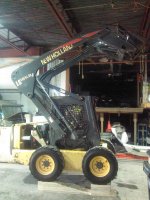
I'd like to have a set of service ramps to park my skid steer on. Right now I've got a small leak and the skid plate removed for inspection but it's a huge pain (and slow) to jack the rear up and crib. If I had a set of ramps I could simply back up onto them (rear wheels), tip the bucket down and insert blocks under the front wheels then.

Not opposed to buying a set, but I had a set of rhino ramps which I managed to crack with a minivan (returned to store for refund). Searching for heavy equipment service ramps doesn't bring up much on google.

Skid steer weighs near 8000 lbs with most of that weight on the back wheels.

I've got a shitload of 12 inch LVL beam rejects. They measure 1 7/8 thick and I think they'd be a good choice for wooden ramps. I know they'll be heavy, but they'll also be sturdy and easy to make.

I'd like these to function for road vehicles as well.

This is what we use at work and they're awesome, but I'm not buying them. Might build these someday.

download.jpg

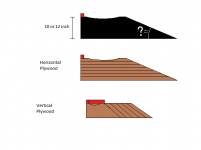
This is what I'm thinking so far:

LVL car ramps.png

This is what searching for homemade car ramps brings up. Seems that most people go with 45-60 degree cuts and steps to avoid making steep 70+ degree cuts on the board ends. Seems to work, but if "steps" were better than a continuous angle then the commercially available ramps would have steps rather than a smooth angle.

009-1-640x480.jpg

Haven't decided on vertical or horizontal plywood. The vertical seems like the pointy part of the plywood would be stronger and it would be far easier to cut the steep angle by making a template then cutting out 10 or 12 pieces before gluing together. I could also drill them and add threaded rod to tie all pieces together.

Horizontal would be easier to make the stair tread style. Probably run the circular saw sideways accross the ramp to make the cove at the top. I could also glue up a solid block then cut the angle from both sides with a circ saw and finish with a sawzall, but this would likely leave a crappy surface that probably wouldn't be flat.

Paint the tops with rhinoliner or sanded paint for traction?
Thinking 12 inches wide to match the skid steer tires and for stability.
Also thinking of adding something to stick out at the point part (like conveyor belt, or 3/4 inch plywood) to prevent the ramps skidding out when first driving on.

I cross posted this on pirate as well.
 
To avoid these ads, REGISTER NOW!

greg13

Well-known member
Joined
Aug 2, 2018
Messages
497
Location
Weedsport, NY
I use a set of truck brake drums. I have had a 650 dozer on them. They are big enough around so they are stable and you will never collapse one. You can't drive up them. But as a stand you can't beat them.
 
Last edited:

matt_i

Well-known member
Joined
Mar 14, 2008
Messages
10,728
Location
SE Michigan
If you have a vertical bandsaw big enough (going to guess a 20" saw for now) you can easily cut the acute angle at the end of the horizontal lamination process.

I'd layout a 15 degree included and see what kind of length that requires.
 

3rdgendslmech

Well-known member
Joined
Mar 12, 2017
Messages
499
Location
Maryland
Stack some pressure treated 2x10 or 12 and drive up.
Also being a heavy equipment mechanic....not sure of the make and model of your skid steer, the bottom plates are mainly for cleaning out when you're pressure washing. If you've got a leak your best bet is to flip the cab up or remove as many access panels you can.
 

Gotcha640

Well-known member
Joined
Jan 27, 2015
Messages
948
Location
Houston TX
Definitely overthinking the strength side, I've parked up to a 5 ton Yale forklift on a stack of 5 2x12s ramps. I couldn't quickly find compressive failure numbers, but think about what would have to happen to (shatter? burst?) a 2x. Nothing that drives around on 4 inch slabs and asphalt and uncompacted dirt is going to have any impact.

Cut like you showed, it's easy to count 1 2 3 4 bumps and stop. I have another set I set up my router sled and machined much closer to a smooth ramp.

It might be a good idea to have a spotter the first time you drive up, to tell you when to stop. That square at the top doesn't feel much different than the 45, and if you've built short, it's easy to drive right over it. I put a BMW on the door sills once. The smooth ramp takes care of that issue (different feeling).
 

Bretny

Well-known member
Joined
Jul 31, 2017
Messages
3,918
Location
Dutchess county NY
I think #2 in your drawing is the best. Lvls could flake off the corners in you run them vertical. I do like the little dip in the middle. These things are going to weigh a literal Ston but thats better than a skid steer on your head. You going to make a set of blocks for the front wheels or just use jack stands once you get the weight off the bucket?
 

doctordirt

Well-known member
Joined
May 15, 2014
Messages
492
I built a set years ago to raise semi tractor high enough to service. Used 2 x 12s placed vertically. Ramps were about 8 feet long. Part of 2x 12 was the wedge then part was a flat area. Used what was cut from wedge as spacers in between full lengh length boards to reduce weight. Works really good. Apologies that Photos are not available, as not at shop this week.
 

575cat

Well-known member
Joined
Dec 18, 2013
Messages
244
I lifted my 8K tracked skid loader on my Triumph 9K hoist , chained of hoist arms to under carriage worked great dropped belly pans to replace hydraulic lines .
 
To avoid these ads, REGISTER NOW!

jblnut

ALLIANCE MEMBER
Joined
Jan 17, 2015
Messages
7,041
Location
In the Middle of MN
I'll see if I can get a picture posted sometime but what we use on the farm is a home build set of ramps made from 2x12's laid flat on each other. If I remember correctly there is 8 stacked up and they're 5'ish long each. We've got a pair of them and use a couple chunks of railroad tie if we need them longer.

We stacked the 2x12's up and screwed them together at both ends and used a chainsaw to cut the ramp in half and cut the angle at the same time. Worked very well. Picture cutting a 30 or so degree miter cut with a chop saw but using a chainsaw instead. I have no idea of the exact angle as we went with what looked good at the time lol.
 

matt_i

Well-known member
Joined
Mar 14, 2008
Messages
10,728
Location
SE Michigan
Just another idea for the ramps, if you make the bottom ply extra long, then the weight on that tire will increase friction and prevent the ramp from skidding forward as the wheel starts up the incline.

I had some quickie built homebrew ramps out of 2x flat stock and tried to drive the front end of a RWD car up on them to change oil and all I did was push the ramps along the asphalt. Eventually I lengthened the bottom ply and blocked against the footing of the shop and it was all good but I couldn't use them out in the center of the drive very well.
 
OP
M

Muckin_Slusher

Well-known member
Joined
Apr 1, 2017
Messages
465
Location
Abitibi
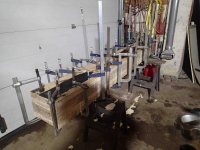
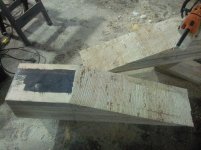
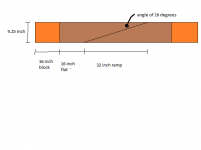
So, seems like the ramps will end up 48 inches long. 16 inch flat spot at the top and 9.25 total height. 5 LVL stacked horizontal. The angle will be a bit less than the rhino ramps, which I know my van will climb. Took half a gallon of yellow glue and all my clamps.

Glued up 8 feet of beam, will use the cutoffs as my cribbing for the front wheels.

If I need more height I can always jack and crib a bit more.

lv ramps 2.png

PB290655.jpg

PB290658.jpg

PB290663.jpg
 
OP
M

Muckin_Slusher

Well-known member
Joined
Apr 1, 2017
Messages
465
Location
Abitibi
I use a set of truck brake drums. I have had a 650 dozer on them. They are big enough around so they are stable and you will never collapse one. You drive up them. But as a stand you can't beat them.

I really, really doubt my skid steer will climb a brake drum on a smooth concrete floor backwards. Sounds like great cribbing though.

If you have a vertical bandsaw big enough (going to guess a 20" saw for now) you can easily cut the acute angle at the end of the horizontal lamination process.

I'd layout a 15 degree included and see what kind of length that requires.

My bandsaw is only a 14 inch and it threw a pulley. Need to fix it first.

Stack some pressure treated 2x10 or 12 and drive up.
Also being a heavy equipment mechanic....not sure of the make and model of your skid steer, the bottom plates are mainly for cleaning out when you're pressure washing. If you've got a leak your best bet is to flip the cab up or remove as many access panels you can.

That's the plan, but I've got LVL beams to use up instead of warping/splitting 2x12s.

I pulled the plates to pressure wash and now I'm chasing a small leak that's driving me nuts. I want to inspect from the bottom to find the hanging drips.

Definitely overthinking the strength side, I've parked up to a 5 ton Yale forklift on a stack of 5 2x12s ramps. I couldn't quickly find compressive failure numbers, but think about what would have to happen to (shatter? burst?) a 2x. Nothing that drives around on 4 inch slabs and asphalt and uncompacted dirt is going to have any impact.

Cut like you showed, it's easy to count 1 2 3 4 bumps and stop. I have another set I set up my router sled and machined much closer to a smooth ramp.

It might be a good idea to have a spotter the first time you drive up, to tell you when to stop. That square at the top doesn't feel much different than the 45, and if you've built short, it's easy to drive right over it. I put a BMW on the door sills once. The smooth ramp takes care of that issue (different feeling).

Haven't built a router sled yet, that would make a perfect surface though.

I think #2 in your drawing is the best. Lvls could flake off the corners in you run them vertical. I do like the little dip in the middle. These things are going to weigh a literal Ston but thats better than a skid steer on your head. You going to make a set of blocks for the front wheels or just use jack stands once you get the weight off the bucket?

I'll use the cutoff sections for the blocks. It'll be nice to have some big chunks of wood for cribbing.

I lifted my 8K tracked skid loader on my Triumph 9K hoist , chained of hoist arms to under carriage worked great dropped belly pans to replace hydraulic lines .

Someday.

I'll see if I can get a picture posted sometime but what we use on the farm is a home build set of ramps made from 2x12's laid flat on each other. If I remember correctly there is 8 stacked up and they're 5'ish long each. We've got a pair of them and use a couple chunks of railroad tie if we need them longer.

We stacked the 2x12's up and screwed them together at both ends and used a chainsaw to cut the ramp in half and cut the angle at the same time. Worked very well. Picture cutting a 30 or so degree miter cut with a chop saw but using a chainsaw instead. I have no idea of the exact angle as we went with what looked good at the time lol.

I'm hoping to start the cuts with the circ saw and finish with a sawzall, but it may yet come to the 2 stroke jig saw.!
 
OP
M

Muckin_Slusher

Well-known member
Joined
Apr 1, 2017
Messages
465
Location
Abitibi
The two-smoke jig saw got the job done.

I cut the blocks off with the hypoid saw, 4 cuts then finished with a sawzall. Did ok. Then I scored both sides with the hypoid saw. It did NOT like those cuts. Tried the sawzall to finish but it just wouldn't happen. Ended up using the Stihl and it worked great.

Got underneith her and already found the source of two leaks.

IMG_20191201_142249.jpg

IMG_20191201_142310.jpg

IMG_20191201_143140.jpg

IMG_20191201_143210.jpg

IMG_20191201_143249.jpg
 
OP
M

Muckin_Slusher

Well-known member
Joined
Apr 1, 2017
Messages
465
Location
Abitibi
Also, if anyone's interested I sorta used Advoko's technique (Russian Youtube guy in the bush). Works well to make straight, plumb cuts.

Video is definetly worth watching. I'm going to try it on a log this winter to see how well I can do it.

 
To avoid these ads, REGISTER NOW!
Top Bottom