To avoid these ads, REGISTER NOW!

Skilsaw 825 restore

yardiron

Well-known member
Joined
Oct 9, 2014
Messages
209
Location
NJ
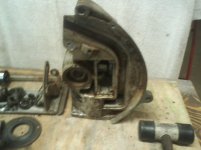
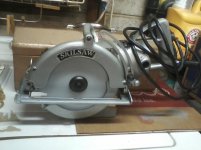
I have a Skilsaw 825 that I'm trying to get apart for a complete overhaul/restore.
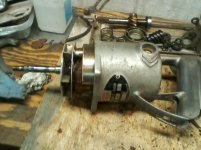
I've got the entire saw torn down except for the armature.
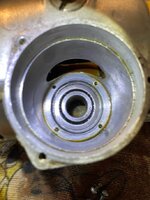
I've got the gear box off the motor housing.

The saw ran, but needed a new cord and it was low on oil.
So far I found the front bearing a bit rough, some expected gear wear, but other wise its not that bad. The blade guard is pitted a bit, but that's fixable.

Keep in mind here that the saw ran. with the gear box off, the armature will barely turn as if the rear bushing or bearing is tight. I removed the brushes, they both look great, as does the commutator.

Has anyone had one of these older saws apart? Its very different than the newer Skilsaws.

Any idea how to remove the armature? Does it have to be pulled out with a puller somehow? I didn't want to force anything and break it, parts for this are likely non existent other than bearings.
 

Attachments

  • 0419200326-02.jpg
    0419200326-02.jpg
    119.2 KB · Views: 67
  • 0419200326-03.jpg
    0419200326-03.jpg
    127 KB · Views: 52
To avoid these ads, REGISTER NOW!
OP
Y

yardiron

Well-known member
Joined
Oct 9, 2014
Messages
209
Location
NJ
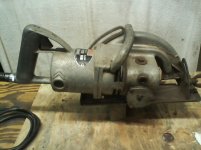
I figured it out. The armature was completely covered in pitch and sawdust, the instant the armature moved forward, it bound up in inside the stator. I ended up softening the mess with some mineral spirits and using a puller to draw the armature out of the housing. I just spent three hours cleaning up the armature, stator and rear housing.

After cleaning the bearings, they all seem fine, some fresh lube, some new gaskets, and some paint and it should be like new again.

The blade guard halves are going to take some work though, both are badly pitted. They appear to be made from a different alloy and I think they were originally chrome plated. I had no clue it was chrome plated till some copper back plating showed up after bead blasting.
 

Attachments

  • 0419201027-00.jpg
    0419201027-00.jpg
    88.2 KB · Views: 62
  • 0419200326-05.jpg
    0419200326-05.jpg
    97.4 KB · Views: 46
  • 0419200326-00.jpg
    0419200326-00.jpg
    83.4 KB · Views: 49
  • 0419200326-01.jpg
    0419200326-01.jpg
    123.4 KB · Views: 53
Last edited:
OP
Y

yardiron

Well-known member
Joined
Oct 9, 2014
Messages
209
Location
NJ
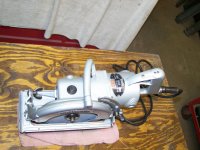
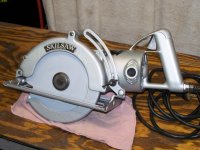
Got it all cleaned up and back together.
It came out better than I expected it to in the end.

The only problem now is that its too clean to use.
(I've got several other newer models though).
 

Attachments

  • F.jpg
    F.jpg
    151.6 KB · Views: 69
  • E.jpg
    E.jpg
    101.8 KB · Views: 59
  • D.jpg
    D.jpg
    149.9 KB · Views: 70
  • C.jpg
    C.jpg
    103.4 KB · Views: 62
  • B.jpg
    B.jpg
    148.7 KB · Views: 81
  • A.jpg
    A.jpg
    115.9 KB · Views: 70
OP
Y

yardiron

Well-known member
Joined
Oct 9, 2014
Messages
209
Location
NJ
Now I guess I have to build it a case.

I think this makes 5 or 6 Skil worm drive saws now.

I got it for free an couldn't bare to see it just sitting on a shelf taking up space in the condition it was in.

Somewhere around here there's a model 77 from the same era, when I come across that one, its getting the same treatment.

Having had this all apart, its hard to tell if this thing was barely used or if these just don't show any wear. The brushes, armature, and gears were all in like new shape, but the blade guards were badly pitted and peeling, the motor was so jammed up with sawdust I had problems getting it apart. It took me 4 hours to scrape the pitch from the inside of the stator and off the armature.
All but one bearing is made by New Departure, with one being from Farina.

The original cord was rotted to the point there was nothing left but the copper wire and a plug.

I think the blade guards were originally chrome since when I glass beaded them they quickly showed a copper layer underneath. Only the blade guards were pitted, the rest of the saw was just dirty.

The paint I used is sort of an aluminum 'dye'. I used to use it for auto restorations to clean up badly stained aluminum intake manifolds. Its super thin, has a little bit of aluminum powder in it, but it doesn't build any thickness and if you make a run, it sort of soaks in. The cans don't even have a label, they're just marked "aluminum recond." I bought like 50 cans of the stuff 25 years ago and have been using it for all sorts of projects.

All of the black bits were glass beaded, polished, and nitride 'blued', like the parts on a gun.
 

Attachments

  • 0421201707-03.jpg
    0421201707-03.jpg
    101.6 KB · Views: 49
OP
Y

yardiron

Well-known member
Joined
Oct 9, 2014
Messages
209
Location
NJ
I made a few cuts with it with a newer blade, its basically a new saw again.

Most of the issues it had were from sitting and neglect. For whatever reason saw dust had built up real bad in the motor area. Strangely enough the fan housing area was pretty clean. The steel plates in the stator were coated with sticky pine sap or tar.
I thought at first it may have been oil and saw dust that hardened up in there but there was nothing around the shaft seals or the fan. It was so bad I thought there was something mechanical holding the armature in place.
I scrubbed the housing in mineral spirits then glass beaded the whole thing to make the finish more uniform.
I couldn't tell if this was put out of service due to the bad cord or the caked up motor, but it was obvious it was sitting for a really long time.

I did find that they never stamped a serial number on this odd. I left both name plates in place and just masked them off for cleaning with vinyl tape.

The 825 is a lot heavier than my newer saws, but a lot. The addition of the shaft stop pin on the newer models is nice, but I suppose that was needed with the addition of a blade clutch versus straight splines.

I've got another one of these to do as well, a buddy gave it to me after seeing this one. So I guess I get to do it all over again. Hopefully the second one is in as nice a shape mechanically as this one was.

Does anyone know if Skil changed the type of oil used in the gear box?
The original oil in these things is thick, it barely flows at all at room temp. but the stuff in the tube from Skil now is very liquid. I bought a couple of tubes of the new stuff at HD, but I had two tubes that my father had bought years ago and never used. The old stuff comes out of the tube the consistency of toothpaste, while the new stuff is more like gear oil. I used the old stuff in the 825, with the thought a thicker lube would be better with the felt seals that saw uses. I was afraid that the felt seals would let the thinner lube weep past the felt over time.
 
OP
Y

yardiron

Well-known member
Joined
Oct 9, 2014
Messages
209
Location
NJ
I should also ad that the original oil in the 825, and in the second saw I just took apart, is more of a yellow/brown color and more the consistency of Vaseline than oil. It flows but only if its warm. At 60 degrees on the bench, it just gave me a few drips. I had to warm the gear case with a hair drier for a few minutes to get it to drain, and even then its going to take an hour to get it all to run out. Its not separated, and the gears are well coated. Even when cold, it offers little resistance to the motor, but its not really oil, more like a runny grease.

I'm thinking that maybe the older saws used a heavier or thicker lube due to the type of seals they had? A buddy of mine said the stuff in the older tubes look like apple butter. Its almost grainy looking as it comes out of the aluminum tube.
The old lube has a slight odor to it, the new stuff is basically odor free. Neither smells like gear oil.

I do see that some other brands call for Mobil SHC 636 gear oil, which I believe is a 75w/90 synthetic gear oil meant for high shear type gear boxes, something that would never have been around in the 40's when these saws were new. I'm wondering if the original lube was a wax based lube? Something other than a petroleum based lube?

Something else that comes to mind is that back in the late 1940's there were no multi weight oils, gear boxes in general often referred to the grade or number oil they required.
Those oils would often have very poor cold weather performance, so if they were to have used 90 grade oil in the gear box, chances are at 32 degrees it would have been more or less a solid. I highly doubt they would chance this in an electrical power tool since cold operation would have likely burned up the motor.

Does anyone have a copy of the original owners manual for one of these from the 40's or early 50's?

I'm probably over thinking this but it makes sense since they likely didn't have the same lubes back then as they do now. The new stuff is probably perfectly fine, but I have my concerns about it leaking past felt seals. I thought about coming up with a rubber seal solution for the old saw but figured that it had survived all these years with felt seals, I wasn't about to re-engineer it now.
 

RTM

Well-known member
Joined
May 13, 2019
Messages
13,157
Location
SF Bay Area
I wonder if something dropped into the motor, then hardened, base on the weird distribution of pitch
 
To avoid these ads, REGISTER NOW!

Bigblockyeti

Banned
Joined
Feb 1, 2018
Messages
2,550
Location
Upstate, SC
I wonder if something dropped into the motor, then hardened, base on the weird distribution of pitch

The factory leather seals work well if they're exercised regularly, otherwise they start to leak and need to be replaced. When they start to leak, the oil mixes with sawdust or worse masonry dust and through several heat cycles can turn into one big mess varying in consistency from oily dirt to almost concrete given enough time. Cleaning behind the blade guard and in the fan housing is always my least favorite part as the gunk seems endless and compressed air, though effective, will make a gigantic mess everywhere.
 

GalaxyRat

Well-known member
Joined
Nov 16, 2018
Messages
386
Location
Florida
I made a few cuts with it with a newer blade, its basically a new saw again.

Most of the issues it had were from sitting and neglect. For whatever reason saw dust had built up real bad in the motor area. Strangely enough the fan housing area was pretty clean. The steel plates in the stator were coated with sticky pine sap or tar.
I thought at first it may have been oil and saw dust that hardened up in there but there was nothing around the shaft seals or the fan. It was so bad I thought there was something mechanical holding the armature in place.
I scrubbed the housing in mineral spirits then glass beaded the whole thing to make the finish more uniform.
I couldn't tell if this was put out of service due to the bad cord or the caked up motor, but it was obvious it was sitting for a really long time.

I did find that they never stamped a serial number on this odd. I left both name plates in place and just masked them off for cleaning with vinyl tape.

The 825 is a lot heavier than my newer saws, but a lot. The addition of the shaft stop pin on the newer models is nice, but I suppose that was needed with the addition of a blade clutch versus straight splines.

I've got another one of these to do as well, a buddy gave it to me after seeing this one. So I guess I get to do it all over again. Hopefully the second one is in as nice a shape mechanically as this one was.

Does anyone know if Skil changed the type of oil used in the gear box?
The original oil in these things is thick, it barely flows at all at room temp. but the stuff in the tube from Skil now is very liquid. I bought a couple of tubes of the new stuff at HD, but I had two tubes that my father had bought years ago and never used. The old stuff comes out of the tube the consistency of toothpaste, while the new stuff is more like gear oil. I used the old stuff in the 825, with the thought a thicker lube would be better with the felt seals that saw uses. I was afraid that the felt seals would let the thinner lube weep past the felt over time.
I would like to add my experience on the original oil topic. When I picked up my blue label 825, it came with a tube of the original oil. The oil was thick and tacky, almost like bar chain oil for a chainsaw. But, it was still runny and would flow freely out of the tube if it was held pointing down. It seemed similar in consistency to the modern oil. The color was dark brown with a green-ish film in the light.

The box mentions the tube contains "Type A" lubricant, maybe they changed it over the years or had different types? 20200404_163811.jpg20200404_163741.jpg

Sent from my SM-G973U using The Garage Journal mobile app
 
OP
Y

yardiron

Well-known member
Joined
Oct 9, 2014
Messages
209
Location
NJ
The gunk I cleaned out of this saw looked like old fashioned roofing tar, the kind that you can break when its hardened or cold.
I did consider the fact that someone may well have dripped some roofing tar on it and just gave up on it. I used a heat gun and a home made wood scraper to clean out the majority of it then I wiped it out with mineral spirits. I was trying to be careful with the windings, or else I'd have just dunked the whole thing in the parts tank.
It came up pretty decent. I cut plastic shields from a washer fluid jug and then sanded the inside of the stator plates clean. I sat there with a tooth pic and a rag and got as much of it out of the wire wraps as I could.

The grease I used was in a similar tube, but where that one is blue, mine was black, and the 'SKIL' logo was done in orange, just as on the saw. I don't recall it saying Type A or 249 on it though, I'll have to see if I can find it in the trash and unroll it.
The other tubes I found were all orange, with white writing, marked "For Skil wormdrive saws" and a short part number. The contents look the same on either type of tube.
The tube I used had a price tag on it of 29¢, along with a hand written sales receipt from a long gone lumber yard here in town dated from June of 1957. The orange tubes are in a plain brown box, its corrogated cardboard with thin interlocking dividers, the box holds 12 tubes, there were four left, plus the one Skil tube.

The Skil lube that I used did have sort of a green/yellow iridescent look to the surface, but it was thick, like pudding. The sheen on it reminded my a bit of old Kendal GT motor oil. It would run, but I suppose if I took a spoon full of it and turned it upside down, it would likely hang there and finally just fall off in a glob. I did shake the tube before opening it trying to see if it was liquid or grease. It was VERY sticky, I put some on my thumb and forefinger and it would string about 2" as I opened my fingers.
The tackiness reminded me of the Wurth Sig 3000 grease I use on my heavy equipment, only much thinner.
The old Skil lube was thin enough that it could be a gear lube, but thick enough that it could also be called grease. Kind of like sticky, brown engine assembly lube.
After it was in the saw and run a bit, it did seem more viscous though.
 
OP
Y

yardiron

Well-known member
Joined
Oct 9, 2014
Messages
209
Location
NJ
The factory leather seals work well if they're exercised regularly, otherwise they start to leak and need to be replaced. When they start to leak, the oil mixes with sawdust or worse masonry dust and through several heat cycles can turn into one big mess varying in consistency from oily dirt to almost concrete given enough time. Cleaning behind the blade guard and in the fan housing is always my least favorite part as the gunk seems endless and compressed air, though effective, will make a gigantic mess everywhere.

The fan area on this one was spotless, all the gunk was in the motor all over the stator and middle of the armature. There was nothing back near the brushes, and nothing on the fan itself or on the gear box side of the fan.
There was some saw dust built up behind the lower blade guard but that cleaned up with some compressed air. How it all got in there didn't make sense, the only openings are around the fan and that area was clean, just barely dusty. The gear box was low on oil but I didn't see any signs of any leaks.
The blade side seals were dry. It did seem to be missing an outer seal between the blade hub and the inner housing. I found a rubber lip seal to put in there that fit snug. I figured that was likely just a seal to keep dust out of the oil seal, sort of a one inward, one outward type of seal arrangement.The inner seal fit super tight to the collar, as did the rear seal. I filled the gear box with light sewing machine oil first to make sure nothing would leak. I had made the gaskets by hand and wanted to make sure they were sealed up. If I had a spare fill plug or front bung, I'd likely make up a pressure test rig for it and use my outboard lower unit pressure test set to make sure it was sealed.

Leather and felt seals like this generally rely on some minimal leakage to stay lubed, so I'm also not sure if a pressure test or vacuum test would work on the older models like this.
 

J_Grasso

Member
Joined
Oct 25, 2020
Messages
5
Location
New York
Now I guess I have to build it a case.

I think this makes 5 or 6 Skil worm drive saws now.

I got it for free an couldn't bare to see it just sitting on a shelf taking up space in the condition it was in.

Somewhere around here there's a model 77 from the same era, when I come across that one, its getting the same treatment.

Having had this all apart, its hard to tell if this thing was barely used or if these just don't show any wear. The brushes, armature, and gears were all in like new shape, but the blade guards were badly pitted and peeling, the motor was so jammed up with sawdust I had problems getting it apart. It took me 4 hours to scrape the pitch from the inside of the stator and off the armature.
All but one bearing is made by New Departure, with one being from Farina.

The original cord was rotted to the point there was nothing left but the copper wire and a plug.

I think the blade guards were originally chrome since when I glass beaded them they quickly showed a copper layer underneath. Only the blade guards were pitted, the rest of the saw was just dirty.

The paint I used is sort of an aluminum 'dye'. I used to use it for auto restorations to clean up badly stained aluminum intake manifolds. Its super thin, has a little bit of aluminum powder in it, but it doesn't build any thickness and if you make a run, it sort of soaks in. The cans don't even have a label, they're just marked "aluminum recond." I bought like 50 cans of the stuff 25 years ago and have been using it for all sorts of projects.

All of the black bits were glass beaded, polished, and nitride 'blued', like the parts on a gun.

Any idea where I can get the cord restraint. I am in the process of rebuilding an old 825, have done everything. I even had to make a new gasket seal for the worm gearbox. I can't seem to find anyplace that even knows what I am talking about when it comes to getting that cord restraint?
 

fixxor

Member
Joined
Nov 3, 2020
Messages
6
Location
ct
Hey YardIron, can you help me? I cant PM you because of the lack of points or whatever...


Hope this doesnt get buried...

I am currently restoring an 825, and have a question about re-assembly.

Thank you for your post on your 825 rebuild by the way. Any info helps.. as there is none available on this unit anywhere..

2 questions actually.

First one is, upon reassembly, i had set aside a small piece of what feels like a gasket material, or felt. This piece (if i recall correctly) fit inside the blade drive shaft somehow. I didnt take a picture of how it fit, or it was just junk. Any idea if this was set in between the sealed bearings in the blade drive shaft? If it was, how do I order a new one? I cant find any detailed info or drawings on this machine? (first picture).

Second was where does this piece fit? Its a circular piece, which I had set aside with the blade housing, guard. Having a bit of confusion on this one.

Hope you see these pics, and can give me a hand since it wasnt too long ago that you rebuilt yours it seems..


Thanks for your help if you are able!!

Fix

edit... also i cant post the pictures of what im referring to because i dont have enough points.. cool. not sure how this helps me! If there is a way i can get you the pictures, let me know?
 

Bigblockyeti

Banned
Joined
Feb 1, 2018
Messages
2,550
Location
Upstate, SC
edit... also i cant post the pictures of what im referring to because i dont have enough points.. cool. not sure how this helps me! If there is a way i can get you the pictures, let me know?

You need to make more posts to be able to post pictures, it's either 5 or 10 as the minimum. After that, you might be able to edit your original post to add or otherwise make visible the pictures you've already attached or you might have to post them again.
 

fixxor

Member
Joined
Nov 3, 2020
Messages
6
Location
ct
You need to make more posts to be able to post pictures, it's either 5 or 10 as the minimum. After that, you might be able to edit your original post to add or otherwise make visible the pictures you've already attached or you might have to post them again.

Yeah i know.

Either way, i figured out where the two pieces I mentioned went.

larger ring went inside the saw. felt seal went in the drive shaft area.
 

J_Grasso

Member
Joined
Oct 25, 2020
Messages
5
Location
New York
The factory leather seals work well if they're exercised regularly, otherwise they start to leak and need to be replaced. When they start to leak, the oil mixes with sawdust or worse masonry dust and through several heat cycles can turn into one big mess varying in consistency from oily dirt to almost concrete given enough time. Cleaning behind the blade guard and in the fan housing is always my least favorite part as the gunk seems endless and compressed air, though effective, will make a gigantic mess everywhere.
Do you know how to replace those leather seals? I have a 1947 825 that recently started leaking. I have the saw 100 % apart and am trying to find new seals or gaskets.
gasket.jpg
 
To avoid these ads, REGISTER NOW!
Top Bottom