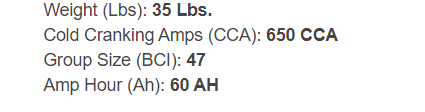
You're not listening. There is NO generalized fixed relationship between CCA and AH (or between either of these values and ESR). Your tester is fooling you by implying that such a relation ship exists. In reality, it tests ONE value (and truthfully its none of the above) that has a good proprotionality with ESR (when the charge state is full, and the temperature is moderate). It then hallucinates a guess about those other values based on the one fact it does know. The problem with that is without knowing more about YOUR battery, those other values aren't meaningful. It's like guessing your car's speed based on the radio volume. A big name like Midtronics comes with profiles that list known values for major lines of batteries (and matching big prices).
I happen to own a similar ESR battery tester, and I also happen to like it. But I've tested enough batteries to know its limitations. First off, when I get a new battery I'll charge it up and test it immediately, then paint-pen the values I get on the top. A few years later, when I know it's charge state is >95% (because below that, it's completely untrustworthy), I can compare the CCA with my prior value. As a general rule for standard car starter battery testing, my tester will indicate 125% to 150% of the label CCA when new, and by the time it drops to 80% of the label CCA, that battery is toast.
But even with that, there is NO point in using a tester like this to compare against multiple battery parameters. Unless we're talking about deep cycle batteries, stick with the CCA and forget the AH values. The false relationship between these two that exists ONLY within the "mind" of these testers can only lead you astray.
At the other end of the spectrum, I have experience with the commercial big brothers of these products. In the past, on my job we used an Alber Cellcorder to collect conductance history semi-annually, and currently we use Generex BACS to get hourly data (backed up by spot testing with a load bank AND Midtronics). I have a bank of 80 batteries being proactively swapped out tomorrow, based on that hourly data that's been collected since their installation in 2016. But before having that unbroken data history, there's no way I'd have the confidence to push them this far using just the Alber (roughly $8000 hardware) readings. There's value in them, when you can compare one reading against a past reading of the SAME battery, as well as when you've got hundreds of identical jars to compare, but no, it's worthless information without that foundational data.