To avoid these ads, REGISTER NOW!

Slab Edge Insulation Detail for pole barn

megachimp

Active member
Joined
Jul 14, 2019
Messages
28
Location
NY
Hi all

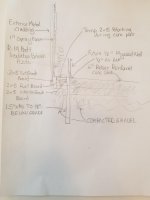
Can you critique my slab edge insulation detail for my pole barn?. Climate zone 5a, unheated slab with a heated space. Code requires 24" of r-10 insulation on the edge of the slab.

I'm installing r-7.5 1.5" xps around the perimeter and there will be r-19 batt in a cavity behind it. The xps will be temporarily reinforced by 2*8 blocking during the concrete pour to prevent blowout.

Does this make sense? I think technically I don't comply with the code below grade and I'm still worried about blowouts during the concrete pour. I could potentially replace the top of xps with a 2*8 to stop blowouts or change from 1.5" xps to 2" xps.

Thanks on advance
 

Attachments

  • 20200523_091502.jpg
    20200523_091502.jpg
    43.4 KB · Views: 183
To avoid these ads, REGISTER NOW!

purediesel

Well-known member
Joined
Apr 17, 2016
Messages
193
Location
Ada Oh
To prevent frost heave of your floor you should really go down to the frost line with your XPS and change it to 2", especially since it isn't heated. Also I'd do at least 2" closed cell spray foam, then you wouldn't have to use a vapor barrier in the walls. Would have to use unfaced batts though.
 
OP
M

megachimp

Active member
Joined
Jul 14, 2019
Messages
28
Location
NY
To prevent frost heave of your floor you should really go down to the frost line with your XPS and change it to 2", especially since it isn't heated. Also I'd do at least 2" closed cell spray foam, then you wouldn't have to use a vapor barrier in the walls. Would have to use unfaced batts though.

I've changed to 2". Not sure about going down to the frost line - by going that far I'm risking compromising the integrity of the poles and to be honest 40+ in is going to be a really tough dig for the entire perimeter of the building.

As for the foam - I'm not sure I understand why 2" is better than 1" in this application. I've already had my contractor seal all gaps/cracks/holes with the 1" of foam and it seems to be working great. 2" wouldn't hurt, but it would double the cost.

I've received the opposite advise about the kraft paper batts - https://www.jlconline.com/how-to/insulation/flash-and-batt-insulation-good-idea-or-bad-practice_o seems to be indicating that it's a good idea to have kraft faced batts on the interior of the building and to avoid sealing the interior wall (such as by running plastic sheeting in there) in my scenario.
 

like2wheel

Well-known member
Joined
Oct 29, 2014
Messages
1,693
Location
On an as needed basis
To prevent frost heave of your floor you should really go down to the frost line with your XPS and change it to 2", especially since it isn't heated. Also I'd do at least 2" closed cell spray foam, then you wouldn't have to use a vapor barrier in the walls. Would have to use unfaced batts though.

How deep is the frost line in your area?
 

beatuptruck

Member
Joined
Oct 25, 2010
Messages
13
Location
Calgary, AB
Have you considered insulating as a Frost protected shallow foundation instead?

In my Pole building project I used sheets of 2" thick Type 1 EPS foam insulation 40" wide around the entire perimeter of the building. They are burried 12" deep and slope away from the building. This was done instead of placing foam vertically which would have comprimised the integrity of the posts while digging.
I also used blocks of EPS foam to fill the voids between the posts as shown in your drawing. The foam blocks are 7 1/4" wide (width of a 2x8 board), and go 12" deep to intersect with the perimeter foam.

This is in Calgary AB, Canada
 

purediesel

Well-known member
Joined
Apr 17, 2016
Messages
193
Location
Ada Oh
Have you considered insulating as a Frost protected shallow foundation instead?

In my Pole building project I used sheets of 2" thick Type 1 EPS foam insulation 40" wide around the entire perimeter of the building. They are burried 12" deep and slope away from the building. This was done instead of placing foam vertically which would have comprimised the integrity of the posts while digging.
I also used blocks of EPS foam to fill the voids between the posts as shown in your drawing. The foam blocks are 7 1/4" wide (width of a 2x8 board), and go 12" deep to intersect with the perimeter foam.

This is in Calgary AB, Canada


:beer: Perfect. :thumbup: This is the other option so you don't have to dig to the frost line. I went 18" vertical even though my frost line is 32" I can go back later and go horizontal on the outside of the building if needed. With how our winters have been the past 5 years or so I don't think Ill have to for a long time or ever. I wanted to go the full 32" but my soil said i wasn't.
 
To avoid these ads, REGISTER NOW!

purediesel

Well-known member
Joined
Apr 17, 2016
Messages
193
Location
Ada Oh
I've changed to 2". Not sure about going down to the frost line - by going that far I'm risking compromising the integrity of the poles and to be honest 40+ in is going to be a really tough dig for the entire perimeter of the building.

As for the foam - I'm not sure I understand why 2" is better than 1" in this application. I've already had my contractor seal all gaps/cracks/holes with the 1" of foam and it seems to be working great. 2" wouldn't hurt, but it would double the cost.

I've received the opposite advise about the kraft paper batts - https://www.jlconline.com/how-to/insulation/flash-and-batt-insulation-good-idea-or-bad-practice_o seems to be indicating that it's a good idea to have kraft faced batts on the interior of the building and to avoid sealing the interior wall (such as by running plastic sheeting in there) in my scenario.

You need to look up condensation curve. I would think that 1" will not keep water vapor from condensing in your area. Im in Ohio and we need a min of 2". Like I said, IF you do 2" or more ccf you wouldn't need a vapor barrier because the ccf will act as your vapor barrier and you never use 2 barriers because it'll trap moisture.
 
Last edited:
OP
M

megachimp

Active member
Joined
Jul 14, 2019
Messages
28
Location
NY
Thanks for all the good thoughts guys. I probably should address the FPSF question first. Obviously there are two factors influencing slab edge and horizontal insulation design: slab structural concerns (frost heave) and energy efficiency concerns. The energy code and ASHRAE 90.1 are pretty clear, the FPSF guidance is definitely less clear. I'm located in an area with an air freezing index of <1500 which means that per the design guidance for FPSF I am ok with installing 12 in of vertical slab edge insulation in a heated scenario and 20 in in a semi heated scenario. The design tables I used did not include guidance on values between semi heated and heated but I will make the reasonable assumption that my assumed indoor temp can be used to linearly scale the slab edge insulation depth and make 18 in below grade ok.

So to summarize all that FPSF stuff, by my research and calculations my slab design is ok and not susceptible to frost heave without horizontal insulation. My design also exceeds IECC requirements as it is at least r-10 except the portion above the wall which is r-29.

As for the vapor barrier issue...my understanding is that 1" is the minimum requirement for foam to act as a vapor barrier in my location. However I am troubled about the question about whether or not to use Kraft faced Batts in my wall cavity and where to install the Kraft paper (outside or inside). I wish there was better published guidance on this. If you guys have good resources on this im interested. I'm only finding little articles online...might need to speak to an architect and confirm.
 

matt_i

Well-known member
Joined
Mar 14, 2008
Messages
10,725
Location
SE Michigan
Have you considered insulating as a Frost protected shallow foundation instead?

In my Pole building project I used sheets of 2" thick Type 1 EPS foam insulation 40" wide around the entire perimeter of the building. They are burried 12" deep and slope away from the building. This was done instead of placing foam vertically which would have comprimised the integrity of the posts while digging.
I also used blocks of EPS foam to fill the voids between the posts as shown in your drawing. The foam blocks are 7 1/4" wide (width of a 2x8 board), and go 12" deep to intersect with the perimeter foam.

This is in Calgary AB, Canada

This is what I would do.

If you read the HUD guide on FSPF (frost protected shallow foundation) their "cookbook design" recommends it. One can google search the .pdf from those keywords and get a lot of reading milege.
 

lakeroadster

Well-known member
Joined
Jan 19, 2015
Messages
5,166
Location
Central Colorado
Curious as to why the slab is going to the inside of the posts? :headscrat

Run the concrete to the outside of the posts and eliminate the horizontal 2x8's. Why bury wood in the ground if you don't have to? Also this eliminates the pathway for critters to bore through the wood and access the building.
 

Attachments

  • Megachimp Foundation Detail.jpg
    Megachimp Foundation Detail.jpg
    143.1 KB · Views: 83
Last edited:
OP
M

megachimp

Active member
Joined
Jul 14, 2019
Messages
28
Location
NY
Curious as to why the slab is going to the inside of the posts? :headscrat

Run the concrete to the outside of the posts and eliminate the horizontal 2x8's. Why bury wood in the ground if you don't have to? Also this eliminates the pathway for critters to bore through the wood and access the building.

Good question...a few reasons for not using the outer boards to hold the concrete
1. Reduces size of concrete pour slightly
2. Allows slab to float without encapsulating the posts
3. Eliminates posts as a thermal break
4. Simplifies geometry of concrete slab...just a rectangle...and would appear to reduce break points
5. Gives me r-29 insulation for most of the slab edge

The rat board at the.bottom is a detail borrowed from RR Buildings on YouTube. Stops insects from entering the wall cavity.
 

lakeroadster

Well-known member
Joined
Jan 19, 2015
Messages
5,166
Location
Central Colorado
Good question...a few reasons for not using the outer boards to hold the concrete
1. Reduces size of concrete pour slightly
2. Allows slab to float without encapsulating the posts
3. Eliminates posts as a thermal break
4. Simplifies geometry of concrete slab...just a rectangle...and would appear to reduce break points
5. Gives me r-29 insulation for most of the slab edge

The rat board at the.bottom is a detail borrowed from RR Buildings on YouTube. Stops insects from entering the wall cavity.

Seems extremely over complicated for little, if any, real advantage. Lot's of buried lumber, lot's of insect entry points, lot's of labor to install all the lumber..... which when I see folks doing such things I can't help but ask....

"Why didn't / don't you just build a stick building? "
 
Last edited:

walrus

Well-known member
Joined
Nov 12, 2008
Messages
11,675
Location
Maine
You need to look up condensation curve. I would think that 1" will not keep water vapor from condensing in your area. Im in Ohio and we need a min of 2". Like I said, IF you do 2" or more ccf you wouldn't need a vapor barrier because the ccf will act as your vapor barrier and you never use 2 barriers because it'll trap moisture.

This. R10 in Maine keeps moisture in wall from going thru dew point and turning into a drip of water.
 
To avoid these ads, REGISTER NOW!
Top Bottom