To avoid these ads, REGISTER NOW!

Slab Heat Questions

wildernessgarage

New member
Joined
Mar 28, 2023
Messages
1
1) What are people doing with insulation on the outside perimeter of slab? How high are you going with it? Are you burying? Flashing?

2) In monolithic slabs are you running tubing in footings?
 
To avoid these ads, REGISTER NOW!

Brly

Active member
Joined
Oct 9, 2019
Messages
42
Location
PA
I did a footer and frost wall, slab poured inside the wall. I ran 2" foam from the footer to the top of the slab. I'm not sure where you're located and what type of winters/frost you have. Look up "Frost Protected Shallow Foundations". You need insulation on the perimeter.
Can't answer your second question.
 

jblnut

ALLIANCE MEMBER
Joined
Jan 17, 2015
Messages
6,990
Location
In the Middle of MN
2" foam 2' down around perimeter. Ends at the top of the slab.

By monolithic I assume you mean something with a thickened outer edge you'll be building on top of ? My shop is a "monolithic slab" and I ran the outermost pipes 8" from the edge of the slab. My shop is also a pole building with no formal footings. So no thickened edge, just 6" thick all the way from one end to the other. It supports no building weight. Not sure if that makes it a monolithic of floating slab but it is what it is !!

Any heated building will benefit from insulation going down around the perimeter. It'll keep the heat in the footprint of the building.

To give more accurate answers we'll need to know your rough location, building type and if it's stick or pole built. And anything else you can think of. Ask away, someone will answer !!
 

mcbane

Well-known member
Joined
Jul 23, 2017
Messages
794
Location
California
I put 2" insulation on the outside of the frost wall, down to the top of footing. I also put 2" foam between the frost wall and floating slab, but that foam is reduced to 1/2" for the top few inches of slab.
 

600SL

Well-known member
Joined
Apr 26, 2012
Messages
1,794
Location
Connecticut
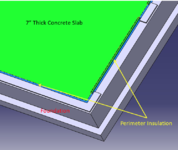
A very timely thread. I have a question about the top of the perimeter insulation. I am currently planing this foundation in CT. It will be a standard footing and foundation with a 7" slab on a radiant heat grid. So my question is as shown hear, the perimeter insulation is visible to the naked eye when the slab is complete. It just seams wrong to me as it appears that it will now be subject to debris and water etc and tires rolling over it at the garage door opening.

Is there any special way to address this 2" gap around the perimeter?

1680385793992.png
 

kabinenroller

Well-known member
Joined
Sep 14, 2013
Messages
898
Location
S.E. Wisconsin USA
I have a full poured foundation with 2” ridged foam on the exterior, 1” on the interior both rise above the the level of the floating slab. There is a vapor barrier and 2” of ridged foam with taped seams under the slab. The exposed foam is covered by tin flashing on the exterior and a decorative wood base on the interior.
 
To avoid these ads, REGISTER NOW!

juddspaintballs

Well-known member
Joined
Sep 1, 2011
Messages
324
Location
Hedgesville, WV
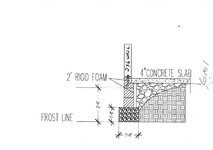
This is what my contracting friend has planned for the house I'm about to build. He forgot to draw in the 2" foam under the slab, but otherwise, here's the plan:

i-8MhpJwz.jpg


I don't love that there's a hard masonry connection from the slab to the foundation, but I don't know a better way to do it either. I guess it doesn't matter a whole lot. Foam on the exterior extending to ground level is not allowed due to insects.
 

600SL

Well-known member
Joined
Apr 26, 2012
Messages
1,794
Location
Connecticut
I put 2" insulation on the outside of the frost wall, down to the top of footing. I also put 2" foam between the frost wall and floating slab, but that foam is reduced to 1/2" for the top few inches of slab.

I like this if my inspector likes it.
 

600SL

Well-known member
Joined
Apr 26, 2012
Messages
1,794
Location
Connecticut
I have a full poured foundation with 2” ridged foam on the exterior, 1” on the interior both rise above the the level of the floating slab. There is a vapor barrier and 2” of ridged foam with taped seams under the slab. The exposed foam is covered by tin flashing on the exterior and a decorative wood base on the interior.

What do you do in the area where the cars roll into at the garage doors?
 

jblnut

ALLIANCE MEMBER
Joined
Jan 17, 2015
Messages
6,990
Location
In the Middle of MN
A very timely thread. I have a question about the top of the perimeter insulation. I am currently planing this foundation in CT. It will be a standard footing and foundation with a 7" slab on a radiant heat grid. So my question is as shown hear, the perimeter insulation is visible to the naked eye when the slab is complete. It just seams wrong to me as it appears that it will now be subject to debris and water etc and tires rolling over it at the garage door opening.

Is there any special way to address this 2" gap around the perimeter?

1680385793992.png
My shop garage doors have concrete aprons outside of them .... So I put 2" foam down 2' like everywhere else but stopped at the bottom of the concrete. Where the slabs meet I used that gray squishy sill seal stuff. If a little heat gets out there and melts some snow I'm totally okay with that.

My house doors I tried to get creative and cut the foam off at a 45° angle and kept it 2" under the topp of the slab to keep it looking nice. I put sill seal everywhere but where the doors were. Here is what happened. Big ol' fail but now I know something that I already knew. Dumb. Oh well :headshake

KIMG1728.JPG

My Pops just built a new house with a shed that has a heated slab and he's going to have just good ol' dirt up against the one door. No foam or anything. The house doors and other shed doors are going to be done like my shop. Foam up to the bottom of the slab and sill seal between the slabs where they meet. Seems to work well.
 

Toolfool

Well-known member
Joined
Aug 22, 2011
Messages
4,982
Location
Tallahassee, FL
Most of the buildings we did in WA we put the 2" rigid foam on the outside of the slab, from bottom of slab to top. After framing walls, and before backfilling, I had a local tinbender fabricate flashings that would cover the foam down past backfill level (8-10"), make the 2" horizontal step, then run up the framed wall 6" , and outside corner pieces. Exterior building wrap would cover the 6" vertical part of flashing and taped to waterproof.
 
Last edited:

kabinenroller

Well-known member
Joined
Sep 14, 2013
Messages
898
Location
S.E. Wisconsin USA
What do you do in the area where the cars roll into at the garage doors?
That is the only area where the concrete floor goes over the foundation, the insulation is still there bit under the slab. The doors sit in a 3/8” recess in the concrete that has a slight taper to the outside, this stops any wind forced rain from migrating under the door seal. It works well. My hydronic tubes are held back from the door opening by about 18”, the heat is drawn to the cold which works out perfectly well for a doorway. On the coldest snowy days I have snow build up on the exterior of the overhead door. My lazer thermometer reads constant temperatures anywhere I point it in the building, even heating is the ultimate goal.
i also have a cold storage side of the building, the two slabs do not touch each other, there is a 2” vertical wall of ridged foam between the slabs, the 6” insulated dividing wall sits directly over the vertical foam. The cold side has a vapor barrier and foam under the slab but no tubing.
 
To avoid these ads, REGISTER NOW!
Top Bottom