To avoid these ads, REGISTER NOW!

Slab Insulation Climate Zone 7 (-35C)

bodaggin

Member
Joined
Oct 21, 2018
Messages
19
Location
Canada
Will be building a shop here in Manitoba, Canada. A few Q's about the slab:

-What is the required R value under the slab (heated or unheated). I always see "inches" of insulation, but not R value.
-Is GPS (graphite board) suitable?
-What footing depth/protection is required to avoid frost heave?

Thanks!
 
To avoid these ads, REGISTER NOW!

JunkBonds

Well-known member
Joined
May 19, 2011
Messages
1,005
I would insulate the perimeter down to frost line with an R20 and not the slab. It is what I did on my garage.
 

billconner

Well-known member
Joined
Jul 20, 2021
Messages
6,964
Location
Thousand Islands NYS
Based on my reading of IRC, heated, slab on grade requires just R10, but it has to extend out or down or combination 4'. Not heated, slab on grade requires no insulation.

I don't know GPS. Usually 2" of foam. I've been looking at Glavel, which for me is less expensive than foam - me renting truck and picking up 100 miles from me.

Slab edge if heated.

Not finding depth for a footing in that zone. Somewhere between 5 and 10 feet best I can tell.
 
Last edited:

cannuck

Well-known member
Joined
Nov 30, 2021
Messages
4,623
Location
Rural SK
I don't have the answers, as about to do the same thing (build shop near Saskatoon SK). Have read here often about the idea of putting a "curtain wall" of insulation vertically below the "frost line" (that here I believe to be over 5' deep) but not so sure I would want the energy bill for heating 50 tons per 1,000 sq.ft. of subsoil all winter. Around here, most put polystyrene board below the slab, but I don't like the long term implication of a plastic foam that could absorb water over time. I plan on placing at least 6" of PFCC geofill ("foamcrete" in slang) under the slab to provide a dead level and reasonable insulation layer beneath the slab.

Would love to hear from people who have built in these climates
 
OP
B

bodaggin

Member
Joined
Oct 21, 2018
Messages
19
Location
Canada
Super helpful, thanks guys. Yes @cannuck it's tough to find info up here. I get a giggle when they talk about furnaces in Arizona.

Thanks @billconner yes frost gets about 6-8 feet here depending on the year. Thankfully no permafrost like a little further north. Trying to avoid digging down that deep if possible.

I used to install screw piles. Like you mentioned, our engineer would get us to insulate outward from the piles (foundation/slab in this case) if the piles didn't get deep enough.

Do you remember the formula? Is it 1 foot outward protects 1 foot down? Or 1 out, 2 down? I forget now... Thanks again.
 

billconner

Well-known member
Joined
Jul 20, 2021
Messages
6,964
Location
Thousand Islands NYS
Here's one free guide:
https://www.homeinnovation.com › ...PDF
Revised Builder's Guide to Frost Protected Shallow Foundations

I found a copy of ASCE 32 and think it's worth it.

Heated or unheated makes a big difference in design and extent of the insulation. Also depth below grade affects the extent.

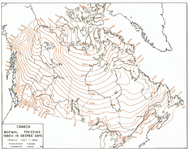
Finding the AFI (air freezing index) and MAT (mean annual temperature) to calculate all this was not easy and I notice the guide only includes US.
 

matt_i

Well-known member
Joined
Mar 14, 2008
Messages
10,726
Location
SE Michigan
If you are heating, you lose a lot of heat to the earth even if its 50F. The R-value of concrete is ~1.

You can do a very basic conductive equation to determine the magnitude....Q = U * A *(delta T) which in "Old English units" is

Q = heat (BTU/hr) = U (conveniently 1/R-value in BTU/hr/ft^2/deg-F) * A (area in ft^2) * (delta T in deg F).

Run the example of 70F inside, 50F ground temp, concrete R value is 1, area = 1000 ft^2

Q =1/1 * 1000 * 20 = 20,000 BTU/hr thru the concrete which is a fairly large amount.

This is a simple equation with various flaws, normally air is heated and it doesn't account for the temp gradient...

But you can see how greater R-value assists, if you added 2" of F-250 foam and got R-10, then your new heat flow value would be

Q = 1/10 * 1000 * 20 = 2,000 BTU/hr thru the concrete, a nice savings (!)
 

jmdirk

Well-known member
Joined
May 4, 2015
Messages
705
They don't bother listing R-value because most rigid board is ~4-5R per inch. I believe GPS is okay for the perimeter. Maybe not for under the slab itself if it doesn't have a psi rating.

The amount of insulation would vary based on you frost depth, depth of footings etc., type of subgrade and it's susceptibility to heave etc. Presuming you need to have an engineered foundation in your area, the foundation designer should specify the type, depth and width of the insulation needed.
 

billconner

Well-known member
Joined
Jul 20, 2021
Messages
6,964
Location
Thousand Islands NYS
Ballparking here. Here's a map of AFI zones in Canada. I picked Winnipeg, and used 3000 for AFI. Just googling MAT is 38 degrees F. You can see in chart - this is for unheated building - that it would require insulation with an R of 18.2 -so 4" of most foams - and that it extend 79" beyond exterior walls all around, with minimum 10" ground cover. Then you can change things and that changes other things.
for instance, for every inch deeper, 1.25 inch less extension. There is gravel ("non–frost-susceptible layer") requirements, and other details called out in ASCE 32. So maybe a little deeper and foam apron is only 6'. Go from 6" of gravel to 12 and you may get to 3" of foam.

Just some amateur work on a frost protected shallow foundation. Heated buildings have less restrictive requirements, but may have energy use consequences. I spent a lot of time planning mine and decided to go to footing below frost line - 48" here - as less expensive. The additional blocks and mortar were $1000 less than foam, and $600 less than Glavel, though more labor of course.

A heated building - which would have required foam under slab anyways, probably saves material cost because only the apron or vertical extension.
 

Attachments

  • AFI canada.png
    AFI canada.png
    297.7 KB · Views: 8
  • canada fpsf.JPG
    canada fpsf.JPG
    92.5 KB · Views: 9
To avoid these ads, REGISTER NOW!

Sumboodie

Well-known member
Joined
Mar 20, 2021
Messages
10,690
Location
AK
Around the slab of my house and garage I have a 3ft apron of 2" foam. It's about 8-10" below grade. Zone 4 at home. Frost depth about 10ft.
Here at work, frost is permanent.
 

marak

Well-known member
Joined
Jan 26, 2015
Messages
338
Location
Anchorage, Alaska
Around the slab of my house and garage I have a 3ft apron of 2" foam. It's about 8-10" below grade. Zone 4 at home. Frost depth about 10ft.
Here at work, frost is permanent.
Alaska is Zone 7 or 8 for buildings, but USDA Zone 4 for plants. May be causing some confusion. Zone 7 (Anchorage, AK) has a frost depth of 9.5 to 10.0 ft.
 

jasondavidmann

Well-known member
Joined
Aug 16, 2009
Messages
162
Location
Manitoba, Canada
I am also in Manitoba. I don't know where you are building but my rural municipality didn't require anything. You can check my build thread to see what I did. After the first winter I have been satisfied with the slab insulation.
 

cannuck

Well-known member
Joined
Nov 30, 2021
Messages
4,623
Location
Rural SK
Sorry to have been a stranger for a while. On emergency callouts out of the country. No data service.

Many thanks to those who have posted such good information. I am anticipating PFCC (i.e. "foamcrete") at very low density under the slab, and possibly higher density under column footing pads. Still trying to get my head around the vertical vs. horizontal heat paths vs. how much thermal transmissivity vs. cost (PFCC chem not exactly cheap).
 
To avoid these ads, REGISTER NOW!
Top Bottom