To avoid these ads, REGISTER NOW!

Slab pour over piers?

asmith1923

Active member
Joined
Sep 13, 2021
Messages
36
I’m building a pole barn with 16” sonotube formed piers every 8’. My 6x6 posts will be bolted to the center of the piers, with a 2x6 rake board running horizontally between the posts at the bottom. I plan to cover the rake board on the inside with 2” foam board from the top to about 10-12” below the finished floor because I’m installing radiant floor heating. My finished poured slab will be poured against the foam board to the top of the rake board.

The slab will be poured over a portion of the piers (about 2-3”) but not tied to them in any way. Essentially floating above the piers but in direct contact.

my question is, is there a better way to do this? Am I asking for cracks around the piers when the slab and piers move independently?

thank you all for any advice here, this is my first pole barn job.
 
To avoid these ads, REGISTER NOW!

jives

Well-known member
Joined
Jan 4, 2013
Messages
2,807
Location
Central NY
Check out RR Buildings, who have many very nice vids on pole building. They generally do exactly as you are planning. In the video below at about minute 14:45 they address your question directly.


Leaflessshadetree

Well-known member
Joined
Aug 1, 2013
Messages
7,165
Location
Don't ask.
You can putsome expansion joint material there.
I insulated under my entire floor (in your case the styrofoam would be teh expansion joint).
I know some people say to insulate around the edges. One of my friends has a garage that was built with insulation around the perimeter (2" thick. 4 ft around the edges). He never was able to get the floor warm and abandoned it after 1 season.
 

dcg9381

Well-known member
Joined
Jun 20, 2018
Messages
11,766
Location
Austin, TX
It's not real obvious in this photo, but our garage was poured over 8' sonotube piers. Concrete guys had some sort of "corkscrew" rebar that they put down each of the piers. Note, these piers connected to the 24" concrete beams. There is actually a pier at every beam corner. We essentially built a garage foundation that is an 8' table with a bunch of legs. Underlying ground material was left over road spoils and didn't do well on a soil test.

1631630674830.png
 
Last edited:

ConCretin

Well-known member
Joined
Jan 20, 2011
Messages
3,378
Location
Central Maine
I'd be inclined to thicken the slab a couple inches over the piers for a little extra strength. Even better would be to thicken the entire perimeter of the slab and add a couple rebars as a sort of ring beam to hold everything together since a slab in a pole structure basically just floats.

I'd definitely isolate the slab from the poles with expansion material.
 

WNYflyer

Well-known member
Joined
Sep 13, 2009
Messages
2,119
Location
Lockport, NY
Couple of questions not related to the slab.

- If you are bolting the 6x6 post to the 16" diameter sonotube foundations is the bolted connection designed as a "pin" connection and the thus the building is designed with appropriate lateral vertical bracing, shear walls, etc to instill lateral stability to the building based upon the assumption of a "pinned" post to foundation connection?

- Perhaps the post to foundation bolted connection is designed as a "moment" connection rather than a "pin" connection such that it instills some rigidity to the post to foundation connection to in some ways replicate a continuous buried wood post?

- With a bolted post to foundation connection is the connection going to be exposed to the soil and weather at the exterior or does the connection in some way get buried in concrete? Not understanding what the post base detail looks like relative to elevation and say lateral construction/dimensions from say center of post/foundation to the inside face of the exterior siding.
 
OP
A

asmith1923

Active member
Joined
Sep 13, 2021
Messages
36
Check out RR Buildings, who have many very nice vids on pole building. They generally do exactly as you are planning. In the video below at about minute 14:45 they address your question directly.

Yes, Kyle and Greg are my mentors. Sadly this video shows my connection issue but doesn’t address it.
 
OP
A

asmith1923

Active member
Joined
Sep 13, 2021
Messages
36
You need 2" insulation under the whole floor. If it has to be less than that at the pier area to give the full concrete thickness, than use whatever thickness foam will fit.
My barn is 48 x 64, the Radiantec folks said to do the outside 4’ with 2”, the next inner 4’ with 1”, the the remaining center no insulation. He said the heat loss through the center was minimal.
As long as the insulation isn’t COVID priced, I’ll be putting 2” under the entire floor.
 
OP
A

asmith1923

Active member
Joined
Sep 13, 2021
Messages
36
I'd saw cut at the posts. Any cracks should hopefully start and stay in the saw cuts.
Concrete estimates are coming in around $25000. I can only imagine what they’d charge for pier perimeter relief cuts X 28 piers 🤦🏻‍♂️
 
OP
A

asmith1923

Active member
Joined
Sep 13, 2021
Messages
36
Couple of questions not related to the slab.

- If you are bolting the 6x6 post to the 16" diameter sonotube foundations is the bolted connection designed as a "pin" connection and the thus the building is designed with appropriate lateral vertical bracing, shear walls, etc to instill lateral stability to the building based upon the assumption of a "pinned" post to foundation connection?

- Perhaps the post to foundation bolted connection is designed as a "moment" connection rather than a "pin" connection such that it instills some rigidity to the post to foundation connection to in some ways replicate a continuous buried wood post?

- With a bolted post to foundation connection is the connection going to be exposed to the soil and weather at the exterior or does the connection in some way get buried in concrete? Not understanding what the post base detail looks like relative to elevation and say lateral construction/dimensions from say center of post/foundation to the inside face of the exterior siding.
6 x 6 bolted to piers with sturdi-wall brackets and lateral cross bracing in all corners for lateral stability.
Exterior gravel halfway up skirt to a couple inches below board/batten siding.
Inside concrete poured to top of skirt board (which will be wrapped with 2” foam board down to earth.
 
OP
A

asmith1923

Active member
Joined
Sep 13, 2021
Messages
36
Couple of questions not related to the slab.

- If you are bolting the 6x6 post to the 16" diameter sonotube foundations is the bolted connection designed as a "pin" connection and the thus the building is designed with appropriate lateral vertical bracing, shear walls, etc to instill lateral stability to the building based upon the assumption of a "pinned" post to foundation connection?

- Perhaps the post to foundation bolted connection is designed as a "moment" connection rather than a "pin" connection such that it instills some rigidity to the post to foundation connection to in some ways replicate a continuous buried wood post?

- With a bolted post to foundation connection is the connection going to be exposed to the soil and weather at the exterior or does the connection in some way get buried in concrete? Not understanding what the post base detail looks like relative to elevation and say lateral construction/dimensions from say center of post/foundation to the inside face of the exterior siding.
I don’t understand pinned vs moment connection. I can say that the slab is floating and provides no structural rigidity to the barn. Therefore I need it to float independent of the piers.
My concern is when the slab and piers settle at a different rate, the slab will crack around the piers.
I can’t attach the slab to the piers via rebar, because the center of the 3044SF slab has no center support. That would most certainly crack.
I will be doing 10’x10’ relief cuts on the entire slab 🤞
 

kj_mustang

Well-known member
Joined
Feb 9, 2011
Messages
1,213
Location
Harrisonburg, VA
My barn is 48 x 64, the Radiantec folks said to do the outside 4’ with 2”, the next inner 4’ with 1”, the the remaining center no insulation. He said the heat loss through the center was minimal.
As long as the insulation isn’t COVID priced, I’ll be putting 2” under the entire floor.
You won't regret the insulation cost. I always wondered how people accounted for the different heights of insulation. Do you add more rock base to even it up to the next area insulation height or do you just pour more concrete? Either way it is costing you more labor/money so might as well put the 2" insulation under the whole floor and not lose any BTUs.
 
OP
A

asmith1923

Active member
Joined
Sep 13, 2021
Messages
36
You won't regret the insulation cost. I always wondered how people accounted for the different heights of insulation. Do you add more rock base to even it up to the next area insulation height or do you just pour more concrete? Either way it is costing you more labor/money so might as well put the 2" insulation under the whole floor and not lose any BTUs.
Depends on the insulation cost, but I’d prefer all 2”. At a minimum I’ll run 2” in 2 rows and gravel up to 1” insulation for the center. I don’t want any uninsulated areas
 

NUTTSGT

Super Moderator
Staff member
Joined
Sep 14, 2009
Messages
50,968
Location
Northern Central Ohio
Concrete estimates are coming in around $25000. I can only imagine what they’d charge for pier perimeter relief cuts X 28 piers 🤦🏻‍♂️
Most guys around here include the relief cuts with the price of the job.

I don’t understand pinned vs moment connection. I can say that the slab is floating and provides no structural rigidity to the barn. Therefore I need it to float independent of the piers.
My concern is when the slab and piers settle at a different rate, the slab will crack around the piers.
I can’t attach the slab to the piers via rebar, because the center of the 3044SF slab has no center support. That would most certainly crack.
I will be doing 10’x10’ relief cuts on the entire slab 🤞
A properly compacted base shouldn't be settling, nor should the piers. The piers should be deep enough in the ground to prevent heaving during winter months, that's why they should be at or below the frost line.
 
To avoid these ads, REGISTER NOW!
OP
A

asmith1923

Active member
Joined
Sep 13, 2021
Messages
36
Most guys around here include the relief cuts with the price of the job.


A properly compacted base shouldn't be settling, nor should the piers. The piers should be deep enough in the ground to prevent heaving during winter months, that's why they should be at or below the frost line.
Agreed. Piers won’t move, but the slab will no matter how much I compact. It’s over 36 yards of concrete! I will be compacting earth and 6” of gravel every 2”.
 

sjvicker

Well-known member
Joined
Aug 9, 2014
Messages
602
Location
SW Washington
I'm going to get a shop quoted about the same size as yours in the spring. $25k for 36 yards of concrete seems really high for some compacting, mud and cutting joints. What's your location?
 

ConCretin

Well-known member
Joined
Jan 20, 2011
Messages
3,378
Location
Central Maine
The OP raises a valid concern. The piers and your slab will move. The slab will settle (no such thing as 100% compaction) and it will shrink. The piers will move with frost and building loads. Some of the movement will never be noticeable or harmful but if the two elements have too much differential movement, it could cause cracks.

Try to isolate the slab from the piers. Lateral movement is pretty easy to deal with. Wrap the posts with expansion material. Install a bond breaker between the piers and slab. If the piers are smooth enough, your vapor barrier could fill this role. Vertical movement is a little tougher to deal with, which was why I suggested thickening the slab a couple inches over the piers.

In a perfect world, I don't really think you'd have to much of an issue if you didn't do anything but we rarely find ourselves in one of those.
 

WNYflyer

Well-known member
Joined
Sep 13, 2009
Messages
2,119
Location
Lockport, NY
6 x 6 bolted to piers with sturdi-wall brackets and lateral cross bracing in all corners for lateral stability.
Exterior gravel halfway up skirt to a couple inches below board/batten siding.
Inside concrete poured to top of skirt board (which will be wrapped with 2” foam board down to earth.
Understood, sounds like you have a professional design for your building. I was thinking that perhaps you were in someway trying to design it yourself.
I don’t understand pinned vs moment connection. I can say that the slab is floating and provides no structural rigidity to the barn. Therefore I need it to float independent of the piers.
My concern is when the slab and piers settle at a different rate, the slab will crack around the piers.
I can’t attach the slab to the piers via rebar, because the center of the 3044SF slab has no center support. That would most certainly crack.
I will be doing 10’x10’ relief cuts on the entire slab 🤞
With a professional design you really don't need to understand a pinned (no rotational rigidity) connection vs a moment (rotational rigidity) connection since that is taken care of by the building designer. I see you are using the Sturdi-Wall post to concrete foundation connection. Just looked up the information on both "SW" (Sturdi-Wall) and "SWP" (Sturdi-Wall Plus) connectors and at one time the published literature indicated that the "SWP" connectors had "moment capacity" so as to impart rotational rigidity to the post/concrete joint but surprisingly the latest literature indicates the "SWP" connectors no longer have moment capacity. Wonder what happened? Perhaps current codes don't allow it or they ended up having problems.

Regardless, sound like you have a nice building going (y)
 
OP
A

asmith1923

Active member
Joined
Sep 13, 2021
Messages
36
I'm going to get a shop quoted about the same size as yours in the spring. $25k for 36 yards of concrete seems really high for some compacting, mud and cutting joints. What's your location?
I’m in northern VA. Still getting quotes, I’ll put some pics and pricing up as I get it.
I'm going to get a shop quoted about the same size as yours in the spring. $25k for 36 yards of concrete seems really high for some compacting, mud and cutting joints. What's your location?
Most guys around here include the relief cuts with the price of the job.


A properly compacted base shouldn't be settling, nor should the piers. The piers should be deep enough in the ground to prevent heaving during winter months, that's why they should be at or below the frost line.
The piers better not heave, kinda the purpose of digging them below the frost line. Agreed that slab will float in every direction. It will have to compress the 2” foam vertically or horizontally before touching the piers. I’m just gonna cross my fingers…
 

ConCretin

Well-known member
Joined
Jan 20, 2011
Messages
3,378
Location
Central Maine
I’m in northern VA. Still getting quotes, I’ll put some pics and pricing up as I get it.


The piers better not heave, kinda the purpose of digging them below the frost line. Agreed that slab will float in every direction. It will have to compress the 2” foam vertically or horizontally before touching the piers. I’m just gonna cross my fingers…
I wasn't trying to imply the piers would 'heave' but they will move. I doubt you have much of a concern in northern VA but I've been through enough cold Maine winters to know frost will grab onto anything stuck in the ground and try to squeeze it out. It may not always be a lot but it's there. Concrete is a brittle material and it doesn't take much movement to create a crack.

If you have 2" of foam between your piers and the slab, you'll be absolutely fine anyway.
 

billconner

Well-known member
Joined
Jul 20, 2021
Messages
6,970
Location
Thousand Islands NYS
First, great thread, thank you all.

Based on my current planning I am a little dismayed by the variety of opinions on some basics. For instance, related of things moving, I've gotten a wide range of interpretations of what the building code requires regarding the slab on grade typical of a post frame building. I thought that even over 600 sf, it was not required to be frost protected. So did building officials at thebuildingcodeforum.com, calling me dense for asking. So this morning my building official said of course the slab has to be frost protected, which is not simple in an unheated building.

The thickened edge in a floating slab - nothing but live load of stuff and occupants - deserves more thought. I really like most of what LLWillysfan says but I have trouble seeing benefit. But I"m not sure there is a benefit. Hansen Buildings btw, recommends against it. I'm sure the actual "undisturbed earth" below and fill and the filk's compaction is key to success or failure. (I have well drained coarse sand for many feet of depth so expect no problems I this regard.)

Other different points of view here, all understandable and we'll meaning, but makes it really hard to plan. Good thing is more than one way probably works.
 

ConCretin

Well-known member
Joined
Jan 20, 2011
Messages
3,378
Location
Central Maine
The thickened edge in a floating slab - nothing but live load of stuff and occupans - deserves more thought. I really like most of what LLWillysfan says but I have trouble seeing benefit. But I"m not sure there is a benefit. Hansen Buildings btw, recommends against it. I'm sure the actual "undisturbed earth" below and fill and the filk's compaction is key to success or failure. (I have well drained coarse sand for many feet of depth so expect no problems I this regard.)
Thickening a slab at stress points is a common and very inexpensive way to reinforce a slab. I'd be curious why Hansen recommends against it. I fail to see a downside other than a modest additional cost.

A slab in a pole structure is similar to an exterior pad or a monolithic slab in that it's not contained by perimeter foundation walls and is subject to more movement especially when not in a heated space. The thickened edge helps to hold everything together and provides some extra strength where you drive onto the slab and in your case, where the slab passes over the piers. It just costs a little time to dig out some soil and little extra concrete. Absolutely necessary? No. Cheap insurance? Yup.
 

billconner

Well-known member
Joined
Jul 20, 2021
Messages
6,970
Location
Thousand Islands NYS
I can see thickened at entry, but I don't see stress points at walls. If anything, the floating edge at walls sees lowest stress unless compaction is poor allowing center to settle.

Whether the slab is protected from frost or not would have an impact too. As I noted, some building officials say code does not require it, others - including mine - say absolutely required.

Lots of cheap insurance opportunities in building. All together, not so cheap.

I think it depends on expectations and use. When I was thinking post frame, I was considering just pea gravel, no slab. I looked at asphalt too, but preferred the pea gravel. Even considered pavers. If any of those slab alternatives are acceptable, how bad is a cracked slab? Or control joints every 8 or 6'?

Also depends on whether you're doing it your self or paying someone or being paid to do it.
 

billconner

Well-known member
Joined
Jul 20, 2021
Messages
6,970
Location
Thousand Islands NYS
So I just met with my building official and he's death on wood in ground, so looking at the Sturdy Wall Plus or Perma-Column options. ASmith - did your designer call out the 16" sonotube? And is there a larger base or pad, or just 16" bearing on soil? Just seems very large diameter, which exacerbates the slab vs. pier issue. I thought the R&R folks used a smaller base and only poured to a 2by on inside of posts.

On the cost, it seems to be $8+ sq ft at barely 4". (48 x 64 @ 36 yds? $25,000?) and I assume that includes compacted base, forms, reinforcing, pouring (pump?), finishing, and control joints. I was just quoted $8-10 sq ft for same scope at 5 1/5 inch.
 
OP
A

asmith1923

Active member
Joined
Sep 13, 2021
Messages
36
So I just met with my building official and he's death on wood in ground, so looking at the Sturdy Wall Plus or Perma-Column options. ASmith - did your designer call out the 16" sonotube? And is there a larger base or pad, or just 16" bearing on soil? Just seems very large diameter, which exacerbates the slab vs. pier issue. I thought the R&R folks used a smaller base and only poured to a 2by on inside of posts.

On the cost, it seems to be $8+ sq ft at barely 4". (48 x 64 @ 36 yds? $25,000?) and I assume that includes compacted base, forms, reinforcing, pouring (pump?), finishing, and control joints. I was just quoted $8-10 sq ft for same scope at 5 1/5 inch.
I dont have a designer, but I can tell you having done all this work myself - you dont want any smaller than 16" piers. The sturdywall columns take up a lot of space and you dont wanna drill too close to the edge. If I had to do it again, I'd do 18" piers - and spend a little more time in the layout stage.
 

billconner

Well-known member
Joined
Jul 20, 2021
Messages
6,970
Location
Thousand Islands NYS
Refresh my memory: did you use the wet set or drill set post bases?

While I moved on from the post frame design to rubble trench on current project, I would definitely just bury properly treated wood posts - UC-4B - if/when I build post frame. Stronger, simpler, less expensive.
 
OP
A

asmith1923

Active member
Joined
Sep 13, 2021
Messages
36
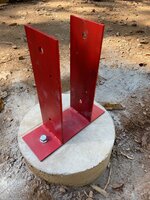
I had 28 piers and work alone, so wetsetting them all wasn't an option. Not a lot of time to fuss with them while trying to manage the concrete truck and smooth the tops. I drill set mine, but Sturdi wanted $130 a piece, so I made my own.
 

Attachments

  • IMG_5443.jpg
    IMG_5443.jpg
    548.7 KB · Views: 35
  • IMG_5472.jpg
    IMG_5472.jpg
    863.3 KB · Views: 29
  • IMG_5445.jpg
    IMG_5445.jpg
    528.4 KB · Views: 29
  • IMG_5448.jpg
    IMG_5448.jpg
    656.7 KB · Views: 29
  • IMG_5462.jpg
    IMG_5462.jpg
    549.8 KB · Views: 30
  • IMG_5464.jpg
    IMG_5464.jpg
    654.5 KB · Views: 34

dcg9381

Well-known member
Joined
Jun 20, 2018
Messages
11,766
Location
Austin, TX
All of my tube piers were tied into the concrete foundation above. This work is beyond the scope of what I'm comfortable with and our slab was done by engineers. Here's another photo, this span is eventually a "concrete bridge" between structures foundation, but the piers were tied into the bridge... 1655997136183.png
 

dwasifar

Well-known member
Joined
May 28, 2017
Messages
2,096
I misread the title as "Slab pour over pliers?" and I thought, "Is he worried that the buried pliers are going to damage the concrete, or is he just upset that now he has to buy a new set of pliers?"

:ROFLMAO:
 
To avoid these ads, REGISTER NOW!
Top Bottom