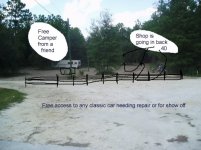
Our slow project is starting to move some. Land box bladed, well working now, getting ready for slab.
In Ocala Florida, what would you suggest for the pour.
Garage to double as Ag storage and part time classic car hideaway. 2x4 build and 24' by 26' with 10' walls. No loft.
1, Concrete, mesh in mix or fibers in mix no mesh.
2, deeper around where walls will be or simply 4inches around.
3, best substrate, Stone with plastic barrier, what gauge/manufactoring/store
or company to purchase the plastic from.
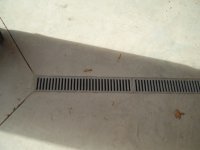
4, best way to provide water drain off, cuts in floor, slant etc.
Most important thing I need to learn is how to keep it wet the correct way.
Once poured I have no real clear idea on the best way to keep it moist over the days it sets up.
One fella suggested back and forth sprinkler in am, then sets all day and after supper he gets it wet again, does this for 5 to seven days.
Do we cut an inch deep thru center to prevent cracks?
Anyone in Ocala area want to help, earn some paint booth time or body work time

Thanks
There's a ton of info and posts here.
I'll pass on my $0.02
1) Fiber is not reinforcement. It serves another entire purpose in concrete. Do not think of gaining any reinforcement benefits from fiber. However I'd use it for the inexpense and the purpose it does serve where it's a beneficial add-mixture. Also require an air-entrainment add-mixture, however in FL, you will not need it for what it serves, but again for the inexpense of the add-mixture, have them use it. Order a 4000 pound mix. Three thousand pound is what it is, but 4000 will eventually hydrate and produce about a 8 - 12k pound compressive strength after about 20-45 days. Concrete never stops hydrating but after about 3 - 6 months, hydration no longer serves any additional functionality.
2) Wire mesh will last about as long as a sucker in a kid's mouth. The chemical composition of the concrete will eat through it in a few years at best. And on top of that, it will likely not be placed in the concrete to be (mythological) effective. Use rebar and place it properly within the concrete. Wire or rebar lying on the ground during concrete placement is useless and serves no function purpose. Most folks using wire will take a rake and pull it upward during the concrete placement. Guess where it ends up? Right back in the bottom. Invest your money wisely in reinforcement bar and proper placement. Here's an example of a rebar chair. This is the basic idea of which will result you in the proper rebar placement for maximun reinforcement benefits. (
http://www.conacweb.com/rebar_chair.htm).
Never rely on the concept of using a rake to lift rebar (or wire) and have it placed properly. It doesn't work. If your concrete contractor leaves it lying on the ground during the placement, ask for a refund. You'll be wasting money and have the slab to crack big time, in a very short time period. Don't rely on a contractor to place your concrete in a manner of "We do it this way and have for years!" You'll be less than structurally sound with the results.
Insist on your self-imposed Quality Control methods.
3) You should dig a footer with rebar in it. Digging deeper where the walls will be placed is what we call a floating footer or a step-down footer. If you have the opportunity, dig a footer and place rebar in it also (properly placed).
4) Use a French drain system around any and all walls that will see run-off from adjacent geography. You'll then be assured to not have moisture seep through your foundation walls.
5) I personally prefer to place expansion joints in the concrete before it sets up (cures or hydrates). Cutting is OK but it is not getting effective control of where you want your cracks to go. Cutting is a lazy-man's way (no offense to those whom prefer a dry cut) dealing with stress after it has already started to exert. Expansion joints should be placed where you want the cracks to be. The concrete will crack no matter what you do. The joints control "where" it cracks, if placed properly. I prefer overkill on expansion joints, because they will serve you very well and you can then fill them in with self-leveling joint filler. Dry cuts are an after-the-fact control method. It works but it's a risk that can be greatly reduced by placing the joints in the wet concrete as it is being finished.
6) Forget the sprinkler. That only sprays what you are trying to control, that being slowing the hydration process to allow the chemical reaction (hydration) to maximize its strength gains. Your "Fella" friend means well but that is not an effective way to slow hydration. The old school method of keeping a placement wet (or slowing the evaporation of moisture) is to place burlap (sacks or roll material) over the surface and keep the burlap wet. A sprinkler can potentially leave small (unnoticeable until later) water droplet indentations (divots) in the surface. I have them in a concrete surface now (if you need pics) from the very thing. Also, I have seen many folks use a tarp to cover the concrete and this will serve the purpose as well.
I will say this as a forethought.... Some finishers like to use a curing compound or a curing sealer (again to seal the surface to slow the evaporation) and this looks all nice and pretty and does serve fairly well for it's intended purpose. However, if you ever want to put a nice floor cover in your garage later (such as an epoxy finish) you will not be able to do this without acid etching or surface scarifying (grinding) the surface to remove the sealer. My opinion is to be prepared to stay with the placement until it sets up nicely without a curing sealer. Then you always have the option to add a floor cover later without a headache of work in preparation for the floor cover. If you don't use a sealer, it's no big deal. The concrete is under roof and there are no freeze-thaw cycles in middle FL to worry about "sealing" moisture from penetrating the porous concrete (a reason for air-entrainment). Every Tom-****-and-Harry will tell you to use it and that is OK, but plan forward to your flooring. I promise you that you'll want an epoxy or tile floor finish sooner or later. A sealer will only make that a pain in your ****.
7) I'd suggest a 1-1/2" stone from the local quarry. It compacts quite nicely and also allows any moisture to seep back into the ground. Crusher-run gravel or 3/4" stone compacts too tightly to allow any moisture to drain back to the soil. Also use 1-1/2" with your French Drain system. Place a thick plastic (maybe a 10 - 20 mil thick) vapor barrior on top of the stone, then the rebar in chairs on top of that. Make sure that you have checked your slope with a sruveyor's level. If not, you'll see high spots where you don't want them, and low spots where you don't want them. I have pictures of that scenario too, if you want to see them (
). Remember Quality Control, not "we've done it this way for years."
These points are my opinion and others will have different opinons. Your mileage may vary. I will tell you this for what it's worth.... I have worked concrete as an Engineer for 20 + years while building nuclear powered electric generating plants. We do it right. Period. That and formal schooling have brought me to these points of opinion. Take it or leave it. If anyone argues about the fiber or wire mesh (they always do) tell them to go back to concrete 101 and re-study.
I wish you well. A simple garage structure seems simple enough but it is no less important and uses the same principles of engineering as do the power plants that serve you safe and reliable electricity....
And one last peeve of a point for me...because I am one **** person...
"Pouring" concrete will mean that you have a slump of about 11", which is about pure liquid with aggrigates at the bottom.
Always "place" concrete with a nicely manageable slump.