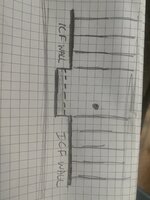
Not a dumb question, at all. This is a vexing issue for ICF builders and there are no elegant/easy answers on what to do. The good thing is that you can be creative.
My comments assume your slab is a traditional floating slab that sits directly on the ground and not tied into the walls in any way...
When you pour a floating slab and then extend it over the thresholds, it defeats the purpose of having a floating slab. Many people do this anyway, but it creates a stress point as the slab moves and also introduces reentrant corners on either side of the "toungue" that extends through the threshold. Both features will cause cracking.
https://www.concreteconstruction.ne...et-a-reentrant-corner-crack-ruin-your-image_o
In my house, I poured a separate threshold, the same thickness as the ICF wall and level with the floating slab indoors:
(My dust lips are also integral to the poured threshold.) The threshold is isolated from outside slabs by an expansion joint and isolated from the inside slab by foam insulation in-line with the surface of the ICF. This eliminates re-entrant corners, keeps the floating slab isolated from any fixed objects, (like the foundation) and also keeps the inside slab thermally isolated from the outside.
^ For finishing this on the inside, I carved out the top inch of foam in between the slab and the threshold and used a product called SlabGasket to fill the gap and give a finished interior joint. (The black line in the picture above is a regular expansion joint and the grey line to the right is the SlabGasket in the interior.)
Here's a picture of the opening before pouring the threshold. I drilled some holes in the ICF wall and used rebar to pin the threshold to the wall, just to help a little with stability.
For the front door, we got creative and put a railroad tie down for a threshold:
For this one, I added some rebar coming out of the ICF, some lag bolts in the bottom of the railtorad tie, and then joined the two together with a bed of mortar. I also have a layer of insulation between the tie and the slab here, and the built-in threshold of the door covers all that up.
The downside of all of this is the thresholds are an extra pour, in addition to the slab. It's really hard to pour them at the same time and keep straight divisions between everything. Most contractors want the concrete trucks to show up one time and be done with you. Since our entire house was ICF and we also had subsequent concrete deliveries for sidewalks and other pavement, it was easy for me to steal additional concrete off those trucks to get the thresholds done.