To avoid these ads, REGISTER NOW!

Slab thickness for forklift

Hobby_Man22

Well-known member
Joined
Nov 16, 2020
Messages
3,581
Location
tx
So I looked up the weight for various brands of forklifts they all come in at around 9200 pounds for a 5000 pound capacity forklift. Which brings me to wonder if a 4" slab would be just fine. I mean my 3/4 ton truck is 7000 pounds and it does fine, but I suppose the tires on that spread the load a bit more.
 
Last edited:
To avoid these ads, REGISTER NOW!

WNYflyer

Well-known member
Joined
Sep 13, 2009
Messages
2,119
Location
Lockport, NY
500# capacity? or I'm thinking you meant 5000#? for a 5000# lifted load 24" in front of the forks your front axle load with probably be on the order of 12,000# to 13,000#.
 

NUTTSGT

Super Moderator
Staff member
Joined
Sep 14, 2009
Messages
50,903
Location
Northern Central Ohio
Proper base compaction is going to be a big factor.

How big is the slab and what is it going to cost you to add another inch or two of concrete ?
 
OP
H

Hobby_Man22

Well-known member
Joined
Nov 16, 2020
Messages
3,581
Location
tx
Proper base compaction is going to be a big factor.

How big is the slab and what is it going to cost you to add another inch or two of concrete ?
How do know the contractor did a good job compacting the dirt?
 

Dadillac

Well-known member
Joined
Apr 14, 2017
Messages
257
At my place of employment we are having a large section (larger than a football field) of concrete torn out and relaid. We store 20 foot shipping containers filled with liquid chemicals. These containers weigh as much as 40,000 pounds each. And they are stacked 4 high. Each shipping container has 4 corner locks that measure roughly 5 inches by 8 inches which supports the entire weight. So considering 160,000 pounds each corner (on the bottom container) has 40,000 pounds in each of the 5 inch by 8 inch area. We store several thousand containers in our yard. Now get this. The concrete that was removed and the new concrete poured is 12 inches thick rebar reinforced. In other ares that have one or two containers stacked we have 6 inches of concrete reinforced with rebar. I have no idea what grade of concrete is being used but that is a whole lot of weight that is being placed on 12 inches and 6inches of concrete. And it holds up without an issue. Just throwing it out there

Don
 

Kaizen

Well-known member
Joined
Jan 9, 2015
Messages
6,948
Location
New England
You sure that wasn't just the perimeter?
Pretty sure the edge was 16 or 24. Not sure if they laid out thicker or thinner then 12" in piers to support roof and such but i saw them cut out a section for a drain issue and it was about 12. I think outside areas are less but the store walls footprint is serious stuff.
 

wssix99

Well-known member
Joined
Mar 2, 2011
Messages
5,159
Location
Chicago, IL
The rules for slabs that apply to cars and trucks do not apply to all forklifts. The biggest problem is not the weight - its the wheels and tires.

Will you have pneumatic tires on the forklift? If so, you can go thinner. If so, what PSI will the tires be inflated to?

If using hard tires, the concrete will be stressed much more and will need to be strengthened.
 

4 FN 27

ALLIANCE MEMBER
Joined
Oct 19, 2015
Messages
4,635
Location
Minnesnowta
At the plant here we have 6 inch floors, 12 inches of Base, #4 Rebar on 2 foot centers with Wire Mesh, 4500 PSI Mix Fiberglass. Our biggest Forklift is 14,500 empty and lift cap is 8000. 24 1/2 years and no cracks.

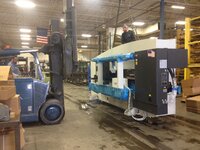
We have had 44,000 lb machines lifted into place using a Versa-Lift Forklift weighing in at 58000 lbs and no issues rolling across the floor.

IMG_1755.JPG

You will be fine.
 

Walkers

Well-known member
Joined
May 17, 2021
Messages
3,912
Location
Cave Creek Az
My pneumatic Nissan 7K weighs over 11 grand empty. I have been driving it on my 4“ shop floor for years with no issues. I had a 3K and a 5K before this one.
 

FredWanaker

Well-known member
Joined
Mar 27, 2021
Messages
1,470
Location
NorCal
I'd be asking an engineer and not an online general garage forum. Soil and other factors will play a part.
 

duneslider

Well-known member
Joined
Jan 20, 2013
Messages
2,252
Location
Riverton, Utah
Every warehouse we work in has 6" floors. That is pretty much the standard for general warehouses. 6" with rebar is better but not all of them get any steel. The 6" floor is holding up a lot of racking with a lot of weight on it with fork trucks driving all over all day everyday.

I would suspect 4" with steel will hold up fine for what you need assuming the ground under the floor is good.
 
To avoid these ads, REGISTER NOW!

ConCretin

Well-known member
Joined
Jan 20, 2011
Messages
3,378
Location
Central Maine
Think of a slab on grade as a non structural work surface that depends almost entirely on the ground below to support loads placed on it. The loads imposed by your forklift aren't particularly high relative to most soil bearing capacities. As long as your base provides uniform support to the slab, 4" is fine.

With that said, a 5" slab is significantly stronger than a 4" slab and a 6" slab is significantly stronger than a 5" slab. Additional concrete doesn't add a tremendous amount to the cost relative to the whole, which is why thicker slabs are often spec'd. While an extra inch of two won't overcome an insufficient base, it does provides a little margin for error for localized areas such as backfill, pipe trenches, etc. that might experience more settlement.

Rebar doesn't add to the bearing capacity of a slab on grade. It will hold a crack together once it occurs but it won't prevent cracking due to shrinkage or loads.

If it were me, the highest priority would be the construction of the base. Depending on my comfort level with that, I might add an inch to the slab. Every additional inch would add about a grand assuming you are paying about $100 cy. Not cheap but it might provide a little peace of mind.
 
Last edited:

txvwnut

Well-known member
Joined
Jan 1, 2015
Messages
7,608
Location
Bedford, Texas
My driveway and sidewalk is 4” and I haven’t had an issue driving my forklift on them. It’s a 69 Allis-Chalmers picks 3500# and weighs in around 7000#.
 
OP
H

Hobby_Man22

Well-known member
Joined
Nov 16, 2020
Messages
3,581
Location
tx
At the plant here we have 6 inch floors, 12 inches of Base, #4 Rebar on 2 foot centers with Wire Mesh, 4500 PSI Mix Fiberglass. Our biggest Forklift is 14,500 empty and lift cap is 8000. 24 1/2 years and no cracks.

We have had 44,000 lb machines lifted into place using a Versa-Lift Forklift weighing in at 58000 lbs and no issues rolling across the floor.

IMG_1755.JPG

You will be fine.
With what? 4"?
Think of a slab on grade as a non structural work surface that depends almost entirely on the ground below to support loads placed on it. The loads imposed by your forklift aren't particularly high relative to most soil bearing capacities. As long as your base provides uniform support to the slab, 4" is fine.

With that said, a 5" slab is significantly stronger than a 4" slab and a 6" slab is significantly stronger than a 5" slab. Additional concrete doesn't add a tremendous amount to the cost relative to the whole, which is why thicker slabs are often spec'd. While an extra inch of two won't overcome an insufficient base, it does provides a little margin for error for localized areas such as backfill, pipe trenches, etc. that might experience more settlement.

Rebar doesn't add to the bearing capacity of a slab on grade. It will hold a crack together once it occurs but it won't prevent cracking due to shrinkage or loads.

If it were me, the highest priority would be the construction of the base. Depending on my comfort level with that, I might add an inch to the slab. Every additional inch would add about a grand assuming you are paying about $100 cy. Not cheap but it might provide a little peace of mind.
That's based off of 3000 square feet?
 

csp

Well-known member
Joined
Mar 23, 2010
Messages
5,719
Location
Franktown, CO
With what? 4"?
That is the thickness you stated the existing slab is, right? Why would he assume anything other than that when stating you'll be fine?
That's based off of 3000 square feet?
As he stated, it's based off of the assumption that you're paying about $100 per cubic yard. YOu may be paying more per cubic yard or you may be paying less. Square footage can contribute to that just as regional prices and labor costs can.
 
Last edited:

ConCretin

Well-known member
Joined
Jan 20, 2011
Messages
3,378
Location
Central Maine
That's based off of 3000 square feet?
Gotta admit I had a moment of panic when you asked cause I'd done the math quickly in my head. Luckily a quick check with a calculator confirmed that an inch of concrete over 3000 sf is 9 1/4 cy. We are paying about $110 per cy so I just rounded up to a $1000 per inch.
 

matt_i

Well-known member
Joined
Mar 14, 2008
Messages
10,725
Location
SE Michigan
I built my shop for this, 6" thick, 4ksi mix, #4 rebars on 16" centers, set on 2" chairs. I cured with a BASF Kure & Seal compound. Saw to 10-12' squares. There's a full 6" of crushed washed limestone base (#57s in some areas) compacted, I spent time with a jumping jack compacting the soil where I had excavated and disturbed for the foundation.

I wanted to be able to move and set up to a 10k machine, the physics of a forklift are basically such that the front tires are akin to the pivot point in a playground see-saw. When operating at max capacity the load on the front tires is 2x the load being carried.

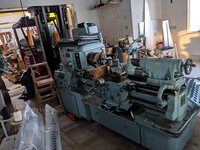
Here is what happens when the base is insufficient and not enough strength in the bearing layer to distribute the load. Note that this helps illustrate the point raised by LLWillys - that the same driveway works well enough to lift and move the same machine, I just found a point where the base is insufficient (probably wet clay).

51332737278_cc0c1ba3da_b.jpg

I was moving this Monarch, 7100 lbs, Note the designers of this machine were not shy about the use of cast iron, the tailstock looks like it could substitute for a small piece of artillery :)

51314740881_f2e19d4097_b.jpg
 
Last edited:

wssix99

Well-known member
Joined
Mar 2, 2011
Messages
5,159
Location
Chicago, IL
I believe they're referred to as all terrain tires.
Can you post a picture of an example. I would think all terrain would be pneumatic/air-filled tires. If so, the important detail is to find out the fill pressure of those tires. (That will equal the pressure imparted on the slab.)

Solid tires are hard rubber, like the machines pictured above. They concentrate the loads much more than an air-filled tire and require an engineered slab if you will be lifting heavy loads.
 

wssix99

Well-known member
Joined
Mar 2, 2011
Messages
5,159
Location
Chicago, IL
As long as your base provides uniform support to the slab, 4" is fine.

It might be, depending on the design of the forklift. ACI360 has some design considerations for forkflifts and has some hard forkflift tires imparting 250 PSI to the pavement. If I had one of these machines, I would be inclined to go with a little extra depth to provide the same bearing on the soil below as I would experience with regular trucks (say 50 or 60 psi) on a regular 4" slab.
 
OP
H

Hobby_Man22

Well-known member
Joined
Nov 16, 2020
Messages
3,581
Location
tx
Gotta admit I had a moment of panic when you asked cause I'd done the math quickly in my head. Luckily a quick check with a calculator confirmed that an inch of concrete over 3000 sf is 9 1/4 cy. We are paying about $110 per cy so I just rounded up to a $1000 per inch.
Might as well pay an extra 2k for a 6inch slab. I do believe the rebar needs to be larger for a thicker slab. I heard 1/8" diameter per inch was the rule of thumb.
 
OP
H

Hobby_Man22

Well-known member
Joined
Nov 16, 2020
Messages
3,581
Location
tx

This is the forklift I would have. These tires are still solid imo just bigger than the warehouse style tires.
 
Last edited:
OP
H

Hobby_Man22

Well-known member
Joined
Nov 16, 2020
Messages
3,581
Location
tx
The picture of the forklift that's stuck are called cushion warehouse tires. The CAT forklift pictured are solid pneamatic tires. I have no idea if they have air in them because i've never had to add air and also i've never seen them squish down much even with a heavy load. They do have a softer ride than the tires with the forklift that stuck. Those forklifts ride like you have wooden tires, where the solid pneumatic tires you can take them outside on somewhat uneven ground without getting stuck. I purposefully tried to get it stuck and it never did even going up a concrete ramp with one tire off. The other forklift would spin out because one tire would come off the ground and the pneamtic tire forklift never had that issue for some reason.
 
Last edited:

wssix99

Well-known member
Joined
Mar 2, 2011
Messages
5,159
Location
Chicago, IL
Regardless of the pneumatic tire type, the American Concrete Institute Guide I have indicates that a 100 psi equivalent would be a conservative estimate for what the tire would impart on the slab. (This would be similar to a concrete or any other heavy truck.)

If you go with a 6" slab, the soil pressures on your base material should be equivalent to what the soil pressures would be for a pickup truck with 45 psi tires on a regular 4" slab. (So, I think 6" is a great choice for the forklift you are choosing!)

I do believe the rebar needs to be larger for a thicker slab. I heard 1/8" diameter per inch was the rule of thumb.

If you have a rebar design you are using, you want to make sure the steel area or reinforcement ratio stays constant as the thickness increaces. So, you do need to add steel for a thicker slab to get that thicker slab to perform the same way as the thinner slab. You can add steel through adding bigger bar or more bar at lesser spacing.

reinforcement ratio = Cross Section area of Steel / (Spacing * Slab Depth)
 

matt_i

Well-known member
Joined
Mar 14, 2008
Messages
10,725
Location
SE Michigan
The main reason to own a semipneumatic "yardlift" is to not sink into an unpaved gravel outdoor storage lot.

I wouldn't design the slab differently because of the type of forklift....you'd be locked into owning a yardlift forever.

The cushion tired versions are about 20x as common from what I see and sometimes less abused since they don't get used or stored outside very much.

Its important to define what you want to do with it as well. If you're going to use the machine daily its also different scenario from one that cranks up 6x per year.
 

wssix99

Well-known member
Joined
Mar 2, 2011
Messages
5,159
Location
Chicago, IL
The main reason to own a semipneumatic "yardlift" is to not sink into an unpaved gravel outdoor storage lot.

I wouldn't design the slab differently because of the type of forklift....you'd be locked into owning a yardlift forever.

The physics at play on the unpaved lots (keeping the wheels from sinking) are also in effect on the slab - the stresses are distributed and the pressures are lower. :)

If one doesn't want to be locked into one lift forever - than one can go for a hard tire design. A 250 psi pressure is a fine estimate for that, which puts us in to 10-12" territory for slab and high-quality compacted base material. (This would seem to fit with 4 FN 27's design, above.)
 

matt_i

Well-known member
Joined
Mar 14, 2008
Messages
10,725
Location
SE Michigan
I think there's still some effect for vertical shear....in direct experience a slab that's fine for 5k-6k lifts running across it for years on end was broken thru by a 40k/60k versa lift moving a hem-press. Obviously not supported in a couple spots but the ~8" slab had enough strength to handle the lower capacity traffic.

As you prep for the slab, I would try to make it so that the slab floats and isn't pinned to anything on its edges, or under-supported by stem wall remnants, etc.
 
OP
H

Hobby_Man22

Well-known member
Joined
Nov 16, 2020
Messages
3,581
Location
tx
Got a quote today. He said $9/sqft for a 4" slab. Guess he didn't hear me yesterday over the phone when I said I wanted 6". I forgot to ask what psi the concrete was. When he came out to the job site he seemed to think 6 was overkill, but it would be another $3/sq foot for the extra 2"
 
OP
H

Hobby_Man22

Well-known member
Joined
Nov 16, 2020
Messages
3,581
Location
tx
Then he said I'd need about 50 loads of premium fill at $118 for a 12 yard truck. He said I can start at 30 loads and go from there. That's not bad.
 
OP
H

Hobby_Man22

Well-known member
Joined
Nov 16, 2020
Messages
3,581
Location
tx
My friend used this guy and he answers the phone and does what he says he's going to do so can't ask for more than that.
 

rbgearz

Well-known member
Joined
Nov 20, 2011
Messages
2,899
Location
Illinois
I have a Yale lift truck with the hard tires. Been driving on my 4" garage floor moving lathes and mills around for over 30 years. No problems.
 
To avoid these ads, REGISTER NOW!
Top Bottom