To avoid these ads, REGISTER NOW!

Small PVC pipe junction leak

Skooterj

Well-known member
Joined
Mar 11, 2021
Messages
756
Location
Indiana
Other than cutting it out and totally replacing a PVC T that I can't determine exactly where a leak is happening, is there a way to patch a couple of PVC joints?
One of my pool return lines is leaking. Not much, but it is constant. The line runs from my chlorinator, splits off 5 ways, 3 of these go into 1 1/2" valves that then lead to a sideways T with the down of the T going towards the pool and the up of the T a screw in plug for winterizing the system by blowing air through it and pouring anti-freeze into the line. Somewhere in one of these three joints there is a small leak. Has anyone had any luck with silicone tape? I have turned off this valve for now, but would like to get it running again before swim season starts. I know I can just cut it all out and start again, but then one of the 3 returns would look all janky compared to the other 2. Whatever I do has to stand up to chlorinated water.
 
To avoid these ads, REGISTER NOW!

larry4406

Well-known member
Joined
Jan 27, 2006
Messages
20,129
Location
Northern Virginia
I have pried open small cracks in pvc and applied glue into the crack joint and let it set up. This on pvc waste, not pressurized supply piping.

JB weld also makes an epoxy that is NSF certified and I have used that on waste lines that had holes drilled in by mistake. Again, not pressurized.

Honestly, I would locate the bad fitting, cut it out, and replace.
 

mm08822

Well-known member
Joined
Jan 13, 2012
Messages
6,225
Location
NJ
That's the problem with glued fittings.....any break, leak or modification usually requires cutting out lots of fittings until you can get back to straight pipe. Then you are adding couplings and so on, to get back to the original point of concern.

I have some pool diverter valves that are leaking. I can't locate the identical valves (for parts) available in the US......just Australia. So they are in some sort of supply chain obsolescence process. Having conceded to replacing the diverter valves, I started looking for ways to minimize everything typically needed to be cut back.

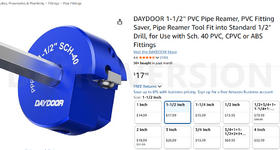
I found these on Amazon and several mfr's web sites. I'm not sure how good they might work......can it maintain a reasonable gap tolerance so the primer/glue has the proper strength over time? This saves the fitting and I am looking to save the pipe b/c I will replace the diverter valve.

Let me know if you find any other solutions please.....
1747938521033.png
 

rlitman

Well-known member
Joined
Oct 18, 2010
Messages
24,738
Location
Long Island
...
I found these on Amazon and several mfr's web sites. I'm not sure how good they might work......can it maintain a reasonable gap tolerance so the primer/glue has the proper strength over time?...
Well, PVC sockets are taper fit, and that cutter would make them cylindrical. It'll still probably be fine though.

Most likely cause of the OP's issue was failure to prime before gluing. The above cutter makes fast work of clearing a fitting out for re-use, but I've had just as good luck taking apart PVC using a heat gun. If you move around to avoid burning, you can heat the PVC until it's soft, then take it apart with a welding glove and scrape out gooey cement with a screwdriver (the one you relegate to stirring paint).
 

mm08822

Well-known member
Joined
Jan 13, 2012
Messages
6,225
Location
NJ
Well, PVC sockets are taper fit, and that cutter would make them cylindrical. It'll still probably be fine though.

Most likely cause of the OP's issue was failure to prime before gluing. The above cutter makes fast work of clearing a fitting out for re-use, but I've had just as good luck taking apart PVC using a heat gun. If you move around to avoid burning, you can heat the PVC until it's soft, then take it apart with a welding glove and scrape out gooey cement with a screwdriver (the one you relegate to stirring paint).
I'm not sure if that cutter has any taper to it. If it does, it would be limited to where the cutter bottoms out/stops.

I'll try the heat gun on the valve body that I am replacing. :thumbup:
 

rlitman

Well-known member
Joined
Oct 18, 2010
Messages
24,738
Location
Long Island
I'm not sure if that cutter has any taper to it. If it does, it would be limited to where the cutter bottoms out/stops.

I'll try the heat gun on the valve body that I am replacing. :thumbup:
It can't taper. The pilot tip rides the ID of the pipe, and the body basically rides the ID of the socket as the face of the cutter chisels down like a forstner bit. My gut feeling is that it should be fine with a heavy bodied cement. PVC sockets are intentionally pretty deep, because porosity in the joint is to be expected. The taper allows for a tighter fit deeper in, while not squeezing out too much glue, but so long as you're gluing both the pipe and the socket, squeeze out shouldn't be an issue.

Next time you have some clean-ish PVC scraps you've cut out (obviously not something lined with waste), get some practice on it. It's harder to see the pipe go yellow and brown where you've overheated it on grey conduit (still works the same), but easy to spot on white plumbing. PVC pipe gets about as flexible as clear vinyl hose when the temperature is right, and you should have a minute or so of working time before it stiffens in the air. It's just a little bit too hot to safely handle without leather. I have bending springs for 1/2" and 3/4", that I use on conduit (better sunlight resistance) for outdoor hydroponics projects (so I don't buy elbows any more), but I've used heat guns to rescue 2" and even 4" fittings many times. It has a strong memory, so if you allow a fitting to cool, it should return to it's factory cast round shape, even if it bends a little as you remove the pipe.

The biggest downside to using heat is that it takes time. Time that most plumbers wouldn't be willing to wait for.
 
To avoid these ads, REGISTER NOW!

larry4406

Well-known member
Joined
Jan 27, 2006
Messages
20,129
Location
Northern Virginia
Repair couplings (slip couplings) don’t have taper and work well with copious application of glue and primer.

I’ve not tried those save a fitting cutters.

I have done the heat gun, screw driver, pry method to undue joints. Then more heat to reshape the female hub. Then primer, lots, lots, lots, of glue and back in business. This was a relocated slab floor drain with I recall 2” pvc.
 
Last edited:

no704

Well-known member
Joined
Apr 27, 2016
Messages
5,257
Come up with a way to hook a shop vac to the system (maybe the discharge?) set valves so you are pulling vacuum on the suspect joint. Liberally apply more pvc glue to the joint, it will get sucked into the leak. And Bobs ur uncle!
 
OP
S

Skooterj

Well-known member
Joined
Mar 11, 2021
Messages
756
Location
Indiana
Come up with a way to hook a shop vac to the system (maybe the discharge?) set valves so you are pulling vacuum on the suspect joint. Liberally apply more pvc glue to the joint, it will get sucked into the leak. And Bobs ur uncle!
That I can do easily. Would have been even easier a week ago before I opened the pool and filled the return pipes. They sit empty all winter except for a gallon of antifreeze. I can blow the water out, cap the end at the pool and **** back towards the valve. I'll probably try that first before starting to cut everything apart. I just need to make sure no glue gets on the valve, since it is all pvc too.
 

rlitman

Well-known member
Joined
Oct 18, 2010
Messages
24,738
Location
Long Island
Come up with a way to hook a shop vac to the system (maybe the discharge?) set valves so you are pulling vacuum on the suspect joint. Liberally apply more pvc glue to the joint, it will get sucked into the leak. And Bobs ur uncle!
It's not a terrible plan, but start with primer (doesn't have to be purple). It's thinner, so it'll get sucked in further and wash out anything in there, plus primer is the actual PVC solvent that starts the adhesion. The glue has a little of that solvent in it, but unless you use an all-in-one glue, it's not enough.

And be aware that the fumes are flammable, so use a shop vac with an empty canister, and set it away from anything combustible. Just in case, because remember that in 99% of shop vacs, the air stream getting pulled in the hose goes out through the motor (with sparking brushes and all that).
 

no704

Well-known member
Joined
Apr 27, 2016
Messages
5,257
It's not a terrible plan, but start with primer (doesn't have to be purple). It's thinner, so it'll get sucked in further and wash out anything in there, plus primer is the actual PVC solvent that starts the adhesion. The glue has a little of that solvent in it, but unless you use an all-in-one glue, it's not enough.

And be aware that the fumes are flammable, so use a shop vac with an empty canister, and set it away from anything combustible. Just in case, because remember that in 99% of shop vacs, the air stream getting pulled in the hose goes out through the motor (with sparking brushes and all that).
I understand your concerns, not unfounded. But got the tiny amount that might make it thru the OPs pinhole leak I don’t think it warrants a concern on the vacuum exploding. OP please get video! As for the primer concerns maybe use redhot? I’ve actually done this before with success and no shopvacs were harmed.
 

rlitman

Well-known member
Joined
Oct 18, 2010
Messages
24,738
Location
Long Island
... the tiny amount that might make it thru the OPs pinhole leak I don’t think it warrants a concern on the vacuum exploding...
Agreed, regarding explosion. I just wouldn't want to see (on an unlikely off chance) a puff of fumes to be a source of ignition of a shop vac already full of sawdust. It's not that outlandish a scenario (as opposed to using a vac to siphon gasoline, where it's pretty much a guaranteed outcome). And since this involves vacuuming pipes, you should already be working in wet vac mode, which should already have an empty canister and paper filter removed, and this was a friendly reminder of that too. Really, the only thing I recommended paying attention to was setting the vacuum away from combustibles. i.e. put it on the patio, and not under a dry bush or touching your vinyl siding.

Redhot, or another all in one should work. Recently I've had great luck with Oatey Fusion. It's another one-step dripless cement in a black can. I'm still priming in pressure applications, but in some outdoor hydroponic gravity drains where a leak wouldn't hurt, I've skipped the step of painting my fingers purple.

With the vacuum on and the joint well gooped, wiggle the pipe around to help work it in.

large_038753321929_H_001.jpg
 
To avoid these ads, REGISTER NOW!
Top Bottom